This unique study breaks new ground in engaging the study of Northern Ireland politics directly with broader debates about European integration and European governance. The text offers the most comprehensive coverage to date of the institutional development of Northern Ireland following the UK government's devolution programme and Northern Ireland's development as an autonomous policy actor in Europe.
This study marshals evidence from Northern Ireland's relationship with the European Union (EU) during the contemporary era of devolved power. The text argues that in Northern Ireland a series of national and regional constraints, complexities and divisions limit regional autonomy. These original insights question the synergy between devolution and the EU and query the existence of new forms of 'governance'. This is a contribution of both immense substance and considerable importance and should be essential reading for those with an interest in Northern Ireland and EU politics.
eBook - ePub
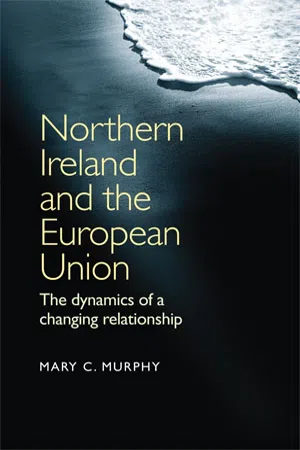
Northern Ireland and the European Union
The dynamics of a changing relationship
- 214 pages
- English
- ePUB (mobile friendly)
- Available on iOS & Android
eBook - ePub
About this book
Information
1
Introduction
In the years since the United Kingdom (UK) joined the European Union (EU) in 1973, Northern Ireland has endured bloody conflict, confronted profound political challenges and, more recently, experienced remarkable change. The journey from violent political conflict to a tentative peace has been long and arduous. It has demanded great compromise and sacrifice of all sections of Northern Ireland society. The result has been the removal of large-scale and widespread violence and the creation of new and legitimate devolved political institutions built around consociational principles. This process of peace-building has been accompanied by improved community relations and some degree of economic progress. The precise start date of this journey of change is difficult to pinpoint, but it has been visibly underway since the 1994 paramilitary ceasefires and the signing of the 1998 Belfast Agreement.1 This same twenty-year period coincides with an era of wider change across Europe. The widening and deepening of the European integration process has been apparent since the drive to complete the single market intensified from the late 1980s. Subsequent treaty revisions, the introduction of the single currency, the enlargement of the EU and the ongoing politicisation of the European project followed. These developments also marked a turning point in relation to theorising the EU. No longer did the claims of either neofunctionalists or intergovernmentalists fully capture EU events. Alternative tools and approaches emerged to challenge these once dominant theoretical interpretations of the EU. Multi-level governance (MLG) was born during this period. First articulated by Marks (1992), the model drew on insights from the study of domestic/comparative politics and international politics (Bache 2012: 629).
MLG emphasises the multi-level nature of EU politics and attaches significance to the role played by subnational units and supranational institutions in the policy process. The governance component of the model offers a specific conception of EU politics based on an altered relationship between state and non-state actors, where the latter have become increasingly influential. MLG, however, has been subject to some criticism. Questions concerning the conceptual clarity of the model have been voiced by a number of analysts (see for example Jessop 2005 and Warleigh 2006). A key criticism has been the suggestion that MLG understandings of governance are not sufficiently robust and rigorous to sustain the contention that power has slipped away from the central state. Moreover, the notion that MLG identifies a normatively better process of EU decision-making as proposed by Marks and Hooghe (2004: 16) is problematic. This particular view overlooks the potentially damaging impact of emerging governance structures on the democratic credentials of modern political decision-making processes (see Peters and Pierre 2004).
Similar to the way in which MLG proposes new forms of governance, the UK devolution project is likewise construed as heralding the emergence of a ‘new politics’ based on ‘a more cooperative style of inter-party relations than that at Westminster’ and ‘policy innovation’ (Bradbury and Mitchell 2001: 257). Implicitly, this ‘new politics’ alludes to a new style of governing, which differs from the traditional Westminster-style British model and embraces elements of ‘governance’ articulated first by Rhodes (1996) and later Marks and Hooghe (2004). According to Mitchell (2010: 86), devolution offers the scope to embark on ‘different trajectories’, despite being the ‘offspring of Westminster’. Carter (2013: 392) identifies other elements of the ‘new politics’ scenario, including ‘norms of openness, participation and power-sharing’. This study marshals evidence from Northern Ireland’s relationship with the EU during the contemporary devolved era, and against a backdrop of change at the EU and subnational levels, to produce an analysis which determines if new devolved structures and processes conform with the features of governance (and ‘new politics’) as propounded by MLG theorists.
The changing dynamics of Northern Ireland’s relationship with the EU provide a ready case-study with which to test and examine the conceptual tenets of the MLG model. Today, Northern Ireland is not dissimilar from other EU regions.2 It may have a unique and unenviable history, but in adapting to an evolving EU political and economic environment, the region faces the same challenges as many other parts of Europe. The introduction of devolved powers in 1999 (following the signing of the Belfast Agreement) firmly placed Northern Ireland in a category of European regions with advanced decentralised powers. The region may have its specific idiosyncrasies in terms of history, economy and society, but its darkest days appear to be confined to the past. Moreover, the expansion of the EU to incorporate new and less advanced regions to the East is a reminder that Northern Ireland’s historic experiences of conflict are no longer unusual (Cyprus is a specific case in point here).
Now, during the post-conflict period in Northern Ireland, less politically charged economic and political challenges dominate and have replaced those of a constitutional and security nature. In contemporary Northern Ireland, the relative normality and mundaneness of current policy issues are those which are common to many European regions. In confronting this new policy environment, the EU is an important arena. Northern Ireland’s interactions within this domain are not wholly unique or distinctive. On the contrary, Northern Ireland operates in the same crowded EU arena as all other European regions. It has developed internal structures aimed at optimising EU advantages. It struggles with similar EU policy dilemmas. It jostles for access and influence in Brussels. It engages in lobbying and negotiation within the state and with the EU. For all its sorry history and contemporary problems, its situation – as a region of the EU – is remarkably similar to that of other European regions. For this reason, the relevance of this study of Northern Ireland and the EU is not one which stands alone; instead, it offers analytical potential for generalisability. The region’s treatment of EU issues and its interactions with Brussels provide observations which have resonance beyond Northern Ireland. In other words, this study of Northern Ireland and the EU starts from the contention that Northern Ireland does not constitute a sui generis case-study; rather, the region represents an important and telling case-study with which to interrogate the MLG model. The use of the MLG conceptual framework makes it possible to unpack the detail, limits and potential which the EU offers its constituent regions. The focus here is ostensibly on the governance component of MLG and its application in Northern Ireland. The Northern Ireland peace settlement has experimented with novel forms of governance. The extent to which the EU supports or undermines supposedly new governance structures and processes is examined in some detail. This allows for judgements to be made as to how well the EU affects a shift from government to governance at the subnational level, or indeed whether the reverse is in fact the case. This methodical examination of the detail, dynamics and dimensions of Northern Ireland’s engagement with the EU since 1999 produces a wealth of unique data and provides important insights as to the intellectual rigour of the MLG model. It produces an authoritative account of the detail and dynamics of an evolving EU–subnational relationship. It uncovers new political and administrative developments; identifies key state and non-state actors; tracks EU policy progress; and charts new relationships and linkages across and within state boundaries. It seeks to clarify elements of the conceptual confusion which critics of MLG have voiced and simultaneously streamline and normalise the study of Northern Ireland politics. Using the analytical tools which MLG offers, the research produces findings which validate some elements of the model, but it also identifies developments and outcomes which do not neatly fit MLG categorisation. In short, the MLG model may not sufficiently accommodate some of the internal constraints, complexities and divisions which are characteristic of Northern Ireland’s recent political experience and which are reflected in the region’s evolving relationship with the EU. The central MLG argument that state power is undermined does not find strong endorsement here. Interestingly, the features of Northern Ireland’s EU experience which question aspects of the MLG model are more to do with the dynamics of decentralised power than with the supposedly unique (conflict-related) features of Northern Ireland’s political history. The key contention of this study is that the EU policy arena is certainly evolving, but that this is not necessarily happening in the ways proposed by MLG proponents. To put it succinctly, the changing multilevel character of the EU policy process is not matched by comparable changes in the nature of contemporary governance. This finding is consequential because it proposes a more nuanced understanding of the dynamics of MLG generally. This, in turn, is theoretically significant and necessarily important for all other regions of the EU.
The research objective
Northern Ireland has long attracted the attentions of scholars. The bulk of this attention has traditionally been focused on the conflict which formed the primary backdrop against which studies of the region have been conducted. As one of the most researched conflicts in the world, the length and intensity of what has been termed Northern Ireland’s ‘Troubles’ and their one-time seemingly intractable nature have spawned much research and commentary. The overwhelming focus has been on attempts to identify the roots of the conflict and possible solutions (see Carmichael and Knox 2004). The outbreak of conflict in Northern Ireland began in the late 1960s, a period which coincided with the start of UK and Irish negotiations aimed at securing membership of the then European Economic Community (EEC).
Northern Ireland’s relationship with the EU has enjoyed some limited academic commentary. An edited volume by Kennedy (2000a) stands out for its impressive breadth and depth. Much of the literature on Northern Ireland and the EU has, however, focused on examinations of the role of the EU vis-à-vis the Northern Ireland conflict. The emphasis has been on the ability of the EU to diminish national identity; to promote cross-border relations; to (financially) support the peace process; and to provide a model for conflict resolution (see for example Buchanan 2008; Hayward 2006; McCall and O’Dowd 2008; Meehan 2006; and Tannam 2007). Although such studies of Northern Ireland may have touched on wider debates concerning European integration, they tend to be narrow in focus and do not connect fully with broader debates about European integration and European governance.
This can be readily explained by a widespread view of Northern Ireland as unique, distinct and incomparable. Even today, over a decade and a half after the signing of the 1998 Belfast Agreement and 20 years since the calling of paramilitary cease-fires in 1994, there remains a tendency to treat Northern Ireland as being removed from wider literatures on governance. Indeed, studies of territorial politics in the UK have often excluded considerations of Northern Ireland (see for example Bulmer et al. 2002). This study of Northern Ireland contends that in a wider EU context, treating Northern Ireland as distinct is no longer warranted or justified. In reality, all regions of the EU are unique and distinctive in their own right. The Report of the Northern Ireland Taskforce (NITF) noted this explicitly by assessing Northern Ireland relative to other comparable European regions:
looking at the position of other small regions in the EU, Northern Ireland demonstrates certain key strengths in terms of economic growth, employment, population growth and the educational attainment of its labour force. (European Commission 2007: 21)
Like regions elsewhere, Northern Ireland can tell us much about the EU and the nature of European governance. Using Northern Ireland as a case-study also dovetails with wider developments in the study of territorial politics and its implications for the EU (and vice versa). Recent discourse and literature on EU regions have been fuelled by an understanding that there are
numerous ways in which the EU remains highly important for regions, and in which regional politics plays a significant role in shaping the nature and direction of European integration. (Elias 2008: 487)
The final element in the implementation of the 1998 Belfast Agreement – the devolution of justice and policing powers – has been achieved. It is therefore an opportune time to approach studies of Northern Ireland with a fresh focus and an open mind, based on a broader consideration of the internal and external dynamics of Northern Ireland politics. This book is a first step on that road.
Since 1998, Northern Ireland’s politics have evolved in ways once believed unlikely, if not impossible. The achievement of a functioning power-sharing Northern Ireland Executive is remarkable. Although this outward image of progress should not disguise ongoing internal difficulties and tensions, there is no denying that change has come and has touched every facet of domestic politics, albeit to differing degrees. Northern Ireland’s relationship with the EU has been subject to that change. Consideration of how that relationship has changed and what its impact has been on Northern Ireland governance, and thereafter on conceptions of European governance, is the subject of this book. The central research question asks if Northern Ireland’s engagement with the EU has a governance like character, as per the MLG discourse, which equates to a diminishing role for the state and a movement away from government. In addressing this question, the research examines the impact of Europe at the domestic level on administrative change, political party dynamics, public opinion, civil society, cross-border and transnational relations, networking, interregional linkages and relations with Brussels. By extension, conclusions can be drawn as to how identifiable changes and developments fit broader conceptual understandings of the EU. Does the Northern Ireland experience correspond to MLG accounts of the EU? Can we identify different forms of ‘new politics’ and governance in Northern Ireland which are attributable or connected to a new relationship with the EU? Does the devolution of powers facilitate different and/or improved governance in Northern Ireland vis-à-vis the EU? Or on the contrary, has devolution reinforced the traditional role and power of the central state as a key EU actor? Has the UK state founds ways and means of mediating the effects of subnational mobilisation at the EU level? Do internal political and ideological divisions limit the extent to which the EU can energise and galvanise EU regions? And moreover, does this evolving political and administrative landscape produce unintended or unanticipated consequences in terms of undermining democratic accountability, inclusiveness and pluralism? Are civil society actors the unexpected casualties of this new EU policy environment?
Uniquely, this study of Northern Ireland uses an MLG (European) frame of analysis to disentangle and map a specific (European) aspect of the region’s political journey post-1998. An important part of this analysis is its European flavour and its connection to broader questions concerning the governance concept. The merit of this approach is that it places Northern Ireland in the European mainstream and, in so doing, it tells us much about the nature of the EU’s evolving relationship with the subnational unit.
Northern Ireland: an overview
In the wider European context, Northern Ireland, like the Spanish Basque Country and the French island of Corsica, is somewhat unusual in having ex...
Table of contents
- Cover
- Half Title Page
- Title Page
- Copyright Page
- Dedication
- Contents
- List of tables
- Abbreviations
- Acknowledgements
- 1 Introduction
- 2 Northern Ireland and the European Union: the context
- 3 Northern Ireland and the European Union: the economic dynamics
- 4 Northern Ireland and the European Union: the political dynamics
- 5 Northern Ireland and the European Union: the internal dynamics
- 6 Northern Ireland and the European Union: the external dynamics
- 7 Northern Ireland and the European Union: the policy dynamics
- 8 Northern Ireland, regional governance and the European Union
- Bibliography
- Index
Trusted by 375,005 students
Access to over 1.5 million titles for a fair monthly price.
Study more efficiently using our study tools.
Frequently asked questions
Yes, you can cancel anytime from the Subscription tab in your account settings on the Perlego website. Your subscription will stay active until the end of your current billing period. Learn how to cancel your subscription
No, books cannot be downloaded as external files, such as PDFs, for use outside of Perlego. However, you can download books within the Perlego app for offline reading on mobile or tablet. Learn how to download books offline
We are an online textbook subscription service, where you can get access to an entire online library for less than the price of a single book per month. With over 1.5 million books across 990+ topics, we’ve got you covered! Learn about our mission
Look out for the read-aloud symbol on your next book to see if you can listen to it. The read-aloud tool reads text aloud for you, highlighting the text as it is being read. You can pause it, speed it up and slow it down. Learn more about Read Aloud
Yes! You can use the Perlego app on both iOS and Android devices to read anytime, anywhere — even offline. Perfect for commutes or when you’re on the go.
Please note we cannot support devices running on iOS 13 and Android 7 or earlier. Learn more about using the app
Please note we cannot support devices running on iOS 13 and Android 7 or earlier. Learn more about using the app
Yes, you can access Northern Ireland and the European Union by Mary C. Murphy in PDF and/or ePUB format, as well as other popular books in Politics & International Relations & European Politics. We have over 1.5 million books available in our catalogue for you to explore.