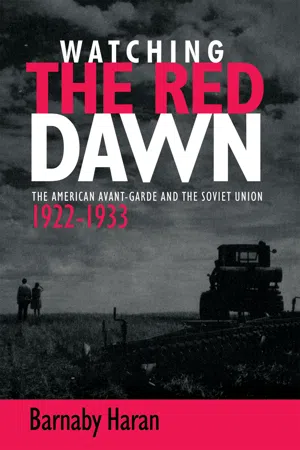
This book offers the first sustained examination of the cultural relations of the American and Soviet avant-gardes in a period of major transformation. From the formation of the USSR in 1922 until its recognition by the American government, American avant-garde artists, writers and designers watched the 'Red Dawn' with fascination, enthusiastically reporting on its post-revolutionary cultural developments in articles and books, and brought these works to an American audience in ground-breaking exhibitions. Americans also emulated and adapted aspects of Soviet culture, as in the case of the New Playwrights Theatre, a group that mixed Russian avant-garde theatrical techniques with jazz, vaudeville and slapstick comedy in plays about strikes and racial injustice. Figures discussed include Louis Lozowick, Jane Heap, Frederick Kiesler, Ralph Steiner, John dos Passos, Margaret Bourke-White and Langston Hughes.
Watching the red dawn takes an innovative interdisciplinary approach, considering these developments in architecture, theatre, film, photography and literature, and will be invaluable for students and specialists in these subject areas. It provides a new perspective on American avant-garde culture of the inter-war years.
- 205 pages
- English
- ePUB (mobile friendly)
- Available on iOS & Android
eBook - ePub
About this book
Information
Topic
ArtSubtopic
History of Modern Art1
Constructivism in the USA: machine art and architecture at The Little Review exhibitions
For Americans, the picture of Russian art in the first decade and a half following the Revolution was chequered, and attempts to disseminate Soviet artworks in books, articles, and exhibitions were sporadic and uneven. Too often a pre-revolutionary rationale determined the discourse on post-revolutionary work by situating the works within the amorphous and increasingly institutionalized figure of modern art. Therefore the treatment of Constructivism, the most far-reaching cultural phenomenon of the early Soviet Union in its abandonment of art for new forms of production, was unrepresentative because it typically reversed its collapse of disciplines and merging of art into everyday life, ultimately delimiting its social promise. However, there were some occasions when the American avant-garde seemed to grasp the utopian possibilities, if not always the revolutionary politics, of Constructivism
Chiefly, two exhibitions took place in New York that engaged thematically with Constructivism – the 1926 International Theatre Exposition and the Machine-Age Exposition of the following year, both of which were hosted by The Little Review, an avant-garde magazine edited by Jane Heap.1 If both exhibitions were international and interdisciplinary in scope, between them they contained the largest concentration of Soviet cultural works, of theatre and architectural designs respectively, shown in the United States to date. While the exhibitions were not specifically concerned with fine art, in its traditional disciplines of painting, sculpture, and printmaking, they were in important ways Constructivist in ethos. The International Theatre Exposition belied the localism of its title by exploring the entire scope of experimental theatrical work, while applying new modes of display so that the exhibition design itself invoked Constructivism. The Machine-Age Exposition situated architectural designs and works of art alongside actual machines according to the Constructivist nexus of artists, architects, and engineers. Uniquely, the exhibitions synthesized Russian and international cultural works within a framework that was thematically informed by Constructivism. However, unlike the theatre and film groups discussed in the next two chapters, these exhibitions diverged from Soviet analogues at the point of political intent. Heap, the curator of both shows, had limited comradeship with the Revolution, and importantly promoted Constructivism in the United States as ‘machine art’, minimizing its revolutionary contingency. This was because her conception of machine art derived mostly from her dialogue with Theo van Doesburg, the leader of De Stijl and a pioneer of ‘International Constructivism’. Indeed, the importation of Constructivism into the United States, most evident in Heap’s expositions, was imprecise because even in the Soviet Union the term was contested.
The emergence of Constructivism
Constructivism principally involved the remodelling of the arts following the Revolution. It emerged within the new state institutions, taking shape in INKhUK, the Institute of Artistic Culture (Institut khudozhestvennoi kultury), which was an organization within Narkompros, the People’s Commissariat of Enlightening (Narodnyi komissariat prosveshcheniya), directed by the playwright and theorist Anatoli Lunacharsky. Constructivism cross-pollinated across media and included writers (Alexei Gan, Vladimir Mayakovsky, and Ossip Brik), artists (Alexander Rodchenko, Liubov Popova, and Vladimir Tatlin), filmmakers (Dziga Vertov and Sergei Eisenstein), architects (Alexander and Leonid Vesnin), poster and graphic design (El Lissitzky, Gustav Klutsis, and the Stenberg brothers), and theatre directors and designers (Vsevolod Meyerhold and Alexandra Exter). In the visual arts, the Constructivists engaged in an extensive analysis of the object in quasi-‘laboratory’ conditions termed ‘faktura’, and equated this new rational fabrication of constructions made of mostly unaltered, industrially produced materials with the revolutionary reconfiguration of society. The First Working Group of Constructivists proclaimed that Constructivism was ‘the communist expression of material constructions’.2 Constructivism would catalyse the sovietization of the citizenry, on the understanding that new ways of seeing could engender new ways of being.
As the core symbol of the avant-garde’s appropriation of technological modernity – heralded by Futurism and Dada – the machine was the binding motif of Constructivism, and permeated plays, films, photography literature, and even ballet, as well as recalibrated visual art practices. Alexander Vesnin’s ‘Credo’ asserted:
Just as every part of the machine is a force that has been realized in an appropriate form and material, active and necessary in a particular system, and its form and material cannot be arbitrarily discarded or altered without reducing the efficiency of the system in question, i.e. the object. The contemporary engineer has created objects of genius, the bridge, the steam locomotive, the airplane, the crane.3
Gan proclaimed Constructivism as ‘the slender child of an industrial culture’, whereby through eradicating the reactionary category of art, the Constructivist producer would ‘join the proletarian order for the struggle with the past, for the conquest of the future’.4 Constructivism brought art into everyday life to help generate the new society in the making. The Constructivist would construct the new culture of the Soviet Union as if making a machine, and so the artist merged with the engineer to become the producer. M. Lavinsky coined the term ‘Engineerism’ as the title of a paper delivered at INKhUK in which he enthused that ‘the artist-engineer creates objects at a tempo a million times more intensive, and so justifies his mission to bring about tomorrow’s progress’.5 This convergence of the artist and engineer would ensure that the barrier between art and life would be shattered, as ideology and form were aligned with a transformative revolutionary force geared to the construction of a new society. However, the laboratory mode of Constructivism – especially in the work of Naum Gabo and Antoine Pevsner, who maintained their status as artists – always risked collapsing into a generic Modernism that catered for an elite. In contrast, the First Working Group of Constructivists asserted ‘WE DECLARE UNCOMPROMISING WAR ON ART!’6 The eradication of art was necessary because ‘without art, by means of intellectual-material production, the Constructivist joins the proletarian order for the struggle with the past, for the conquest of the future’.7
Introducing Constructivism to America
When an international audience encountered Constructivism, this invective was less pronounced. The key event was the Erste russische Kunstaustellung, or First Exhibition of Russian Art, which took place at the van Diemen Gallery in Berlin in 1922. The exhibition was the first dedicated display of the new art outside Russia and featured work by El Lissitzky, Rodchenko, Gabo, Kazimir Malevich, and included a model of the Monument to the Third International by Vladimir Tatlin, the definitive Constructivist construction. It also showed works dating back several years by artists operating in older styles, such as Konstantin Yuon and Abram Arkhipov who drew largely from Impressionism and Paul Cézanne, and expatriate modernists such as Alexander Archipenko.8 The van Diemen show couched the exhibits carefully in non-political terms. In the foreword to the catalogue, the curator David Shterenberg stressed that the Revolution stimulated an assault on the ‘dead, official …“high art” ’ that opened ‘new avenues for Russia’s creative forces’ and demanded ‘new forms of creation and construction’ that would bring artists closer to the people.9 Yet Christina Lodder concludes that the exhibition witnessed the dilution of Constructivism: ‘depoliticized by their emigration to the West, Russian Constructivist experiments were viewed by the Germans solely within an aesthetic context’.10 She specifically cites the non-utilitarian position of Gabo, who ignored the radical disparities between his own version of Constructivism and that of the First Working Group of Constructivists, serving to ‘camouflage the differences which existed in Russia between the constructive artist and the Constructivist’, an ‘identification which forced the West’s concept of Constructivism as an aesthetic’.11 For Lodder, the van Diemen show set an unfortunate trend by facilitating the reception of Constructivism as a stylistic development within, rather than a departure from, art. Conversely, John Bowlt has argued that the van Diemen show was more ‘a political gesture than an altruistic endeavour to disseminate Soviet culture’.12 He quotes the satisfied conclusion of Lunacharsky that it was ‘first and foremost a political success. Even those who were hostile to it assert – not without much spluttering – that once again the Soviet government has demonstrated its diplomatic capabilities in organising this exhibition’.13
The Americans who attended the van Diemen show and thereafter brought Constructivism to the USA largely ignored its political ramifications. Katherine Dreier, the founder of the exhibition and publication organization Société Anonyme, may well have been the first American to own Constructivist works when she purchased pieces by Lissitzky, Gabo, and Popova. From the van Diemen show onwards, Dreier was a crucial figure in the importation of Russian art into America. Founding the Société Anonyme in 1920 with Marcel Duchamp and Man Ray as a putative ‘Museum of Modern Art’, she presided over a pioneering forum for the dissemination of European modernist art in general, and in the early 1920s hosted several solo shows of work by Russians, including David Burliuk, Vassili Kandinsky, and Archipenko. Dreier was less interested in the politics of post-revolutionary art, because she favoured a spiritual amalgam of Expressionism and Theosophy over Constructivism’s communist predicates. In her 1923 study Western Art and the New Era, Dreier revealed her preferred Russian artist: ‘it was but natural that that strong and vigorous mind among the painters, Kandinsky, was chosen by the Soviet Russian government to establish museums throughout all the smaller towns’.14
Her 1924 Modern Russian Artists show was the first exhibition in the USA to present Soviet avant-garde developments. It followed tw...
Table of contents
- Cover
- Half Title
- Title Page
- Copyright
- Contents
- List of figures
- Acknowledgements
- Introduction: the red Atlantic
- 1. Constructivism in the USA: machine art and architecture at The Little Review exhibitions
- 2. The mass and the machine: The New Playwrights Theatre and American radical Constructivism
- 3. Kino in America: Soviet montage and the American cinematic avant-garde
- 4. Camera eyes: the worker photography movement and the New Vision in America
- Epilogue: red train journeys
- Bibliography
- Index
Trusted by 375,005 students
Access to over 1.5 million titles for a fair monthly price.
Study more efficiently using our study tools.
Frequently asked questions
Yes, you can cancel anytime from the Subscription tab in your account settings on the Perlego website. Your subscription will stay active until the end of your current billing period. Learn how to cancel your subscription
No, books cannot be downloaded as external files, such as PDFs, for use outside of Perlego. However, you can download books within the Perlego app for offline reading on mobile or tablet. Learn how to download books offline
Perlego offers two plans: Essential and Complete
- Essential is ideal for learners and professionals who enjoy exploring a wide range of subjects. Access the Essential Library with 800,000+ trusted titles and best-sellers across business, personal growth, and the humanities. Includes unlimited reading time and Standard Read Aloud voice.
- Complete: Perfect for advanced learners and researchers needing full, unrestricted access. Unlock 1.5M+ books across hundreds of subjects, including academic and specialized titles. The Complete Plan also includes advanced features like Premium Read Aloud and Research Assistant.
We are an online textbook subscription service, where you can get access to an entire online library for less than the price of a single book per month. With over 1.5 million books across 990+ topics, we’ve got you covered! Learn about our mission
Look out for the read-aloud symbol on your next book to see if you can listen to it. The read-aloud tool reads text aloud for you, highlighting the text as it is being read. You can pause it, speed it up and slow it down. Learn more about Read Aloud
Yes! You can use the Perlego app on both iOS and Android devices to read anytime, anywhere — even offline. Perfect for commutes or when you’re on the go.
Please note we cannot support devices running on iOS 13 and Android 7 or earlier. Learn more about using the app
Please note we cannot support devices running on iOS 13 and Android 7 or earlier. Learn more about using the app
Yes, you can access Watching the red dawn by Barnaby Haran in PDF and/or ePUB format, as well as other popular books in Art & History of Modern Art. We have over 1.5 million books available in our catalogue for you to explore.