Since its emergence in Italy in 1968, one model of football fandom has become the most dominant in the world: the ultras. Producing complex choreography, chants, banners and pyrotechnics, ultras represent a highly organised style of fandom that has an increasing global reach and visibility. Over the last fifty years, ultras fandom has spread from Southern Europe across North Africa to Northern and Eastern Europe, South East Asia and North America. Their collective performance, unity and harmonisation not only distinguish ultras from other football fans, but from many other forms of group behaviour. By focusing on the common form of expression through the performance of choreographies, chants and sustained support throughout the match, this book shows how members build an emotional attachment to their club that valorises the colours and symbols of that team while mobilising members against opponents.
This volume seeks to make a clear theoretical shift in studies of football fandom by asking fundamental sociological questions concerning group formation, collective performance and emotional relationships. As a collective that pride themselves on having a shared, coherent sense of identity based on an act of consumption, ultras represent an important site of enquiry into masculinity and nationalism in contemporary society.
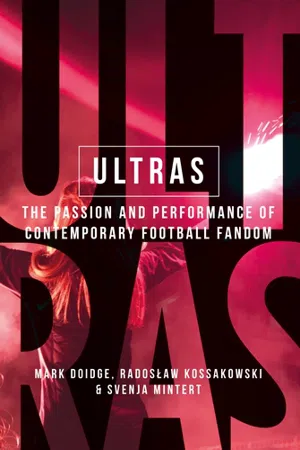
eBook - ePub
Ultras
The passion and performance of contemporary football fandom
- 223 pages
- English
- ePUB (mobile friendly)
- Available on iOS & Android
eBook - ePub
Ultras
The passion and performance of contemporary football fandom
About this book
Information
Publisher
Manchester University PressYear
2020Print ISBN
9781526163714
9781526127624
eBook ISBN
9781526127648
1
The ultras’ performance
Shortly before kick-off at the UEFA Europa League match between Legia Warsaw of Poland and FK Aktobe of Kazakhstan in 2014, the home fans displayed a giant frieze that extended across the height of both tiers of the Zyleta stand of the stadium. The image was a lampoon of the logo of UEFA. In the centre of the UEFA insignia was an illustration of an obese pig, dressed in a shirt bestowed with euro currency symbols. In his trotters, the pig was holding a piece of paper inscribed with ‘6 < 1’. Underneath this altered UEFA logo was a banner, written in English, stating, ‘Because football doesn’t matter. Money does’. Pointedly, the word ‘football’ was written in red and green ink, the colours of the Polish champions. Meanwhile, the colours of the word ‘money’ were green and white horizontal stripes. Throughout the display the Legia Warsaw fans chanted loudly while rhythmically clapping. After their rendition, they applauded themselves before many members of the stand held aloft red flares to provide a powerful visual display. Once the smoke subsided the match began, while the fans continued to sing loudly in unison.
In one performance, it is possible to encapsulate the phenomenon of the ultras, a particular form of football fandom. Over seven thousand fans occupy the Zyleta stand at the Marshall Józef Piłsudski Municipal Stadium. The fanatical fans, or ultras, also take their name from the moniker of the stand. Predominantly male, they wear white T-shirts over their outerwear to present a uniformed bloc and sing and clap throughout the match. On the occasion of the match against FK Aktobe, these fans were making clear their dislike of football’s governing body in Europe. Legia Warsaw had recently beaten Celtic, the Scottish champions, 6–1 over two legs in Europe’s premier competition, the Champions League. Despite this victory on the field, a bureaucratic error had resulted in an ineligible player, Bartosz Bereszynski, coming on as a substitute in the eighty-eighth minute of the second leg. Due to the error, Legia Warsaw were expelled from the competition and demoted to the Europa League, while Celtic continued in place of the Polish champions. The Zyleta ultras group were displaying their displeasure at being the victims of UEFA’s bureaucracy and suggested that money was the real cause of their expulsion. The banner’s message, ‘Because football doesn’t matter. Money does’, was unambiguous and written in English to reach a global audience. ‘Football’ was inscribed in the colours of Legia to reinforce that their team stood for the values of the sport. The colours of Celtic – green and white – were used for the word ‘money’ to insinuate that their larger fan base and potential television audience was the ‘real’ reason that Legia Warsaw had been expelled from the Champions League. The central image strengthened the suggestion that UEFA bureaucrats were fat pigs, adorned with money. The ultras’ protest was reinforced by the use of hundreds of flares; bearing in mind that pyrotechnics are banned by UEFA, these fans wanted to make their repudiation of UEFA regulations unambiguously clear. In one scene, it was possible to see a public expression of protest against European regulation that drew on a variety of cultural forms taken from across the continent.
There is a diverse range of aspects that make up the identity of the ultras. From choreographies, striscione (banners) and chanting, stickers that are exchanged with friends or used to publicise the group, to violence and chaos, there are certain common themes that unite ultras from all teams. Despite this unification and similar culture, there are certain specific features that are unique to fans of each team. Choreographies are one of the distinctive aspects of ultras culture, and the one that distinguishes it from other fan cultures, specifically the ‘English style’ of hooligans or casuals (Roversi and Balestri, 2000). The choreographies are a vivid, colourful expression of the passion of the ultras in the stands. They range from flags, banners, scarves or coordinated clothing, to vast works of art painted onto colossal pieces of cloth that are stitched together to cover the stand. These images will draw on local history, significant moments from the club’s past, or make barbed political statements. Alongside this visual spectacle, fans will also engage in singing, chanting and clapping. The combination of this aural and visual spectacle is designed to present the group to the wider public. As these performances constitute such an important part of the ultras style of fandom, this chapter will draw on theories of performance and group mobilisation. And with the ultras representing one of the largest collectives across contemporary Europe, and expanding into Africa, Asia and North America, this chapter will challenge notions of a growing individualism in society, before addressing how the rituals of football encourage the collective identity of ultras. Finally, it seeks to place the role of emotion centrally in the story. One of the most important ingredients of the fan experience is the atmosphere. This is vital in encouraging the collective effervescence of the group and helps link the individual fan to the wider collective.
Collective identity in an individualistic society
The ultras represent a rare collective culture that manifests itself across geographical boundaries. Consequently, they pose a theoretical puzzle for those commentators that suggest that society is becoming more individualistic and less focused on wider social collectives. The decline in public engagement in civil society has been a central focus of academic, media and political discourse for centuries. Rapid industrialisation and urbanisation during the nineteenth century led to increased academic analysis of transitions from Gemeinschaft to Gesellschaft and resulted in the birth of sociology as a discipline (Tönnies, 2001). Communities began to move from the rigid mechanical solidarity of small kinship communities to the organic solidarity of larger, fragmented society (Durkheim, 1997). This transition was seen to contribute to a sense of helplessness, or anomie, as members of society lost their traditional purpose and focus of life (Durkheim, 1952).
Taking a social-psychological approach, Riesman (1961) suggested that social actors have moved through various character traits. Society has moved from groups of ‘tradition-directed’ individuals, who focused on tradition to provide group solidarity and regulation to the more ‘inner-directed’ individuals of the modern era. These individuals had a moral compass internalised through their education and upbringing and this drove the individual to succeed. These individuals were possessed of a strong work ethic and focused inwards, on themselves and their family. As businesses changed from small family enterprises into large corporations, and as the service sector and bureaucracy grew, individuals became more ‘other-directed’; they had to be aware of other people, as they had to rely on them for support. Morality was not internalised, but was done in relation to others, depending on the context and impact.
Public participation has become increasingly privatised throughout modernity. Elias (1978; 2000) suggested that the public body became increasingly privatised as intimate actions, such as eating, bathing and going to the bathroom, were removed from the public gaze. These new manners and morals became internalised by cultural elites that then acted as a marker of distinction for others (or those who Riesman would call ‘other-directed’) to emulate. As human activities became increasingly specialist with greater division of labour, individuals began to form figurations, or networks of interdependence. As these networks grew, individuals became increasingly disconnected from each other and it became harder for the individual to understand the overall social context (Elias, 2001). As individual personality was asserted, social actors removed themselves from the wider public, a development which has been assisted by the increased range of privatised spaces available to individuals (Elias, 2001). However, this privatisation and individualisation necessitated a paradox. According to Habermas (1989), the ‘public’ became a space where private individuals utilised the knowledge they had amassed privately to debate wider issues publicly. As the ‘public’ debated politics and science in associations and coffee houses, there was a greater interest in the wider public life, which led to the State and society becoming entwined. Separation from the ‘public’ would lead to a less holistic understanding of the world. However, Habermas’s conception of the ‘public’ clearly focused on white, middle-class, masculine discussions of ‘public opinion’, which also isolated itself from other forms of knowledge. That said, for the ultras, engagement with other fans online, in bars and around the stadium helps to create a broader understanding of themselves as a wider collective of ultras.
Changes to consumption have facilitated the increased individualisation of society. Habermas (1989) argued that the rise of television took individuals away from public discussion by keeping them at home. Consumption was also identified as a key foundation of individualisation by Sennett (1976), a student of Riesman. Sennett argued that other-directed individuals, who became focused on presenting themselves to other people, lost sight of the wider public engagement which built a cohesive society. Other-directed social actors learned to develop themselves in relation to others, but in Sennett’s opinion this led to increased narcissism and inward-focus, rather than wider public engagement. Increases in production actively promoted and provided an increased range of commodities for consumption. This permitted individuals to consume commodities that could present their personality and identity to the public gaze (Sennett, 1976).
The decline of community has captured the imagination of politicians, academics and the media. In particular, the term ‘social capital’ has evolved to reflect this decline and has become a popular academic abstraction. Broadly speaking, social capital refers to the networks of people an individual can call upon in order to navigate their way through life (Bourdieu, 1986; Coleman, 1988; Putnam et al., 1993; Portes, 1998; Putnam, 2000). The current popularity of social capital has enabled it to be seen as the ‘missing link’ between the anomie of society and the increased individualism and decline of participation in public life. Furthermore, the term has been extended to explain political involvement and democracy. In his analysis of the success and failure of Italian regions, Putnam has suggested that social capital generated in civic associations helps in ‘making democracy work’ (Putnam et al., 1993). Putnam builds on the observations of Tocqueville, who suggested that lack of associationism led to ‘soft despotism’, where individuals stop engaging with government in exchange for material needs (Tocqueville, 1969).
The arguments towards individualism negate the social aspects of the self (Mead, 1934). Our sense of identity and self is located through interaction with others and in opposition to conceptions of the ‘other’ with whom we choose (or not) to interact. This informs our social actions, morals and opinions (Mauss, 1967; Goffman, 1971; Elias, 2001). Modern society has become evermore complicated with wider networks and divisions of labour (Elias, 1978; 2001). ‘But the epoch which produces this standpoint,’ as Marx (1970: 189) argues, ‘namely that of the solitary individual, is precisely the epoch of the (as yet) most highly developed social … relations.’ The more complicated the society, the more opportunities there are to articulate one’s sense of self. In a global society that has intensified inter-relations between individuals through regular interaction in cultural events like football, there become many opportunities to articulate the self.
Football fandom is an extension of the self. Ontologically, the team becomes an extension of the individual. As Maguire (1999) argues, fans refer to teams in the first-person plural: ‘we’ won or lost on Saturday or Sunday; friends ask how ‘you’ did at the weekend. The use of personal pronouns explicitly links the individual with the team. With football fandom, this ontological extension ensures that fans can take changes to ‘their’ football team very personally. Katz (1999) showed in relation to road rage that an ‘attack’ on the car becomes an ‘attack’ on the individual. This can be true of physical violence or abuse by other fans. As demonstrated in relation to hooliganism, indiscriminate policing can help unify the group of fans (Stott and Reicher, 1998; Stott et al., 2001; Doidge, 2015a). Politico-economic changes within the governance of the game can also act as motivation. These ‘attacks’ elicit an embodied emotional response. Some fans take them personally and this drives their motivation to challenge or resist. As Katz (1999: 24) argues, ‘we must understand how becoming “pissed off” is not simply a “release of tension” or some other negatively defined phenomenon but is a positive affect to construct new meaning for the situation’. Likewise, social movements occur from a ‘moral shock’ which helps mobilise activists who work to build on this moral outrage and anger to focus attention (Jasper, 1997). Fans, and ultras in particular, mobilise in order to assert some control over their club.
The decline of participation in associations underplays the proliferation of new forms of association and new social movements since the 1960s. There has been an increase in single-issue movements in a wide range of fields, from environmentalism to consumer groups (Touraine, 1981; Melucci and Mier, 1989). These groups have also been affected by changes to consumption. While Putnam (2000) identifies this range of social movements, he suggests that they have been reduced to acts of consumption where individuals ‘purchase’ a social movement through a regular donation. This argument negates the influence of new social movements in transforming consciousness, particularly around the civil rights, feminism, sexuality and environmental issues. While traditional political and social groups are fragmenting, Maffesoli (1996: 81) argues that movements and groups are forming and are often ‘tied by culture, communication, leisure or fashion, to a commodity’. It is in this context that we can see how ultras have emerged as a collective force.
The ultras’ performance
The ultras provide an opportunity to see how social groups form. They comprise two significant aspects: repetitive performances and conflict. Football provides a regular space where collective identities can be performed; they are a ritual. These performances arise out of conflict with others – be they rival fans, the football authorities or the State. According to Geertz (1983: 29): ‘Given the dialectical nature of things, we all need our opponents, and both sorts of approach are essential.’ Likewise, Carlson (1996: 5) states: ‘Performance is always performance for someone, some audience that recognises and validates it as a performance even when, as is occasionally the case, that audience is t...
Table of contents
- Cover
- Half Title
- Title Page
- Copyright
- Contents
- Acknowledgements
- Introduction
- 1 The ultras’ performance
- 2 It’s only a game? Centralising emotions in football fandom
- 3 The formation of the ultras
- 4 Social media as a space of continuous performance
- 5 Ultras and the performance of gender
- 6 Violence and the world of the ultras
- 7 Ultras and politics
- The ultras: a conclusion
- References
- Index
Trusted by 375,005 students
Access to over 1.5 million titles for a fair monthly price.
Study more efficiently using our study tools.
Frequently asked questions
Yes, you can cancel anytime from the Subscription tab in your account settings on the Perlego website. Your subscription will stay active until the end of your current billing period. Learn how to cancel your subscription
No, books cannot be downloaded as external files, such as PDFs, for use outside of Perlego. However, you can download books within the Perlego app for offline reading on mobile or tablet. Learn how to download books offline
Perlego offers two plans: Essential and Complete
- Essential is ideal for learners and professionals who enjoy exploring a wide range of subjects. Access the Essential Library with 800,000+ trusted titles and best-sellers across business, personal growth, and the humanities. Includes unlimited reading time and Standard Read Aloud voice.
- Complete: Perfect for advanced learners and researchers needing full, unrestricted access. Unlock 1.5M+ books across hundreds of subjects, including academic and specialized titles. The Complete Plan also includes advanced features like Premium Read Aloud and Research Assistant.
We are an online textbook subscription service, where you can get access to an entire online library for less than the price of a single book per month. With over 1.5 million books across 990+ topics, we’ve got you covered! Learn about our mission
Look out for the read-aloud symbol on your next book to see if you can listen to it. The read-aloud tool reads text aloud for you, highlighting the text as it is being read. You can pause it, speed it up and slow it down. Learn more about Read Aloud
Yes! You can use the Perlego app on both iOS and Android devices to read anytime, anywhere — even offline. Perfect for commutes or when you’re on the go.
Please note we cannot support devices running on iOS 13 and Android 7 or earlier. Learn more about using the app
Please note we cannot support devices running on iOS 13 and Android 7 or earlier. Learn more about using the app
Yes, you can access Ultras by Mark Doidge,Radoslaw Kossakowski,Svenja-Maria Mintert in PDF and/or ePUB format, as well as other popular books in Social Sciences & Cultural & Social Anthropology. We have over 1.5 million books available in our catalogue for you to explore.