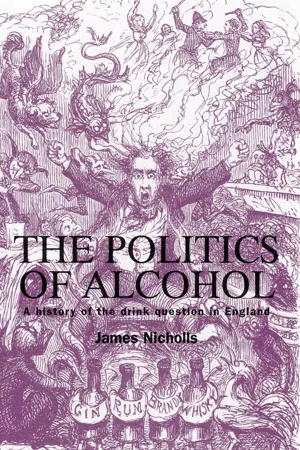
Questions about drink – how it is used, how it should be regulated and the social risks it presents – have been a source of sustained and heated dispute in recent years. In The politics of alcohol, newly available in paperback, Nicholls puts these concerns in historical context by providing a detailed and extensive survey of public debates on alcohol from the introduction of licensing in the mid-sixteenth century through to recent controversies over 24-hour licensing, binge drinking and the cheap sale of alcohol in supermarkets. In doing so, he shows that concerns over drinking have always been tied to broader questions about national identity, individual freedom and the relationship between government and the market. He argues that in order to properly understand the cultural status of alcohol we need to consider what attitudes to drinking tell us about the principles that underpin our modern, liberal society.
The politics of alcohol presents a wide-ranging, accessible and critically illuminating guide to the social, political and cultural history of alcohol in England. Covering areas including law, public policy, medical thought, media representations and political philosophy, it will provide essential reading for anyone interested in either the history of alcohol consumption, alcohol policy or the complex social questions posed by drinking today.
- 282 pages
- English
- ePUB (mobile friendly)
- Available on iOS & Android
eBook - ePub
About this book
Information
Publisher
Manchester University PressYear
2013Print ISBN
9780719086373
9780719077050
eBook ISBN
9781847797070
Topic
HistoireSubtopic
Histoire de la Grande-Bretagne1
A monstrous plant: alcohol and the Reformation
Let me set down this for my general proposition, that all drunkards are beasts. (George Gascoigne)
Help to blast the vines that they may bear no more grapes, and sour the wines in the cellars of merchant’s storehouses, that our countrymen may not piss out all their wit and thrift against the walls. (Thomas Nashe)
In 1628, a writer called Richard Rawlidge published a pamphlet with the eye-catching title A Monster Late Found Out and Discovered. That monster was drunkenness. According to Rawlidge, England was suffering from an explosion of social disorder caused by a dramatic rise in the number of alehouses springing up across the country. This, he insisted, had caused a disastrous breakdown in public morality. ‘Whereas,’ he observed, ‘there are within the City’s liberties but an hundred twenty two churches for the service and worship of God: there are I dare say above thirty hundred ale-houses, tippling-houses, tobacco-shops &c. in London and the skirts thereof, wherein the devil is daily served and honoured’.1
Rawlidge’s monster was, in truth, not so ‘late found out’. In the previous twenty-five years no fewer than six Acts of Parliament had been passed, and two Royal Proclamations published, targeting alehouses and drunkenness. The licensing of alcohol retail was less than a century old, however, and much of the legislation which had been passed in Rawlidge’s lifetime was designed to shore up the power of local magistrates who had been tasked with using their licensing powers to control excessive drinking. Underpinning all this was a wider religious attack on drunkenness and the places where drinking took place. The legislative control of alehouses – initiated by a Licensing Act of 1552 – had been accompanied by a rise in the condemnation of drunkenness from the pulpit and in print. In rough historical terms the development of a public discourse on drink, in which drink was identified as a specific social ‘problem’ in both literature and legislation, accompanied the spread of the Reformation. This is not to say that there was a direct causal link between the rise of Protestantism and the earliest appearance of the drink question, but it is to say that the social, economic, political, technological and religious transformations that both drove and were driven by the Reformation also created the conditions in which drink became political.
Drunkenness in early modern England
While it would be an oversimplification to draw a neat dividing line between pre- and post-Reformation drinking culture in England, there is no doubt that the sixteenth century saw dramatic changes in the way alcohol was both produced and consumed. In 1500 there were only the most rudimentary of licensing laws. An Assize of Bread and Ale, enacted in 1266, had pegged the price of ale to the price of bread, but it was a law that was only applied in the most ad hoc way.2 Since 1393, alehouses had been required to display a stake in front of their doors – a practice which eventually led to the development of the pub signboard. In 1494 legislation targeting the itinerant poor gave local Justices the power to ‘reject the common selling of ale’ where appropriate, but this wasn’t the same as requiring a licence to sell ale in the first place.
In the sixteenth century beer made with hops was still a novelty. Instead people drank unhopped ale, which was thicker, weaker, sweeter and far less stable than hopped beer. The ale people drank was mostly brewed domestically and by women. Brewing ale was a poor person’s profession – often the last-ditch resort of the desperately needy. There were no big brewers and alehouses were as rudimentary as the laws which governed them: often simply a part of someone’s home temporarily opened up for as long as there was a brew for which people were willing to pay. Brewing was seasonal and unpredictable, though reasonably profitable when drinks were actually being sold, and the market for beer was steadily increasing as water sources became increasingly less and less reliable thanks to population expansion and the rise of polluting industries such as tanning.
In the late middle ages, ale also contributed to a rudimentary welfare system. Communal ‘ales’ – local fund-raising events based around a specially-brewed consignment of ale – were one of the key sources of revenue for both parish churches and secular good causes.3 ‘Bride-ales’ for newly-weds, ‘bid-ales’ for needy individuals, and the notorious ‘scot-ales’ (which became a form of semi-official extortion imposed by corrupt feudal lords) involved members of the local community contributing to a fund which would finance the preparation of a special ale brewed for the occasion, the profits would then be passed on to the person for whom the ale was held. Not only were ‘ales’ of this kind an effective way of raising money, they also provided ‘a system of circulating aid in which economic activity, neighbourly assistance and festivity were subtly blended’.4
The Catholic Church initially frowned on any such activities, often forbidding priests from any kind of involvement whether official or otherwise. However, by the mid-fifteenth century ‘church-ales’, set up to raise funds for the local parish, had become a common, albeit irregular, feature of community life in many parts of Britain.5 Church-ales provided a much-needed means of topping up parish finances, but they also provided a useful source of poor-relief. The seventeenth-century antiquarian John Aubrey recalled being told that ‘there were no rates for the poor in my grand-father’s day; but for Kington St Michael (no small parish) the church-ale at Whitsuntide did the business’.6
From the late 1520s links between the Church and ale production became the object of increasing criticism. In 1529 Henry VIII passed legislation targeting the ‘plurality of livings’ among the clergy, which specifically barred ‘spiritual persons’ from keeping ‘any Manner of Brew-house’ other than to produce ale for their own use, a measure which probably contributed to the rise of alehouses by forcing brewer monks to seek new employment.7 Church-ales also fell foul of wider reforms of local government which saw fixed taxes, such as ‘pew-rents’, replace more irregular forms of income generation.8 More broadly, church-ales became the victim of a concerted effort by the Church of England to distance itself from the traditions of its Catholic predecessor. From 1576 checks on whether church wardens had ‘suffered any plays, feasts, banquets, church-ales, drinkings or any other profane usages’ of their churches began to appear in the visitation articles drawn up by bishops.9 Nine episcopates included such clauses in their visitation articles between 1571 and 1600, although their application remained sporadic.10
Early Puritan reformers in particular found something distinctly unsavoury in local churches relying heavily on the periodic facilitation of mass drunkenness to fund their expensive infrastructure and the upkeep of their clergy. In his splenetic invective against vice, The Anatomy of Abuses (1583), Philip Stubbes castigated church-ales, complaining that:
when the Nippitatum, this Huf-cap (as they call it) and the Nectar of life, is set abroad, well is he that can get the soonest to it, and spend most at it, for he that sits closest to it, and spends the most at it, he is counted the godliest man of all the rest … In this kind of practise, they continue six weeks, a quarter of a year, yea half a year together, swilling and gulling, night and day, till they be as drunk as apes, and as blockish as beasts.11
However exaggerated Stubbes’s account may be (and he certainly did have a penchant for rhetorical excess) his argument that drunkenness in the service of God was both immoral and absurd was one that found increasing resonance in Protestant England. Stubbes objected that church ales ‘build this house of lime and stone with the desolation, and utter overthrow of his spiritual house’.12 Even writers who attempted to defend church-ales were forced to acknowledge that ‘drunkenness, gluttony, swearing, lasciviousness’ were not unusual features of such events.13 By the late sixteenth century, however, church-ales were in a state of terminal decline. Four years after Stubbes’s broadside, William Harrison claimed that ‘church-ales, help-ales, and soul-ales, called also dirge-ales, with the heathenish rioting at bride-ales, are well diminished and laid aside’.14
Drink and popular festivity
At the broadest cultural level, the decline of church-ales was one feature of a much wider attack on the festive and ritual culture of medieval Europe. The riotous pre-Lenten carnivals that culminated in Mardi Gras were more a feature of popular culture in mainland Europe than in Britain. Nevertheless, the fundamental elements of carnival – masquerade, the inversion of conventional authority, satire, sexual freedom and considerable drunkenness – were central to festive culture, including church-ales and religious feasts, in medieval England.15 William Harrison described ‘our maltbugs’ at fairs getting drunk on ‘huffecap, the mad dog, father whoreson, angels food, dragons milk, go by the wall, stride wide, and lift leg’ until they ‘lie still again and be not able to wag’.16 Drunkenness fuelled the spirit of temporary disorder and communal freedom (tinged with the palpable threat of violence) that defined carnival periods.
The toleration of carnival excess was always conditional, however, and the drunkenness of popular festivities was one of the common reasons given for their suppression. In 1448 a law passed by Henry VI banning fairs and markets on traditional feast days and Sundays cited ‘drunkenness and strifes’ as a cause of ‘abominable injuries and offences done to almighty God’. Responding to sustained attacks on this aspect of its culture, in 1563 the Council of Trent issued a formal warning to Catholics against allowing religious festivals to be ‘perverted into revelling and drunkenness’. Protestant radicals, however, insisted that the problem was intractable. They maintained that popular fairs and church-ales were nothing more than excuses for ‘bullbeating, bowling, drunkenness, dancing and such like’.17
There has been much debate over the ambivalent role of festive excess in early modern culture.18 It has been argued that while festive periods often involved outrageous displays of social inversion (the establishment of ‘lords of misrule’, parodies of the Catholic mass, etc.), carnival was always ‘a licensed affair in every sense, a permissible rupture of hegemony’.19 Others have gone further, insisting that the ‘supreme ruse of power is to allow itself to be contested ritually in order to consolidate itself more effectively’, and that popular festivities simply reaffirmed social power by creating periodic spectacles of illusory freedom.20 We shall see that among nineteenth-century temperance campaigners drink was commonly depicted as a technique by which oppressed peoples were kept in their place by allowing periodic – or even constant – drunkenness to provide a distraction from their actual conditions. Nevertheless, the traditional notion that periodic excess could provide an acceptable, and ecclesiastically sanctioned, safety-valve for otherwise pent-up emotions ran absolutely counter to that Protestant world-view which saw life as a disciplined project of rational endeavour. The post-Reformation suppression of popular festivities, including church-ales, was part and parcel of this. However, this approach risked politicising carnival excess: as Joseph Gusfield has argued, the repression of carnival ‘gave to drunkenness and festival behaviour an added feature of social protest that made the emergence of rowdy behaviour even more fearful to those who sought to control it’.21 The dialectic between the suppression and celebration of the transgressive behaviours associated with drunkenness would become something which characterised the politics of alcohol throughout the modern period.
The development of the alehouse
The attacks on drunkenness penned by the likes of Philip Stubbes were motivated by a religious desire to redefine Englishness as part of a wider moral reformation. For Stubbes, drunkenness was a feature of an old, corrupt England: an England of not only licentious fairs but also sordid drinking dens. Every city, town and village, Stubbes complained ,’hath abundance of alehouses, taverns and inns, which are so fraughted with malt-worms, night & day that you would wonder to se them … swilling, gulling, & carousing from one to another, til never a one can speak a ready word’.22 Indeed, from the earliest period of the Reformation alehouses were identified as a particularly pressing problem, for both moral and political reasons. When Coventry magistrates complained in 1544 that ‘a great part of the inhabitants of this city be now become brewers and tipplers’, they were voicing a common concern.23 Drunkenness was targeted partly for wider religious and moral reasons, but also because the number of drinking places had increased substantially over the course of the early sixteenth century.
Economic and demographic factors drove this expansion. Both Keith Wrightson and Peter Clark have argued that economic uncertainty and periodic unemployment contributed significantly to the rise of the alehouse as a social institution for two reasons: firstly, more people to...
Table of contents
- Cover Page
- Title Page
- Copyright Page
- Contents
- Introduction
- 1 A monstrous plant: alcohol and the Reformation
- 2 Healths, toasts and pledges: political drinking in the seventeenth century
- 3 A new kind of drunkenness: the gin craze
- 4 The politics of sobriety: coffee and society in Georgian England
- 5 A fascinating poison: early medical writing on drink
- 6 Ungovernable passions: intoxication and Romanticism
- 7 Odious monopolies: power, control and the 1830 Beer Act
- 8 The last tyrant: the rise of temperance
- 9 A monstrous theory: the politics of prohibition
- 10 The State and the trade: the drink question at the turn of the century
- 11 Central control: war and nationalisation
- 12 The study of inebriety: medicine and the law
- 13 The pub and the people: drinking places and popular culture
- 14 Prevention and health: alcohol and public health
- 15 Beer orders: the changing landscape in the 1990s
- 16 Drinking responsibly: media, government and binge drinking
- Conclusion: the drink question today
- Bibliography
- Index
Trusted by 375,005 students
Access to over 1.5 million titles for a fair monthly price.
Study more efficiently using our study tools.
Frequently asked questions
Yes, you can cancel anytime from the Subscription tab in your account settings on the Perlego website. Your subscription will stay active until the end of your current billing period. Learn how to cancel your subscription
No, books cannot be downloaded as external files, such as PDFs, for use outside of Perlego. However, you can download books within the Perlego app for offline reading on mobile or tablet. Learn how to download books offline
Perlego offers two plans: Essential and Complete
- Essential is ideal for learners and professionals who enjoy exploring a wide range of subjects. Access the Essential Library with 800,000+ trusted titles and best-sellers across business, personal growth, and the humanities. Includes unlimited reading time and Standard Read Aloud voice.
- Complete: Perfect for advanced learners and researchers needing full, unrestricted access. Unlock 1.5M+ books across hundreds of subjects, including academic and specialized titles. The Complete Plan also includes advanced features like Premium Read Aloud and Research Assistant.
We are an online textbook subscription service, where you can get access to an entire online library for less than the price of a single book per month. With over 1.5 million books across 990+ topics, we’ve got you covered! Learn about our mission
Look out for the read-aloud symbol on your next book to see if you can listen to it. The read-aloud tool reads text aloud for you, highlighting the text as it is being read. You can pause it, speed it up and slow it down. Learn more about Read Aloud
Yes! You can use the Perlego app on both iOS and Android devices to read anytime, anywhere — even offline. Perfect for commutes or when you’re on the go.
Please note we cannot support devices running on iOS 13 and Android 7 or earlier. Learn more about using the app
Please note we cannot support devices running on iOS 13 and Android 7 or earlier. Learn more about using the app
Yes, you can access The politics of alcohol by James Nicholls in PDF and/or ePUB format, as well as other popular books in Histoire & Histoire de la Grande-Bretagne. We have over 1.5 million books available in our catalogue for you to explore.