eBook - ePub
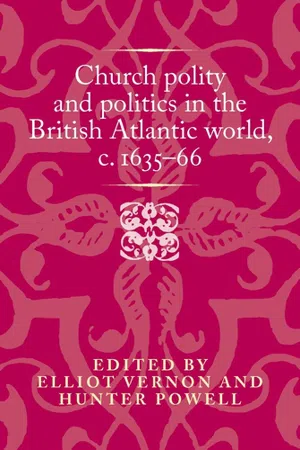
Church polity and politics in the British Atlantic world, <i>c</i>. 1635–66
- 265 pages
- English
- ePUB (mobile friendly)
- Available on iOS & Android
eBook - ePub
Church polity and politics in the British Atlantic world, <i>c</i>. 1635–66
About this book
This volume looks at how mid-seventeenth-century debates on the government and order of the Church related to the political crisis of the time. It explores debates concerning the relationship between church, state and people, the nature of the various post-Reformation settlements in the British Atlantic and how they impacted on each other, as well as central and local responses to ecclesiastical upheaval. This is one of the first scholarly collections to focus on the topic of church polity and its relation to politics during a critical period of transatlantic history. It will be of interest to scholars and students of the British revolutions as well as those working on the history of the Church and early dissenting tradition.
Trusted by 375,005 students
Access to over 1.5 million titles for a fair monthly price.
Study more efficiently using our study tools.
Information
Chapter 1

Introduction: church polity and politics in the British Atlantic world, c. 1635–66
Elliot Vernon
The topic of church polity is one of the ‘Cinderella’ subjects of early modern religious history, late to the ball but entrancing none the less.1 The chapters presented in this volume argue that the topic of church polity was a crucial factor in the politics of the British Atlantic world during the mid-seventeenth century. By ‘church polity’ is meant the manner in which the church is structured and governed. It is related to the term ‘ecclesiology’, which in this volume is used for more abstract theological reflections on the nature of the church.2
Religious non-observance was minimal in the early modern British Atlantic world, with the consequence that church polity was inescapably bound up with the political in its wide definition: the relationships of power between individuals, groups and nations. The structures of church governance, therefore, had the potential to impact substantially on the lives of the vast majority of people in the seventeenth-century British Atlantic world.3 Church polity also had a strong effect on politics more narrowly defined as the institutions and ideas constitutive of the political community. Many of the debates on the subject from the 1630s to the 1660s were triggered by forceful conversations on how to prevent the church from being used as a naked political tool of kings and magistrates, or, conversely, to prevent the clergy from establishing a separate sphere of authority.4 In addressing the relationship of church polity to political power, the belligerents in the mid-seventeenth-century British Atlantic world also sought to reaffirm the position that the church (or churches) should serve the community of faithful. Such concerns and ambitions revealed the many contradictions and paradoxes within the post-Reformation politics of religion.
In the environment of the British revolutions, these debates on church polity impacted on many of the crucial questions of the era. Key among these issues were: whether the Reformation had come to an end, or was further reformation necessary? What stress, if any, should be put on the credal notes of oneness, holiness, catholicity and apostolicity in the government of the church? What was the proper relationship between an individual Christian’s liberty of conscience and that individual’s obligation to the community of the faithful at large? Who could properly be considered a member of the church and who was empowered to teach and guard the faith ‘once delivered unto the saints’ (Jude 1:3)? How did these ‘watchmen’ (if indeed they were to be solely men) acquire legitimate authority? What were the proper means of exercising this power? In other words, to whom had the keys to the kingdom of heaven (Matthew 16:19) been committed in the post-apostolic age? These questions of church power, in turn, begged enquiry into the proper boundaries and relationship between the civil state, the law and the church.5
These issues came to dwell at the heart of the crisis triggered by the policy and failure of Charles I’s monarchies in the late 1630s. The research of historians and historical theologians over the past few decades has highlighted that church polity was at the centre of the call to ‘reform the Reformation itself’ (to use Edmund Calamy’s peroration to the Long Parliament) and thus was critical to the religious history of the seventeenth century.
The debate on church polity, therefore, was fundamentally political. One need look no further than the (mis)use of labels such as ‘presbyterian’, ‘independent’ and ‘episcopal’ to describe English political factions in civil war and interregnum politics to see the importance of church polity to the wider political history of the period. It is these issues that the chapters in this volume seek to address.
A single collection of chapters can aspire only to touch the surface of the connection between church polity and politics in the British Atlantic world during the middle decades of the seventeenth century. The focus here is on protestantism and largely those whom the theologian and sociologist Ernst Troeltsch would have identified as holding to a ‘church type’ rather than a ‘sect type’ view of religion. For example, this collection does not have separate chapters on either separatist or baptist views of church polity. This is regrettable, but thankfully these groups have been well served by a number of full-length studies by Geoffrey Nuttall, Stephen Brachlow, Murray Tolmie, Stephen Wright and Mark Bell among others.6 To some degree, of course, the concept of a ‘separatist’ ceased to be a meaningful category in the late 1640s and 1650s, with the increasing acceptance by the political authorities of voluntary gathered churches as a legitimate form of Christian worship. Furthermore, as Matthew Bingham has shown, the category of ‘baptist’ is something of an anachronism, with many of those we now call ‘particular baptists’ positioning themselves within the umbrella of ‘the congregational way’. While congregations gathered around the principle of believer’s baptism suffered persecution in mid-seventeenth-century New England and the censure of the Kirk in Scotland, the English governments of the period were increasingly willing to consider the matter of believer’s baptism as a matter of conscience. In early 1648 a joint declaration of both Houses of Parliament understood otherwise doctrinally orthodox Christians who held to ‘a difference about a circumstance of time in the administration of an ordinance’ as being within the fold of the faithful.7 While this parliamentary concession to the principle of adiaphora was somewhat muffled by the May 1648 blasphemy ordinance, it became the norm under the governments of the interregnum.8
The limitations of space in this volume did not allow a chapter on the internal organisation of antiformalist groups, particularly the quakers. A good starting point for modern scholarship in this regard can be found in the 2015 collection of essays Early quakers and their theological thought edited by Stephen Angell and Pink Dandelion.9 Studies of major episcopalian theorists such as Herbert Thorndike, Jeremy Taylor and Henry Hammond, while discussed in this volume by Benjamin Guyer, are somewhat underrepresented in the historical literature, with J.W. Packer’s 1969 monograph The transformation of Anglicanism remaining a key survey of this field.10 Also missing from this volume are debates on polity within British and Irish catholicism during the period. This omission, together with that of Ireland, was due to not being able to find a scholar to write a chapter for this collection at the time of commissioning the chapters rather than an absence of material. Stefania Tutino’s 2008 monograph Thomas White and the Blackloists: between politics and theology during the English civil war can be recommended as a starting point for catholic discussions on church polity and politics in the period.11 Ireland is served by John McCafferty’s study of the Laudian period, The reconstruction of the Church of Ireland and Toby Barnard’s 1975 study Cromwellian Ireland, although Seymour’s 1921 Puritans in Ireland (1647–1661) is still a valuable source.12
THE MEDIEVAL AND REFORMATION BACKGROUND TO THE MID-SEVENTEENTH CENTURY DEBATE ON CHURCH POLITY
Prior to the Reformation, the polity of the Western church had largely been episcopal in structure. Although there was wide variation throughout Europe, the great experiments in church polity would come with the Reformation and its call for a return to the purity of the earliest church foundation, howsoever that era was interpreted. Nevertheless, late medieval debates had impinged on questions of church polity and its relationship with politics. The thirteenthcentury political philosopher Marsilius of Padua had been critical of the medieval papacy’s claim to wield power over civil authorities. Formulating ideas that would be deployed in favour of the power of temporal rulers during the Swiss and Tudor Reformations, Marsilius had argued against the political dualism of the ‘two swords’ theory of church and state relations dating back to Pope Gelasius in the fifth century.13 In a similar vein, the fourteenth- and fifteenth-century controversy between conciliarists and papalists arising out of the great schism provided a body of ideas that not only challenged the authority of the pope but emphasised the power of councils in the governance of the church.14 As Hunter Powell’s study of the Westminster assembly debates has shown, conciliarist ideas would influence the 1640s debates on church polity. For example, the Lancashire delegate Charles Herle, whose activity before joining the Westminster assembly is explored in James Mawdesley’s chapter, was deeply steeped in conciliarist thought.15
The reformers’ reassessment of many aspects of the medieval church led to a new phase of questions and experiments concerning church polity. Martin Luther’s attack on the pre-Reformation church’s sacramental system had the knock-on effect of undermining the medieval church’s claims to governmental power generally.16 In the English Henrician Reformation, the common law heritage, blended with notions of Old Testament kingship, advanced the power of the imperial monarchy to order ecclesiastical affairs. Such a power of order was potentially limited only by the consent of the community in Parliament and not by ‘the Church’ conceived of as a separate realm of jurisdiction.17 Others, potentially antithetical to this notion of the power of theocratic and imperial kings, looked to the community of the faithful as the legitimate source of church power. The sixteenth-century consistorial model of church polity, most commonly associated with Calvin’s Geneva, and its spread to countries where protestantism was ‘under the cross’ of persecution, such as France or the Netherlands, established presbyterial forms of church government throughout Europe.18 The experiments of Jan Łaski and Jean Morély in congregational independency and the anabaptist communities of the ‘radical’ reformation provided Reformation Europe with further experiments in church polity.19
Church polity was also at the heart of the Scottish Reformation. The early adoption (albeit with a relatively slow uptake) of kirk sessions in the parishes presented a significant departure from the traditional polity of the Scottish church. Beyond the parish, the mid to late sixteenth-century struggle between supporters of episcopacy and the presbyterianism of the Second book of discipline took aim not only at the institution of episcopacy but also at the connection between the church and royal and aristocratic power. In this struggle, James VI managed to outmanoeuvre his presbyterian opponents on numerous occasions, culminating in the ratification of the Five Articles of Perth in 1621. However, the struggles over the polity of the Scottish church in the sixteenth and early seventeenth century left a residual body of thought, together with a deep layer of resentment within Scottish political and religious culture. This would blossom throughout the British Atlantic world in the mid-seventeenth-century crisis.20
The church settlement of England’s Elizabeth I, combining an episcopalian structure, a traditional liturgy, Reformed confessional theology and magisterial supremacy would become a cherished institution for many Christians throughout the British Atlantic world. To others, the worship and polity of the Church of England continued to remain ‘but half-reformed’ and unfit for the evangelical mission of protestantism. The failure of the Elizabethan church to reform its polity in line with the European Reformed churches would become the substance of disputes and debates within the Church of England. The consequence of the failure of presbyterian attempts to grow ‘presbytery within episcopacy’ in the 1580s led to the emergence of separatist ideas in the 1590s.21 An alternative model that developed was the attempt to square the circle of a national church, the royal supremacy and congregational independence. This model, advocated by William Bradshaw, would develop through the experiments of Henry Jacob into a distinctive congregationalist position in the seventeenth century.22 At the same time, figures such as Thomas Bilson were asserting the apostolic foundations of episcopacy against th...
Table of contents
- Cover
- Half Title
- Title Page
- Copyright
- Contents
- List of Figures and Tables
- Acknowledgements
- Notes on Contributors
- List of Abbreviations
- 1 Introduction: church polity and politics in the British Atlantic world, c. 1635–66: Elliot Vernon
- 2 ‘From the Apostles’ time’: the polity of the British episcopal churches, 1603–62: Benjamin M. Guyer
- 3 Peers, pastors and the particular church: the failure of congregational ideas in the Mersey Basin region, 1636–41: James Mawdesley
- 4 ‘One of the least things in religion’: the Welsh experience of church polity, 1640–60: Stephen K. Roberts
- 5 Polity, discipline and theology: the importance of the covenant in Scottish presbyterianism, 1560–c. 1700: R. Scott Spurlock
- 6 Presbyterian ecclesiologies at the Westminster assembly: Chad Van Dixhoorn
- 7 ‘They agree not in opinion among themselves’: two-kingdoms theory, ‘Erastianism’ and the Westminster assembly debate on church and state, c. 1641–48: Elliot Vernon
- 8 The New England way reconsidered: an exploration of church polity and the governance of the region’s churches: Francis J. Bremer
- 9 The association movement and the politics of church settlement during the interregnum: Joel Halcomb
- 10 Polity and peacemaking: to what extent was Richard Baxter a congregationalist?: Tim Cooper
- 11 ‘Promote, protect, prosecute’: the congregationalist divines and the establishment of church and magistrate in Cromwellian England: Hunter Powell
- 12 The Restoration episcopate and the interregnum: autobiography, suffering and professions of faith: Sarah Ward Clavier
- Index
Frequently asked questions
Yes, you can cancel anytime from the Subscription tab in your account settings on the Perlego website. Your subscription will stay active until the end of your current billing period. Learn how to cancel your subscription
No, books cannot be downloaded as external files, such as PDFs, for use outside of Perlego. However, you can download books within the Perlego app for offline reading on mobile or tablet. Learn how to download books offline
Perlego offers two plans: Essential and Complete
- Essential is ideal for learners and professionals who enjoy exploring a wide range of subjects. Access the Essential Library with 800,000+ trusted titles and best-sellers across business, personal growth, and the humanities. Includes unlimited reading time and Standard Read Aloud voice.
- Complete: Perfect for advanced learners and researchers needing full, unrestricted access. Unlock 1.5M+ books across hundreds of subjects, including academic and specialized titles. The Complete Plan also includes advanced features like Premium Read Aloud and Research Assistant.
We are an online textbook subscription service, where you can get access to an entire online library for less than the price of a single book per month. With over 1.5 million books across 990+ topics, we’ve got you covered! Learn about our mission
Look out for the read-aloud symbol on your next book to see if you can listen to it. The read-aloud tool reads text aloud for you, highlighting the text as it is being read. You can pause it, speed it up and slow it down. Learn more about Read Aloud
Yes! You can use the Perlego app on both iOS and Android devices to read anytime, anywhere — even offline. Perfect for commutes or when you’re on the go.
Please note we cannot support devices running on iOS 13 and Android 7 or earlier. Learn more about using the app
Please note we cannot support devices running on iOS 13 and Android 7 or earlier. Learn more about using the app
Yes, you can access Church polity and politics in the British Atlantic world, <i>c</i>. 1635–66 by Elliot Vernon,Hunter Powell, Elliot Vernon, Hunter Powell in PDF and/or ePUB format, as well as other popular books in History & Early Modern History. We have over 1.5 million books available in our catalogue for you to explore.