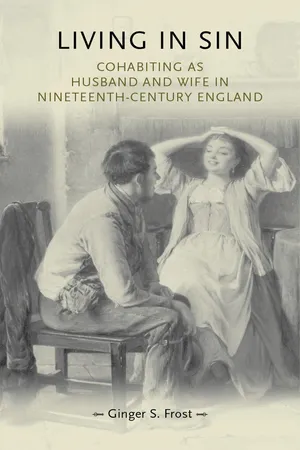
Living in sin is the first book-length study of cohabitation in nineteenth-century England, based on research into the lives of hundreds of couples. 'Common-law' marriages did not have any legal basis, so the Victorian courts had to wrestle with unions that resembled marriage in every way, yet did not meet its most basic requirements.
The majority of those who lived in irregular unions did so because they could not marry legally. Others chose not to marry, from indifference, from class differences, or because they dissented from marriage for philosophical reasons. This book looks at each motivation in turn, highlighting class, gender and generational differences, as well as the reactions of wider kin and community.
Frost shows how these couples slowly widened the definition of legal marriage, preparing the way for the more substantial changes of the twentieth century, making this a valuable resource for all those interested in Gender and Social History.
- 264 pages
- English
- ePUB (mobile friendly)
- Available on iOS & Android
eBook - ePub
About this book
Information
Publisher
Manchester University PressYear
2013Print ISBN
9780719085697
9780719077364
eBook ISBN
9781847797100
1
Cohabitation, illegitimacy, and the law in England, 1750–1914
THOUGH CONSERVATIVES liked to believe otherwise, the legal definition of marriage changed over time, including and excluding couples as it did so. The key legislation in these transformations was the Hardwicke Marriage Act of 1753, a watershed in family law. Parliament took control over the regulation of marriage, challenging the principle of marriage as an eternal sacrament, since the state now determined who was married and who was not. In addition, this act and subsequent pieces of legislation tightened the laws of marriage and defined marriages more rigorously. As English law divided those married from those unmarried, a growing number of couples found themselves outside its parameters. The legal consequences were considerable, so the provisions of the law were vitally important.
Prior to 1753, the marriage laws of England were chaotic. The validity of marriages was a major source of litigation, because couples could marry secretly in a variety of ways. A man and woman could simply state ‘I marry you’ in front of witnesses, and the church recognised the union as legal. Couples who said ‘I will marry you’ and then cohabited were also married. Though the church courts became increasingly unwilling to validate such unions as the eighteenth century wore on, clandestine weddings remained popular. As a result, many couples bound themselves for life without licences or their parents’ consent.1 In the Hardwicke Marriage Act, Parliament abolished the binding power of betrothals and much of the authority of the church courts in England. Many factors influenced Parliament to make the change. First, the confusions of the law led to difficulties, especially when prior contracts threatened long-standing marriages. Second, the upper classes wanted to stop their under-age children from making unwise marriages, a reassertion of patriarchal control. Third, the act gave more freedom to men, since regularising cohabiting unions became much more difficult. Thus, the only legal marriages were those performed on certain days of the week, at specified times, and at registered Anglican churches (exempting Quakers, Jews, and the royal family). The wedding had to be performed after a reading of the banns three weeks in a row or the purchase of an expensive licence. In addition, no marriage was legal unless both parties were over twenty-one or had the consent of their guardians. In other words, all secret marriages of minors, all clandestine marriages, and all oral contract marriages were void.2
As Ralph Outhwaite has pointed out, the act was not the ‘last word’ on marriage reform. Opponents of the bill tried to overturn it several times, and repeals passed the House of Commons in 1765 and 1781, but failed in the Lords. The entire law was repealed in 1822, only to be reinstated in an amended form in 1823. Most especially, Parliament had to address the grievances of Dissenters, whose religious ceremonies were now invalid. Marriage by civil registration, which came into law in 1836, began this process. After 1836, couples could obtain a licence from the local Registrar’s office (created in 1835) and marry there. This law broke the monopoly of religious establishments over marriages, since Dissenters and Catholics could marry by registrar and then have their own religious rites as they saw fit.3 The original act had intended to cut through the confusion of church marriages and define a legal marriage in unambiguous terms. Nevertheless, difficulties remained, in part because of the very specificity of the act. Couples who made mistakes in the parish registers, married at the wrong times, or picked an unregistered chapel might not be legally married at all. At times, a man or woman might assume that a marriage with some minor mistake was not legal and so remarry, thereby making a possibly bigamous marriage. Furthermore, both Ireland and Scotland had different marriage laws, which meant a couple might be married in one country, but living in ‘concubinage’ in another. In short, the law meant to clarify the definition of marriage instead offered a host of new problems.
Further complicating matters was the fact that common-law marriage did not exist as a legal category in England. Indeed, commentators rarely tried to describe ‘concubinage’, though they spent scores of pages explaining marriage, since anyone who did not marry legally automatically fell into the former category. Those who did attempt a description often had to reference marriage; cohabitation was not something positive in its own right, but a ‘non-marriage’. James Cookson, writing in 1782, described ‘concubinage’ as ‘the cohabitation of a man and woman in the way of marriage, without its ceremonies and solemnity, – the marriage of nature; but below that of positive Institution.’4 Cohabitation, then, was a lesser relationship and never compared favourably with marriage. But what, specifically, was missing?
Obviously, cohabitees lacked the sanction of the church and the state. All the same, they had often been through a ceremony of some sort and were parents. After the passage of Civil Marriage in 1836, some married couples also evaded the religious ceremony; though they had legal sanction, they were not all that distinct from couples who lived together. Thus, in a number of circumstances, cohabitees mirrored those legally wed. In fact, the attitude of many people to cohabitation was connected to their opinion of a ‘true’ marriage. If the person saw marriage as an institution and a sacrament, he or she was more likely to condemn concubinage. But if a commentator stressed the relationship as the basis of marriage, he or she tended to be more sympathetic to those who lived ‘in sin’. In the end, however, the key point for the law was the lack of legal standing, even more than the lack of church sanction. Without a legal marriage, a family lost many benefits, particularly women and children.
Despite this, some couples still lived together irregularly and relied on reputation and long cohabitation to give their unions public sanction; without property considerations, the ambiguous state of the union rarely mattered. And even when the courts did get involved, judges might declare the marriage valid, since one of the axioms of English law was that such reputation could be taken as proof of marriage.5 All the same, those who cohabited were vulnerable. If one partner determined to leave the relationship, he or she could use the law to end the union. In fact, Hardwicke’s critics foresaw this possibility. Robert Nugent pointed out that ‘to declare a marriage void, if not celebrated with all the punctilios prescribed by this Bill, is really to divorce the husband and wife’. His prediction was accurate, sometimes with serious consequences.6
On the plus side, no legal penalty to cohabitation existed. With the decline of the church courts, punishments for fornication withered away. Though some local leaders disliked the new licence, they could do little about it. In 1842, a magistrate wrote to Justice of the Peace to complain about a couple who lived ‘in a n avowed state of concubinage’. He asked if the local clergyman could force them ‘either to separate, or to marry?’ The editors replied that ‘such parties are usually left to the punishment which society inflicts upon them … if they move in any decent sphere of life.’7 In other words, if the couple did not care about public reputation, they could live together as long as they pleased.
Nevertheless, such freedom came at a price, particularly for women. Women who cohabited with men now had no legal claim to the status of wife. Critics of the bill had pointed out the hardships it would entail for women; Charles Townshend, for example, predicted that it would be ‘the ruin of a multitude of young women’. As late as 1838, the editors of Justice of the Peace asserted that ‘the choice was to be made between the inconveniences of clandestine marriages and the destruction of one of the bulwarks of morality, and the legislature adopted the former’. Furthermore, children born to these unions were illegitimate, and this was no small consideration, since the English bastardy law was the harshest in Europe. Illegitimate children were literally parentless at law (filius nullius), and even the subsequent marriage of their parents did not legitimise them.8
The position of illegitimate children became even more precarious after the New Poor Law of 1834. This law’s Bastardy Clause placed the responsibility of maintaining illegitimates onto their mothers. Women could no longer name the putative fathers of their children and receive support from them. Although some changes occurred in this law in 1844 (and more substantially in 1872), women remained at a disadvantage in collecting support; in addition, the amount of maintenance was small and ended when the child reached thirteen.9 And even if women avoided the legal and financial penalties, they were far more likely than men to face social snubs. In short, the Hardwicke Act, combined with the New Poor Law, made marriage both more difficult and more necessary for women.
Accidental cohabitation?
Despite the changes in 1753, the church and secular courts still had to define legal marriage in the nineteenth century. This should have been straightforward, due to the specificity of the Hardwicke Act, but it was not. Many Britons disagreed with the new marriage law and tried to get around it. More exalted examples of this phenomenon were the children of George III, who tried to escape from the strictures of the Royal Marriages Act of 1772 (which specified that the monarch’s children could not marry legally without the sovereign’s consent). The Prince of Wales married Maria Fitzherbert in 1785 by bringing a clergyman out of the Fleet prison and bribing him; though the marriage was illegal, Fitzherbert had the position of a pseudo-wife.10 Similarly, George III’s sixth son, the Duke of Sussex, married Lady Augusta Murray in 1793. Murray was the daughter of an earl, but the king still had the marriage voided. Their son, Sir Augustus D’Este, petitioned frequently to be legitimated, to no avail.11
Less elite examples of attempts to get around the marriage laws also abound. In Reddall v. Leddiard (1820), the bridegroom, who was twenty, swore out an affidavit that he was of age, and the bride and her two guardians acquiesced in the lie, all so that he could marry without his parents’ consent. Sir John Nichol, one of the judges, complained, ‘they trifle with the sanctity of an oath in a manner to undermine the very foundation of society.’ 12 But judges would remain disappointed in the population’s regard for marital oaths. In 1830, the Consistory Court in London heard the case Wiltshire v. Prince, a typical case. Henry John Wiltshire married Elizabeth Prince on 5 February 1828 after the reading of the banns. Henry was a minor who changed his name – from Henry John to John – in order to conceal his marriage to the family cook. When his parents found out, they sued to have the marriage annulled. The court invalidated the marriage; this couple had clearly acted fraudulently to get around the statute.13
In other words, in this and similar cases, couples defied the law, but the courts enforced it strictly. The fact that couples refused to accept the new legal definition was worrisome, however. Furthermore, other sources showed that people married illegally in a number of ways, and, unless parents intervened, the government was reluctant to prosecute. In 1866, a parson wrote to the Home Secretary, trying to get him to prosecute two cases in which apprentices had gone to local Registrar’s offices and ‘obtained clandestine marriages through fraud & perjury.’ The Registrar General refused to help, so the parson turned to the Home Office, who, likewise, declined to get involved, despite the clergyman’s insistence that something must be done to stop ‘so serious and encreasing [sic] an Evil.’14 The only time the authorities prosecuted was when one of the couple had defrauded the other or committed bigamy, both more serious off...
Table of contents
- Cover Page
- Title Page
- Copyright Page
- Contents
- Acknowledgements
- Introduction
- 1 Cohabitation, illegitimacy, and the law in England, 1750–1914
- 2 Violence and cohabitation in the courts
- 3 Affinity and consanguinity
- 4 Bigamy and cohabitation
- 5 Adulterous cohabitation
- 6 The ‘other Victorians’: the demimonde and the very poor
- 7 Cross-class cohabitation
- 8 Radical couples, 1790–1850
- 9 Radical couples, 1850–1914
- Conclusion
- Bibliography
- Index
Trusted by 375,005 students
Access to over 1.5 million titles for a fair monthly price.
Study more efficiently using our study tools.
Frequently asked questions
Yes, you can cancel anytime from the Subscription tab in your account settings on the Perlego website. Your subscription will stay active until the end of your current billing period. Learn how to cancel your subscription
No, books cannot be downloaded as external files, such as PDFs, for use outside of Perlego. However, you can download books within the Perlego app for offline reading on mobile or tablet. Learn how to download books offline
Perlego offers two plans: Essential and Complete
- Essential is ideal for learners and professionals who enjoy exploring a wide range of subjects. Access the Essential Library with 800,000+ trusted titles and best-sellers across business, personal growth, and the humanities. Includes unlimited reading time and Standard Read Aloud voice.
- Complete: Perfect for advanced learners and researchers needing full, unrestricted access. Unlock 1.5M+ books across hundreds of subjects, including academic and specialized titles. The Complete Plan also includes advanced features like Premium Read Aloud and Research Assistant.
We are an online textbook subscription service, where you can get access to an entire online library for less than the price of a single book per month. With over 1.5 million books across 990+ topics, we’ve got you covered! Learn about our mission
Look out for the read-aloud symbol on your next book to see if you can listen to it. The read-aloud tool reads text aloud for you, highlighting the text as it is being read. You can pause it, speed it up and slow it down. Learn more about Read Aloud
Yes! You can use the Perlego app on both iOS and Android devices to read anytime, anywhere — even offline. Perfect for commutes or when you’re on the go.
Please note we cannot support devices running on iOS 13 and Android 7 or earlier. Learn more about using the app
Please note we cannot support devices running on iOS 13 and Android 7 or earlier. Learn more about using the app
Yes, you can access Living in sin by Ginger Frost in PDF and/or ePUB format, as well as other popular books in Social Sciences & Early Modern History. We have over 1.5 million books available in our catalogue for you to explore.