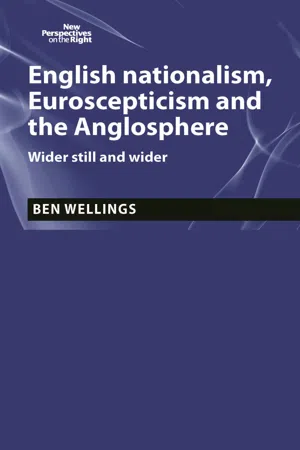
This is the first book to examine the relationship between English nationalism, Brexit and 'the Anglosphere' – a politically-contested term used to denote English-speaking countries sharing cultural and historical roots with the UK.
In the aftermath of the UK's EU referendum some pointed to a 'revolt' of those 'left behind' by globalisation. Ben Wellings argues instead that Brexit was and is an elite project, firmly situated within the tradition of an expansive English nationalism. Far from being parochial 'Little Englanders', elite Brexiteers sought to replace the European Union with trade and security alliances between 'true friends' and 'traditional allies' in the Anglosphere. Brexit was thus reassuringly presented as a giant leap into the known. As the UK's future relationship with the rest of the world is negotiated, the need to understand this 'English moment' has never been more pressing.
- 206 pages
- English
- ePUB (mobile friendly)
- Available on iOS & Android
eBook - ePub
About this book
Information
Publisher
Manchester University PressYear
2019Print ISBN
9781526117731
9781526117724
eBook ISBN
9781526117748
Part I
Discovering England
1
Introduction: English nationalism, Euroscepticism and the Anglosphere
Dare to dream that the dawn is breaking on an independent United Kingdom … Let June 23 go down in our history as our independence day! (Nigel Farage, cited in Withnall, 2016)
It is hard to understate the historic significance of the vote to leave the European Union (EU) that emerged from the rain on the morning of 24 June 2016. It was the greatest policy failure leading to a geo-strategic reorientation since the Suez Crisis of 1956 and potentially the greatest loss of markets since independence in the Indian subcontinent in 1947, if not the Thirteen Colonies in 1783. But Suez left few traces on the electorate or domestic British politics and was conducted in the ‘black box’ of foreign relations. In contrast, the decision to leave the European Union was enacted by the electorate who, in so doing, challenged the sovereignty of Parliament that some Brexiteers claimed they were trying to save. Moreover, this was a campaign and outcome dominated by England. Examining this event as a ‘moment’ of English nationalism opens up fruitful ways of understanding both the vote to leave the European Union and the nature of English nationalism itself.
In parts of the world where national memory is conditioned by resistance to British imperialism the idea of the English seeking and winning their independence is disconcertingly absurd. In almost every part of the world – from the Americas, to Asia, Africa, the Middle East and even within the United Kingdom (UK) itself – the English (not the Scots, Welsh and least of all the Irish) are the chief malefactors in many national narratives that end in independent nationhood for formerly subject peoples. Until recently, the English were a people from whom you sought independence, not a people seeking to regain their own nationhood by rising up against the inequities of foreign rule.
Yet this is how Brexit was portrayed in Nigel Farage’s victory speech at 4 a.m. on 24 June 2016: with the important caveat that Farage was ostensibly speaking for the United Kingdom, not for England. But the disparity in support for leaving the European Union in the four nations of the United Kingdom raised the question of which nation might be seeking its independence and from what or whom? A newly politicised English identity was not just a salient feature of the 2016 referendum but also of the ten years leading up to it. In this way politicised Englishness became an important element in explaining the decision to hold the Brexit referendum and its eventual outcome.
Raising questions of where sovereignty lay and who exactly was in charge in the United Kingdom was only one of the political dilemmas that were opened by the attempt to resolve three others. In seeming to resolve one grand dilemma – the United Kingdom’s membership of the European Union – the referendum deepened two more inter-related problems: England’s relationship to the United Kingdom and Britain’s relationship to the world. The way that the decision to leave the European Union was arrived at opened up questions about what kind of country the United Kingdom had become. The outcome of the referendum vote was the result of diverse causes: the political effects of wealth disparities, the use of xenophobia to mobilise parts of the Leave vote and the difficulties of political communication in a democratic system that was adapting slowly to the disruptive effects of misinformation borne by new media. The national divisions that the 2016 referendum exposed are often noted. Yet little sustained attention has been given to the place of nationalism as an ideology (rather than shorthand for xenophobia) in explaining Brexit. This book attempts to make such an explanation.
This book builds on research that highlights the peculiar Englishness of Euroscepticism and the Englishness of Brexit (Wellings, 2012; Henderson et al., 2017). Some analysis downplays the particularity of Brexit in favour of broader, underlying strains and tensions in Western democracies, noting the ‘long-standing suspicions’ of the European project as a sub-text to Brexit (Flinders, 2018: 185–188). These shorter-term explanations are important, but we must not throw the English baby out with the comparative bathwater. Analysing the UK’s ‘awkwardness’ through the lens of an emergent politicisation of English nationhood and longer continuities in the construction of English nationalism allows for a medium-term explanation of Brexit, as well as allowing us to gain valuable insights into English nationalism. Doing so therefore allows us to open up new fields of explanation for this major event in British and European political history. In this sense, Brexit is understood as an extended event, not solely the referendum campaign of 2016. The analysis that follows considers the politics of nationalist mobilisation in the years preceding the decision to leave the European Union and the inter-relationship between an elite project to alter the UK’s relationship with the EU and popular grievances. The famously ‘awkward’ relationship between the UK and the EU cannot be understood separately from the increasingly awkward set of relationships between the nations of the United Kingdom themselves (Wellings, 2015). In this light – with an interpretation of English nationalism at its centre – Brexit becomes explicable as the result of an important but contingent alliance between a politicised Englishness and an elite project that aimed at withdrawing the United Kingdom from the European Union. It was this cross-sectional alliance that shifted politicised Englishness into an English nationalism defined by a political desire to separate the UK from the EU.
In order to respond to and manage popular grievance that was increasingly voiced in the language of this politicised Englishness, a political strategy formed that was shaped by this emergent nationalism. An elite project to get Britain out of the EU and reposition it in a globalising world was able to ally with a recently politicised Englishness mobilised by the issue of the United Kingdom’s membership of the European Union and the free movement of labour that membership entailed. By so doing, it delivered a slim but significant majority to take the UK out of the EU in the referendum of 2016. The contingent alliance between elites and masses was not the only aspect of the creation of this ‘national’ moment. Past and future were joined in a critique of present political arrangements. Britain’s imperial past allowed Brexiteers to imagine a global future for the United Kingdom. The ‘Anglosphere’ was part of this particular national imagination that appeared to offer a solution to the dilemma of exit from the EU. As a named ideology it emerged at the same time as England began to emerge as a de facto political community in the asymmetrically devolved United Kingdom. England found itself at the centre of a three-level game bought about through the politics of Brexit. The three levels of this dilemma were, first of all, how to get the UK out of the EU whilst, secondly, keeping the UK together on English terms and, thirdly, how to reintegrate a post-EU UK into the ‘wider world’ as a means to lessen the rupture of withdrawal from the EU and mitigate the possibility of a break-up.
By reframing Brexit through the lens of English nationalism, this book offers a medium-range explanation for the origins and outcome of the campaign to secure the United Kingdom’s departure from the European Union and the part played by ‘the Anglosphere’ in it. It also helps explain the nature of contemporary English nationalism as an emergent political project, and not just a ‘stand alone’ entity or ‘Little England’, but backed by other countries to help fill the diplomatic and trading space left by the UK’s departure from the EU. Grounded in the growing literature on the politics of English nationalism and nationhood, this book examines the important – yet under-researched – inter-relationships between three ideas and ideologies in British politics: English nationalism, Euroscepticism and the Anglosphere. There may be good reasons to hesitate in calling each of these political ideas an ideology. However, if we do so based on a broad understanding of ideology as an interconnected set of ideas which form a perspective on the world that have implications for action-oriented political behaviour (Leach, 2002: 1), we can begin to appreciate how each relates to and informs the other which in turn helps us comprehend Brexit – and to comprehend it as a major moment in the history of English nationalism.
The current manifestations of these three political ideas are closely linked to contemporary politics and in that sense are relatively novel. The first recorded use of the term ‘Eurosceptic’ was in the British press in 1985 (Vasilopoulou, 2018: 23). Thatcher’s ‘Bruges Speech’ in 1988, although tame by Brexiteers’ standards, gave this putative resistance to particular directions in European integration some political coherence. Whether or not there was such a thing as English nationalism was a moot point after New Labour’s electoral win (and the Conservatives’ poor showing in Scotland and Wales) in 1997. Nevertheless, a politicised Englishness emerged just after the re-emergence of Euroscepticism as a parliamentary force in the 1990s and – as we shall see – there were important links between these two phenomena. The last element in this ideational trinity, the Anglosphere, developed as a project on the disgruntled right of the political spectrum in the English-speaking democracies at the high point of the influence of the ‘Third Way’ in 1999–2000.
Notwithstanding the novelty of these political phenomena, they all rest on much older ideas and traditions in English politics and thus have significant continuities with the past. Importantly, this gives each of them legitimacy as a response to the political dilemmas outlined above and provides reassuring continuity in times of political dislocation. But these ideologies are not only a response to these great dilemmas: in their own ways they helped cause those dilemmas too. This is because the understanding of sovereignty in these ideologies differs markedly from the understanding of sovereignty required to legitimise European integration. Sovereignty is a crucial element in any nationalism and it holds a special place in the long development of English political practice and national consciousness (Black, 2018). Sovereignty is a major constitutive element of Eurosceptic thought that seeks alternative models of European integration or an alternative to European integration altogether. Anglosphere thought nurtures the constitutional development of sovereignty in England as part of its collective historical narrative and suggests that alternatives to European integration are to be found in a renewed set of international relationships based on the civilisational commonalities stemming from this English past.
This book examines these important inter-relationships between English nationalism, Euroscepticism and the Anglosphere. Building on important analyses of English nationalism from Tom Nairn to the more recent (and differing) accounts of this phenomenon written by Krishan Kumar, Arthur Aughey and Michael Kenny, it explains the nature of what Nick Startin and Simon Usherwood have referred to as the ‘pervasive, embedded and persistent’ nature of Euroscepticism (Startin and Usherwood, 2013: 10). It does so in this case in the United Kingdom, by linking it with an analysis of nationalism in England and shows that what we might call ‘Euroscepticism’ is far more embedded and persistent than even these authors’ enquiry into the general EU-wide phenomenon suggests.
This re-energised English worldview was located at the intersection of three political inter-relationships: between English nationalism and Euroscepticism; between Euroscepticism and the Anglosphere; and between the Anglosphere and English nationalism. The memory of England’s historical development that underpins the dominant articulation of British sovereignty inclines the English worldview away from the EU and out towards the ‘English-speaking peoples’, recently rehabilitated and reconceptualised for a global era as ‘the Anglosphere’. The strain that these competing conceptions of England and Britain placed on national traditions were expressed in the arguments whether to ‘Remain’ in or ‘Leave’ the European Union up to and after the historic vote to take the UK out of the EU held on 23 June 2016.
Thus, far from being inwardly focused and parochial, when understood as a contingent alliance between electorate and elites, contemporary English nationalism is a globally connected phenomenon, which is deeply engaged with the wider world. To be sure, nationalism in England displayed what we might call a ‘defensive posture’ towards European – and even British – levels of governance and those policies that we associate with globalisation in the decade after the Global Financial Crisis. The debate during the Brexit referendum campaign was certainly tainted by xenophobia, symbolised the murder of the Labour and pro-Remain MP Jo Cox during the referendum campaign and in the rise in hate crimes: the Home Office reported a 41 per cent rise in racist or religious abuse in the month after the vote (cited in the EU Observer, 2016). But this does not necessarily make it parochial. Instead of the Brexit vote being caused by a deepening parochialism, it was an awkward but decisive alliance between sections of the electorate disaffected by the effects of neo-liberal globalisation and elites attempting to expose Britain to more of the same. The arguments of the official Leave campaign sought to stress Britain’s global links as an alternative to a European vocation for the United Kingdom. From this historically informed perspective, English nationalism was one of the least parochial on the planet. This global orientation is crucial in explaining the link between English nationalism, Euroscepticism and the Anglosphere that shaped Britain’s European policy from the 1960s right up to the Brexit referendum in 2016 and the politics of withdrawal thereafter.
Stating the argument
This book mounts an argument that resistance to European integration and the drive to withdraw the UK from the EU was constitutive of the contemporary manifestation of English nationalism. Euroscepticism revitalised English nationalism as a defence of British sovereignty. In doing so, it created the conditions for a contingent alliance between supporters of an elite project to withdraw from the EU and realign the UK with its ‘true friends’ in the Anglosphere and sections of the electorate expressing popular grievances through a recently politicised Englishness.
English nationhood is expressed in a variety of ways and is informed by a variety of ideological traditions (Kenny, 2014). However, the single most important concept shaping English nationalism as a political ideology is the historically derived notion of sovereignty at the heart of the British political tradition. Whilst this appears most obviously to be about politics, it is about that elusive concept ‘culture’ too. Nationalism politicises culture and the alignment or misalignment of ‘national values’ and everyday experiences with the political structures of governance is a major motor of nationalist mobilisation. To understand English nationalism as a pervasive, persistent and embedded phenomenon and as a structuring force in British politics, one needs to comprehend the relationship between the political and the historical in articulations of England that coalesce as presentations of ‘English political culture’ and the relationship of that version of England to structures of governance. So whilst some of the drivers of contemporary English nationalism – that which Richard Wyn Jones and colleagues characterised as ‘devo-anxiety’, Euroscepticism, immigration (Wyn Jones et al., 2013) – violate general principles of nationalism (that the state and nation should be congruent and that the nation should be governed by ‘its own people’), the worldview that shapes these demands and makes them appear legitimate is based on an English understanding of sovereignty that is presented as being both political and cultural.
What makes this English worldview politically appealing when faced with major dilemmas of statecraft is a heady brew of initial success – symbolised by the Glorious Revolution of 1688 and the subsequent Whig interpretation not just of English history but of British politics – and the expansion, imitation and endurance of that system; the latter symbolised by England and Britain’s ‘finest hour’ in 1940 (what followed was by implication not as good). In all of this lay an important relationship between history and memory: in creating a narrative that legitimised the operation and existence of government and governance within the United Kingdom and the British Empire, this version of the past shaped and informed the contemporary politics of nationalism in England.
The narrative thread that links English nationalism, Euroscepticism and the Anglosphere is founded on three pillars: first of all, England’s constitutional development; secondly, the expansion and contraction of first the ‘Atlantic’ Empire and then the truly ‘British’ Empire; and, thirdly, the memory of twentieth-century conflict in preserving English sovereignty and global liberty. The emergence of the English constitution in the seventeenth century laid important foundations for the expansion of English trade that, in turn, laid the foundations of the ‘first’ empire in the ‘Atlantic world’ (including ...
Table of contents
- Cover
- Half Title
- Series Information
- Title Page
- Copyright Page
- Dedication
- Contents
- Acknowledgements
- Part I Discovering England
- Part II Three pillars of the English Anglosphere
- Part III England’s Brexit and the Anglosphere
- References
- Index
Trusted by 375,005 students
Access to over 1.5 million titles for a fair monthly price.
Study more efficiently using our study tools.
Frequently asked questions
Yes, you can cancel anytime from the Subscription tab in your account settings on the Perlego website. Your subscription will stay active until the end of your current billing period. Learn how to cancel your subscription
No, books cannot be downloaded as external files, such as PDFs, for use outside of Perlego. However, you can download books within the Perlego app for offline reading on mobile or tablet. Learn how to download books offline
Perlego offers two plans: Essential and Complete
- Essential is ideal for learners and professionals who enjoy exploring a wide range of subjects. Access the Essential Library with 800,000+ trusted titles and best-sellers across business, personal growth, and the humanities. Includes unlimited reading time and Standard Read Aloud voice.
- Complete: Perfect for advanced learners and researchers needing full, unrestricted access. Unlock 1.5M+ books across hundreds of subjects, including academic and specialized titles. The Complete Plan also includes advanced features like Premium Read Aloud and Research Assistant.
We are an online textbook subscription service, where you can get access to an entire online library for less than the price of a single book per month. With over 1.5 million books across 990+ topics, we’ve got you covered! Learn about our mission
Look out for the read-aloud symbol on your next book to see if you can listen to it. The read-aloud tool reads text aloud for you, highlighting the text as it is being read. You can pause it, speed it up and slow it down. Learn more about Read Aloud
Yes! You can use the Perlego app on both iOS and Android devices to read anytime, anywhere — even offline. Perfect for commutes or when you’re on the go.
Please note we cannot support devices running on iOS 13 and Android 7 or earlier. Learn more about using the app
Please note we cannot support devices running on iOS 13 and Android 7 or earlier. Learn more about using the app
Yes, you can access English nationalism, Brexit and the Anglosphere by Ben Wellings in PDF and/or ePUB format, as well as other popular books in Politics & International Relations & British History. We have over 1.5 million books available in our catalogue for you to explore.