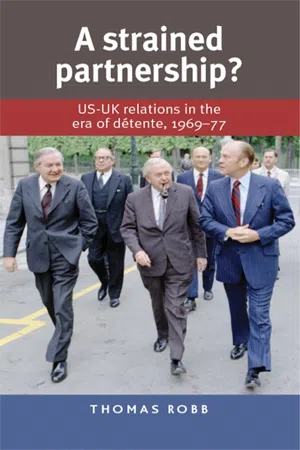
This is the first monograph-length study that charts the coercive diplomacy of the administrations of Richard Nixon and Gerald Ford as practised against their British ally in order to persuade Edward Heath's government to follow a more amenable course throughout the 'Year of Europe' and to convince Harold Wilson's governments to lessen the severity of proposed defence cuts. Such diplomacy proved effective against Heath but rather less so against Wilson. It is argued that relations between the two sides were often strained, indeed, to the extent that the most 'special' elements of the relationship, that of intelligence and nuclear co-operation, were suspended. Yet, the relationship also witnessed considerable co-operation. This book offers new perspectives on US and UK policy towards British membership of the European Economic Community; demonstrates how US détente policies created strain in the 'special relationship'; reveals the temporary shutdown of US-UK intelligence and nuclear co-operation; provides new insights in US-UK defence co-operation, and re-evaluates the US-UK relationship throughout the IMF Crisis.
- 256 pages
- English
- ePUB (mobile friendly)
- Available on iOS & Android
eBook - ePub
About this book
Information
1
Introduction
American leaders saw it [to be] in their self-interest to obtain British advice before taking major decisions. It was an extraordinary relationship because it rested on no legal claim; it was formalized by no document; it was carried forward by succeeding British governments as if no alternatives were conceivable. Britain’s influence was great precisely because it never insisted on it; the ‘special relationship’ demonstrated the value of intangibles.
Henry Kissinger’s assessment of the US–UK ‘special relationship’1
Introduction
The above quote from Henry Kissinger, who served as US national security adviser (1969–75) and US secretary of state (1973–77) under presidents Richard M. Nixon (1969–74) and Gerald R. Ford (1974–77), gives the impression that the US–UK special relationship functioned in a cooperative manner during his years in office. Moreover it suggests that British policy-makers could also exercise a decisive influence upon the course of US foreign policy. Readers will find that a quite different picture emerges in the following chapters. During the period under examination, the US–UK special relationship would come under severe strain. Demonstrative of this was the fact that on a number of separate occasions the most ‘special’ areas of US–UK cooperation, which related to the intelligence and nuclear aspects of the relationship, were suspended at the behest of Washington because of wider US–UK political disagreements. Indeed, by the end of 1973, it appeared as if the special relationship was at an end with both Richard Nixon and Henry Kissinger declaring it to be ‘over’.2
Yet, in spite of such rhetoric, the US–UK relationship remained extremely resolute. The decision by Edward Heath in late 1973 to upgrade Britain’s strategic nuclear deterrent ensured US–UK nuclear cooperation would continue for at least another generation. Intimate cooperation between the two countries with regard to international diplomacy was also evident throughout the period. Similarly, the intelligence relationship between the two countries continued throughout the era and beyond. Thus, cooperation, as well competition, was a continual feature of the US–UK relationship during the years under examination here.
Whilst cooperation and competition are the two main features of the relationship, there is, however, another key element that is largely overlooked by scholars analysing the relationship, that being coercive diplomacy. Traditionally, scholars believe that the coercive elements of US foreign policy were a tactic applied by the United States towards its foes, such as the Soviet Union (USSR), the People’s Republic of China (PRC) and North Vietnam. It is shown, in contrast to existing accounts, that this aspect of US diplomacy was also applied to its relationship with the United Kingdom. By utilising new documentary evidence unearthed in both US and British archives, it is demonstrated that the United States sought to convince British policy-makers to pursue alternative policy choices on a number of different occasions by utilising its security relationship with the United Kingdom as a means of political leverage. For instance, during what Henry Kissinger would term the ‘Year of Europe’, the United States would suspend its intelligence and nuclear cooperation with the United Kingdom to persuade British policy-makers to pursue a more amenable foreign policy line. As shown later in the book, this was a rather successful policy and unsurprisingly we see the United States pursuing a similar course when US–UK disagreement emerged in subsequent years.
Existing accounts of the Nixon–Heath years (1970–74) have tended to emphasise the points of difference and antagonism between the two countries. The relationship is depicted as being fraught with difficulty either because of Heath’s European ambitions, which necessitated a loosening of the ties with Washington, or because of Washington’s pursuit of détente on a bilateral basis which resulted in the US–UK relationship being largely ignored. Regardless of how you attribute the cause of the difficulties in the relationship, all accounts agree that the Nixon–Heath years were largely antagonistic for US–UK relations.3
In opposition to this, it is suggested below that the Nixon–Heath years are better understood as having consisted of two distinct phases. The years between 1970 and 1972 saw a failure to address fundamental points of difference between London and Washington. Consequently, US–UK differences about the course of détente, EEC entry, NATO restructuring, potential strategic arms limitations between the US and USSR and progress towards an Arab–Israeli settlement came to a head in 1973–74, when the United States sought to bring some definitive conclusions to these subjects. The period 1970–72 should also be seen as a transitional one for US–UK relations. Détente meant that a less antagonistic Cold War was evolving and the imperative for close US–UK cooperation therefore diminished. Added to this, the Heath government’s confirmation of the British withdrawal East of Suez meant that the opportunity for potential US–UK interaction declined. Along with this, a number of policy decisions concerning the breakdown of the Bretton Woods system; the war between India and Pakistan in 1971; the evolution of triangular diplomacy between the US, USSR and PRC, and Britain’s bid for membership of the EEC caused difficulties for US–UK relations. In spite of this, there was also a remarkable amount of cooperation between the two sides which is often overlooked or downplayed in existing accounts of the Nixon–Heath years. Thus, we see nuclear diplomacy being actively re-energised as Heath’s government sought to find an upgrade to its strategic nuclear deterrent. Likewise, British intelligence worked closely with its American counterparts. Finally, British diplomats and officials had considerable contact with the leading figures within the Nixon White House. The early years of the Nixon–Heath epoch were hardly ones of unmitigated antagonism that they are so often presented as being.
The years 1973–74 were undoubtedly a more troubling time for US–UK relations, when differences surrounding the ‘Year of Europe’, the fourth Arab–Israeli War and the subsequent oil crisis led to serious discord. Nevertheless, scholars should not overlook that intelligence, nuclear and diplomatic cooperation did continue throughout this period. Indeed, in 1974 Edward Heath confirmed that US–UK nuclear cooperation would continue for at least another generation when he approved the updating of Britain’s strategic nuclear deterrent. Thus, the Heath years should not be viewed as ones of constant disagreement. Rather, the archival record which is now open to scholars provides us with a more nuanced assessment of the relationship where considerable cooperation and profound disagreement as well as coercive diplomacy were the hallmarks of the relationship.
US–UK relations between 1974 and 1977 witnessed rather less bellicosity than seen in the Nixon–Heath years. However, a number of important points have been omitted in existing historical accounts. US threats relating to the continuation of US–UK nuclear and intelligence collaboration were made periodically as a means of influencing British defence policy. This coercive diplomacy is an element of the relationship that is much underappreciated within the literature of the US–UK special relationship. Further to this, it is demonstrated that this coercive diplomacy was only partially successful. By 1976 Harold Wilson had concluded that US threats to reappraise its security cooperation with London if the Wilson government enacted further defence cutbacks were mere bluster and he subsequently largely ignored them. Wilson was right to conclude that the United States had little intention of permanently severing the defence relationship it had with London. However, he miscalculated just how seriously the defence cutbacks affected how US policy-makers viewed the United Kingdom as an ally. As his successor, James Callaghan, would find out, this would have serious consequences for British interests during the 1976–77 IMF crisis.
Book organisation
The book is divided into four core chapters which are, broadly speaking, chronologically organised and focus upon the political–diplomatic dynamics of the US–UK relationship during 1969–77. They all begin with a brief overview of the existing literature, and this is followed by an analytical narrative of key US–UK interaction within the designated timeframe. Chapters 2 and 3 focus upon the Nixon years (i.e. 1969–74), whilst Chapters 4 and 5 are concerned with the administration of President Ford (1974–77). The book addresses several interconnected topics and questions. It analyses how the US reacted to British membership of the European Economic Community (EEC), as well as providing an examination of how US–UK relations were conducted within the context of international superpower détente. Broader themes of economic decline; intelligence and nuclear collaboration; and US and UK conceptions of multilateral diplomacy are also studied.
Chapter 2 illustrates that the Nixon administration re-assessed whether the US should continue to support British membership of the EEC. Throughout the Eisenhower, Kennedy and Johnson administrations, the US had encouraged its British counterparts to join the EEC for largely economic and wider political reasons. However, in the 1960s a number of US policy-makers had begun to make arguments about the detrimental impact that EEC expansion would have upon US economic interests.4 Nixon’s economic advisers repeated this advice, with John Connally – the US Treasury Secretary – being especially vocal in making such arguments. Economics, though important for Nixon, were never the determining factor behind US policy towards British membership of the EEC. For the president, longer-term strategic and political considerations would determine policy, and these were the areas that were seriously analysed by Nixon and his chief foreign policy adviser, Henry Kissinger. While both raised doubts as to whether British membership of the EEC benefitted long-term US interests, they reluctantly concluded that US support for this should be given. As Nixon was aware, the United States was largely powerless in determining whether Britain would become a member of the EEC. More important yet was the concern that without EEC membership the US would be ‘saddled with the UK and the pound in a permanent client status’.5 Along with this, Nixon also believed that British membership of the EEC could encourage Europe to accept the burden-sharing concept he was keen to foster. In the next two years, such aspirations failed to materialise and, as Kissinger noted, Nixon would come to regret supporting British membership of the EEC.6
Chapter 2 also explores several areas of US–UK interaction vis-à-vis détente. Particular attention is given to the ongoing Strategic Arms Limitation Talks (SALT), the Conference on Security and Cooperation in Europe (CSCE) and the Mutual and Balanced Force Reduction (MBFR) negotiations. Nixon’s triangular diplomacy with the USSR and the PRC, and the subsequent impact this would have upon US foreign policy actions – notably during the India–Pakistan war – are also examined. All of these areas witnessed US–UK disagreement. Heath’s government feared that superpower cooperation in SALT could prevent future US–UK nuclear cooperation. It was the view of the Heath administration that MBFR could seriously impinge on British security interests, and that the onset of triangular diplomacy was needlessly distorting US policy.
However, as Chapter 2 argues, one should not forget that, despite the many difficulties for US–UK relations, there existed many points of agreement and examples of cooperation. Moreover, it should not be overlooked that Nixon and Heath actually re-established closer US–UK interaction in the nuclear realm with US–UK working groups convening to discuss the upgrading of Britain’s Polaris nuclear deterrent. Equally, the intelligence relationship between the two countries continued throughout this period. Nor should it be forgotten that Heath publicly supported Nixon’s Vietnam policies even in the face of severe criticism from his European allies. Coupled with this, British officials managed to establish remarkably close contact with Henry Kissinger which enabled them to learn of US policy intentions (if not actually influence them a great deal). SALT, MBFR and the CSCE were also matters which were to be resolved via diplomatic consultation between the two countries, and the existence of disagreement should not be taken as a demonstration of an antagonistic US–UK relationship. This chapter therefore provides a rather more mixed assessment of US–UK relations than is currently available.
Chapter 3 marks the rapid decline of the Nixon–Heath relationship into one of open disagreement between the two countries. Such was the deterioration in relations that both Nixon and Kissinger would declare that the special relationship was over, and both intelligence and nuclear collaboration between the two sides were suspended on a number of occasio...
Table of contents
- Cover
- Half Title Page
- Title Page
- Copyright Page
- Contents
- Acknowledgements
- Abbreviations
- 1 Introduction
- 2 Re-assessing foreign policy, 1969–72
- 3 A year of discord, 1973–74
- 4 Wilson returns, 1974–76
- 5 All out of money, 1976–77
- 6 Conclusion
- Select bibliography
- Index
Trusted by 375,005 students
Access to over 1.5 million titles for a fair monthly price.
Study more efficiently using our study tools.
Frequently asked questions
Yes, you can cancel anytime from the Subscription tab in your account settings on the Perlego website. Your subscription will stay active until the end of your current billing period. Learn how to cancel your subscription
No, books cannot be downloaded as external files, such as PDFs, for use outside of Perlego. However, you can download books within the Perlego app for offline reading on mobile or tablet. Learn how to download books offline
Perlego offers two plans: Essential and Complete
- Essential is ideal for learners and professionals who enjoy exploring a wide range of subjects. Access the Essential Library with 800,000+ trusted titles and best-sellers across business, personal growth, and the humanities. Includes unlimited reading time and Standard Read Aloud voice.
- Complete: Perfect for advanced learners and researchers needing full, unrestricted access. Unlock 1.5M+ books across hundreds of subjects, including academic and specialized titles. The Complete Plan also includes advanced features like Premium Read Aloud and Research Assistant.
We are an online textbook subscription service, where you can get access to an entire online library for less than the price of a single book per month. With over 1.5 million books across 990+ topics, we’ve got you covered! Learn about our mission
Look out for the read-aloud symbol on your next book to see if you can listen to it. The read-aloud tool reads text aloud for you, highlighting the text as it is being read. You can pause it, speed it up and slow it down. Learn more about Read Aloud
Yes! You can use the Perlego app on both iOS and Android devices to read anytime, anywhere — even offline. Perfect for commutes or when you’re on the go.
Please note we cannot support devices running on iOS 13 and Android 7 or earlier. Learn more about using the app
Please note we cannot support devices running on iOS 13 and Android 7 or earlier. Learn more about using the app
Yes, you can access A strained partnership? by Thomas Robb in PDF and/or ePUB format, as well as other popular books in Politics & International Relations & Politics. We have over 1.5 million books available in our catalogue for you to explore.