eBook - ePub
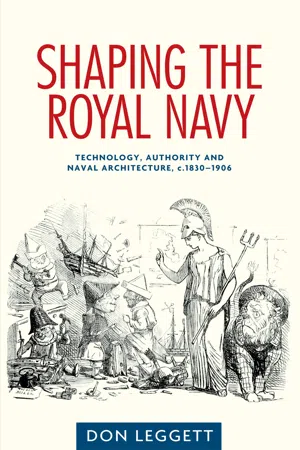
Shaping the Royal Navy
Technology, authority and naval architecture, c.1830–1906
- 300 pages
- English
- ePUB (mobile friendly)
- Available on iOS & Android
eBook - ePub
About this book
The nineteenth-century Royal Navy was transformed from a fleet of sailing wooden walls into a steam powered machine. Britain's warships were her first line of defence, and their transformation dominated political, engineering and scientific discussions. They were the products of engineering ingenuity, political controversies, naval ideologies and the fight for authority in nineteenth-century Britain. Shaping the Royal Navy provides the first cultural history of technology, authority and the Royal Navy in the years of Pax Britannica. It places the story firmly within the currents of British history to reconstruct the controversial and high-profile nature of naval architecture. The technological transformation of the Navy dominated the British government and engineering communities. This book explores its history, revealing how ship design became a modern science, the ways that actors competed for authority within the British state and why the nature of naval power changed.
Information
1
Authority, judgement and the sailor-designer
[T]rust that prejudice has begun to yield to proof and experience… . Do not be ashamed to correct any imperfections which may be demonstrated to your own satisfaction, and go on improving; recollecting always the responsible duties of your high office, which call on you to furnish the means of our national defence; and remember that you build for posterity as well as for the present day, and that your fair fame is at stake. No passing wound to vanity, no triumph of the moment, is to be compared to this; and if you steadily persevere, your permanent reputation will be established on a rock.
First Lord of the Admiralty James Graham reassures William Symonds, Surveyor of the Navy, as criticism mounts of his ship designs.1
I know that you take a deep interest in Vernon, owing to so many contradictory reports being spread about her … this is the ship I would sooner belong to than any other in the service, although she is such a ‘dangerous’ vessel. You must have perceived that I am become a regular Symondian; so must every unprejudiced person be that has served in any of his ships.
An officer on Symonds’s HMS Vernon places his faith in the controversial ship.2
HMS Vernon was one of Captain William Symonds’s first ships built for the Royal Navy. When she was laid down he was neither a member nor a trusted associate of the Navy Board that controlled naval shipbuilding. By the time she began her trials, he had been given unprecedented authority over naval ship design. The 1830 Whig government’s Board of Admiralty abolished the Tory-controlled Navy Board and appointed Symonds to oversee many of its duties. These reforms were among a number that James Graham, the Whig First Lord of the Admiralty, made to the Admiralty’s structure. The Vernon, and Symonds’s credentials as the Admiralty’s ship designer, became subject to a debate that ran deep into the technical and political cultures of the period. This debate formed around two questions: ‘What skills was a ship designer required to have?’ ‘How should the merits of a ship’s design be judged?’ Responses to these questions highlight the role of professional rivalry, political manoeuvring, social tension and epistemic controversy in early nineteenth-century debates about authority and naval architecture.
The Vernon was a fourth-rate warship, meaning that she carried between fifty and sixty guns. She was launched from Woolwich on May Day 1832 in a ceremony that saw Lady Graham name the ship after Symonds’s patron, Lord Vernon. A large crowd formed at the Thames dockyard expecting an appearance from the King. The monarch did not appear and poor weather ‘rendered the ceremony … less imposing than it would otherwise have been … the presence of dank and dripping umbrellas, gave a sombre appearance to the scene’.3 The Vernon’s long-range sailing trials were delayed when Graham ordered the ship to join Vice-Admiral Pulteney Malcolm off the south of Ireland to intimidate tithe protesters into backing down.4 Vernon then proceeded to Antwerp with a combined Anglo-French fleet to compel the Dutch forces to leave the port city following the Belgian Revolt. Despite agreeing an armistice, Dutch forces had continued to bombard the port city. Symonds’s nineteenth-century biographer notes that Vernon greatly impressed the French officers during the operation.5 At the end of the year, Vernon was ordered to Devonport to have her defects fixed and prepared for sailing trials.6
In 1833, Vernon was given to Vice-Admiral George Cockburn for his flagship on the North America and West Indies station. Cockburn wrote to Graham mid-voyage, reporting his initial judgment of the Vernon: she ‘impressed me with a very unfavourable opinion of her as regards her behaviour in bad weather’.7 On arriving in Bermuda, Cockburn wrote of the Atlantic crossing: ‘any further experience of the Vernon in this last portion of our voyage has only tended to confirm my former statements … I should prefer any other frigate in the service’.8 Cockburn’s judgement of the Vernon was not universally shared. In 1837, the officers of the Vernon wrote to the Admiralty to place their support behind Symonds’s ship: ‘having observed that various erroneous statements have gone abroad respecting her qualities, [they] consider it a duty that they owe their country to disabuse the public mind of the prejudices thereby created’. The officers expressed that ‘after nearly three years’ trials … [they] consider her a perfect man-of-war in every respect’.9 Admiral Charles Napier expressed a similar assessment, believing the Vernon to be the ‘most magnificent frigate ever built by any nation’.10 This dispute over the Vernon continued unabated for over a decade, sustained by a continuous stream of contradictory testimonies. In turn, the verdict on the Vernon served as a focal point in the ongoing assessment of Symonds’s credentials to be Surveyor.
Cockburn addressed his assessment of the Vernon directly to Graham in the hope of increasing pressure on the new Surveyor to remedy his designs.11 Cockburn did not appreciate the support that Symonds enjoyed from the First Lord, so turned to Parliament, where his considerable professional clout helped to ensure a warmer reception. In the House of Commons he was referred to as ‘a great naval authority’, respected for his long and distinguished career that included serving alongside Horatio Nelson, John Jervis and Samuel Hood in the Mediterranean, conveying Napoleon to Elba and service as first naval lord at the Admiralty.12 MPs who were unhappy with Symonds’s appointment utilised Cockburn as a source of authority in their political discourse. The shipbuilder George Young, a moderate Whig MP for Tynemouth and North Shields, cited Cockburn while criticising Symonds’s appointment;13 while in 1832 Joseph Hume, the radical Whig MP for Middlesex, similarly objected to the appointment of Symonds over the long-serving dockyard officers who had been educated at the School of Naval Architecture (SNA). Taking Cockburn’s criticisms out of the institutional boundaries of the Admiralty and into Parliament altered their original status, in effect politicising a professional disagreement.
Symonds’s appointment, together with the judgements passed on the Vernon, reveal the important interplay of politics and judgement for the authority of ship designers at the Admiralty. The connected issues of who was an authority on ship design and how a ship should be judged encompassed a wide range of professional, political and social threads. This chapter unravels these threads to examine the cultures of authority and judgement within which the ships of the Royal Navy were shaped and careers were made. It will be seen that criticism of Symonds found form in a number of public forums, parliamentary, press and print, where arguments moved fluidly from assessments of Symonds’s ships to the type of knowledge and skills he brought to ship design. Moreover, in the context of British reform-period politics, these arguments frequently contained partisan overtones. The political nature of these controversies has not been lost on naval historians, but there is an equally important discourse on authority and engineering rooted in the values assigned to experience, practice and theory that have been ignored.14 It is clear, placing the social politics of this controversy aside, that this debate on ship behaviour rested a great deal on the perceived authority of experimental cruises as a mode of enquiry and the type of values actors employed to judge there results.
A series of connected discourses reveal the fundamentally different sets of knowledge and skills that sailors and naval architects emphasised in their claims for authority to direct Admiralty ship construction. In parliamentary discussions the radical MP for Bridport, Henry Warburton, defended Symonds’s appointment, asking: ‘Is an architect required to be a carpenter or a mason? It is certainly necessary, that he should be able to judge when the works are well put together, and that knowledge can only be learnt from experience, but it is not necessary that he should be able to place the boards, and put them all together.’15 This controversy holds great appeal to the historian of expertise. Symonds resembles the ‘expert mediators’ described by Eric Ash: actors who did not necessarily have practical experience in their areas of specialisation but, through their skills in abstraction, distillation and consultation, triumphed over skilled workers.16 Ash’s framework for studying claims to expertise is insightful, but to the actors involved in the controversy the...
Table of contents
- Cover
- Half Title
- Title Page
- Copyright
- Contents
- Figures
- Acknowledgements
- Abbreviations
- Introduction
- 1 Authority, judgement and the sailor-designer
- 2 Steam and the management of naval architecture
- 3 Iron experiments and guaranteeing naval power
- 4 The Captain catastrophe and the politics of authority
- 5 A scientific problem of the highest order
- 6 The politics of management and design
- 7 Re-engineering naval power
- Conclusion
- Select bibliography
- Index
Trusted by 375,005 students
Access to over 1.5 million titles for a fair monthly price.
Study more efficiently using our study tools.
Frequently asked questions
Yes, you can cancel anytime from the Subscription tab in your account settings on the Perlego website. Your subscription will stay active until the end of your current billing period. Learn how to cancel your subscription
No, books cannot be downloaded as external files, such as PDFs, for use outside of Perlego. However, you can download books within the Perlego app for offline reading on mobile or tablet. Learn how to download books offline
Perlego offers two plans: Essential and Complete
- Essential is ideal for learners and professionals who enjoy exploring a wide range of subjects. Access the Essential Library with 800,000+ trusted titles and best-sellers across business, personal growth, and the humanities. Includes unlimited reading time and Standard Read Aloud voice.
- Complete: Perfect for advanced learners and researchers needing full, unrestricted access. Unlock 1.5M+ books across hundreds of subjects, including academic and specialized titles. The Complete Plan also includes advanced features like Premium Read Aloud and Research Assistant.
We are an online textbook subscription service, where you can get access to an entire online library for less than the price of a single book per month. With over 1.5 million books across 990+ topics, we’ve got you covered! Learn about our mission
Look out for the read-aloud symbol on your next book to see if you can listen to it. The read-aloud tool reads text aloud for you, highlighting the text as it is being read. You can pause it, speed it up and slow it down. Learn more about Read Aloud
Yes! You can use the Perlego app on both iOS and Android devices to read anytime, anywhere — even offline. Perfect for commutes or when you’re on the go.
Please note we cannot support devices running on iOS 13 and Android 7 or earlier. Learn more about using the app
Please note we cannot support devices running on iOS 13 and Android 7 or earlier. Learn more about using the app
Yes, you can access Shaping the Royal Navy by Don Leggett in PDF and/or ePUB format, as well as other popular books in History & British History. We have over 1.5 million books available in our catalogue for you to explore.