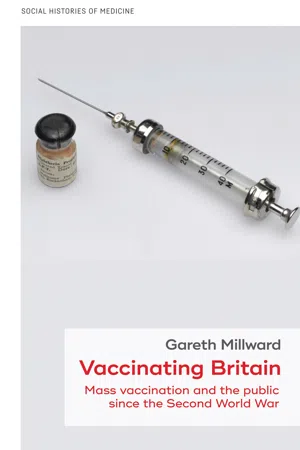
This book is available as an open access ebook under a CC-BY-NC-ND licence. Vaccinating Britain shows how the British public has played a central role in the development of vaccination policy since the Second World War. It explores the relationship between the public and public health through five key vaccines – diphtheria, smallpox, poliomyelitis, whooping cough and measles-mumps-rubella (MMR). It reveals that while the British public has embraced vaccination as a safe, effective and cost-efficient form of preventative medicine, demand for vaccination and trust in the authorities that provide it has ebbed and flowed according to historical circumstances. It is the first book to offer a long-term perspective on vaccination across different vaccine types. This history provides context for students and researchers interested in present-day controversies surrounding public health immunisation programmes. Historians of the post-war British welfare state will find valuable insight into changing public attitudes towards institutions of government and vice versa.
eBook - ePub
Vaccinating Britain
Mass vaccination and the public since the Second World War
- 296 pages
- English
- ePUB (mobile friendly)
- Available on iOS & Android
eBook - ePub
About this book
Information
The development and evolution of the vaccination programme
1
Diphtheria
In 1940, diphtheria became the first vaccine of the bacteriological age to be offered free to British children on a national scale. It achieved impressive results in its first years, reducing the case load from over 46,000 in 1940 to just 962 in 1950, and deaths from 2,480 to 49.1 Medical authorities celebrated this success, but were mindful of the paradox they had created. With diphtheria no longer a common disease, would parents stop immunising their children? And if they did, would a disease that should be eliminated make a deadly return?
These fears appeared to be realised in 1950. After solid progress in immunisation of the child population throughout the 1940s, there was a sudden decline in the number of children being presented for immunisation. While a number of causes were investigated, the main culprit, in the eyes of the Ministry of Health, was apathy. A publicity campaign began and was maintained throughout the 1950s, coordinated through the Ministry of Health and Central Office of Information (COI) and supported through direct interactions with the public by local medical authorities.
This chapter discusses how “apathy” acted as an explanatory model and call to action for health authorities seeking to improve uptake of immunisation services among the population. It played a key role in constructing the public in the minds of policy makers, built out of long-standing paternalistic attitudes towards the working classes, particularly mothers. The Ministry considered apathy a problem because it threatened the successes achieved by public health policy up to this point. Immunisation had reduced the burden of diphtheria on the health services and, it was hoped, could eventually eliminate the disease entirely. The risk was that this apparent progress might stall – or, worse, the disease would return to higher levels. By defining apathy as low uptake of immunisation, the problem could be identified and quantified. In turn, apathy tells us how these authorities viewed the public and their relationship with them. The Ministry of Health focused on encouraging individuals to immunise their children in order to minimise the risk of diphtheria's return. Its campaign ran on the basis that parents no longer feared diphtheria and therefore were unmotivated to present their children for immunisation. Nevertheless, authorities also understood that there were many reasons why parents might not vaccinate. At the local level, medical officers worked with the public and responded to their needs. That is to say, the public was not simply lectured to; rather, policy makers consistently monitored the public through various systems of surveillance for signs that could be interpreted. Apathy actively guided policy in ways that often made immunisation more convenient for parents and children. It was a form of communication; a translation of the diffuse behaviours of the public into a language which administrators and policy makers could understand.
Apathy is an amorphous concept. Indeed, the imprecise nature of the term in itself gives us insight into the motivations and thinking behind local and national policy. This chapter therefore attempts not to deconstruct how the concept was experienced by parents in 1950s Britain but, rather, to explore how it was used – often without precision – by various authorities. Apathy was often invoked to explain public behaviour, and attempts were made to combat it. It was a rhetorical device, one without an objective basis, yet still built into the longer history of British public health practice.
This chapter begins by outlining how the national anti-diphtheria programme came into being during the Second World War. It shows how this continued after 1945, and through the formation of the new NHS. In 1950, however, the Ministry of Health became concerned at declining vaccination rates. The reasons for this are explored, in terms both of changing patterns of behaviour and of the ways in which the statistical indicators available to the Ministry allowed it to “see” (or construct) apathy among parents. The chapter then goes on to explain what national and local government did to combat apathy over the course of the 1950s.
Diphtheria immunisation before 1945
If the decline in immunisation rates suggested that the British people had become complacent about diphtheria, this was not always the case. After some initial difficulties, take-up of diphtheria immunisation was high throughout the later war years and into the late 1940s. Diphtheria immunisation developed out of the work in the emerging science of bacteriology at the turn of the twentieth century.2 As Claire Hooker and Alison Bashford have argued, ‘diphtheria is ideally placed for thinking through the historical connections between bacteriology and applied public health precisely because it was so strongly associated with laboratory medicine and the new capacities to understand and therefore control disease’.3 The condition itself was discovered to be caused by a bacterium, Corynebacterium diphtheria, and tended to attack through the larynx and the tonsils. Complications could include heart disease and paralysis, sometimes leading to death. In Britain during the 1930s, before the introduction of immunisation, an average of 58,000 cases were seen each year, with 2,800 deaths.4
However, Britain had not always been so enthusiastic about the procedure. British public health authorities had come to adopt immunisation relatively late, compared to those in other Western nations. Toronto and New York City, for example, had run successful interventions during the inter-war years to significantly reduce morbidity and mortality.5 Despite this, and although some local authorities had used immunisation prior to the Second World War, Britain was rather conservative with regard to new immunisation technologies. The anti-vaccination and anti-vivisection organisations were still relatively powerful in the 1930s, and the experience of resistance to compulsory smallpox vaccination in the nineteenth century still loomed large.6 There was also a widespread belief among medical authorities that the well-established p...
Table of contents
- Cover
- Half-title page
- Series page
- Title page
- Copyright page
- Contents
- Figures and tables
- Acknowledgements
- Abbreviations
- Introduction
- I: The development and evolution of the vaccination programme
- II: Vaccination crises
- Conclusion
- Select bibliography
- Index
Trusted by 375,005 students
Access to over 1.5 million titles for a fair monthly price.
Study more efficiently using our study tools.
Frequently asked questions
Yes, you can cancel anytime from the Subscription tab in your account settings on the Perlego website. Your subscription will stay active until the end of your current billing period. Learn how to cancel your subscription
No, books cannot be downloaded as external files, such as PDFs, for use outside of Perlego. However, you can download books within the Perlego app for offline reading on mobile or tablet. Learn how to download books offline
We are an online textbook subscription service, where you can get access to an entire online library for less than the price of a single book per month. With over 1.5 million books across 990+ topics, we’ve got you covered! Learn about our mission
Look out for the read-aloud symbol on your next book to see if you can listen to it. The read-aloud tool reads text aloud for you, highlighting the text as it is being read. You can pause it, speed it up and slow it down. Learn more about Read Aloud
Yes! You can use the Perlego app on both iOS and Android devices to read anytime, anywhere — even offline. Perfect for commutes or when you’re on the go.
Please note we cannot support devices running on iOS 13 and Android 7 or earlier. Learn more about using the app
Please note we cannot support devices running on iOS 13 and Android 7 or earlier. Learn more about using the app
Yes, you can access Vaccinating Britain by Gareth Millward in PDF and/or ePUB format, as well as other popular books in Social Sciences & Sociology. We have over 1.5 million books available in our catalogue for you to explore.