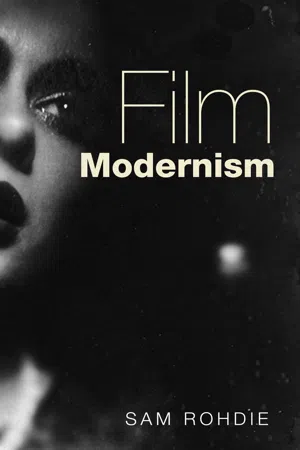
This book is at once a detailed study of a range of individual filmmakers and a study of the modernism in which they are situated. It consists of fifty categories arranged in alphabetical order, among which are allegory, bricolage, classicism, contradiction, desire, destructuring and writing. Each category, though autonomous, interacts, intersects and juxtaposes with the others, entering into a dialogue with them and in so doing creates connections, illuminations, associations and rhymes which may not have arisen in a more conventional framework.
The author refers to particular films and directors that raise questions related to modernism, and, inevitably, thereby to classicism. Jean-Luc Godard's work is at the centre of the book, though it spreads out, evokes and echoes other filmmakers and their work, including the films of Michelangelo Antonioni, Bernardo Bertolucci, John Ford, Howard Hawks, Alfred Hitchcock, João César Monteiro, Pier Paolo Pasolini and Orson Welles. This innovative and eloquently written text book will be an essential resource for all film students.
- 239 pages
- English
- ePUB (mobile friendly)
- Available on iOS & Android
eBook - ePub
Film modernism
About this book
Information
Publisher
Manchester University PressYear
2015Print ISBN
9780719099281
9781784992637
eBook ISBN
9781784996062
Subtopic
Englische LiteraturkritikInvestigations (1)
The credit sequence of Bertolucci’s Strategia del ragno (1970) takes place against brightly coloured, schematic naif images of animals and objects painted by Ligabue. The opening entry into the film is to the make-believe fairyland of the primitive created by the painter. The narrative opens with the arrival of Athos Magnani, the younger, the son of Athos Magnani, the elder, with the same name, at the railway station in the town of Tara. The father is an anti-fascist hero, murdered, so the story goes, by fascists in 1936. Father and son, played in the film by the same actor, Guido Brogi, look exactly alike as their names are alike. The credit sequence sets the tone for a ‘reality’ that, as with the credit sequence, is an entry into the imaginary. Because characters and time are doubled, and literally so, they confound any reality whatsoever.
Tara, the name of the town in the film, is the town of Sabbioneta, a late sixteenth-century northern Italian town near Mantova built by Duke Vespasiano Gonzaga. Much of the action in the film occurs in the town centre, in the Piazza Ducale. Sabbioneta is near Parma where Bertolucci grew up. It is the setting for his Prima della rivoluzione (1964). The Piazza Ducale in Sabbioneta resembles the Palazzo del Comune in Parma. Both are real locations that are like each other, and also like theatre, at once real and fantastic. They resemble the Surrealist landscapes of Giorgio De Chirico and the strange, often erotic juxtapositions of figures, place and objects in the paintings of René Magritte that go to a beyond into an ‘other’ world as in the naïf work of Henri Rousseau and Antonio Ligabue.
Sabbioneta is a Renaissance ‘ideal’ city. The Piazza Ducale was designed to be like a theatre, a setting of spectacle, ceremony, pageants, almost as if was wearing a mask, draped in masquerade. The film migrates in time across centuries, from the sixteenth during the Renaissance when Sabbioneta was built to the twentieth, and the consolidation of Italian fascism, going back and forth in time almost in a single camera movement, in the same gesture or by a cut, less a transition than an overlap, an answering shot which is not a reverse shot but a reply from another time, almost magical when Athos the son becomes Athos the father and the father the son, not unlike the overlap between Giacobbe 1 and Giacobbe 2 in Partner, where one becomes the other.
Becoming the other is everywhere in Bertolucci’s films.
The name Tara for Sabbioneta is the name of a mythical place, the Kingship of Tara in Ireland, and the fictional plantation in the American South of the same name in Gone with the Wind (1939). The Irish connection with Borges’s story is compelling. Historically, there was a Viscount Tara and a Baron Tara. Tara is an ancient Irish title of authority. The real becomes fictional without losing its reality, and reality becomes mythical, where limits between the real and the legendary, past and present, vacillate.
Athos Magnani, the son, comes to Tara at the invitation of Draifa, a former lover of Athos Magnani, the father. Draifa has two ages, when she was young, in love with the father, and now older, possibly in love with the son, the duplicate of his father. Draifa is also the duplicate of herself, the similar sense of a doubled identity as with Athos the elder and Athos the younger. Draifa, like the Magnani, is both. The transition from one state to another, one time to another, one identity to another, is fluid and indefinite, comparatives and analogies moving alongside each other in parallel lines that refuse to be still, as with Tara and Sabbioneta.
Differences are both parallels and vague intersections. The young Draifa is like the older Draifa reliving the past. She seems to offer herself sexually to Athos Magnani, the younger, as if the younger Athos was instead the older and still living.
When Athos, the son, comes to Tara to investigate the life of his father, he discovers that his father was not the hero that the town seems to have believed he was and that it had so honoured with plaques, engravings, speeches, place signs, celebrations, but instead a traitor, the negative of what appeared to be, where the negative is real and the positive an illusion. Like his father, the son chooses to defend the myth of the father as hero as concocted by the father, that is, not the fact, but the fiction, despite what the son discovers to be the truth. The son becomes, in loyalty to his father, a traitor to the truth and to reality. His loyalty to myth is a loyalty to story, more nearly true because poetic and close to Shakespeare. It is not the heroism of the father that the son is loyal to, but the staging of a theatrical death and heroism to deny the realities of suicide and treason. Athos the son, to be true to his father, shares and sustains his father’s falsity, and becomes, as his father had been, false in order to be true, the sense of his father’s staging of the entire masquerade of heroism and history. Athos Magnani the son, recreates himself in the image of his father.
It seems that not only are the companions of the father aware of the truth because they shared in the arranging of his death but so too is the entire town of Tara aware of it, and everyone therefore, like the father, is acting out a role that had already been ‘written’ by the father and that included a role for his son and his return to Tara in order to sustain the father’s myth of himself, a myth he had concocted, and that the whole of Sabbioneta would (falsely) confirm as true. What is at stake and what is ‘saved’ is fiction.
Tara does not become theatre, but is theatre from the beginning as are the stories of father and son. All know the truth, yet all are loyal to the legend. The town is a theatrical set and a stage, and the people of the town are actors, defending not the truth but a script.
When the son, at the close of the film, goes to the railway station to finally leave Tara, the railway tracks are covered over with grass as if they had not functioned for some time. There is no train. Perhaps the son had never arrived in Tara, and Tara is truly mythical, and so too perhaps is Athos Magnani, the father, with no more an existence than Brigadoon in the Minnelli film or the ‘Histories’ staged by Shakespeare.
Bertolucci’s camera is constantly in movement in shot sequence pans, tracking shots and zooms, as if his camera is in search of something, an inquest into a truth, a place to rest, an explanation and clarification. The movements, however, rather than elucidating what is sought, cause the already obscure, feigned, enigmatic, labyrinthine to become still more obscure and to the very end and beyond the end, the film by its movement, its seeking and restlessness, moving in opposite directions at once, towards something and away from it, or in a circle arriving at the end at the beginning, turning back on itself, trying to grasp what is already past and has been lost.
Nothing is more puzzling and opaque than the fixed, definitive, solid, the ostensibly clear. The decisive is often no more than what things appear to be, but seldom are, like Draifa’s charming pretty young servant girl, who is a boy.
Investigations (2)
One of the loveliest yet seemingly inconsequential scenes in Antonioni’s La notte (1961) is Lidia’s walk from the centre of Milan to its periphery after she leaves the launch party for Giovanni’s new book. During that party, as well as at the later party at the Gherardinis’, and perhaps in most of the scenes with her, for example, at the nightclub, in the hospital, even at home dressing and in the bath, there is the same sense as during her walk of Lidia observing what occurs and what catches her attention of what people do, how they react, however banal or seemingly unimportant the action: a car park attendant eating a sandwich, two workers giggling, snippets of conversation, a band playing, Giovanni’s sadness, the illness of a friend. Lidia seems to have no apparent reaction to these events beyond momentarily attending to them. She seems both intent and removed, not exactly indifferent, but blank. In any case, it is difficult to find the significance of these events, in part because her reactions are unclear and because there is no mechanism to underline her view (the lack of reverse shots), in part because the events seem to have no dramatic or narrative function. They lead nowhere and are without apparent importance for the narrative and its progression.
The insignificance, the lack of drama, the blankness is not only an attitude of Lidia’s but an attitude of the film, as if it too is strolling without giving anything encountered particular importance, at least not in advance of the encounter. Yet, if you think about it, the lack of emphasis gives these small events solidity, concreteness and a presence that is exceedingly rare.
In traditional films, nothing occurs that is not part of the logic of events and a narrative dramatic progress. Each occurrence is a link to another and yet another still from the moment the film begins until the events conclude as if running their appointed course. There are two evident consequences of these procedures. The first is that however immediate and compelling traditional narratives may be, because of their directional, progressive nature they belong to the past. What you see is the telling of a story that has already occurred. It represents what has been and not what is. The film is not finding a story as it proceeds but telling a story that has already proceeded. La notte works differently – nothing is given in advance of its occurrence and certainly not a preordained significance. It is as if the film is finding itself in the course of its becoming. Because there is nothing that pre-exists the film there is nothing for the film to re-present. It is instead creating new realities as it moves along free from the demands of a narrative, of representation and above all of the obligation ‘to signify’.
The second consequence in the traditional film is that each of its events, however grand, like a battle, a murder, an accident, or however infinitesimal, like a glance, a fiddling with an object, mixing a drink, lighting a cigarette, say in a film by Hawks, has significance narratively. Thus no event is there for itself but instead for something else to which it adheres. It is that adherence that lends it significance and meaning and is part of a narrative economy in which everything ‘tells’ and is clearly functional. Precisely because nothing tells in that way in La notte, it is the insignificance, the unrelatedness of things, the lack of evident function that gives things a presence and uniqueness and gives the film its freedom. They are simply ‘there’ – the rockets set off in the field in Breda, the pattern of light and water on the windscreen of the car taking Lidia and Roberto to nowhere in particular.
There is a lyrical, beautiful quality to La notte that can be felt and experienced but is difficult to specify. As Lidia, and with her the film, move from one thing to another during Lidia’s walk after the book launch party, and in which none of the things encountered are in themselves important or of consequence and yet concretely present in part for their lack of consequence, the going between things and between events at once emphasises their separation and individuality and hence the gap (of significance, of temporality) between them as if they belong to a real space, but not to an imaginary progressive time and narrative, while other connectives of a different order are made possible. Rhythm is not quite the right word for it, but, if the objects are not connected, the images as a flow and fluidity and duration of intensities are connected, as if the concreteness of objects and gestures is left behind as they dissolve into the concreteness of the images of them.
It is a curious transformation of the solidity of things into the fragility of images, almost at the borders of abstraction like the paintings of Giorgio Morandi and the sculptures of Alberto Giacometti. Hence things in the film assume a quality that is both abstract and impermanent not despite, but because of their concreteness. The dissolution of connections, of relations, of place, of emotions that establish the possibility of each element to be itself and to be equally ‘there’ enables the film to engage in a perpetual transformation of the things it represents and of the film itself. If nothing is fixed, nothing made permanent, nothing irretrievably connected, joined, made to function and signify, then any number of new relations become possible and the film and the lives within its fiction are opened up and liberated. The price of that liberation for the characters is the dissolution of relations, the realisation of separateness, seeing the gap, perceiving the banalities and emptiness; the price of that liberation for the film is the breaking of representational and narrative ties whose yield is the possibility for images to freely relate, as occurs in Lidia’s walk where a sandwich becomes laughter and laughter a pussy cat and a pussy cat a baby crying and then there are rockets in a field and ruins of a relation. What is so absorbing is the way each of these images of things seems to call to the others, rhythmically combining and then passing on, dissolving into something else, not for any direct function or clear purpose except for the beat and cadence of these new and surprising connections, of new realities.
Language
The Fascist party came to power in Italy in 1922. It remained in power until the middle of 1943 when Italy was invaded by a joint American and British force that landed in Sicily from North Africa and progressed from there, across the straits of Messina, to the Italian mainland. Effectively, fascist power came to an end in September 1943 as the Allies fought their way north first to Naples, then to Rome and then, in 1944, ‘liberated’ the whole of Italy from both Italian fascist rule and the Italians’ allies the Germans who had become, with the surrender of the Italians in 1943, occupiers.
In the 1920s, the Italian film industry was essentially an industry of distributors and exhibitors of foreign films, mostly American. That situation began to change with the coming of sound in 1927 and markedly in 1938, when the Italian government banned the import of foreign films, mostly American, as an economic measure, but also as a political one while at the same time subsidising Italian film production by way of pre-production grants (thus stimulating production to make up for the shortfall in films for exhibition due to import restrictions), the building of a modern studio on the model of Hollywood and production subsidies based on box-office receipts. Until 1938, Italian production was relatively limited to around thirty films a year, but after that date production remarkably increased to nearly 120 films just before the collapse of the fascist government.
Until then, Italians were entertained to primarily American films dubbed into Italian, and after that date to films made on the model of American studio films: adventure films, war films, light romantic comedies, musicals, melodramas. The Italian cinema was a ‘classical’ cinema like the Hollywood cinema it imitated for reasons of economy as much as for fashion. For many, the American cinema was a model for a ‘fascist’ cinema because of its emphasis on action, movement, energy and its avoidance of reflectiveness and of ideas. The ‘new’ Italian cinema, like the American cinema, was primarily a cinema of narrative fictional fantasies. At the same time, a new cinema began to take shape different from the genre-based classical one. It tended to be more realistic in the sense of taking, if not its subject, its atmosphere and milieu from everyday Italian reality: its towns and cities, countryside and people. It first manifested itself in a documentary direction and in films not dissimilar to the dark and social dramas referred to as film noir in America and in France. These films, rather than emphasising romantic make-believe situations in artificial constructed locations, went out into the street, among ordinary people, and what they revealed was a new reality or rather a familiar one but not the one that had been the subjects of the cinema: poverty, social need, misery, distress, corruption, criminality, eroticism, the unhealthy, the underground, the dirty. There was little sunshine to these films.
This new cinema began to have linguistic features more reflective of the realities of Italy than the classical Italian cinema. The picture of Italy that emerged from the Italian cinema in the 1930s was of a unified and essentially contented, endearing people brightly lit. One sign of that unity (and it should not be underestimated) was a uniform Italian speech, the Italian being taught in schools and broadcast on the radio, but not spoken by most Italians. Until relatively recently, Italians spoke the language of their region or even their district as a ‘first’ language rather than ‘Italian’, or they spoke Italian in a pronounced accented regional, localised speech. The reality of Italian regionalism (cultural, linguistic, economic, social) contrasted with an image of unity and populist conformity that Italian fascism helped to promote (schools, radio, government) and certainly sought to project (in the cinema, in the press, in magazines).
A cinema that began to be concerned with Italian realities, as opposed to the artificiality of screen representations as they had been, necessarily concerned itself with Italy’s linguistic and regional realities. What is notable about Italian films of this kind made after 1943 (for example, Visconti’s Ossessione (1943), Rossellini’s ‘fascist’ war trilogy, De Sica’s I bambini ci guardano (1944), De Santis’s Riso amaro (1949)) is their linguistic diversity in which characters either speak with noticeable regional accents (albeit in ‘Italian’) or speak in dialect (for example, the fishermen of Aci Trezza in La terra trema (1948) speaking a sub-dialect of Sicilian).
What the linguistic diversity of Italy revealed is contradictory: on the one hand the reality of a plurality of languages identified with regions and with class (dialect as the language of the Sicilian poor and the dispossessed in La terra trema and in the earlier films of Pasolini, in the Neapolitan sequence in Rossellini’s Paisà) whereas ‘Italian’ is a language of the educated and the relatively comfortable, belonging to bourgeois culture and the bourgeois State (the language of the bureaucracy, of the police, of the Church, of intellectuals, of the media). The reality of Italy was a reality of disunity set against an ideal ‘f...
Table of contents
- Cover
- Half Title
- Title Page
- Copyright
- Contents
- Foreword by Geoffrey Nowell-Smith
- Acknowledgements
- Introduction
- Allegory
- Ambulation
- Archive
- Arrangements
- Authorship
- Bodies
- Bricolage
- Characters
- Classicism
- Colour
- Contradiction
- Desire
- Destructuring
- Drama
- Duplication
- Elsewhere
- Film noir
- Frames
- History
- Images
- Immediacy
- Inertia
- Insufficiency
- Investigations (1)
- Investigations (2)
- Language
- Levels
- Masquerade
- Melodrama
- Minimalism
- Mise en scène
- Modernity
- Montage (1)
- Montage (2)
- Museum
- Myth
- Narrative
- Networks
- Nowhere
- Pop
- Portraiture
- Randomness
- Realism (1)
- Realism (2)
- Realities
- Reproduction
- Returns
- Theatre
- Time
- Truth
- Vertigo
- Voyages (1)
- Voyages (2)
- Writing
- Bibliography
- Filmography
Trusted by 375,005 students
Access to over 1.5 million titles for a fair monthly price.
Study more efficiently using our study tools.
Frequently asked questions
Yes, you can cancel anytime from the Subscription tab in your account settings on the Perlego website. Your subscription will stay active until the end of your current billing period. Learn how to cancel your subscription
No, books cannot be downloaded as external files, such as PDFs, for use outside of Perlego. However, you can download books within the Perlego app for offline reading on mobile or tablet. Learn how to download books offline
Perlego offers two plans: Essential and Complete
- Essential is ideal for learners and professionals who enjoy exploring a wide range of subjects. Access the Essential Library with 800,000+ trusted titles and best-sellers across business, personal growth, and the humanities. Includes unlimited reading time and Standard Read Aloud voice.
- Complete: Perfect for advanced learners and researchers needing full, unrestricted access. Unlock 1.5M+ books across hundreds of subjects, including academic and specialized titles. The Complete Plan also includes advanced features like Premium Read Aloud and Research Assistant.
We are an online textbook subscription service, where you can get access to an entire online library for less than the price of a single book per month. With over 1.5 million books across 990+ topics, we’ve got you covered! Learn about our mission
Look out for the read-aloud symbol on your next book to see if you can listen to it. The read-aloud tool reads text aloud for you, highlighting the text as it is being read. You can pause it, speed it up and slow it down. Learn more about Read Aloud
Yes! You can use the Perlego app on both iOS and Android devices to read anytime, anywhere — even offline. Perfect for commutes or when you’re on the go.
Please note we cannot support devices running on iOS 13 and Android 7 or earlier. Learn more about using the app
Please note we cannot support devices running on iOS 13 and Android 7 or earlier. Learn more about using the app
Yes, you can access Film modernism by Sam Rohdie in PDF and/or ePUB format, as well as other popular books in Medien & darstellende Kunst & Englische Literaturkritik. We have over 1.5 million books available in our catalogue for you to explore.