eBook - ePub
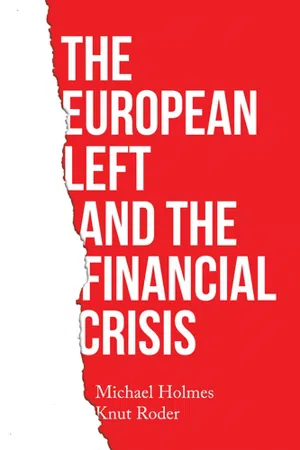
The European left and the financial crisis
- 240 pages
- English
- ePUB (mobile friendly)
- Available on iOS & Android
eBook - ePub
The European left and the financial crisis
About this book
The global financial crisis of 2007–8 did not offer the political and economic opportunities to the left that many thought it would. As financial institutions collapsed, traditional left-wing issues were apparently back on the agenda. However, instead of being a trigger for a resurgence of the left, in many European countries left-wing parties have suffered savage electoral defeat. At the same time, the crisis has led to austerity programmes being implemented across Europe. This book brings together essays that consider ten EU member states, including all bail-out recipients and some of the main 'donor' states, in an examination of this crucial period for the left in Europe from a number of perspectives. Comparisons are presented between the various EU member states, as well as different party families of the left, from social democracy through green left to radical left.
Information
Publisher
Manchester University PressYear
2019Print ISBN
9781526163691
9781526124289
eBook ISBN
9781526124302
1
The European left and the crisis: opportunity or catastrophe?
Introduction
This book examines how the European left reacted to the economic crisis triggered by the banking collapses of 2008. For some, the crisis was an opportunity for a triumphant comeback for left-wing ideas and policies and for the left to regain the political initiative. The German Social Democrats talked about the crisis being ‘a new starting point for more democracy and a new common ground’ (SPD, 2009: 5), and there were assertions that ‘the crisis in Europe can be a chance for social democracy to rediscover itself’ (Martell, 2013: 33). The crisis was interpreted as a failure of the neoliberal model. As SPD (Sozialdemokratische Partei Deutschlands, or Social Democratic Party of Germany) leader Sigmar Gabriel put it, ‘we, the Social Democrats, are convinced that capitalism needs to be tamed a second time’ (2011).
But the record of the ten years since the start of the crisis suggests that instead of creating an opportunity for a comeback, left-wing parties have suffered a series of catastrophic electoral defeats across Europe. In 2017 alone, social democratic parties suffered historic losses in a succession of elections. In the Netherlands, the Dutch PvdA was ‘hammered by its supporters’ (Graham, 2017) as it endured by far its worst-ever result. In Germany, SPD leader Martin Schulz admitted to ‘a difficult and bitter day for social democrats in Germany’ (BBC, 2017) as the party recorded its worst post-war result. In France, a commentator could ask ‘is France's Socialist Party dead?’ after its candidate fell to fifth in the presidential election (Schofield, 2017).
This book examines this crucial period for the left in Europe. It presents a comparative analysis across two dimensions. The first is between ten EU member states during the economic crisis, including bailout countries and what could be termed ‘creditor’ countries. The second dimension compares the different party families of the left, from social democracy through green left to the radical left. Even allowing for the fact that not every member state has a party system in which all these varieties of the left are present, it still leaves quite some range to consider. Rather than try to prescribe a rigid approach for every chapter, the book presents three loose over-arching questions.
First, it explores how the left-wing political parties in each country responded to the crisis both programmatically and politically. Each of our case study contributions outlines the left in their country, with the focus being primarily on parties that are present in parliament. However, one of the features of the crisis was the important role of extra-parliamentary actors and movements, so the contributors were free to broaden their analysis where appropriate. The chapters evaluate how the left has dealt w...
Table of contents
- Cover
- Half-title page
- Title page
- Copyright page
- Contents
- Figures and tables
- Notes on contributors
- Glossary and abbreviations
- 1 The European left and the crisis: opportunity or catastrophe?
- 2 The Greek left and the crisis: the demise of PASOK and the rise of SYRIZA
- 3 The changing nature of the Spanish left: an uncertain balance
- 4 Geringonça: the Portuguese left approach to the crisis
- 5 ‘Frankfurt’s way or Labour’s way’: the Irish left and the crisis
- 6 The Cypriot left and the crisis: one step forward, two steps back
- 7 The Italian left and the crisis: the case of Matteo Renzi’s Partito Democratico
- 8 The financial crisis and the curse of Latvian left parties
- 9 Navigating through troubled times: the left and the euro crisis in Finland
- 10 Take a walk on the left side: the impact of austerity politics in France
- 11 In the shadow of Merkel: the German left and the crisis
- 12 Between Scylla and Charybdis: Europe, nationalism and left politics
- 13 Alter-Europeanism? The left and European integration after the crisis
- Index
Trusted by 375,005 students
Access to over 1.5 million titles for a fair monthly price.
Study more efficiently using our study tools.
Frequently asked questions
Yes, you can cancel anytime from the Subscription tab in your account settings on the Perlego website. Your subscription will stay active until the end of your current billing period. Learn how to cancel your subscription
No, books cannot be downloaded as external files, such as PDFs, for use outside of Perlego. However, you can download books within the Perlego app for offline reading on mobile or tablet. Learn how to download books offline
Perlego offers two plans: Essential and Complete
- Essential is ideal for learners and professionals who enjoy exploring a wide range of subjects. Access the Essential Library with 800,000+ trusted titles and best-sellers across business, personal growth, and the humanities. Includes unlimited reading time and Standard Read Aloud voice.
- Complete: Perfect for advanced learners and researchers needing full, unrestricted access. Unlock 1.5M+ books across hundreds of subjects, including academic and specialized titles. The Complete Plan also includes advanced features like Premium Read Aloud and Research Assistant.
We are an online textbook subscription service, where you can get access to an entire online library for less than the price of a single book per month. With over 1.5 million books across 990+ topics, we’ve got you covered! Learn about our mission
Look out for the read-aloud symbol on your next book to see if you can listen to it. The read-aloud tool reads text aloud for you, highlighting the text as it is being read. You can pause it, speed it up and slow it down. Learn more about Read Aloud
Yes! You can use the Perlego app on both iOS and Android devices to read anytime, anywhere — even offline. Perfect for commutes or when you’re on the go.
Please note we cannot support devices running on iOS 13 and Android 7 or earlier. Learn more about using the app
Please note we cannot support devices running on iOS 13 and Android 7 or earlier. Learn more about using the app
Yes, you can access The European left and the financial crisis by Michael Holmes,Knut Roder, Michael Holmes, Knut Roder in PDF and/or ePUB format, as well as other popular books in Politics & International Relations & Economic Policy. We have over 1.5 million books available in our catalogue for you to explore.