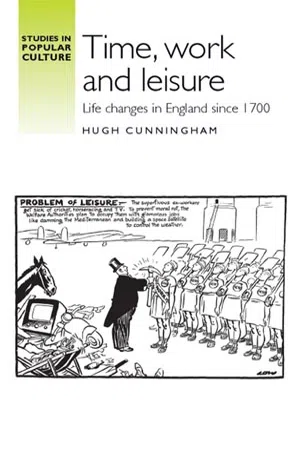
This book traces the history of the relationship between work and leisure, from the 'leisure preference' of male workers in the eighteenth century, through the increase in working hours in the later eighteenth and early nineteenth centuries, to their progressive decline from 1830 to 1970. It examines how trade union action was critical in achieving the decline; how class structured the experience of leisure; how male identity was shaped by both work and leisure; how, in a society that placed high value on work, a 'leisured class' was nevertheless at the apex of political and social power – until it became thought of as 'the idle rich'. Coinciding with the decline in working hours, two further tranches of time were marked out as properly without work: childhood and retirement.
Accessible, wide-ranging and occasionally polemical, this book provides the first history of how we have imagined and used time.
- 225 pages
- English
- ePUB (mobile friendly)
- Available on iOS & Android
eBook - ePub
About this book
Information
Publisher
Manchester University PressYear
2016Print ISBN
9781784993559
9780719085208
eBook ISBN
9781526112286
1
Introduction
This book is about time past; but it is written out of a concern about time present and time future. The use of and attitude to time have changed radically since the 1970s. It was a commonplace of the 1960s and early 1970s that leisure time was going increasingly to eat into work time: robots would do the repetitive work, and most people would have much more free time at their disposal. An increase of leisure as against work can be traced back to the 1830s, and few people saw reason to doubt that the trend would continue and intensify. The concern about time in the 1970s lay in ‘the problem of leisure’, a worry that people wouldn’t know what to do in their leisure time, or would misspend it. Now that worry seems somewhat fantastical; work has come to preoccupy us. Many people now work longer hours; some make themselves available for work 24/7, a term that would have made no sense in the 1970s. We increasingly talk about ‘work–life balance’ rather than ‘work and leisure’.
I first became interested in time in the 1970s and 1980s. There was then a considerable scholarly output on the history of leisure.1 Looking back on that body of publications, and leaving aside its considerable merits, three inadequacies now strike me. First, it was focused very largely on the experience of men to the neglect of that of women. Second, it concentrated on the eighteenth and nineteenth centuries, often petering out round about the time of the First World War or before. And third, it was about leisure, rather than time use more broadly, because of the assumption, so prominent then, that leisure time was on the increase. In returning to the topic after thirty years I have drawn extensively on that earlier work, including my own, but have brought to it a wider perspective. There is now a substantial literature addressing the three inadequacies, and that has informed this rethinking.
When I began to look at what has been written about work–life balance (and there is a lot of it, few topics in the social sciences being more generously funded), I was struck by five characteristics. First, its sense of the possibilities of time was extraordinarily narrow: time was either paid work, or it was life, which sounded good, but in the literature consisted of unpaid work raising a family. Second, it implicitly devalued ‘work’, reducing it to something that had to be done in order to fund ‘life’: who would not prefer ‘life’ to ‘work’? Third, it was addressed, initially exclusively and still dominantly, to women. The ‘work and leisure’ discourse which ‘work–life balance’ replaced had been almost exclusively about men. Fourth, it was by no means comprehensive in its life course coverage. Its focus was on parents at the stage in their life course when they had young children. It took no account of the changes in the experience of time that have affected childhood, now prolonged beyond what anyone could have imagined in 1700, or of retirement which with increasing life expectancy occupies a much larger tranche of life than in previous generations. Fifth, no one writing about work–life balance seemed to have any sense of a past before about 1990. Scholars in the field were trapped into a way of thinking about time that assumed that both the present and to a large extent the future were determined and unalterable. The solutions offered to the problems people faced in trying to balance their work and their life focused on personal choice: be more organised, negotiate flexible hours at work and so on.
This book begins in 1700 in order to provide a longer perspective on current work–life balance discussions. In the late seventeenth and for most of the eighteenth centuries commentators were much concerned with what has come to be called the ‘leisure preference’ of workers. Men, it was complained, (the discourse was entirely about men) worked only as long as was needed to secure an adequate income – they might take three or four days off each week. There is much debate among historians as to the prevalence if not existence of leisure preference forms of behaviour (it was certainly not universal) but, whatever the conclusion, no one can doubt the volume of contemporary concern. Employers wanted a regular workforce. This was what they came near to securing in the harsher economic conditions of the later eighteenth and early nineteenth centuries when hours of work increased by a considerable margin. The fight-back against these long hours began with trade union agitation in the 1820s, and over the next one hundred and fifty years, largely owing to trade union pressure, the hours that were worked diminished by day, by week and by year.
Trade union action had been accompanied by wider public anxiety about the work that children were doing. Legislation in the form of factory acts and education acts, together with decisions by parents about the relative advantages of work or school, established a new pattern of life – children were, not entirely but to a considerable extent, taken out of the workforce. Childhood became a time for not working, or at least not working for wages – children now did schoolwork. At the other end of the life course, in the late nineteenth century people began to campaign for a period of ‘retirement’. State-funded old age pensions were introduced in 1908, but were set at such an inadequate level that in themselves they didn’t stop people working. Only after the Second World War did retirement become a reality for most workers.
By the 1970s the invention of a non-working childhood at one end of life and of retirement at the other had reshaped the life course. Work was now concentrated in the years between childhood and retirement, and the hours spent at work had diminished and seemed likely to continue to do so. This situation had been achieved by a combination of trade union activity, more widespread public pressure and legislation. Capitalism had been brought under control. In the 1980s and subsequently those controls were lifted.
From the 1950s married women increasingly entered the labour market. Women had been remarkably absent from discussions about work and leisure in the nineteenth and first half of the twentieth centuries. In the upper classes the ability of a husband to earn enough to keep his wife at home, outside the paid workforce, was a mark of status. The majority of women, by contrast, sought waged work wherever they could find it and laboured endlessly, unpaid, to maintain households – if asked, they often found it difficult to think of any leisure that they had. In the second half of the twentieth century as household tasks become less arduous they increasingly sought paid work, usually part-time and badly paid. In the nineteenth century there were strong pressures to prevent women from taking paid work so that they could concentrate on their central home-keeping tasks; in the twenty-first century the opposite happens: women, including mothers of young children, are pressured into the labour market.
The combination of the lifting of controls on capitalism and the entry of more women into the labour market has produced the current situation where time pressures are acute – at least for those who are in work. For it is a feature of the period since the 1970s that long hours of work for some have sat alongside unemployment, underemployment or retirement for others. For some time is scarce, for others plentiful.
Work not only takes up time. It also gives many people their sense of identity. If we ask someone ‘What do you do?’ we expect the answer to be ‘I’m an engineer’, ‘I’m a gardener’, ‘I’m a housewife’ and so on. Work also often influences time spent not working, especially leisure, that residue of time left over after work, sleep and other obligations have been met. But leisure can equally be free of work associations. Historically leisure has been closely linked to class. The word first began to be used by the upper classes in the early modern period to describe the time they spent amusing themselves and the activities they engaged in.2 In the eighteenth century the middling sorts began to develop a calendar of leisure and specific places, such as spas, in which to spend it. By the mid-nineteenth century people began to write about ‘the leisured class’, people of wealth who had no need to work though they often felt a sense of obligation to carry out public duties. In a society that placed huge value on work, those at the top of the status ladder proclaimed their leisure. The incentive to work for the wealthy seemed to be the hope of achieving the status of not needing to work.
There was much debate in the eighteenth and early nineteenth centuries as to whether the common people should have any leisure. Leisure for the upper classes was idleness for the lower. There were innumerable attempts to control the ways in which non-work time was spent which sparked a counter movement to provide time and space and facilities for working-class leisure. But leisure was often presented as a ‘problem’, entrepreneurs offering attractions that many commentators found anything but life-enhancing.
The book opens by examining the variety of ways in which time was imagined and experienced in the eighteenth century and the changes that happened within that century. Chapter 2 analyses the prevalence and attractions of leisure preference and the increasing difficulties of exercising it in the late eighteenth and early nineteenth centuries as hours of work rose. Chapter 3 focuses on the attempts to control and shape working-class leisure in the face of entrepreneurs who began to sense a mass market for popular leisure. Chapter 4 traces the long decline in the amount of life devoted to work between 1830 and 1970. Chapter 5 looks at how working-class men experienced work and leisure and the weight each had in shaping their sense of their own identity. Chapter 6 analyses the leisure class, its members from the late nineteenth century all too likely to be described as the ‘idle rich’. Co-existing with this, a much-feared speeding up of life for the middle classes led to calls for ‘a gospel of recreation’: time for leisure was in competition with the demands of work. Chapter 7 looks at the emergence of work–life balance discourse against the background of married women’s entry into the labour force and the end of the long decline in working hours.
Time – how it has been imagined and how it has been spent – is the unifying theme of the book. Few words have gathered around themselves so many associations as time. We pass it, we spend it; we find it and lose it; it flies, or hangs heavy, or we while it away. Time, we know, is money, and many of the words used to describe it would do for money as well. Time is divided up into seconds, minutes, hours, days, weeks, months, years, decades (a recent innovation), lifetimes, centuries, ‘time immemorial’. Everyone is at some level aware, as Isaac Watts put it in 1719 reflecting on Psalm 90, that ‘Time, like an over-rolling stream, bears all its sons away’, that death at some time awaits us. But time can be not only linear, pointing forwards, but also cyclical: it repeats itself, in days and nights, in the seasons of the year, in menstruation.3
Time cannot be understood on its own. Its closest relationship is to space, for time is necessarily passed somewhere, in bed, at work, at home, in the pub and so on. The politics of time, particularly time for leisure, intermesh with those of space, for somewhere to spend it. Time is also bound up with class and the power relationships that go with it for the legitimacy of ways of spending time has never been free of legal, governmental and cultural constraints. Christianity, starting from the premise that time is a gift from God, has historically had a huge impact on how it has been spent and imagined. Perhaps most obviously, time and economic life are closely related. Economists picture individuals and families making decisions about time, trading leisure, income and consumption.4
Thinking about time in these ways and in historical perspective carries one basic message: times change. The future is unlikely to be as we imagine it, and the present need not be as we experience it.
Notes
1 Major works were R. W. Malcolmson, Popular Recreations in English Society 1700–1850 (Cambridge: Cambridge University Press, 1973); J. H. Plumb, The Commercialisation of Leisure in Eighteenth-Century England (Reading: Reading University, 1973); J. Lowerson and J. Myerscough, Time to Spare in Victorian England (Brighton: Harvester Press, 1977); P. Bailey, Leisure and Class in Victorian Britain: Rational Recreation and the Contest for Control, 1830–1885 (London: Routledge and Kegan Paul, 1978); J. Walvin, Leisure and Society, 1830–1950 (London: Longman, 1978); H. Cunningham, Leisure in the Industrial Revolution c. 1780–c. 1880 (London: Croom Helm, 1980); E. and S. Yeo (eds), Popular Culture and Class Conflict, 1590–1914: Explorations in the History of Labour and Leisure (Brighton: Harvester Press, 1981); R. Storch (ed.), Popular Culture and Custom in Nineteenth-Century Britain (London: Croom Helm, 1982); J. K. Walton and J. Walvin (eds), Leisure in Britain 1780–1939 (Manchester: Manchester University Press, 1983); J. M. Golby and A. W. Purdue, The Civilisation of the Crowd: Popular Culture in England, ...
Table of contents
- Cover
- Half Title
- Series
- Title Page
- Copyright
- Studies in Popular Culture
- Contents
- General editor’s introduction
- Acknowledgements
- 1 Introduction
- 2 Time and society in the eighteenth century
- 3 Leisure preference and its critics, 1700–1850
- 4 Leisure and class, 1750–1850
- 5 Work time in decline, 1830–1970
- 6 Men, work and leisure, 1850–1970
- 7 The leisured class, 1840–1970
- 8 Towards ‘work–life balance’
- 9 Conclusion
- Select bibliography
- Index
Trusted by 375,005 students
Access to over 1.5 million titles for a fair monthly price.
Study more efficiently using our study tools.
Frequently asked questions
Yes, you can cancel anytime from the Subscription tab in your account settings on the Perlego website. Your subscription will stay active until the end of your current billing period. Learn how to cancel your subscription
No, books cannot be downloaded as external files, such as PDFs, for use outside of Perlego. However, you can download books within the Perlego app for offline reading on mobile or tablet. Learn how to download books offline
Perlego offers two plans: Essential and Complete
- Essential is ideal for learners and professionals who enjoy exploring a wide range of subjects. Access the Essential Library with 800,000+ trusted titles and best-sellers across business, personal growth, and the humanities. Includes unlimited reading time and Standard Read Aloud voice.
- Complete: Perfect for advanced learners and researchers needing full, unrestricted access. Unlock 1.5M+ books across hundreds of subjects, including academic and specialized titles. The Complete Plan also includes advanced features like Premium Read Aloud and Research Assistant.
We are an online textbook subscription service, where you can get access to an entire online library for less than the price of a single book per month. With over 1.5 million books across 990+ topics, we’ve got you covered! Learn about our mission
Look out for the read-aloud symbol on your next book to see if you can listen to it. The read-aloud tool reads text aloud for you, highlighting the text as it is being read. You can pause it, speed it up and slow it down. Learn more about Read Aloud
Yes! You can use the Perlego app on both iOS and Android devices to read anytime, anywhere — even offline. Perfect for commutes or when you’re on the go.
Please note we cannot support devices running on iOS 13 and Android 7 or earlier. Learn more about using the app
Please note we cannot support devices running on iOS 13 and Android 7 or earlier. Learn more about using the app
Yes, you can access Time, work and leisure by Hugh Cunningham in PDF and/or ePUB format, as well as other popular books in History & Labour Economics. We have over 1.5 million books available in our catalogue for you to explore.