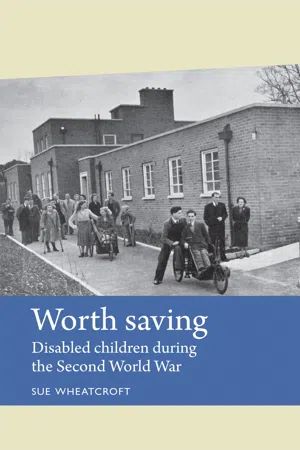
Early in the war, when faced with an acute shortage of accommodation for evacuees, a government official questioned whether disabled children were 'worth saving'. This book examines how the evacuation in England was planned, executed and evaluated for children with various disabilities (including the 'excluded') and explores how this wartime experience influenced public and professional attitudes towards the children long after the war had ended.
Through the use of official documents, newspapers and personal testimony, the book illustrates both positive and negative experiences of the government evacuation scheme, and shows the impact of the attitudes held by the authorities, the general public, and the teaching and nursing staff. It demonstrates how wartime conditions changed special education, both during and after the war, and will appeal to social and medical historians, as well as those studying childhood, the voluntary sector and social policy.
- 203 pages
- English
- ePUB (mobile friendly)
- Available on iOS & Android
eBook - ePub
About this book
Information
Publisher
Manchester University PressYear
2015Print ISBN
9781784991197
9780719088001
eBook ISBN
9781526103369
1
PREWAR DEVELOPMENTS
Special education
By 1939 disabled children had, for the purpose of determining their educational requirements, been divided into five official categories which were used by the evacuation authorities when arranging suitable accommodation in ‘safe’ areas. Before we discuss these evacuation arrangements, a clarification of each group of children should be made, along with a brief history of each category.1 The five groups were:
• Blind
• Deaf
• Physically Defective (PD)
• Epileptic
• Mentally Defective (MD)
The blind and the deaf
Out of these strictly defined groups, it is the blind and the deaf whose history, as far as specific provision is concerned, goes back the furthest. Sources suggest that the first school in Britain to accept a disabled pupil was Thomas Braidwood’s school in Edinburgh, which admitted a deaf boy in 1760.2 In England the first school for deaf children opened in London in 1783, with Braidwood’s nephew as headmaster. The first blind school was established in Liverpool in 1791.3 Like other early institutions for disabled people, these schools were at first merely custodial in nature; they gradually incorporated vocational training, and eventually academic education. Vocational training included crafts such as brush-making, basket-making and chair-caning and, as such provisions were made for blind and deaf children before other disabled children, these occupations have become associated with them.4
In 1885, after extreme pressure from those working primarily with blind and deaf and dumb children, the Egerton Committee was set up.5 This was the first formal attempt by national government to investigate the best way of educating disabled children, and was influential in the passing, in 1893, of the Elementary Education (Blind and Deaf Children) Act. The act made it the duty of school boards (established under the Elementary Education Act, 1870) to provide education for blind and deaf children between the ages of seven and sixteen. They were to be accommodated in schools certified as suitable by the education department and, as a result, day schools and institutions were established and existing ones improved.
Early education, as with health, was provided primarily by a mixture of private and charity organisations, including religious institutions. In 1921 the National Institute for the Blind (NIB) opened a college for private fee-paying blind girls. Although initially intended as an institution of higher education, the Chorleywood College accepted a wide range of ages; in 1923 there were eighteen girls between the ages of six and twenty. The NIB had also been supporting a college for blind boys, Worcester College, since 1917. However, neither college was provided for by the State; higher education was not available for most disabled children until after the Second World War. Before then most voluntary organisations, and the State, were concerned only with elementary-level education.
One aspect of education that was continually debated, for both blind and deaf children, was whether those who were not totally blind or deaf should be segregated from those who were. In 1907 the first separate provision was made for partially sighted (PS) children in London, and the next year saw the first special class for partially deaf children, which opened in Bristol.6 The majority of such children, however, were still being educated either in special schools for blind or deaf children or in ordinary elementary schools. It was not until the 1930s that the government set up two separate committees to investigate the problem.7 The subsequent reports of both committees recommended that partially blind or deaf children should be educated separately, and separate schools were eventually set up. At the outbreak of the Second World War several schools for PS children had been established, but the partially deaf children had to wait until after the war.
By the end of March 1939 there were 45 certified schools for deaf children in England and Wales, accommodating 4,517 pupils; 26 of the schools were day schools (1,848 pupils) and the rest were residential (2,669 pupils).8 With regard to blind and PS children, there were 28 schools in January 1939, including 20 residential (although seven of these admitted both residential and day school children) and eight for day only. All schools combined contained places for 2,250 children.9 The exact number of children requiring such places is unknown, but there was a waiting list in each category.
Physically defective (PD) children
In comparison to children with sensory difficulties, provision for physically disabled children came relatively late. Again, voluntary organisations had been providing for some types of physical disability long before the State. The first school to be opened for orthopaedically disabled children was at Marylebone in 1851.10 The Cripples Home and Industrial School for Girls began as an industrial school and opened with just three girls, one of whom was a cripple. The committee of ladies who had founded the school decided to extend it in order to incorporate more crippled girls and by 1870, the institution catered for 100 girls, 75 of whom were cripples. In 1865 the same committee opened the National Industrial Home for Crippled Boys, in Kensington. The first school to be officially recognised by the Board of Education was a day school for cripples at the Passmore Edwards Settlement in London, which opened in 1899.11 In the same year the first statutory provision for physically disabled children was made, under the Elementary Education (Defective and Epileptic Children) Act. Under the act LEAs were empowered (but not required) to provide training for PD children.
The term ‘physically defective’ covered a wide range of disabilities. In 1899 children attending schools for cripples suffered primarily from TB of the joints and bones, heart disease, congenital physical defects, rickets, severe anaemia and malnutrition.12 Owing to the severe nature of some physical disabilities, however, it was often impossible for a child to attend any kind of school, or even to attend hospital for treatment. In 1888 the Invalid Children’s Aid Association (ICAA) was founded, whose primary aim was to provide visitors to help and advise the seriously disabled children who were confined to the home. At first this help came in the form of voluntary home visitors who took food, bedding and medicine to children and their families, and helped to arrange admission into hospitals and convalescence homes. They also organised holidays, apprenticeships and the loan of spinal carriages and wheelchairs. Eventually, the volunteers were replaced by professional social workers, and ‘homes of recovery’ were set up for the treatment of children with TB and rheumatic heart disease. During the Second World War the association played a vital part in the welfare of disabled children.
In 1919 members of the ICAA and the British Red Cross Society, along with a few notable philanthropists, formed the Central Council for the Care of Cripples, whose aim was to promote a national scheme for the complete provision of treatment and education for PD children throughout the country.13 One of the Council members, the surgeon Sir Robert Jones, had previously been influential in the establishment of the first hospital school for PD children. This was in the West Kirby Convalescent Home for Children and was subsequently certified as a special school in 1901. By 1935 it was acknowledged by the Council that provision for cripples was still seriously inadequate and, with the serious lack of funds, the Council’s future looked uncertain. Then, in December of the same year, the philanthropist Lord Nuffield donated the sum of £125,000.14 The money was held in trust and was used to help disabled children for years to come, including the war years.
Another organisation that was prominent in the early schooling and welfare of disabled children was the Ragged Schools Union (RSU). Primarily set up to help destitute children, the RSU opened special schools for physically disabled children as early as 1917. It pioneered treatment for spina bifida and muscular dystrophy and was influential in the schooling of the more seriously disabled children, taking them out of hospital and into its own residential schools. Throughout the war the organisation, by now called the Shaftesbury Society, after the seventh Earl of Shaftesbury who was so influential in the RSU’s formation, kept open a number of residential special schools.
In 1907 the School Health Service (initially called the School Medical Service) began, and the medical inspection of all children became compulsory. By now rickets, severe anaemia and malnutrition had abated somewhat, although paralysis from poliomyelitis was of major concern. The new health inspectors soon came to realise that some children were suffering through neglect, anxiety, lack of proper nourishment, defective teeth or eyesight or other less apparent disabilities. Sometimes these children would be sent to an ‘open-air’ school for a few weeks until they had recovered or, if they were unable to attend ordinary elementary school regularly, they might become long-term residents.
Originally known as ‘bandstand schools’, the early versions of open-air schools were operated, literally, in the open air. The idea was that these ‘delicate’ children would be less troubled if a certain temperature was maintained, and that the spread of disease was less likely in the open air. These classes also differed from others in that they accommodated a smaller number of pupils, they remained open during ordinary school holidays, they had a midday rest period, up to three meals per day, and regular medical and nursing supervision.15 The first was opened in 1907 at Bostall Wood, Plumstead, and by 1939 there were more than 150 open-air schools in Britain, catering for almost twenty thousand childrens.16
After the First World War, with many soldiers returning with disabilities, there was a renewed interest in disabled people, which had a knock-on effect to disabled children. Despite the weak national economy between the wars, there was an expansion in the scale of school medical provision, and in the development and refinements of new medical techniques. In his annual report for 1930, the Chief Medical Officer, George Newman, reported that between 67 and 90 per cent of crippled children in Leeds, Bath, Staffordshire and Shropshire had been able to return to school or work as a result of orthopaedic treatment provided by the education authorities. Between 1925 and 1938 the number of LEAs providing orthopaedic treatment for crippled children rose from 85 to 270, and the number of school clinics offering specialist orthopaedic services rose from 70 to 382.17 By the end of the 1930s all but one of the LEAs provided school clinics and the average number of clinics in each area had risen to 7.38.
By the time the Second World War began, practically every LEA provided treatment for minor ailments, dental defects and defective vision. Most of the physically disabled children were now being provided with some kind of education, the exception being the more severely disabled who were bedridden or incontinent.18 Home teaching, although provided sporadically before and during the Second World War, would not become widespread until after the war. Another area where services improved during the interwar years was speech therapy. Manchester LEA had started classes for stammerers as early as 1906 but this duty was not imposed upon LEAs until 1944. As a result of the pressure to add this to the list of...
Table of contents
- Cover
- Half Title
- Title Page
- Copyright
- Contents
- List of figures
- List of tables
- Series editors’ foreword
- Preface
- Acknowledgements
- List of abbreviations
- Introduction
- 1 Prewar developments
- 2 Residential special schools during wartime
- 3 Special day schools, hospital schools and the role of charities
- 4 Hostels and institutions
- 5 Postwar change
- Conclusion
- References
- Index
Trusted by 375,005 students
Access to over 1.5 million titles for a fair monthly price.
Study more efficiently using our study tools.
Frequently asked questions
Yes, you can cancel anytime from the Subscription tab in your account settings on the Perlego website. Your subscription will stay active until the end of your current billing period. Learn how to cancel your subscription
No, books cannot be downloaded as external files, such as PDFs, for use outside of Perlego. However, you can download books within the Perlego app for offline reading on mobile or tablet. Learn how to download books offline
Perlego offers two plans: Essential and Complete
- Essential is ideal for learners and professionals who enjoy exploring a wide range of subjects. Access the Essential Library with 800,000+ trusted titles and best-sellers across business, personal growth, and the humanities. Includes unlimited reading time and Standard Read Aloud voice.
- Complete: Perfect for advanced learners and researchers needing full, unrestricted access. Unlock 1.5M+ books across hundreds of subjects, including academic and specialized titles. The Complete Plan also includes advanced features like Premium Read Aloud and Research Assistant.
We are an online textbook subscription service, where you can get access to an entire online library for less than the price of a single book per month. With over 1.5 million books across 990+ topics, we’ve got you covered! Learn about our mission
Look out for the read-aloud symbol on your next book to see if you can listen to it. The read-aloud tool reads text aloud for you, highlighting the text as it is being read. You can pause it, speed it up and slow it down. Learn more about Read Aloud
Yes! You can use the Perlego app on both iOS and Android devices to read anytime, anywhere — even offline. Perfect for commutes or when you’re on the go.
Please note we cannot support devices running on iOS 13 and Android 7 or earlier. Learn more about using the app
Please note we cannot support devices running on iOS 13 and Android 7 or earlier. Learn more about using the app
Yes, you can access Worth saving by Sue Wheatcroft in PDF and/or ePUB format, as well as other popular books in Social Sciences & 20th Century History. We have over 1.5 million books available in our catalogue for you to explore.