Beginning in the 1930s and moving into the post millennium, Newton provides a historical analysis of policies invoked, and practices undertaken as the Service attempted to assist white Britons in understanding the impact of African-Caribbeans, and their assimilation into constructs of Britishness. Management soon approved talks and scientific studies as a means of examining racial tensions, as ITV challenged the discourses of British broadcasting. Soon, BBC2 began broadcasting; and more issues of race appeared on the screens, each reflecting sometimes comedic, somewhat dystopic, often problematic circumstances of integration. In the years that followed however, social tensions such as the Nottingham and Notting Hill riots led to transmissions that included a series of news specials on Britain's Colour Bar, and docudramas such as A Man From the Sun that attempted to frame the immigrant experience for British television audiences, but from the African-Caribbean point of view. Subsequent chapters include an extensive analysis of television programming, along with personal interviews.
Topics include current representations of race, the future of British television, and its impact upon multiethnic audiences. Also detailed are the efforts of black Britons working within the British media as employees of the BBC, writers, producers and actors.
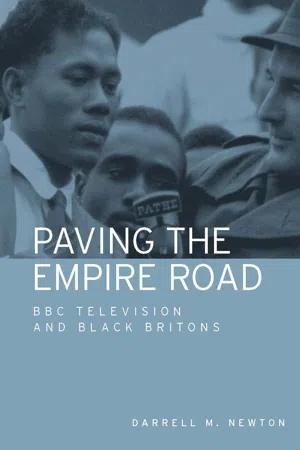
- 267 pages
- English
- ePUB (mobile friendly)
- Available on iOS & Android
eBook - ePub
About this book
Information
Publisher
Manchester University PressYear
2013Print ISBN
9781526143617
9780719081675
eBook ISBN
9781847797674
Subtopic
Modern British History1
Radio, race, and the Television Service
Well one thing I think that will interest West Indians is what is the attitude – of the English people as a whole, – how do they take to strangers. After all West Indians are coming over here in increasing numbers, and they’d like to know what sort of person they’re going to meet, and how they’re going to be treated.
(West Indian humorist and Government Public Relations officer for Jamaica, A.E.T. Henry, on the BBC radio programme We See Britain, 1 June 1949)1
When considering the sentiments of Henry as he spoke to audiences over the BBC’s Caribbean Services, it is likely that this opinion reflected the concerns of many West Indian immigrants at the time. Much like John Elliot’s teleplay A Man from the Sun (BBC, 1956) attempted to highlight the post-war immigration issue from the fictional perspective of actor Errol John’s character Cleve, BBC radio programmes, and the broadcast policies that supported them, occasionally provided actual opportunities for actual perspectives on Britain. Whether guests were students, famed authors, cricketers, or settlers seeking employment, these hopeful citizens, beginning in the 1930s until the reappearance of BBC television after the war, offered their intentions and concerns to radio listeners. This included analyses of social issues such as the colour bar, in a country where one did not supposedly exist.
This chapter examines how BBC radio and its practices created possibilities for the recognition of these African-Caribbean voices, as they discussed life in England years before the Windrush arrival, and just before television re-emerged as a cultural force. It also examines how programmes created for West Indian audiences changed foci, and began to offer varied, personal perspectives on life for African-Caribbean immigrants. Whilst this portion of the study does not seek to research exhaustively the BBC’s influence within the Caribbean, it does attempt to provide a framework for how broadcast policies from radio, and onward to television, engaged the presence of African-Caribbean subjects. West-Indian-themed programmes broadcast from 1941 until 1945 also provided platforms for rallying cries during World War Two, as the empire called out to its colonial peoples to assist in the good fight, and what Webster called the ‘people’s war’. Communities, supposedly bound by duty, helped to reinforce the imperial presence in most intertextual manner, as West Indians Una Marson, Sir Learie Constantine, and Ulric Cross broadcast messages of involvement and commitment over BBC radio and newsreels.2 While race and subsequent social relations were never a principle consideration within these early BBC directives, the mere participation and presence of West Indians and other Colonials made it inevitable.
The Empire Service and West Indies broadcasting
The British Broadcasting Corporation began as a company serving the public with an intention to acculturate audiences on every subject deemed acceptable. By November of 1932, the BBC had over 5,000,000 licence holders and by 1938, 98 per cent of the populace could listen to programmes at their convenience.3 As radio garnered more attention, the public service agenda that was a staple of the BBC’s overall directives emerged as a principle part of its programmes and their production. Sir John Reith believed that radio touched those of every social class as audiences listened in even the most inaccessible and remote regions of the nation.4 It is also apparent that the BBC’s incorporation by royal charter rather than Parliamentary statute still could not mask the high degree of government control. The issuance of a broadcasting licence by the appointment of governors, the amount of the licence fee, the right to veto broadcasts of specific programmes were all issues mandated by the very politicians Reith acknowledged, yet did not like.5 The corporation’s policy with regard to programme structure, founded upon a balanced programme service, hoped to meet the needs of all segments of the public, with reference to minority as well as majority tastes, through broadcasting musical and dramatic repertoire at regular intervals. Furthermore, as suggested by the Beveridge Commission, broadcasting would serve the general social interest, with an educational impulse maintained.6 Issues of censorship and social control were evident, as the government eventually insisted that neither communists nor fascists be given access to BBC wireless or television for their campaigns, and an unofficial news blackout guaranteed that little attention be given to the political programmes of Oswald Mosley’s British Union of Fascists or the right-wing Union Movement.7
The importance of the BBC reached a level of international significance in 1932 when the Corporation began its Empire Service, which, for all purposes, was the early version of the BBC World Service. It was Christmas Day of that year when King George V gave the first royal broadcast to subjects living in the UK and some of its colonies; the message was scripted by Rudyard Kipling, author of ‘The White Man’s Burden’, a poem that directed the British to engage in colonial practices and ethnic subjugation. By the mid-1930s, the BBC reached audiences in Australia, India, South Africa, West Africa, and Canada, with extended foreign-language services beginning in 1938. Within a decade, the BBC Empire Service began broadcasting English language programmes to nearly all of the colonies. Within the British West Indies (BWI), the four most populated islands of Jamaica, Trinidad, Guiana, and the Windward Islands reportedly had 93,000 radio receiver sets according to a report from the United States Information Agency. After considering this data, the organisation determined that these listed radio sets represented a sizable audience of nearly three million citizens, which was worth consideration.8 Efforts toward an expansion of West Indian broadcasts followed discussions in 1936 aimed at supporting a broadcasting service within the colonies. A report filed with the Colonial Office (CO) detailed the feasibility of such an endeavour and its benefits. In a memo to E.B. Bowyer, J.B. Clark, then Director of Empire Service, provided brief biographical notes on those authoring the report, people with whom the BBC had contact regarding broadcasting in the West Indies. Clark mentioned Frank E. Lyons, whom he called ‘distinctly Empire-minded’, as an executive with ‘wireless and newspaper interests’ involved in the promotion of a Jamaica/New York/London telephone service. In addition, Briton Kenneth Skelton ran a commercial radio station in Tampa, Florida and wanted to transfer activities to a British territory, and thus applied for a licence to operate a station in Jamaica. Clark further noted that these men had visited England within the previous three years, inferring a sense of allegiance, if not personal knowledge, to what he referred to as ‘home’.9 In that next year, the group completed an Interim Report on a Committee on Broadcasting Services in the Colonies for the CO.
The report, as filed with Ormsby Gore, MP, who served as Secretary of State for the Colonies, acknowledged that the Empire short-wave service from Daventry had already generated a loyal audience. The operation had the endorsement of the Ullswater Committee, including issues of constitutionality, control, and finance of broadcasting service in the BWI. The importance of the BBC’s influence in the region was noted as going far beyond financial aspects, as the committee cited how the popular broadcasts of King George V and the Jubilee celebrations were examples of the value of linking the Empire through broadcasting. The report suggests that invaluable opportunities for community and patriotism existed as groups assembled to listen and ‘take part’ in similar occasions called psychologically favourable, for a more vivid realisation of their connection with the Empire. The committee also envisaged the development of colonial broadcasting, not only as an instrument of what they called entertainment for Europeans, but also as an instrument for the ‘enlightenment and education of the more backward sections of the population’ including instruction in public health and agriculture.10
As research and feasibility studies continued to examine the region, concerns arose over a small radio operation that began without the support or knowledge of the BBC. In a letter from 21 October 1938, J.C.S. Macgregor as Empire Services Director expressed concern over a station identifying itself as the West Indian Broadcasting Company, Jamaica. A World Radio correspondent reported hearing a broadcast that requested feedback on its reception.11 In response to a letter from Malcolm MacDonald MP, Governor of Jamaica Arthur Richards explained that a young Haitian named Bourke-Denise had begun transmitting from Port au Prince on 24 July 1938 via HH2S. His intention was to develop programmes sponsored by Jamaica merchants, and to provide a daily programme for the benefit of listeners in Jamaica and the other West Indian islands, commencing at 8.30 p.m. each evening. The broadcasts included reports on sporting and other topical events cabled to Haiti for announcement, but mostly reproduced programmes through gramophone records. Technically, the station was poor, with faulty modulation, and service considered deficient in good operating practices. The Governor’s office also reported that an ‘inspector’ had personally listened to the station on a few occasions, and determined the programmes ‘purely commercial’, with no ‘political or propaganda’ broadcasts.12 In this instance, however, the commercial intentions of Bourke-Denise superseded efforts by the Empire Service. Besides planned educational broadcasts on agriculture and health, as earmarked for West Africa by the Ullswater Committee,13 few programmes addressed indigenous West Indian audiences before World War Two, as Bourke-Denise hoped to.
Marson, Madden and Calling the West Indies
According to reports filed in 1939, after Britain declared war on Germany 10,000 West Indian men, primarily from Jamaica, volunteered to fight. The BBC Caribbean Service, which was now operational, served as a recruitment tool for African-Caribbeans who soon travelled to the UK to assist in the war effort.14 After 1941, specific programming featured, among other things, West Indians troops on active service reading letters on air to their families back home in the islands. Through the launch of radio programme Calling the West Indies, a variety of segments revolved around West Indian culture, not as a singular aesthetic, but instead as a host of different, yet familiar forms of island music, dialect, and those individuals heralded by the BBC as worthy of association. The development of radio programmes for audiences of colour now moved beyond cricket matches, and often included pro-Empire propaganda and implications of racial tolerance. These efforts included Una Marson’s involvement through subsequent programming efforts. After Marson had travelled to Britain in the 1930s, Cecil Madden, as a co-creator of the popular Picture Page (BBC, 1936–39; 1946–52), gave her the opportunity to do freelance work on the pre-war television show, working closely with ‘coloured visitors and interviewees’. The show, which followed a magazine format with interviews from well-known personalities of film and radio, was transmitted live from Alexandra Palace, with the first episode broadcast weeks before the official opening of the service on 2 November, as part of ongoing test transmissions. Madden found that, during a summer internship at Alexandra Palace, Marson consistently worked to a high standard.15 As Madden attempted to improve the West Indian Service, he called upon Marson to assist him in overseeing the content of radio programmes for the region. From the start, Marson suggested that programmes address West Indian audiences specifically, which Madden roundly supported. He suggested in a 1940 memo written to Sir Alan Burns, Mr Beckett, and Mr N.J.B. Sabine of the CO, that Marson’s suggestions for the programmes and material for the West Indies was interesting and promising. The Director of Empire Services, R.A. Rendall, also expressed support of Marson’s involvement, and suggested to Madden that she work with J. Grenfell Williams, then African Services Director, to plan and execute specific shows that continued to target West Indian audiences.16 Marson was encouraged to work closely with Lady Davson and the West India Committee to include names of West Indian soldiers and sailors to feature on the ai...
Table of contents
- Cover Page
- Title Page
- Copyright Page
- Dedication
- Contents
- List of illustrations
- Acknowledgements
- List of abbreviations
- Introduction
- 1 Radio, race, and the Television Service
- 2 Television programming and social impact
- 3 Voices of contention and BBC programming
- 4 A Black eye
- 5 Contemporary voices from within
- Appendix
- Selected bibliography
- Index
Trusted by 375,005 students
Access to over 1.5 million titles for a fair monthly price.
Study more efficiently using our study tools.
Frequently asked questions
Yes, you can cancel anytime from the Subscription tab in your account settings on the Perlego website. Your subscription will stay active until the end of your current billing period. Learn how to cancel your subscription
No, books cannot be downloaded as external files, such as PDFs, for use outside of Perlego. However, you can download books within the Perlego app for offline reading on mobile or tablet. Learn how to download books offline
Perlego offers two plans: Essential and Complete
- Essential is ideal for learners and professionals who enjoy exploring a wide range of subjects. Access the Essential Library with 800,000+ trusted titles and best-sellers across business, personal growth, and the humanities. Includes unlimited reading time and Standard Read Aloud voice.
- Complete: Perfect for advanced learners and researchers needing full, unrestricted access. Unlock 1.5M+ books across hundreds of subjects, including academic and specialized titles. The Complete Plan also includes advanced features like Premium Read Aloud and Research Assistant.
We are an online textbook subscription service, where you can get access to an entire online library for less than the price of a single book per month. With over 1.5 million books across 990+ topics, we’ve got you covered! Learn about our mission
Look out for the read-aloud symbol on your next book to see if you can listen to it. The read-aloud tool reads text aloud for you, highlighting the text as it is being read. You can pause it, speed it up and slow it down. Learn more about Read Aloud
Yes! You can use the Perlego app on both iOS and Android devices to read anytime, anywhere — even offline. Perfect for commutes or when you’re on the go.
Please note we cannot support devices running on iOS 13 and Android 7 or earlier. Learn more about using the app
Please note we cannot support devices running on iOS 13 and Android 7 or earlier. Learn more about using the app
Yes, you can access Paving the Empire Road by Darrell Newton,Darrell M. Newton in PDF and/or ePUB format, as well as other popular books in Media & Performing Arts & Modern British History. We have over 1.5 million books available in our catalogue for you to explore.