Despite his controversial reputation and international notoriety as a film-maker, no full-length study of Clouzot has ever been published in English. This book offers a significant revaluation of Clouzot's achievement, situating his career in the wider context of French cinema and society, and providing detailed and clear analysis of his major films (Le Corbeau, Quai des Orfèvres, Le Salaire de la peur, Les Diaboliques, Le Mystère Picasso).
Clouzot's films combine meticulous technical control with sardonic social commentary and the ability to engage and entertain a broad public. Although his films are characterised by an all-controlling perfectionism, allied to documentary veracity and a disturbing bleakness of vision, Clouzot is well aware that his is an art of illusion. His fondness for anatomising social pretence, the deception, violence and cruelty practised by individuals and institutions, drew him repeatedly to the thriller as a convenient and compelling model for plots and characters, but his source texts and the usual conventions of the genre receive distinctly unconventional treatment.
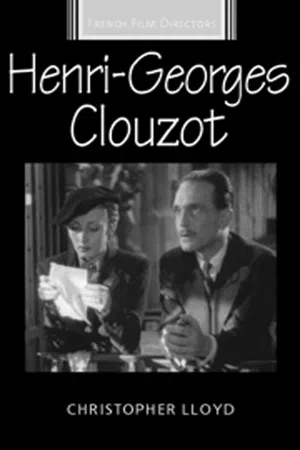
- 190 pages
- English
- ePUB (mobile friendly)
- Available on iOS & Android
eBook - ePub
Henri-Georges Clouzot
About this book
Information
Publisher
Manchester University PressYear
2013Print ISBN
9781784992866
9780719070143
eBook ISBN
9781847796196
Subtopic
Film et vidéo
Clouzot and the cinema
Before studying Clouzot’s films in detail, we need to situate him in the wider context of French history and cinema in the mid-twentieth century. Issues such as the following will be addressed in this introductory chapter. What forces, personal, political and social, shaped his career as a film-maker? To what extent do his films propose a consistent, personal vision, and how do they reflect the important social and aesthetic changes of his time? Does Clouzot qualify as an auteur, as an original and innovative creator, or was he essentially a technically brilliant craftsman, a skilled manipulator of audiences, who produced a series of arresting genre films? If he was as much an entertainer as an artist, why in that case did he direct so few films? And finally, were his films influenced in any way by the rise of the New Wave of French directors and critics from the late 1950s, or did they remain rooted in what some hostile commentators saw as a conventional and stultifying classicism?
Although Clouzot’s output as a director spanned a period of twenty-six years, in this time he released only ten full-length feature films (from L’Assassin habite au 21 in 1942 to La Prisonnière in 1968), as well as one short and six documentaries (including Le Mystère Picasso, 1956). In the 1930s Clouzot served a lengthy and rather obscure apprenticeship (effectively the first third of his career) in France and Germany as a writer and assistant director; he was in fact more productive as a screenwriter and adapter, having the script, dialogue or occasionally lyrics of at least twenty films credited to his name (ranging from Un soir de rafle, directed by Carmine Gallone in 1931, to L’Enfer, finally directed by Claude Chabrol and released in 1994, thirty years after Clouzot was forced by a heart attack to abandon the project). As this last example suggests, one reason for the long intervals between Clouzot’s major films was poor health, which afflicted both the director and some of his closest associates, with devastating personal, professional and financial consequences. Hence the gap of eight years between his last two feature films, La Vérité (1960) and La Prisonnière. During this time Vera, his first wife, who had taken a starring role in three of his films, died in December 1960 at the age of forty-seven after suffering from chronic heart disease for several years; his mother died in June 1964, when filming of L’Enfer was due to start; the leading actor Serge Reggiani fell ill one week after shooting began and had to be replaced. The director’s own ailment after L’Enfer ceased production made it virtually impossible for him to finance and obtain insurance coverage for a large-budget film.
At the start of Clouzot’s career, the onset of pulmonary tuberculosis and the need to retreat for nearly four years to sanatoria between 1935 and 1938 had brutally cut short his slowly rising trajectory. Paul Meurisse (1979) records that, as he struggled to rebuild his career in show business in 1939, Clouzot was reduced to peddling the lyrics of songs to Edith Piaf (which she declined to purchase). The Second World War proved to be his making and his unmaking, as circumstances turned in his favour and then against him. The military and political catastrophe of France’s defeat and subsequent occupation by Germany in 1940 allowed Clouzot, thanks to his pre-war connections with the Berlin film industry, to achieve a certain prominence as head of the script department for the German production company Continental, which was established by the occupying powers in Paris to produce films for French audiences and to achieve cultural and economic hegemony over the French market. Having scripted two films produced by Continental in 1941 (Georges Lacombe’s Le Dernier des six and Henri Decoin’s Les Inconnus dans la maison), Clouzot was finally allowed to direct L’Assassin habite au 21 and Le Corbeau for the company. Although he resigned from Continental in October 1943 (a few days after Le Corbeau was released), Clouzot’s three years of collaboration with the Germans and the caustic satirical message of Le Corbeau led to a further significant setback in his career, since his supposedly anti-patriotic behaviour was held to account by the purging tribunals of the liberation and he was effectively barred from film-making for four years. His reputation as a film-maker was firmly established, however, and the controversy aroused by the banning of Le Corbeau and its director meant that neither of them returned to obscurity. (For a fuller discussion, see the end of this chapter and the next two chapters.)
French audiences during the occupation were unaware that Clouzot’s films were produced by a German company (references to Continental were also removed from the credits of most copies of their films when they were eventually reissued after the war) and they were extremely popular. Le Corbeau was seen by nearly 250,000 people in the first months of its initial release, and set the pattern for the reception of many of his subsequent films, by achieving commercial success, and attracting large audiences and a mixture of critical acclaim and controversy. Only three films were financial failures: Miquette et sa mère (1950), an adaptation of a boulevard comedy which he made reluctantly to fulfil a contractual obligation; Le Mystère Picasso, which despite (or more probably because of) its impressive formal innovations and the award of a special jury prize at the Cannes festival was seen by only 37,000 cinema-goers during its first run in 1956 (Marie 2003: 86); and the convoluted thriller Les Espions (1957). The perfectionism and urge to control all aspects of the film-making process which characterise Clouzot’s mature works (and which also explain his slow output) had with this particular film degenerated into self-defeating stubbornness and a manic attention to detail, at the expense of the bigger picture. According to Tony Thomas (1971: 115), Clouzot held a 51 per cent controlling interest in the production company set up to film Les Espions, representing an investment of $1,000,000 of his own money. When he refused to cut a rambling scene with Vera playing a mute psychiatric patient, he failed to gain US distribution and lost $300,000. (Le Salaire de la peur had been distributed in the US only after supposedly anti-American sequences had been cut.)
Usually, however, Clouzot’s dominating mastery paid off, both at the box office and with French and foreign critics. For example, Quai des Orfèvres was the fourth most popular film in France in 1947, drawing some 5.5 million spectators, as was Manon in 1949, winning 3.4 million spectators and a golden lion at the Venice festival. Le Salaire de la peur was the second most popular film in France in 1953, with nearly 7 million spectators (and it remains among the top thirty most popular films in France); it won awards for best film and best actor (for Charles Vanel) at Cannes. Les Diaboliques won the prix Louis Delluc in 1954 and the New York critics’ circle award for best foreign film; La Vérité was the second most popular film in France in 1960 (5.7 million viewers) and was Brigitte Bardot’s highest grossing film (figures cited from Powrie and Reader 2002). Unsurprisingly, Clouzot’s notoriety and bankability also provoked hostile reviews, which generally objected on moral grounds to the bleak pessimism of his films or to his allegedly cynical manipulation of spectators. More specifically, avant-garde critics associated with what would be called the New Wave of French directors complained that Clouzot was hidebound by outmoded conventions; thus, writing in Cahiers du cinéma in May 1957, Jacques Rivette asserted that middle-aged established directors like Clément, Autant-Lara and Clouzot were ‘afraid to take risks and … corrupted by money’ (quoted by Marie 2003: 56).
The jibe may seem unjust, given that Clouzot’s most recent films (Le Mystère Picasso and Les Espions) actually deviated quite intentionally from the usual conventions of the documentary or thriller and lost money as a result. The target, however, was more probably Les Diaboliques, about which J.-L. Tallenay had observed somewhat dismissively in Cahiers du cinéma ‘It is a pity to waste so much talent on a puzzle’ (quoted in L’Avant-Scène Cinéma 1997: 106). Clouzot evidently took this rebuke to heart, since he remarked in an interview with Lui in 1965 that, along with Miquette, he no longer considered Les Diaboliques important or interesting. (Both Clouzot and his critics seem to underestimate the technical brilliance of this film, as we shall see.) In any case, far from being unchallenging entertainments, all the films he made after Les Diaboliques can be seen as questioning conventional norms of behaviour or the nature of artistic expression. While the courtroom drama La Vérité is in no sense aesthetically innovative, its ostensible theme is the failure of the legal system and bourgeois morality when the truth about human relations is at stake. The documentary films made with Picasso and the conductor Herbert von Karajan are about the mysteries of artistic creation (although both Picasso and Karajan are shown as performers, practical craftsmen rather than aesthetic theoreticians). La Prisonnière, which was the only feature film which Clouzot made in colour, is about sexual obsession and voyeurism (familiar themes, though now treated more explicitly in the permissive era which had dawned by 1968), but also foregrounds the expressive, formal elements of film (colour, patterns, shapes, movement) far more aggressively and continuously than in his previous films.
Before pursuing this exploration of Clouzot’s vision, working methods, and the wider historical and cinematic context which shaped his films, it would be useful briefly to fill in some details about his career and biography. Henri Georges Léon Clouzot was born in Niort on 20 November 1907, where his father ran a book shop, before financial difficulties obliged him to move the family to Brest and work as an auctioneer. After poor eyesight prevented him from training as a naval cadet and following a brief period as a political secretary, Clouzot began writing sketches and lyrics for cabaret artistes and joined Adolphe Osso’s film production company as a script editor (assisted by his younger brother Jean, who was to pursue a successful career as a screenwriter under the pseudonym Jérôme Geronimi). In 1931, Clouzot was able to make a short film, La Terreur des Batignolles, from a script by Jacques de Baroncelli. The film is a fifteen-minute comic sketch, with three actors. The ironically named terror of the title is a cowardly Parisian burglar who hides behind a curtain when the owners of the apartment he is burgling return unexpectedly. They spot his feet and confiscate his loot; he realises belatedly that the couple, despite their evening dress, were not the owners at all but a bolder pair of thieves. None of the film archives which I contacted in Brussels, London and Paris possesses a copy of this film. Claude Beylie (1991) saw a copy lent by a private collector and reported that the film was surprisingly well made, with expressive use of shadows and lighting contrasts, effects which Clouzot would exploit in the full-length features he made ten years later (although Mme Inès Clouzot assured me in March 2004 that this short added nothing to her husband’s reputation).
In 1932, Clouzot moved to Berlin to work for the German production and distribution company UFA, adapting scripts and supervising the French versions of their films. Like many other French people launching their careers in the movie business, Clouzot’s move to the Neubabelsberg studios was triggered by the fragile state of the French industry in the early 1930s (which showed a deficit in up to 40 per cent of productions annually and where French-language versions of films imported from Germany took over 10 per cent of the market: Crisp 1997: 24). Clouzot returned to Paris in 1934, claiming he had been sacked because of his friendship with a Jewish producer, which would have been highly undesirable as UFA fell under the control of Goebbels’ propaganda ministry. In the late 1930s Clouzot met the singer and aspiring actress Suzy Delair, who became his partner for the next decade and starred in L’Assassin habite au 21 and Quai des Orfèvres. He also met Pierre Fresnay in 1939, who was already an established star (having played Marius in Pagnol’s celebrated trilogy and a leading role as Captain de Boëldieu in Renoir’s La Grande Illusion). Fresnay appeared in ten films during the occupation (four of them made with Continental, three of which were either scripted or directed by Clouzot). Clouzot also wrote the script of Le Duel, which Fresnay directed in 1939, and two plays for him, On prend les mêmes, performed in December 1940, and Comédie en trois actes, performed in March 1942.
If Fresnay effectively acted as Clouzot’s patron, Clouzot repaid the favour by giving him one of his greatest roles in Le Corbeau. After Clouzot quarrelled with Fresnay’s wife Yvonne Printemps, relations were broken off. The pattern was set for Clouzot’s tumultuous dealings with the major actors and actresses who appeared in his films. He would attract performers (sometimes rising or waning stars, like Yves Montand or Charles Vanel) from a variety of backgrounds (from stage actors like Louis Jouvet, Paul Meurisse and Laurent Terzieff, to a cabaret singer like Montand, to popular film actresses like Ginette Leclerc, Simone Signoret and Brigitte Bardot), extract a compelling performance from them, but usually at the cost of turning an initially amicable relationship into violent confrontation or icy hostility. Brigitte Bardot presents Clouzot in her memoirs as a repellent, bullying gnome, ‘un être négatif, en conflit perpétuel avec lui-même et le monde qui l’entourait’, while acknowledging that La Vérité was her favourite film and made her an ‘actrice reconnue, enfin la consécration de ma carrière’ (Bardot 1996: 242, 237).1 Louis Jouvet had already achieved such recognition when he took the leading male role in three films (Quai des Orfèvres, Miquette et sa mère and the short Le Retour de Jean), and began work with Clouzot on an adaptation of Graham Greene’s The Power and the Glory. They parted company in February 1951 after Clouzot tactlessly criticised Jouvet at a read-through, and the script was passed on to Pierre Bost. There was no reconciliation: Jouvet died six months later.
Clouzot’s humiliating exclusion from this project is recounted with a certain relish by Jouvet’s secretary, the actor Léo Lapara, who had minor parts in Quai des Orfèvres and Le Retour de Jean. In 1938, Lapara had married Vera Gibson Amado, the daughter of a Brazilian diplomat. When Jouvet’s acting company returned to France in 1945 (having spent the previous four years on tour in South America), Lapara and Vera lived with Jouvet in his spacious Paris apartment for several years, an arrangement which led Vera to accuse her husband of being married to Jouvet (who was himself separated from his wife and family: Lapara 1975: 263). She met Clouzot when working as a continuity assistant on Miquette; after she divorced Lapara, they were married in January 1950. The couple undertook a seven-month visit to Brazil from April 1950, with the intention of making a documentary film about their voyage. When this proved impossible, for technical and financial reasons, Clouzot recorded his experiences in a book, Le Cheval des dieux (1951); apart from purely anecdotal aspects, this deals notably with fetishist sects which practise the ritual sacrifice of animals (slaughter witnessed and described in explicit detail, showing by contrast how restrained and stylised the violent scenes are in his films).
The nearest Clouzot got to filming in South America was when directing Le Salaire de la peur in 1951 and 1952 on an exterior set built in the Camargue, which stood in for the town of Las Piedras (while the scenes showing the lorries on the road were shot in the Cévennes). In order to retain as much independence as possible (one reason he was reluctant to work in the USA, which he visited only as a tourist), Clouzot had created his own production company, Vera Films, through which he co-produced this and most of his subsequent feature films. Unseasonal torrential rain delayed filming of Le Salaire and caused costs to overrun; shooting finally resumed after a lengthy delay needed to allow refinancing. Clouzot’s last five features were expensive ventures. La Vérité had a budget of $1.5 million (five times the cost of the average French film in 1959: Marie 2003: 49), with Brigitte Bardot taking a fee of $250,000, according to Clouzot’s biographers Bocquet and Godin (1993: 120). Writing in Le Nouvel Observateur in November 1964, Clouzot argued that cinema needed to let the public touch ‘the details of the truth’ by showing material space on a large scale; hence very lavish and costly spectacles were most likely to attract the mass audiences needed to defray costs and to compete with television (quoted by Bocquet and Godin 1993: 137).
Following Vera’s untimely death in December 1960, Clouzot retreated to Tahiti, returning to Paris in January 1962. He married Inès de Gonzalez (herself a widow) in December 1963. After the debacle of L’Enfer, the five documentary films which he made for television with Herbert von Karajan between 1965 and 1967 allowed Clouzot to finance filming of his final feature film. Shooting of La Prisonnière began in September 1967, but the director fell ill again and was hospitalised until April 1968. Filming recommenced in August 1968, following a further interruption caused by the events of May 1968, when nation-wide protests and strikes brought de Gaulle’s regime near to collapse. Though no radical, Clouzot joi...
Table of contents
- Cover Page
- Title Page
- Copyright Page
- Contents
- List of Plates
- Series Editors’ Foreword
- Acknowledgements
- 1 Clouzot and the cinema
- 2 Occupation and its discontents
- 3 Reconstruction and retribution: Clouzot’s post-war films
- 4 Beyond genre: Le Salaire de la peur
- 5 Suspense and surveillance: Les Diaboliques and Les Espions
- 6 Filming Picasso and Karajan
- 7 The final films
- Conclusion
- Filmography
- Select Bibliography
- Index
- Footnotes
Trusted by 375,005 students
Access to over 1.5 million titles for a fair monthly price.
Study more efficiently using our study tools.
Frequently asked questions
Yes, you can cancel anytime from the Subscription tab in your account settings on the Perlego website. Your subscription will stay active until the end of your current billing period. Learn how to cancel your subscription
No, books cannot be downloaded as external files, such as PDFs, for use outside of Perlego. However, you can download books within the Perlego app for offline reading on mobile or tablet. Learn how to download books offline
Perlego offers two plans: Essential and Complete
- Essential is ideal for learners and professionals who enjoy exploring a wide range of subjects. Access the Essential Library with 800,000+ trusted titles and best-sellers across business, personal growth, and the humanities. Includes unlimited reading time and Standard Read Aloud voice.
- Complete: Perfect for advanced learners and researchers needing full, unrestricted access. Unlock 1.5M+ books across hundreds of subjects, including academic and specialized titles. The Complete Plan also includes advanced features like Premium Read Aloud and Research Assistant.
We are an online textbook subscription service, where you can get access to an entire online library for less than the price of a single book per month. With over 1.5 million books across 990+ topics, we’ve got you covered! Learn about our mission
Look out for the read-aloud symbol on your next book to see if you can listen to it. The read-aloud tool reads text aloud for you, highlighting the text as it is being read. You can pause it, speed it up and slow it down. Learn more about Read Aloud
Yes! You can use the Perlego app on both iOS and Android devices to read anytime, anywhere — even offline. Perfect for commutes or when you’re on the go.
Please note we cannot support devices running on iOS 13 and Android 7 or earlier. Learn more about using the app
Please note we cannot support devices running on iOS 13 and Android 7 or earlier. Learn more about using the app
Yes, you can access Henri-Georges Clouzot by Christopher Lloyd in PDF and/or ePUB format, as well as other popular books in Médias et arts de la scène & Film et vidéo. We have over 1.5 million books available in our catalogue for you to explore.