Laurent Cantet is of one France's leading contemporary directors. In a series of important films, including Human Resources, Time Out, Heading South, The Class and Foxfire, he takes stock of the modern world from the workplace, through the schoolroom and the oppressive small town to the world of international sex tourism. His films drive the hidden forces that weigh on individuals and groups into view but also show characters who are capable of reflection and reaction. If the films make their protagonists rethink their place in the world, they also challenge the positions of the viewer and the director. This is what makes them so worthy of study.
Combining a fine eye for detail with broad contextual awareness, this book gives an account of all Cantet's works, from the early short films to the major works. Martin O'Shaughnessy is a leading international writer on French cinema,especially in film and politics.
- 190 pages
- English
- ePUB (mobile friendly)
- Available on iOS & Android
eBook - ePub
Laurent Cantet
About this book
Information
Publisher
Manchester University PressYear
2015Print ISBN
9781526123022
9780719091506
eBook ISBN
9781784992101
Subtopic
Film & Video 1
A director and his methods
Cantet was born in 1961 in the small town of Melle in the Poitou-Charentes region. His parents were teachers. His cinematic vocation began to emerge when he studied photography at Marseille University and started to assemble photographs to make short pictorial stories. At the same time, he bought a digital camera, a piece of equipment that was becoming an affordable consumer item at the time, and started to make short films with friends. Then, moving decisively towards cinema, he took the entrance examination at the prestigious Institut des Hautes Etudes Cinématographiques (IDHEC) in Paris and passed, against his expectations. There he would learn his trade and round out his cinematic education by working on his and friends’ films and watching numerous other films with the same people. After graduation in 1986, he worked in television and made Un été à Beyrouth (France 3, 1990), a half-hour film about the Lebanese civil war as seen through the eyes of a child. He would go on to be the assistant of the famous documentary-maker, Marcel Ophüls, on his Veillée d’armes (1994), a film about the reporting of the 1992 siege of Sarajevo. Along with friends from IDHEC like Dominik Moll and Robin Campillo, he would join Sérénade, a small production company founded by Vincent Dietschy, another of the group, in 1991. Sérénade was driven by a collaborative spirit: returning to the kind of collective working that had characterised their IDHEC days, its participants would read each other’s scripts and work on each other’s films, interchanging roles in the process. Cantet made two short films with Sérénade, Tous à la manif and Jeux de plage, and was the cinematographer on Dietschy’s Cette nuit (1998) and Gilles Marchand’s short, Joyeux Noël (1994). Marchand would in turn co-write Tous à la manif and Ressources humaines. This way of working with friends is nothing exceptional within French cinema: for example, Arnaud Desplechin and Matthieu Kassovitz, very different directors in many ways, are both known for doing likewise. But the way in which Cantet routinely asks long-standing acquaintances either to co-write or to comment on his work suggests that he embodies a type of authorship that is anything but narrowly personal. This is something to which we will return.
After the demise of Sérénade in 1998, the next stage in Cantet’s career began when he was contacted by Caroline Benjo of Haut et Court, the Paris-based production company. Benjo and her co-producer Carole Scotta had earlier suggested to Arte, the Franco-German cultural television channel, that they should put together a series of ten films called 2000 vu par … (2000 seen by …) to mark the upcoming millennium. They agreed with Pierre Chevalier, the commissioning producer from Arte, that the films would last about an hour, cost 4 or 5 million francs, with Arte contributing 2.3 million, and generally be made by promising new directors.1 People like Walter Salles and Abderrahmane Sissako were recruited alongside American director Hal Hartley, at that time the best known of the group. Benjo turned to Cantet because she had been impressed by his short films. Cantet’s contribution to the series was called Les Sanguinaires and told the story of a group of friends who take their children to an almost uninhabited island to escape the hype surrounding the millennial festivities. The film was aired on Arte in November 1998 and also shown at a number of festivals including Venice but did not achieve a general cinematic release, not least because of its unsuitable length (Lebtahi and Gillet, 2005: 142).
Pierre Chevalier is an important figure in French television and film and has produced several notable series of made-for-television films, including 2000 vu par … and Tous les garçons et les filles de leur âge (All the Boys and Girls of Their Age). Obliged by legislation to invest in film, television has become one of the main cash-cows of French cinema. This relationship is often seen negatively, with television perceived to exercise a conservative influence on film and to push directors towards pre-formatted works suitable for a mass audience (Le Club des 13, 2008: 78, 93–102). Going against the grain, Chevalier has shown the capacity to encourage some of the best and most imaginative directors, and to support films with a distinct social or critical dimension.2 His encounter with Cantet was undoubtedly an important one for the latter, since Chevalier would again turn to the still relatively inexperienced film-maker when putting together another new series of television films called Au travail (At work). The outcome of this second collaboration was Ressources humaines, Cantet’s film about a management trainee doing a placement in the provincial factory where his father has always worked. Like some of Chevalier’s other productions, notably Robert Guédiguian’s Marius et Jeanette (1997), the film achieved both television screening and cinematic distribution, thus blurring the lines between the two media in a way that was not to everybody’s taste. It went out on television on 14 January 2000 and was released in cinemas the next day. It had a television audience of 1,715, 320 and was seen by 219,434 cinema spectators (Gillet and Lebtahi, 2005: 142). Addressing the introduction of the thirty-five-hour working week by the Socialist Government, the film served as a catalyst for public debate. It marked Cantet out as a politically committed director at a time when French cinema more broadly was moving back towards political involvement after years of disengagement. Shown at New York’s Museum of Modern Art (MOMA), and at the Thessaloniki, Torino, Sundance and San Sebastian film festivals, it also saw Cantet’s international profile begin to develop.
Written with Campillo, now his established co-writer and another IDHEC comrade, Cantet’s next film, L’Emploi du temps, tells the story of a high-flying management consultant who hides his redundancy from friends and family. The film draws on real-life events in the shape of the celebrated Romand affair, the case of an apparently successful professional who was in fact unemployed and murdered his family when his deception was discovered. It thus shared two obvious things with Ressources humaines: it focused on the world of work and bore a relationship to contemporary events, although in this case with a less obvious connection to political debates. Yet, where it was very different is that it was a cinematic production from the start and confirmed Cantet’s growing status as a film- rather than a television-director. Its style was rather more poetic and did far more to express its hero’s evolving subjective state than the much flatter realism of the earlier film. It also relied more on professional actors: while Ressources humaines had deployed a nearly entirely amateur cast, L’Emploi du temps’ two leads, Aurélien Recoing and Karen Viard, were well known stage and screen performers.
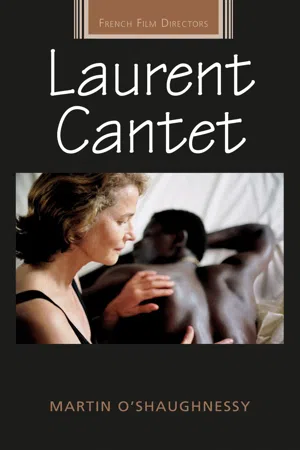
Taking what one might call a midway position between these two films, Cantet’s next work, Vers le sud would self-consciously play off star and amateur performers – Charlotte Rampling and Karen Young on the one hand, Haitian unknowns on the other –, as it sought to render the asymmetrical interaction of prosperous, white tourists and the young black men with whom they sought romance and sexual satisfaction. On the surface at least, the film represented several new departures for Cantet. Firstly, it moved his film-making away from France. Secondly, mixing English, French and Creole, it was a multi-lingual film. Thirdly, although again co-written with Campillo, it was an adaptation, albeit a very free one, of a pre-existing literary text – La Chair du maître (The Master’s Flesh; 1997) by the Haitian novelist, Dany Laferrière – a work whose loosely articulated stories probe the erotically charged interface of race, power, class and sex (Laferrière, 2000). Finally, by situating itself in the 1970s, at the time of the brutally corrupt Baby Doc Duvalier regime, it apparently took Cantet away from the immediately contemporary period that had seemed his preferred terrain. However, at a deeper level, it might be seen as confirming certain key aspects of Cantet’s film-making. Firstly, as we will later see, the historical distance is more apparent than real, and the film speaks eloquently to the current moment. Secondly, although an adaptation might seem a less personal project, the source work was chosen precisely because Cantet recognised some of his own preoccupations in it, notably the complex intersection of the personal and the social, the affective and the political.
Entre les murs would see a double return home. It took the director very much back to France and questions about French society. It also returned him to his preferred practices in terms of how it was made. Like Tous à la manif or Ressources humaines, its shooting, with an all-amateur cast, was preceded by a long period of casting and workshopping during which the script, an adaptation of François Bégaudeau’s successful novel of the same title (2006), was tested and refined. Cantet’s satisfaction with this way of working confirmed his sense of what his directorial ‘method’ should be. His second experience of working in a foreign setting with Foxfire: Confessions of a Girl Gang (hereafter Foxfire) would be very different from Vers le sud. This time there would be no star performers. Instead, he carefully selected his cast (mainly of teenage girls) during a winter spent in Toronto. Casting would give way to two weeks of intense workshopping when, true to his preferences, Cantet had the young women try out ideas from the script, allowing them to inflect its evolution (Mangeot, 2012: 10).
Foxfire seemed to confirm Cantet’s recent preference for adapting literary works, in this case Joyce Carol Oates’s hit 1993 novel Foxfire: Confessions of a Girl Gang. Like Vers le sud, the film also moved the director back in time – in this case to the small-town America of the 1950s – although with Canada standing in for the USA in the same way as San Domingo largely stands in for Haiti in Vers le sud. However, the film’s theme, the revolt of a gang of girls against the misogynist values and attitudes surrounding them, had the same contemporary relevance as the exploration of neo-colonialism in Vers le sud (Mangeot, 2012: 11).
After Foxfire, varying his approach by moving away from direct adaptation of an existing text, Cantet collaborated with Cuban novelist, Leon Padura, to produce the script of his latest film, Return to Ithaca (2014). Cantet had got to know Padura when working on his segment of the multi-director work 7 Days in Havana (2012), a film to which he contributed the final, Sunday, section. Made in Spanish, the latter two works would confirm the increasingly international nature of Cantet’s authorship.
Alongside his film-making, Cantet has maintained a long-standing commitment to France’s illegal migrant workers, the sans-papiers. The sans-papiers came forcefully to French public attention in 1996 when a group of them who had been occupying a Parisian church were forcibly expelled. A short film supporting them was released by a film-makers’ collective and shown at many cinemas around France. It ended with an appeal for public support signed by many film industry figures, including Cantet. The director’s support for the sans-papiers (and that of the collective) was reaffirmed in 2007 with the making and national release of another very short film, Laissez-les grandir ici,3 a work co-sponsored by the Réseau Education Sans Frontières (RESF),4 an organisation of which Cantet is a high-profile member. More recently still, in 2010, Cantet’s commitment to the sans-papiers was again visible when he first turned out to stand with and speak up for a group of migrants threatened with expulsion from a building that they had been occupying in the rue du Regard in Paris, and then took a leading role in making a three-and-a-half-minute film defending their broader cause.5 While Cantet’s support for migrant workers and their children might seem narrow in its focus and humanitarian in its intentions, he is clearly very aware of the political issues at stake. In an interview given to communist daily, L’Humanité, on 24 February 2010, he first commented on how companies use migrant workers’ vulnerable status to drive down wages, and secondly noted how the migrants embodied a precariousness that increasingly threatened French society in general. They were effectively the advance guard of a broader struggle.6 Cantet’s film-making and his commitment to the sans-papiers converged doubly at the time of Entre les murs. The film, as we will see, figures the story of a Chinese pupil whose mother is threatened with expulsion from France. At the same time, the real-life mother of one of its actors, Boubakar, was discovered also to be without papers. Cantet became her sponsor in her application for regularisation.7
Cantet’s method
At around the time of Entre les murs, Cantet would repeatedly refer to his ‘method’ – that is, his preferred way of making a film (Rigoulet, 2008; Burdeau and Thirion, 2008). As discussed above, this involved a long period for casting a largely amateur cast, then a period of workshopping when the script and situations were refined in collaboration with the performers and, finally, the kind of shooting that was flexible enough to allow for this spontaneity and inventiveness to be kept alive. In some ways, the use of amateurs might seem similar to that adopted by other leading contemporary directors like the Dardenne brothers or Bruno Dumont, who seek to make a break with conventional commercial film-making while opening their films to the rawness of the real. Yet, there is something specific and important about what Cantet does. The Dardennes, for example, use amateurs in an essentially Bressonian way: that is, following the method established so famously by Robert Bresson, the great post-war French director, they use amateurs as blank canvases upon whose surfaces performances, as purely external manifestations, can be painted through obsessive rehearsal of gestures and movem...
Table of contents
- Cover
- Half Title
- Series Information
- Title Page
- Copyright Page
- Dedication
- Table of Contents
- list of plates
- Series editors’ foreword
- Acknowledgements
- Introduction
- 1 A director and his methods
- 2 Early applications
- 3 The work diptych
- 4 Going global, heading south
- 5 Between Republican walls
- 6 Before and after the political
- Conclusion
- Afterword. Returning to Cuba
- Filmography
- Further reading
- Index
Trusted by 375,005 students
Access to over 1.5 million titles for a fair monthly price.
Study more efficiently using our study tools.
Frequently asked questions
Yes, you can cancel anytime from the Subscription tab in your account settings on the Perlego website. Your subscription will stay active until the end of your current billing period. Learn how to cancel your subscription
No, books cannot be downloaded as external files, such as PDFs, for use outside of Perlego. However, you can download books within the Perlego app for offline reading on mobile or tablet. Learn how to download books offline
Perlego offers two plans: Essential and Complete
- Essential is ideal for learners and professionals who enjoy exploring a wide range of subjects. Access the Essential Library with 800,000+ trusted titles and best-sellers across business, personal growth, and the humanities. Includes unlimited reading time and Standard Read Aloud voice.
- Complete: Perfect for advanced learners and researchers needing full, unrestricted access. Unlock 1.5M+ books across hundreds of subjects, including academic and specialized titles. The Complete Plan also includes advanced features like Premium Read Aloud and Research Assistant.
We are an online textbook subscription service, where you can get access to an entire online library for less than the price of a single book per month. With over 1.5 million books across 990+ topics, we’ve got you covered! Learn about our mission
Look out for the read-aloud symbol on your next book to see if you can listen to it. The read-aloud tool reads text aloud for you, highlighting the text as it is being read. You can pause it, speed it up and slow it down. Learn more about Read Aloud
Yes! You can use the Perlego app on both iOS and Android devices to read anytime, anywhere — even offline. Perfect for commutes or when you’re on the go.
Please note we cannot support devices running on iOS 13 and Android 7 or earlier. Learn more about using the app
Please note we cannot support devices running on iOS 13 and Android 7 or earlier. Learn more about using the app
Yes, you can access Laurent Cantet by Martin O'Shaughnessy in PDF and/or ePUB format, as well as other popular books in Media & Performing Arts & Film & Video. We have over 1.5 million books available in our catalogue for you to explore.