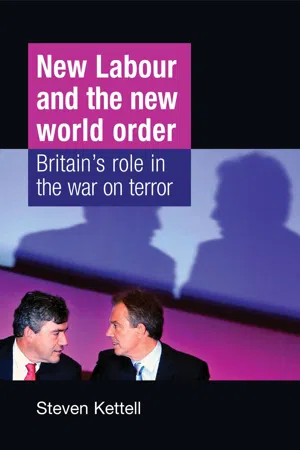
The war on terror has shaped and defined the first decade of the twenty-first century, yet analyses of Britain's involvement remain limited and fragmentary. This book provides a comprehensive analysis of these developments. It argues that New Labour's support for a militaristic campaign was driven by a desire to elevate Britain's influence on the world stage, and to assist the United States in a new imperialist project of global reordering. Ostensibly set within a political framework of promoting humanitarian values, the government's conduct in the war on terror also proved to be largely counter-productive, eroding trust between the citizenry and the state, putting the armed forces under increasing strain and ultimately exacerbating the threat from radical Islamic terrorism.
This book will be of interest to teachers and scholars of British foreign policy, international relations and security studies. It will also appeal to anyone interested in Britain's role in the war on terror.
- 200 pages
- English
- ePUB (mobile friendly)
- Available on iOS & Android
eBook - ePub
About this book
Information
1
Introduction
In the early 1960s, with the sun dipping beyond its imperial horizon, the ex-US Secretary of State, Dean Acheson, famously remarked that Great Britain had lost an empire and had not yet found itself a role. By the early years of the new millennium, however, any sense of uncertainty had been firmly dispelled. Under a New Labour government keen to elevate Britain’s position on the international stage, the country had found itself cast as the supporter-in-chief of the much-vaunted US ‘war on terror’. Launched by the US in the aftermath of the 9/11 terrorist attacks, the overarching objective of this campaign was to advance a wide-ranging project of geo-strategic reordering designed to extend and enhance US global dominance. For the New Labour leadership, support for this endeavour was considered to be vital not only for securing Britain’s national interests, but as a means of helping to forge and fashion a new world order for the twenty-first century.
Not surprisingly, the circumstances surrounding the war on terror have attracted an enormous amount of commentary and analysis. Typologically, this divides into several clear, if not discrete forms. By far the largest of these, again unsurprisingly, has focused on the role of the US. For most accounts the central aim has been to deal with these events via a broad examination of the US role in global affairs, or, conversely, to detail the specific actions and intentions of the Bush administration.1 Beyond this, scholarly attentions have also centred on specific episodes or themes within the war on terror as a whole, such as the invasion of Iraq or the use of extra-legal practices,2 while others have set out to explore the role played by the arch-enemy of the US in the conflict, focusing either on the al-Qaeda network, on its leader, Osama bin Laden, or on the phenomena of radical Islamic terrorism more generally.3
Set against this, analyses of Britain’s role in the war on terror, though vastly smaller in number, have been similarly variegated. Generally speaking, the focus has centred on specific aspects of Britain’s participation, such as the nature of the ‘special relationship’ with the US or its involvement in Afghanistan or Iraq,4 or has set out to consider the domestic consequences, typically focusing on anti-terror legislation, and the impact on civil liberties and social cohesion.5 Still further, other studies have sought to examine these various matters less in their own right, but as part of a broader analysis of the New Labour governments in general, or the leadership of Tony Blair in particular.6
Although these respective accounts are useful for illuminating the numerous and varied issues involved in Britain’s role in the war on terror, the existing coverage of these developments has been notable for its lack of holistic analysis. While focusing on specific aspects, issues and events by definition yields a partial understanding in terms of the overall picture, consideration of the wider context in which these elements are set enables their respective interconnections and underlying dynamics to be brought into clearer view. Such an analysis, then, is the central purpose of this book. The examination that follows is based on two main conceptual frames. The first, and more general premise, is that the unfolding dynamics and circumstances of the war on terror are best explained in terms of the underlying drivers and processes of ‘new imperialism’. This reflects one of the dominant themes in scholarly analyses of contemporary international affairs; namely, the extent to which the actions of the US can be considered as manifestations of a broader imperial project. The second, and the principal frame of the book, sets out to examine the way in which Britain’s role in the war on terror has been shaped both by these developments and by New Labour’s approach to foreign policy, and to consider how these events, in turn, impacted upon domestic political affairs under the governments of Tony Blair and Gordon Brown.
Within this, one of the main themes of the book is that the events and conduct of the war on terror, in both its international and domestic spheres, have failed to effectively deal with the threat posed by radical Islamic terrorism. A central issue here is that the dynamics of Washington’s broader geo-strategic manoeuvres, leading to military invasions of Afghanistan and Iraq, ensured at the same time that the content of both the US military effort as well as the post-war stability and reconstruction operations were limited to doing that which was deemed necessary to ensure a rapid victory and a quick withdrawal of US forces. The corresponding absence of substantive post-war planning in respect of Iraq, however, contributed directly to an outbreak of chaos and insurgency that commanded an ever-rising amount of US resources and attention, and which led ultimately to the abandonment of the initial limited approach in favour of an intensive troop surge. At the same time, a similar lack of engagement with the post-war situation in Afghanistan, in addition to the distractions of Iraq, allowed al-Qaeda, along with the deposed Taliban regime, to regroup and re-gather their capabilities. This led to an intensification of violence in the initial theatre of war, and to the adoption of another military surge in an attempt to gain a measure of control over the situation. Having also (if paradoxically) served to undermine the credibility of Washington’s willingness to use military power to enforce its will on the international stage, the impact of these events extended far beyond the Middle East, with ramifications for the broader balance of power and stability in world affairs.
The impact of the war on terror on domestic British politics has also been profound. The controversies surrounding Britain’s participation in the military conflicts in Afghanistan and (especially) Iraq have left deep and lasting scars on the political landscape, the consequences of which continue to resonate. Beyond this, the government’s support for the US use of extra-legal practices in the fight against international terrorism, including a secret programme of extraordinary renditions and detentions at Guantánamo Bay and elsewhere, also proved to be highly contentious. So too was New Labour’s domestic anti-terror strategy. The core elements of this, based on strengthening the security provisions of the state and on the adoption of a ‘values-based’ approach to dealing with the problems of domestic radicalisation, did little to address the underlying causes of radical Islamic terrorism. Indeed, on the contrary, much of this served to exacerbate and sustain its underlying factors while delimiting the prospects for effective action. In its legislative response, a significant portion of which was driven by party political considerations, a progressive erosion of civil liberties fostered growing levels of distrust and suspicion between the citizenry and the state, and served to politicise and alienate many within Britain’s Muslim community. This accompanied a broader political theme based on debates about ‘Britishness’ and the ascription of social identity along ethno-cultural and religious lines, which also did much to feed the conditions for radicalisation. In addition to this, a fervent rejection by New Labour of any notion that Western (and especially British) foreign policy could itself serve to promote terrorism, a political compulsion in the wake of the Iraq war and the 2005 London bombings, was also problematic. In precluding any critical analysis of a causal role for foreign policy, this foreclosed any consideration of policy change, thereby allowing the list of grievances amassed against the British government to grow ever larger. In all of this, while the circumstances involved clearly changed, the strategic approach to the war on terror taken by New Labour differed little between the governments of Tony Blair and Gordon Brown. In their alliance with the US and their charge of the domestic stage alike, the bearers of the New Labour crown showed greater similarities than either would probably have cared to admit.
This book is structured as follows: Chapter 2 explores the course of British foreign policy since 1945. It considers the centrality of the US special relationship to New Labour’s geopolitical strategy, and examines the utility of ‘new imperialism’ as a conceptual framework for analysing contemporary international affairs. Chapter 3 examines the underlying dynamics of the war on terror. The key elements of this involve the shift to a new imperialist trajectory by the US, the rise of New Labour in Britain and the emergence of radical Islamic terrorism during the 1990s. Detailing the US and British response to the 9/11 attacks, the events surrounding the invasion of Afghanistan as well as the government’s initial legislative reaction are also considered. Chapter 4 covers the events surrounding the invasion of Iraq. The core themes in this centre on the political machinations behind the war, on the ineffective nature of the post-war planning arrangements, and on events in the aftermath of the conflict. Following this, Chapter 5 analyses the extra-legal dimension to the war on terror, and Britain’s support for such measures. These included a US programme of extraordinary renditions and a policy of secret detentions at Guantánamo Bay and elsewhere. The chapter also considers the development of New Labour’s domestic anti-terror strategy and its response to the increasingly prominent theme of radicalisation following the terrorist attacks in Madrid and London. Chapter 6 examines the transition from the final period of Tony Blair’s rule and the initial phase of Gordon Brown’s tenure as Prime Minister. While aspects of change concerning their approach to the war on terror were clearly evident, strong thematic bonds of continuity also remained. The central theme of Chapter 7 focuses on the rapid decline in Brown’s political fortunes amidst a growing crisis of leadership authority from the latter part of 2007. Detailing the way in which the Prime Minister sought to deal with this by centring on the issue of national security and the war on terror, the chapter also assesses the extent to which this proved to be successful. Chapter 8, set against the Presidential transition from George Bush to Barack Obama in the US, examines the growing difficulties of the military campaign in Afghanistan, the unveiling of a new domestic anti-terror framework in Britain, and charts the final demise of New Labour in the General Election of 2010. Finally, chapter 9 sets out the overall conclusions of the analysis and suggests various ways in which some of the issues raised might be addressed.
Notes
1 From amongst the voluminous literature, see for example: Chomsky (2003); Ignatieff (2003); Kagan (2003); Todd (2003); Burrach and Tarbell (2004); Cox (2004, 2005); Ikenberry (2004); Shawcross (2004); Bello (2005); Blum (2006); Johnson (2006); Kiely (2006); Hopkins (2007).
2 See Ahmed (2003); Marsden (2003); Blix (2004); Chatterjee (2004); Diamond (2004); Rose (2004); Woodward (2004); Grey (2006); Smith (2007); Steele (2008); Sands (2009).
3 See for example: Burke (2004); Sageman (2004, 2008); Coll (2005); Rashid (2008); Roy (2008); Kepel (2009).
4 See Stothard (2003); Coates and Krieger (2004); Kampfner (2004); Riddell (2004); Azubuike (2005); Dumbrell (2006); Kettell (2006); Niblett (2007).
5 See for example: Haubrich (2003); Bamford (2004); Elliott (2006); Gove (2006); Oborne (2006); Shah (2006); Walker (2006); Brighton (2007); Croft (2007); Kirby (2007); Githens-Mazer (2008); Hewitt (2008); O’Duffy (2008); Saggar (2009).
6 For example see: Naughtie (2004); Oborne and Walters (2004); Stephens (2004); Seldon (2005).
2
Old and new
British foreign policy after 1945 evolved within a strategic context of progressive imperial and economic decline, Continental moves towards the integration of Europe, and the ‘special relationship’ with the US. One of its central aspects, as the post-war period unfolded, was a desire on the part of British governments to establish closer ties with the US as a means of compensating for Britain’s decline as an independent Great Power. Yet relations with both Europe and the US remained variable during this time, and the problems of decolonisation and decline continued unabated. The coming to power of the New Labour government in 1997 portended a self-conscious attempt to resolve these issues by placing both relationships at the heart of British foreign policy. Framed as a transatlantic bridge strategy, the key aim of this was to elevate Britain’s global influence by establishing mutually reinforcing ties with each side. The pursuit of this objective, however, was also shaped by a transformation of the international sphere in the form of a shift from an old to a ‘new’ imperialist context. Altering both the nature and the balance of power on the world stage, these changes proved to be crucial both for the success of the transatlantic bridge approach, as well as for the dynamics of the war on terror.
A special relationship
The course of British foreign policy after 1945 was shaped by several interrelated dynamics: the emergence and progression of sustained economic decline, the steady demise of the empire, the process of European integration, and the vagaries of the so-called ‘special relationship’ with the US. Taken together, these elements formed the strategic context within which successive governments sought to maintain a leading role for Britain on the international stage, and to enhance its position within the global political and economic order. At the conclusion of the Second World War, the conditions for this appeared to be far from propitious. With the struggle against Nazism having left the country economically exhausted, and with the aftermath of the conflict being accompanied by the onset of a long process of decolonisation, starting with the independence of India in 1947, Britain found itself confronting an uncertain future and the prospect of irrevocable decline. Yet despite these problems, a central aim of governments during the early post-war period was to retain Britain’s global reach and Great Power status. Attempting to sustain a position of imperial authority as the central hub in a Commonwealth of nations, ministers remained aloof and detached from the nascent process of European integration, an approach that was exemplified by Britain’s refusal to participate in the establishment of the European Coal and Steel Community during the early 1950s.
The underlying fragility of Britain’s position, however, was exposed by its newly established special relationship with the US. Although the term was not deployed publicly until after the cessation of hostilities in 1946 (with Britain’s wartime leader, Winston Churchill, referring to a ‘fraternal association of the English-speaking peoples’, and ‘a special relationship between the British Commonwealth and Empire and the United States of America’),1 the high levels of military cooperation forged during the course of the conflict, as well as the close personal ties between Churchill and the US President, Franklin Roosevelt, were considered by many in senior political circles to have established a common and enduring bond that was unique among nations, both in kind and intensity. But the balance of power between the two countries was far from equal, and transatlantic relations were far from trouble-free.2 Notable weak points centred on the issues of Palestine and cooperation over nuclear weapons technology (particularly following the US decision to cease bilateral collaboration in 1946), while the ongoing themes of economic and international rivalry complicated matters also. With the need for high levels of wartime assistance leaving Britain in a position of financial servitude to the US at the war’s end, and with US plans for the creation of a new and liberalised world order being based, in part, on a desire to break up the British empire and to gain access to its markets and resources, US officials wasted no time in pressing home the advantage. In September 1945 the abrupt termination of the 1941 Lend-Lease agreement, through which the US had provided Britain with large amounts of financial and material support for the war effort, provoked an economic crisis and forced the newly elected Labour government to negotiate a fresh Anglo-American loan deal. The terms of this, though far more favourable to the US, led directly to an exchange-rate crisis in 1947 and soured pr...
Table of contents
- Cover Page
- Title Page
- Copyright Page
- Contents
- Preface
- Acknowledgements
- 1 Introduction
- 2 Old and new
- 3 Barbarians at the gates
- 4 Chaos
- 5 Above the law
- 6 A road well travelled
- 7 Brown’s war
- 8 Elysian fields
- 9 Decline and fall
- References
- Index
Trusted by 375,005 students
Access to over 1.5 million titles for a fair monthly price.
Study more efficiently using our study tools.
Frequently asked questions
Yes, you can cancel anytime from the Subscription tab in your account settings on the Perlego website. Your subscription will stay active until the end of your current billing period. Learn how to cancel your subscription
No, books cannot be downloaded as external files, such as PDFs, for use outside of Perlego. However, you can download books within the Perlego app for offline reading on mobile or tablet. Learn how to download books offline
Perlego offers two plans: Essential and Complete
- Essential is ideal for learners and professionals who enjoy exploring a wide range of subjects. Access the Essential Library with 800,000+ trusted titles and best-sellers across business, personal growth, and the humanities. Includes unlimited reading time and Standard Read Aloud voice.
- Complete: Perfect for advanced learners and researchers needing full, unrestricted access. Unlock 1.5M+ books across hundreds of subjects, including academic and specialized titles. The Complete Plan also includes advanced features like Premium Read Aloud and Research Assistant.
We are an online textbook subscription service, where you can get access to an entire online library for less than the price of a single book per month. With over 1.5 million books across 990+ topics, we’ve got you covered! Learn about our mission
Look out for the read-aloud symbol on your next book to see if you can listen to it. The read-aloud tool reads text aloud for you, highlighting the text as it is being read. You can pause it, speed it up and slow it down. Learn more about Read Aloud
Yes! You can use the Perlego app on both iOS and Android devices to read anytime, anywhere — even offline. Perfect for commutes or when you’re on the go.
Please note we cannot support devices running on iOS 13 and Android 7 or earlier. Learn more about using the app
Please note we cannot support devices running on iOS 13 and Android 7 or earlier. Learn more about using the app
Yes, you can access New Labour and the New World Order by Steven Kettell in PDF and/or ePUB format, as well as other popular books in Política y relaciones internacionales & Economía política. We have over 1.5 million books available in our catalogue for you to explore.