eBook - ePub
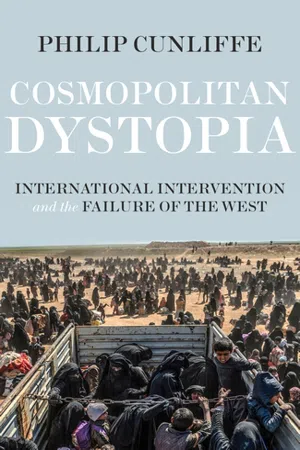
Cosmopolitan dystopia
International intervention and the failure of the West
- 228 pages
- English
- ePUB (mobile friendly)
- Available on iOS & Android
eBook - ePub
About this book
Cosmopolitan Dystopia shows that rather than populists or authoritarian great powers it is cosmopolitan liberals who have done the most to subvert the liberal international order. Cosmopolitan Dystopia explains how liberal cosmopolitanism has led us to treat new humanitarian crises as unprecedented demands for military action, thereby trapping us in a loop of endless war. Attempts to normalize humanitarian emergency through the doctrine of the 'responsibility to protect' has made for a paternalist understanding of state power that undercuts the representative functions of state sovereignty. The legacy of liberal intervention is a cosmopolitan dystopia of permanent war, insurrection by cosmopolitan jihadis and a new authoritarian vision of sovereignty in which states are responsible for their peoples rather than responsible to them. This book will be of vital interest to scholars and students of international relations, IR theory and human rights.
Information
Publisher
Manchester University PressYear
2020Print ISBN
9781526105738
9781526105721
eBook ISBN
9781526105745
Chapter 1
Inverted revisionism and the subversion of the liberal international order
The international order is, it is commonly agreed, facing serious challenges. Incipient trade wars are simmering both east and west. While the European Union struggles to maintain its cohesion, the wars in Syria, Afghanistan and the Sahel continue to rage, and geopolitical tensions between Russia and the West continue to escalate. The challenges are grave, not only by virtue of their magnitude but also because they are antithetical to the ideals and institutions of the liberal order.1 Economic nationalism is eroding multilateral trade and proxy conflicts in Europe and the Middle East are eroding the international peace that has prevailed since the end of the Cold War. In geopolitical terms at least, the fact that authoritarian great powers such as China and Russia, and would-be great powers such as Turkey and Saudi Arabia, seem to exemplify models of self-reliance, strength and stability that are not rooted in liberal democracy exacerbates the sense of crisis. US President Donald Trump’s National Security Strategy brands China and Russia ‘revisionist powers’ and claims that China threatens the sovereignty of states in the Indo-Pacific region.2
Russia in particular has been singled out for its military expansionism and interference, from supporting the Syrian regime of Bashar al-Assad to supporting secessionist rebels in eastern Ukraine, reaching back to its intervention in Georgia in 2008, and it was denounced long before Trump took the White House. Richard Haass, president of the US Council on Foreign Relations, insisted that Russia must be dealt with as a ‘rogue state’ for its interference in the ‘internal affairs of others’ and its failure to show ‘respect for sovereignty’, both keystones of the international order for ‘centuries’, according to Haass.3 Such sharp denunciation has now become par for the course in East–West diplomacy. In her final statement as US representative to the UN in the closing days of the Obama administration, Samantha Power reiterated how Russia had violated the ‘order enshrined in the UN Charter’ based on ‘a set of rules’ that ‘included the rule that the borders between sovereign states should be respected’.4 Obama’s secretary of state Jonathan Kerry had weighed in earlier, saying ‘You just don’t in the 21st century behave in 19th-century fashion by invading another country on completely trumped up pre-text’.5
Such rhetoric is shocking and extraordinary on a number of levels, not least in signalling the return of persistent and bitter denunciations between East and West at the United Nations, something largely unknown since the days of the Cold War. More striking still is the insouciance and effrontery of US diplomats accusing other states of manufacturing pretexts for war and violating states’ sovereignty. Perhaps most striking of all was the sight of Power, a prolific former activist-academic and journalist who had built a career around campaigning for intervention in civil wars around the world, now condemning Russian intervention. Digging under this hypocrisy is the core aim of this chapter. Inasmuch as the use of force has been used to reshape international relations and has consequently destabilised and aggravated geopolitical tensions, this has come from the West – the US, the UK, France and their NATO allies. Such actions were indeed antithetical to quintessentially liberal norms and institutions, undermining self-determination, the sovereign right to non-interference, and subverting the remit and jurisdiction of the UN Security Council. They were also undertaken by liberal powers, states that claimed to stand for the maintenance of the international liberal order and, importantly, cutting against the expectations of International Relations theory. The denunciations of Russia in the same manner in which Russia had criticised the West over the 1990s signals a significant role reversal and, with it, the surest sign yet of the extent to which the constitutive principles of international order have been so thoroughly effaced in international politics that there is no single state or power that can credibly claim to stand for the principled defence of sovereign rights in general.
Before considering the role played by liberal powers in undermining the liberal order, let us consider the role played by authoritarian states and see why it is impossible to attribute the baleful state of international order to their behaviour alone.
Authoritarian great powers such as China and Russia and would-be great powers and regional hegemons such as Turkey, Saudi Arabia and Iran have explicitly cast themselves against the Western-led international order, rejecting democracy and ‘Westernisation’ and scorning the liberal defence of minority rights and the international human rights regime, proffering in their place national self-assertion, religious traditionalism, social conservatism, political cohesion and social order. What sharpen such political differences are the strategic tensions, military interventions and the projections of political influence: Turkey’s intervention in Syria, China’s vast investment programmes across Africa and Eurasia and growing assertiveness in the South China Sea, Saudi Arabia’s intervention in Bahrain and Yemen, Iran’s involvement in Syria and Lebanon and attempt to develop nuclear energy.
Of all these, Russia is seen to be the most militarily assertive and strategically truculent. Russia intervened in Georgia in 2008 as the latter gravitated towards the West, with the former subsequently carving ethnically exclusive protectorates out of Georgian territory and sponsoring their secession – Abkhazia and South Ossetia. More recently and dramatically, Russia annexed Crimea from Ukraine in 2014 and continues to support secessionist rebels in eastern Ukraine, intervening to defend them from central government forces in that country’s civil war. Before all of this, Russia had also been heavily involved in a generation of large and militarily assertive peacekeeping operations across the ex-Soviet Caucasus and Central Asia throughout the 1990s. However, it is Russian military intervention in the Syrian civil war that has arguably been President Putin’s most significant strategic success. Russian intervention in Syria demonstrated the prowess of Russian arms in rescuing a beleaguered ally, turning the war in the latter’s favour and helping to crush Islamic State in Syria – in effect, fighting the war on terror more effectively than Western states themselves. Yet even here, Russian intervention has been limited.6 The actual numbers of Russian troops deployed in Syria are low (estimated at between 3,000 and 5,000): its military successes there amplify the underlying political and military resilience of the Ba’athist regime in Damascus. At the same time, Russia has avoided involving itself in the Yemen war, in which its regional opponents and allies are both involved, and has declined to involve itself in the US campaign against Islamic State in Iraq. It has sought to build its new presence in the Middle East around a conservative vision of defending the political status quo. Moreover, despite the complexity of the multiple proxy factions contending the Syrian civil war, Russia has maintained close, pragmatic relations not only with Iran but also with Turkey and Israel, and has coordinated strategy with Saudi Arabia in the OPEC cartel of oil exporters – all this despite Saudi Arabia being on the opposing side in the Syrian civil war and breaking with the historic pattern of mutual hostility seen in the Cold War. In short, it is difficult to see Russian intervention as rampaging or resurgent, or indeed as merely replicating Cold War geopolitics – Russia remains, in Viatcheslav Morozov’s words, a ‘subaltern empire’, whose paradigm of supposedly cunning ‘hybrid warfare’ reflects weakness more than strength.7
The problem with accounts of the liberal international order that claim it has been subverted by geopolitical rivalry with authoritarian great powers is that it simply doesn’t correspond with the facts. Take China. For the last thirty years, the discourse associated with China’s economic growth has been that of a ‘peaceful rise’.8 For the first time since the Sino-Vietnamese War of 1979, in 2013 China deployed combat forces abroad when it contributed combat contingents to a UN peacekeeping operation with a counter-terrorism mandate in Mali.9 On the whole, China has tended to avoid any international military deployments, restricting its overseas presence to logistics and medical units on peacekeeping missions, and even now it deploys military units only with the sanction of the United Nations.10 In general terms, China’s international behaviour has been cautious and restrained. Moreover, aside from issues concerning Taiwan, up until the Syrian civil war at least, China has generally avoided wielding the veto on the UN Security Council, gamely allowing Russia to lead most confrontations with the P3 since the end of the Cold War.11 Even as recently as 2011, Russia and China abstained from vetoing the NATO campaign against Libya, thereby facilitating the disastrous Western intervention in that country.
For all of Beijing’s political caution, of Chinese economic ascent there is no doubt. Russia by contrast remains economically much weaker and correspondingly more politically defensive. Indeed, in many ways Russian assertiveness today is simply a measure of having enjoyed a degree of economic recovery from the nadir of the 1990s: more than any new foreign policy paradigm, Putinism reflects the rising price of oil.12 Although economically recovered, Russia confronts the same perennial problems stretching as far back as Soviet times: long-term demographic decline, lagging labour productivity and lack of economic diversification. While Russian forces rescued the beleaguered Assad regime, Russia’s limited capacity for global power projection was exposed by the smoky Admiral Kuznetsov aircraft carrier chugging through the Mediterranean as if it were a coal-powered nineteenth-century ship. Indeed, the fact that Syria is geographically close to Russia facilitated Russian intervention in the conflict, as Russia was able to launch cruise missiles into Syria from the Caspian Sea to the east. Neither carving tiny ethnic statelets out of Georgia nor annexing the Ukrainian rust belt will make Russia great again, any more than will a Ba’athist victory in the Syrian civil war. In strategic and political terms at least, Russia remains, at most, a regional great power rather than a global superpower. Neither China nor Russia enjoys an alliance system comparable to NATO either to pool their power or to yoke smaller allies to their cause. The closest analogue to such a grouping, the Shanghai Cooperation Organisation, remains much too youthful and geographically and politically diffuse to be either strategically or military cohesive.
Compounded with these limits, neither China nor Russia offers any ideology of systemic transformation.13 Indeed, quite the opposite. Until recently, Russia and China were both repeatedly castigated not for being too eager to tear up the international order, but rather for being too conservative and attached to the status quo ante! This was the meaning of the charge of being ‘Westphalian’ powers, the accusation that was repeatedly levelled against China and Russian after the end of the Cold War – they were backwards-looking countries, mulishly attached to outmoded models of politics associated with the non-interference principles of the Westphalian order, established long ago, in the eponymous peace accords of 1648.14 This Eurocentric framework, so the charge went, was hopelessly redundant in a globalising world which required new political models of interdependence to substitute for the political ego-centrism and self-sufficiency of the old Westphalian order, not least including extensive rights of intervention to stem international problems that welled up within states but spilled over their boundaries.15 Thus, it was this refusal to change the supposed status quo, not their alacrity in doing so, for which Russia and China were repeatedly castigated.
Indeed, even as China and Russia have asserted themselves on the international stage, it has still often been while cleaving as closely as possible to the status quo. In the wake of the neo-isolationist nostrums of the Trump administration, China has even gestured at claiming the mantle of global liberal leadership to substitute for that of the US, weaving together multilateral free trade and supporting the institutions of collective security such as the United Nations.16 To be sure, Russia has been more militarily revanchist than China, yet even so Russia explicitly models its interventions on those of the West. Murderous oppression of Georgia’s ethnic minorities was cited in defence of Russia’s intervention in Georgia in 2008.17 The Russian-sponsored unilateral declarations of independence by Abkhazia, South Ossetia and more recently Crimea were all explicit in referring to the precedent of Kosovo’s unilateral secession from Serbia in 2008, itself a product of NATO military intervention in 1999 without UN sanction.18 This reflects, as Morozov argues, the ‘normative dependence of the Russian subaltern empire on the West and/or Europe as the only standard against which their own legitimacy is established, domestically as well as internationally’.19 More broadly, strategically speaking, Russian intervention has persistently been reactive: military operations lashing out at the perceived encroachment of Western influence in the Caucasus and Ukraine.20 Even in Syria, Russian intervention has been intended to preserve one of Russia’s few remaining extra-European allies, and to establish a platform for Russia to be considered a geopolitical partner with the West outside of Europe.21
To be clear, the point here is not how authentic or plausible we find the justification provided by Russian foreign minister Sergei Lavrov for Russian intervention in Georgia, or how legitimate a Crimean vote for secession could ever be while under occupation by Russian special forces. The only point germane to the argument here is that Russia does not offer any elaborated alternative ideology or political framework to justify its interventions and protectorates, instead cleaving as tightly as possible to whatever legitimacy can be stripped from existing Western precedent and practice: ‘it has no sources of legitimacy’, argues Morozov, ‘other than repeated reference to the universal values of the “civilized world”’.22 Moreover, Russia continues to criticise Western intervention from the perspective of global multilateralism crowned by the supremacy of the UN Security Council.23 This cleaving to precedent is true of other instances of intervention by non-Western states. So concerned was the Saudi government to claim humanitarian legitimacy for its intervention in Yemen that it even went to the farcical extent of naming its operation there, Operation Restoring Hope, after the ill-fated US intervention on the other side of the Gulf of Aden, in Somalia, back in the 1990s: ‘Operation Restore Hope’. The Saudi intervention has, indeed, been far more inhumane than the US–UN prototype in Somalia. As we have seen, if Russian justifications are hypocritical, the Russians cannot be accused of having a monopoly on hypocrisy. Looking beyond such accusations, though, the fact that Russia has undermined its own credibility as a defender of sovereign rights shows that there is no major state left in the world that can plausibly stand as a consistent and principled exponent of state sovereignty. How could such a thing have come to pass?
Identifying revisionism
If we do look for a revisionist challenge to the international status quo, what do we find? The aggressive use of force, external interference in the internal affairs of sovereign states, an ideology of systemic transformation, the establishment of new international institutions? We do not need to look far: it is obvious that the only contenders for such a role since the end of the Cold War are Western states, principally the US, the UK and France, with varying degrees of support from other Western states both within NATO (Italy, Germany) and outside it (e.g., Australia, New Zealand, Japan, Sweden). That Russian interventions should seem shocking, unprecedented and outrageous only speaks to the extent to which Western intervention has become so normalised and ro...
Table of contents
- Cover
- Half Title
- Dedication
- Title Page
- Copyright
- Contents
- List of figures
- Preface and acknowledgements
- Introduction: the rise of cosmopolitan dystopia
- 1 Inverted revisionism and the subversion of the liberal international order
- 2 Through the looking-glass: the new critics of intervention
- 3 What should we do? The politics of humanitarian exceptionalism
- 4 Failed states, failed empires and the new paternalism
- Conclusion: waiting for the Americans
- Notes
- Bibliography
- Index
Trusted by 375,005 students
Access to over 1.5 million titles for a fair monthly price.
Study more efficiently using our study tools.
Frequently asked questions
Yes, you can cancel anytime from the Subscription tab in your account settings on the Perlego website. Your subscription will stay active until the end of your current billing period. Learn how to cancel your subscription
No, books cannot be downloaded as external files, such as PDFs, for use outside of Perlego. However, you can download books within the Perlego app for offline reading on mobile or tablet. Learn how to download books offline
Perlego offers two plans: Essential and Complete
- Essential is ideal for learners and professionals who enjoy exploring a wide range of subjects. Access the Essential Library with 800,000+ trusted titles and best-sellers across business, personal growth, and the humanities. Includes unlimited reading time and Standard Read Aloud voice.
- Complete: Perfect for advanced learners and researchers needing full, unrestricted access. Unlock 1.5M+ books across hundreds of subjects, including academic and specialized titles. The Complete Plan also includes advanced features like Premium Read Aloud and Research Assistant.
We are an online textbook subscription service, where you can get access to an entire online library for less than the price of a single book per month. With over 1.5 million books across 990+ topics, we’ve got you covered! Learn about our mission
Look out for the read-aloud symbol on your next book to see if you can listen to it. The read-aloud tool reads text aloud for you, highlighting the text as it is being read. You can pause it, speed it up and slow it down. Learn more about Read Aloud
Yes! You can use the Perlego app on both iOS and Android devices to read anytime, anywhere — even offline. Perfect for commutes or when you’re on the go.
Please note we cannot support devices running on iOS 13 and Android 7 or earlier. Learn more about using the app
Please note we cannot support devices running on iOS 13 and Android 7 or earlier. Learn more about using the app
Yes, you can access Cosmopolitan dystopia by Philip Cunliffe in PDF and/or ePUB format, as well as other popular books in Politics & International Relations & Military & Maritime History. We have over 1.5 million books available in our catalogue for you to explore.