- 99 pages
- English
- ePUB (mobile friendly)
- Available on iOS & Android
eBook - ePub
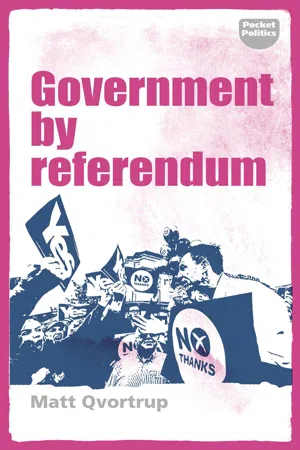
Government by referendum
About this book
Referendums are ubiquitous; from Brexit in the United Kingdom in 2016 to same-sex marriage in Australia in 2017 Why are referendums held at all? And when they are held, why are they won or lost? Moreover, what are the consequences of having referendums? Do they strengthen or weaken democracy? Are they mainly won or mainly lost or do they strengthen populist leaders? Or, are referendums a shield against demagogues and overeager politicians? Government by Referendum analyses why politicians sometime submit issues to the people Based on an historical analysis, but with an emphasis on the last two decades, the book shows that referendums often have been lost by powerful politicians. While sometimes used by autocrats, mechanisms of direct democracy have increasingly performed the function of democratic constitutional safeguards in developed democracies.
Information
1
The world history of referendums
Introduction
IN this chapter I trace the history of the referendum from its earliest origins to its present-day use – or, some would say, abuse. After a tour d’horizon of the earlier use of the direct democracy, it first presents a historical overview of the use of referendums from the Renaissance through to the First World War. It is pointed out that the referendum – contrary to assertions by Tuck (2016) – can be traced back to the fifteenth century. Despite the term’s earlier use, the referendum began to be used in earnest only in the nineteenth century, when the Italian Risorgimento and the early years of the Swiss Federation (after 1848) essentially owed their existence to the use of the referendum. Having analysed these cases I take a closer look at the discussion about the referendum in the United Kingdom and the European continent. Drawing on a functionalist-inspired model, the chapter ends with reflections and research on why there has been an apparent increase in the use of the referendum since the 1980s.
The earlier history of direct democracy
Like so many other things political, the referendum in the form we know it today (a vote by the mass population on a policy proposal) was the invention of the French revolutionaries. The so-called Girondins – who were in conflict with the more radical Jacobins – proposed that the people should be allowed to veto constitutional changes. And this, according to Tuck, ‘was the first time that the modern notion of a plebiscite or a referendum had been raised’ (Tuck 2016: 143). It perhaps says a lot about the cavalier fashion in which direct democracy is treated that the otherwise well-informed scholar got it wrong. For, as we shall show below, the referendum had already operated for hundreds of years at this time. By the time of the French Revolution, the term referendum had first been used in what was to become present-day Switzerland, where, in 1684, the Bürger (all male citizens over the age of sixteen) were given the right to cast their votes on the policy issues that were submitted to them ad referendum by the elected representatives (Pieth 1958: 146).
But the Swiss were not the only ones to submit issues to the people, though they were the first ones to use the word referendum. Before we return to the use of direct democracy in modernity (the period after AD 1500), it is instructive to go back to the very beginning: to Greece and Rome.
As historians of ancient democracy can testify, direct democracy was the central element of the political system of ancient Greece, where in the fourth century BC decrees ‘were passed by majority vote of those Athenians attending the meetings of the Assembly (ekklesia), which were held four times per civil month, or forty times per annum’. This system of direct democratic involvement was also characteristic of the Athenian democracy after the Peloponnesian War, i.e. between 400 and 320 BC (Hansen 1991).
It is possible to argue that the Romans employed a certain kind of direct democracy before the fall of the Republic in 49 BC. And, there are some suggestions that other peoples used what we today may describe as direct democracy. The Roman historian Tacitus (56–117) described the use of proto-referendums among Germanic tribes where ‘on matters of minor importance only the chiefs debate; [but] on the major matters the whole community’ (Tacitus 1970: 110). Similar stories could be told about the Italian Renaissance states. Niccoló Machiavelli eulogised a system of politics that had been brought into being ‘by the consent of a whole people’ – da uno commune consenseo d’una universalità (Machiavelli, III, 7). But it was not until the early sixteenth century that the institution was established in anything resembling the present-day referendum.
The referendum 1527–1789
Historically referendums were about self-determination. The first instances of referendums in anything like the present form date back to 1527 when the French King Francis I (1494–1547) held a plebiscite in Burgundy on whether to transfer the area to the Spanish King in 1527 as he had agreed to in the Treaty of Madrid (Vattel 1758: 263).
The people rejected the transfer and stayed with France. And scholars have later speculated (Wambaugh 1933: xxiii) – though without much by way of concrete evidence – that the French King was inspired by the Dutch philosopher Erasmus of Rotterdam (1466–1536) who in 1517 had made a case for the view that ‘what power and sovereignty so ever you have, you have it by the consent of the people’ (Erasmus 1907: 51).
Of course, ‘the people’ in those days comprised a rather small number: those entitled to vote were only property-owning males. Whether a practical man like King Francis devoured texts by Renaissance theologians – as suggested by Wambaugh (1933: xxiv) – can be questioned. However, a few years later, Francis’s son, Henry II (1519–59) organised a plebiscite in 1552 in Verdun, Toul and Metz before their annexation (Solière 1901: 26).
Before the plebiscite, Bishop de Lénoncourt is reported to have said to the inhabitants of Verdun ‘that the King of France had come as a liberator who will treat the citizens as good Frenchmen … He appealed to the vote of the people’ (Solière 1901: 26). It is noteworthy that the cleric used words such as bourgeois and peuple at a time when Jean Bodin (1530–96) expounded his theory of divinely sanctioned absolutism by the grace of God in Six livres de la République in 1579 (Bodin 1986).
But we have few contemporary accounts of what motivated the use of referendums at the time. Indeed, it was almost a century before these practices were placed on anything like a theoretical footing. Hugo Grotius (1583–1645), the great legal scholar and father of international law, observed in De Jure Belli ac Pacis that ‘in the alienation of a part of sovereignty, it is required that the part which is alienated consent to the act’ (Grotius 2005: 570).
The referendum 1789–1920
The French Revolution heralded a new era of democracy. Rather predictably, therefore, referendums were embraced by the new rulers in Paris. Indeed, no less a theoretician than Baron de Condorcet (1743–94) had published a pamphlet in 1789 with the telling title Sur la Nécessité de faire Ratifier la Constitution par les Citoyens – roughly translated, ‘in the necessity of the people ratifying the constitution’ (Condorcet 1847).
At this stage this was not mere idle talk. Indeed, France’s annexation of Avignon in 1791 took effect only after a referendum had been held in the area. A contemporary report read:
Considering that the majority of the communes and citizens have expressed freely and solemnly their wish for a union with Avignon and France … the National Assembly declares that in conformity with the freely expressed wish of the majority … of these two countries to be incorporated into France. (cited in Martens 1801: 401)
It is conventional to note that the Congress of Vienna dealt a blow to the doctrine of self-determination – and, as a consequence, to the use of referendums: ‘The Congress of Vienna in 1815 did not accept self-determination as a basis for reshaping the map of Europe’ (Griffiths 2003: 38). The victors in the Napoleonic wars were conservatives who wanted to return to a time when the popular sovereignty was not the gold standard of political legitimacy. The perception was that the excesses of ideological fervour and the horrors of the Napoleonic wars gave democracy a bad name. This changed after the revolutionary year of 1848 when the referendum once again became fashionable, though only for Bonapartists: neither Republicans nor Monarchists liked it, and the Socialists abandoned it in this period.
Napoleon III, who used dubious plebiscites to claim popular legitimacy, especially espoused referendums. And in international affairs, self-determination of the people was accepted once again (Weitz 2008). Two areas are of particular interest. Italy – where several referendums were held in the name of self-determination as a part of the process to unify the country – and Schleswig-Holstein (between present-day Denmark and Germany), where a referendum was proposed, but not held, over the fate of the province.
The Risorgimento referendums in Italy were held to put pressure on the great powers that were reluctant to change the status quo. In a series of votes held between 1848 and 1870, different parts of Italy voted to join the new unified state under the constitutional monarch Victor Emmanuel of Sardinia. Camillo Benso di Cavour (1810–61) expressed the consensus among those advocating the use of referendums at the time in a letter before the referendum in Tuscany and Emilia in 1860:
I await with anxiety the result of the count, which is taking place in Central Italy. If, as I hope, this last proof is decisive (questa ultima prova), we have written a marvellous page in the history of Italy. Even should Prussia and Russia contest the legal value of universal suffrage, they cannot place in doubt (non potranno mettere in dubbio) the immense importance of the event today brought to pass. Dukes, archdukes and grand-dukes will be buried forever beneath the heap of votes deposited in urns of voting places of Tuscany and Emilia. (Cavour 1883, vol. 3: 211, my translation)
Cavour was perhaps correct in expressing doubt about the sincerity of the commitment on the part of more autocratic powers such as Prussia and Russia, yet even these countries were surprisingly positive towards referendums on self-determination in the 1850s and 1860s.
Britain’s mediation between Denmark and Prussia following the first part of the First Schleswig War in 1848–51 is a case in point. Lord Palmerston (the British foreign secretary 1846–51) suggested to Christian von Bunsen, the Prussian ambassador in London, that the dispute should be decided ‘with reference to the ascertainable facts’, and that these could be found only through a referendum (Palmerston 1848: 1321). The Prussian diplomat responded:
Germany [sic!] cannot give up the principle declared on all occasions that no separation of any part of Schleswig can ever be thought of, unless the population in the northern districts themselves declare, by an open and unbiased manifestation of their intention to that effect. (Graf von Bunsen to Palmerston, 24 June 1848, British and Foreign State Papers, vol. 40: 1321)
The proposal was, however, rejected by the Danes, who militarily had the upper hand. In 1864, during an armistice following Prussian victories in the first part of the Second Schleswegian War, the Prussian foreign minister Peter Graf von Bernsdorff maintained at the London Conference that he was guided by the conviction that the ‘conference should be aware of the wish of the people whose future they were debating [and that] the inhabitants of Schleswig should be consulted on the subject’ (Bernsdorff, in Conference of London, Protocol No. 10, 1864).
The Danes rejected the proposal, believing – wrongly as it turned out – that the British would oppose Prussian annexation. After the Prussian defeat of Denmark, the Treaty of Prague made annexation conditional upon the consent of the people. However, in January 1867, Prussia (having realised opposition against its rule) annexed Schleswig-Holstein in toto without a referendum. Once again pragmatism – or Realpolitik? – triumphed over idealism.
The referendum on self-determination played a very minor role in the years following the Franco-German War. Tellingly, given that the referendum is often used in an opportunistic way, leading German lawyers now rejected the use of referendums whereas French international lawyers and intellectuals rediscovered the attractions of letting the people decide.
The referendum in Switzerland in the nineteenth century
Meanwhile the referendum was gaining prominence in Switzerland, and not just in the rather arcane form of Landesgemeinde (public open-air meetings where male citizens voted on local laws). That only men were allowed to vote was not unusual in those days. It is worth pointing out, though, that Swiss women gained the vote only in the early 1970s, all previous attempts having been vetoed in referendums.
Notwithstanding this deplorable and sexist discrimination, the Swiss pioneered the referendum and invented the term itself in the seventeenth century. Yet, although the device could be traced back hundreds of years, the modern use of the referendum was a result of a compromise that emerged in the period after the Sonderbund War (1848).
The Radical Party (from 1894 renamed and most commonly known as the Freisinnig-Demokratische Partei der Schweiz, FDP) was the dominant force in Swiss politics immediately after the civil war. The party pursued a twin track of muscular secularism and free-market and laissez-faire liberalism. Under the majoritarian (first-past-the-post) electoral system the party was able to win a majority of the seats in the Bundesrat (the executive) without winning a majority of the votes.
Realising that the Radical majority in the Bundesrat did not always have the support of the voters at large, and that Catholics and Protestants shared some of the same interests, their confessional disagreements notwithstanding, the confessional groups began to push for the introduction of a popular veto: a referendum in which the voters could vote on legislation already passed (provided they could collect a specified number of signatures). The Radicals, for their part, wanted to strengthen their stranglehold on power. After a constitutional reform was rejected in 1872, the Radicals accepted that the popular referendum should be introduced in return for federal control over legislation (something the Catholics opposed). It was not anticipated that the referendum would be widely used as it would require collaboration between Catholics and Protestants against the secular Radicals.
But – contrary to the Radicals’ predictions – the confessional groups were able to co-operate despite their theological disagreements. This resulted in a number of important changes that challenged the Radicals’ virtual monopoly on legislative power in t...
Table of contents
- Cover
- Half Title
- Title Page
- Copyright
- Contents
- List of figures and tables
- Acknowledgements
- Introduction
- 1 The world history of referendums
- 2 The history of the referendum in Britain
- 3 Brexit campaign: the anatomy of a bitter divorce battle
- 4 The myth of populist referendums
- Concluding unscientific postscript
- Further reading
- References
- Index
Trusted by 375,005 students
Access to over 1.5 million titles for a fair monthly price.
Study more efficiently using our study tools.
Frequently asked questions
Yes, you can cancel anytime from the Subscription tab in your account settings on the Perlego website. Your subscription will stay active until the end of your current billing period. Learn how to cancel your subscription
No, books cannot be downloaded as external files, such as PDFs, for use outside of Perlego. However, you can download books within the Perlego app for offline reading on mobile or tablet. Learn how to download books offline
Perlego offers two plans: Essential and Complete
- Essential is ideal for learners and professionals who enjoy exploring a wide range of subjects. Access the Essential Library with 800,000+ trusted titles and best-sellers across business, personal growth, and the humanities. Includes unlimited reading time and Standard Read Aloud voice.
- Complete: Perfect for advanced learners and researchers needing full, unrestricted access. Unlock 1.5M+ books across hundreds of subjects, including academic and specialized titles. The Complete Plan also includes advanced features like Premium Read Aloud and Research Assistant.
We are an online textbook subscription service, where you can get access to an entire online library for less than the price of a single book per month. With over 1.5 million books across 990+ topics, we’ve got you covered! Learn about our mission
Look out for the read-aloud symbol on your next book to see if you can listen to it. The read-aloud tool reads text aloud for you, highlighting the text as it is being read. You can pause it, speed it up and slow it down. Learn more about Read Aloud
Yes! You can use the Perlego app on both iOS and Android devices to read anytime, anywhere — even offline. Perfect for commutes or when you’re on the go.
Please note we cannot support devices running on iOS 13 and Android 7 or earlier. Learn more about using the app
Please note we cannot support devices running on iOS 13 and Android 7 or earlier. Learn more about using the app
Yes, you can access Government by referendum by Matt Qvortrup in PDF and/or ePUB format, as well as other popular books in Politics & International Relations & American Government. We have over 1.5 million books available in our catalogue for you to explore.