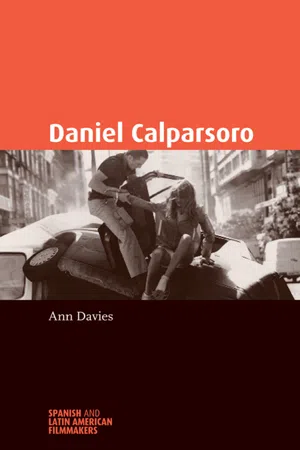
Daniel Calparsoro, a director who has provided a crucial contribution to the contemporary scene in Spanish and Basque cinema, has provoked strong reactions from the critics. Reductively dismissed as a purveyor of crude violence by those critics lamenting a 'lost golden age' of Spanish filmmaking, Calparsoro's films reveal in fact a more complex interaction with trends and traditions in both Spanish and Hollywood cinema.
This book is the first full-length study of the director's work, from his early social realist films set in the Basque Country to his later forays into the genres of the war and horror film. It offers an in-depth film-by-film analysis, while simultaneously exploring the function of the director in the contemporary Spanish context, the tension between directors and critics, and the question of national cinema in an area – the Basque Country – of heightened national and regional sensitivities.
- 200 pages
- English
- ePUB (mobile friendly)
- Available on iOS & Android
eBook - ePub
Daniel Calparsoro
About this book
Information
Publisher
Manchester University PressYear
2013Print ISBN
9781526139405
9780719073649
eBook ISBN
9781847796509
Subtopic
English Literary CriticismPART I
The context
1
Introduction
The purpose of this study is essentially twofold, although one element will appear more immediate than the other. It is in the first place to consider the work of a contemporary Spanish film director, Daniel Calparsoro, and to do so arguably in auteurist terms. The reasons for doing so are theorised more explicitly below, although anyone picking up this book might assume the approach to be already implied by taking a single director as a focus of study. That this study does not take auteurism for granted is suggested by the second element of its overall purpose, to relate the work of one director to his (in this case) specific context, the Spanish industry within which he makes his films. And in doing this it is not a question of simply enlarging the auteurist frame to take in more of the background – the auteur as dominant voice in a chorus, rather than as solo singer. It is to suggest the director as a nexus, a crossing point, of interrelated threads that go to make up the contemporary Spanish cinema scene. In this light, a study of Calparsoro should tell us something not only about Calparsoro’s films but also about Spanish cinema of today and the ways in which it is studied, written about and presented. The present study aims to make explicit some of the ways in which certain films and production processes are implicitly deemed more desirable, more worthy of attention by academics, critics and audiences (with the recognition that these groups are not always distinct from each other: they may find themselves embodied in the selfsame individual). It does so first by studying Calparsoro within his industrial context. Part I of this book offers an overall presentation of Calparsoro and his total corpus of work to date in relation to trends and traditions within Spanish cinema, serving to problematise these. Thus Calparsoro is discussed against the background of specific developments in Spanish cinema since 1995, how both the film industry and critics perceived these developments, and how perceptions changed (or not) after Spanish cinema arguably fell into crisis from 2002. It also considers Calparsoro as part of ongoing efforts on the part of some scholars to distinguish a specifically Basque cinema from Spanish cinema more generally, and within this the director’s oeuvre as part of a more particular debate linking Basque cinema to the representation of violence as an example of the complexities of attempting to determine a Basque national cinema. Part I continues with a consideration of the overlap that can occur between director/auteur and another element of film industry and culture that has risen to prominence more recently in film studies, the star, and how the star can impinge on our perception of the director (and vice versa). The argument here is then placed within a wider framework, that of Calparsoro’s use of female characters in his films in relation to trends of the depiction of women more generally in Spanish cinema. Following this overview of Calparsoro’s interaction with the cinematic context around him, the study then proceeds in Part II to a more detailed discussion of Calparsoro’s individual films with the intention of teasing out still further the interrelation of director and industrial/cultural context.
The overall twofold purpose of this study – the dialogue between auteurism and film industry and culture, and in particular the way in which film is critiqued – makes Calparsoro a particularly apt choice for the simple reason that, as I will argue, his specific styles and themes are at present at odds with preferred forms of filmmaking, and ways of interpreting filmmaking, so that his own films seem anachronistic in contemporary Spanish cinema. In fact, as I hope to demonstrate, Calparsoro’s films suggest greater continuity with some aspects of Spanish film today than such a notion implies. Nonetheless, I would claim that the overall perception of Calparsoro at the moment is very much one of a director against the grain, and this perception tells us as much if not perhaps more about prevailing values within the Spanish film scene as about Calparsoro himself or his own films. Calparsoro formed part of a new vanguard of directors that appeared in the mid-1990s. This resurgence is widely thought to have derived to a great extent from the slicker commercial values synonymous with Hollywood cinema, induced not only by a growing difficulty in obtaining government funding for films (in contrast to government support in the 1980s) but also by a new generation of Spanish directors who had grown up not only without the impulse to resist the ideologies of the dictatorship of 1939–75 but with the desire to make films like the ones they themselves enjoyed, which tended to be the Hollywood ones. Such an interpretation of the contemporary Spanish scene is of course reductive; earlier directors were not all necessarily interested in resistance to dictatorship and some were indeed looking for box-office success (mostly through comedy, a trend that persists today), nor have directors today necessarily dispensed with the desire to critique ideologies and values simply in order to churn out Hollywood imitations. In addition, the perception of the resurgence in terms of Hollywood carries the danger of neglecting the nuances that pertain in the Hollywood industry itself, which does not consist simply of box-office blockbusters. Nonetheless, the sense of a creeping Hollywoodisation haunts discussion of contemporary Spanish cinema, a perception that Spanish cinema is more closely aligned to commercial and high production values commonly associated with Hollywood.
In contrast to a simplistic assumption that Spanish directors today are moulded by US production values, Calparsoro has struck out on his own individual path ever since his debut feature film of 1995, Salto al vacío (Jump into the Void). In the process he has demonstrated the intricacies, conflicts and ambiguities that link a debatable national cinema (Spanish, Basque), the values of other cinemas both Hollywood and European, and also auteur style. Calparsoro’s corpus of work, particularly the early films, is reminiscent of the older style of Spanish auteur with links to the cine social that recurs not only within Spain but European cinema more generally; but his style and themes suggest a contemporary figuration of auteurist cinema that includes his recent move in the direction of the war film with Guerreros (Warriors, 2002) and the growing corpus of contemporary Spanish horror with Ausentes (The Absent, 2005), thus suggesting that the director is neither totally divorced from current filmmaking trends nor confined to older forms of Spanish filmmaking. It is for these reasons that Calparsoro merits a more detailed and systematic study than he has hitherto received in either Spanish or Anglo-American scholarship. While he might not have the national and international status of other Spanish directors, his work garnering less attention than the commercial big hitters of Spanish cinema such as Pedro Almodóvar and, more recently, Alejandro Amenábar, he is nonetheless an important exemplar of Spanish cinema from and beyond the upsurge of 1995. Calparsoro can arguably be claimed as one of the 1995-plus generation (at the risk of saddling Spanish culture with another generational label to match those that pertain in literature): this generational conceptualisation is highly implicit in the two major works by Carlos Heredero, whose writings on the new generation of directors are now, according to Núria Triana-Toribio (2003: 147), generally accepted by Spanish academics and critics. Francisco María Benavent (2000: 12) is less enamoured of the notion of a generation, since he believes that the new directors might share the same age but not the same interests). Heredero’s 20 nuevos directores (1999) showcases the work of those directors who are comparatively new to Spanish cinema but whose films suggest the potential for prominence on the Spanish scene. Heredero’s heftier Espejo de miradas (1997) provides lengthy interviews with these and other directors. Calparsoro is included in both volumes, which has done something to maintain a continued scholarly interest in his work. More will be said about this notion of the new generation of film directors in a more detailed discussion of the Spanish cinema scene below; at the moment it is sufficient to note the importance of the concept in discussion of contemporary film. Now that just over a decade has passed since that upsurge it is time to begin to look in more detail at what has endured into the new century; and looking at the corpus of work of a director such as Calparsoro is one contribution to this process.
This becomes more timely as the original impetus that heralded 1995 fades away and attitudes towards the upsurge – and the directors involved in it – change with the benefit of a certain amount of hindsight (in particular the failure in promise of some of the newer directors) and, as we shall see in Calparsoro’s case in particular, a certain amount of exasperation that some members of the new generation could not settle down to either commercial success or a smooth transition to arthouse cinema. While Calparsoro’s first film was hailed as evidence of raw talent, enthusiasm gradually gave way to impatience from some critics and reviewers with his style. Although academics have not been quite so quick to criticise, they have nonetheless devoted their attention to the very early work of Calparsoro while neglecting the latter (see, for example, Ballesteros (2001), Rodríguez (2002a)). The present volume will draw on these earlier insights, but will expand on them – in conjunction with my own ideas on Calparsoro’s early work – to cover the later work as well, and trace the development of a contemporary director in the contemporary Spanish scene.
The stress I have placed hitherto on Calparsoro’s positioning within contemporary cinema should not, however, obscure his links – whether intentional or not – to other, more established trends in filmmaking in Spain and Europe more generally. I have in mind here the strand of filmmaking that deliberately addresses local social realities – known as cine social in the Spanish context. A particular subgenre of the cine social has become prevalent in Spanish and European filmmaking, what I term the ‘marginalised urban youth’ genre. This involves films that revolve around the frustrations of young people in deprived urban settings with the lack of resources and opportunities in their environment. Calparsoro’s first four films exemplify this genre, but what makes him unusual in this group in his emphasis on female protagonists and female subjectivity, as opposed to the sense of woman as other, as just one more unattainable and incomprehensible thing in a sphere of general frustration. Very few other directors in Spanish cine social do this. This offers another and very urgent reason for the study of Calparsoro’s work.
The resurgence of Spanish cinema at the end of the twentieth century should not obscure the continuities with earlier forms of Spanish cinema more generally, of which cine social is one vital part. Although the marginalised urban youth genre may have become prevalent in contemporary cine social, it was not new. Carlos Saura made a notable contribution to the genre with his early film Los golfos (Hooligans, 1962) and later Deprisa deprisa (Hurry, Hurry, 1981), while Luis Buñuel provided perhaps the classic example with his Mexican film Los olvidados (The Young and Damned, 1950). It is significant that these are major directors in Spanish film history; previously cine social coincided with the height of auteurism in Spain, facilitating a distinction between cinema as high art – or at the very least social comment – and cinema as entertainment. This dichotomy between the two forms of cinema can be condemned as oversimplistic, not least because it frequently led to a devalorisation of popular and commercial vehicles. But the recent swing in Spanish film scholarship towards popular cinema, welcome as it is, should not blind us to the fact that this division is still with us and that we have not left behind the desire to make difficult cinema. The challenges to interpretation of arthouse cinema mean that academics, despite the turn towards the popular, are unlikely to leave arthouse alone for long. The disadvantage for now is that those directors deemed less accessible to audiences get less of the attention lovingly devoted to earlier directors who offered similar problems. Currently, directors who do not fit the popular or populist model run the risk of neglect due to a dismissal of older models of film critique. Calparsoro’s style of filmmaking does not approach the surrealism of Buñuel (though there are still some continuities, as we shall see in the discussion of his second film Pasajes (Passages, 1996)); nonetheless, his early films are not so slick or easily digestible as the works of other directors. Entertainment has filtered into contemporary cine social with films that offer heart-warming stories alongside a dissection of specific social issues; notable examples include Solas (Alone, Benito Zambrano, 1999) and Flores de otro mundo (Flowers from Another World, Iciar Bollaín, 1999). Calparsoro does not seek to entertain. His stories are not tied up with neat bows at the end: the early films – Pasajes above all – end rather abruptly. The sheer noise of some of the films, the incomprehensible dialogue, the sense of bleak annihilation and despair; all these are not easy to absorb.
For the above reasons, then – all of which will be elaborated further in the course of this book – a study of Calparsoro’s films can tell us not only about the work on an individual director and the potential for auteurism in Spanish cinema today but also something about the wider national industry and culture and the ways in which they are perceived and interpreted, indicating that the auteur is neither a thing apart from a more pervasive cinema culture and industry nor subordinate to it or absorbed by it. I hope in the course of this study to explore in depth the intricacies of Calparsoro’s films but in so doing to say something not just about him but about his context.
Calparsoro, theories of auteurism and the Spanish context
Why discuss Calparsoro in auteur terms at all? Mark Allinson notes that Hispanists have preferred to use an auteurist approach to film, while critics in Spain have preferred a historical approach, both of which ignore the transformation of the Spanish film industry by the market and by an increasing preference for genre (Allinson, 2003: 143–4). Yet he also observes that this does not in fact mean the death of the auteur but reformulations of the notion: ‘Young, hip Spanish directors are keen to exploit constructions as auteurs commercially while creating increasingly genre-based films’ (151). This description of the contemporary Spanish director fits Calparsoro neatly as he moves from social realist film to the war and horror genres. It is reflected in the critique of his work which, as I shall discuss in the following chapters, insists on assessing him in quasi-auteurist terms (in slight contradiction of the historical perspective perceived by Allinson). But while Calparsoro has recognisable links with the generation of ‘young, hip directors’ within which he is customarily included, his works have elements that either distinguish him from or problematise prevailing trends in Spanish cinema. In particular, the fact that since approximately 2002 and the putative new crisis in Spanish cinema (of which more below) he appears to be at odds with the main contemporary strand of Spanish film scholarship and critique allows us to consider the value of discussing the work of an individual director in terms of the cultural and industrial context. It is interesting, although probably coincidental, that the upsurge of Spanish cinema came towards the end of a revival of auteurist theory within film studies, which earlier fell out of favour because of its separation of the director from the collaborative production context within which he (and it nearly always was he) worked. The concept of the auteur has, however, proved a little too useful or convenient to disappear completely, and the 1990s saw a revamped concept of the auteur proposed, one that included crew, production, industry and socio-historical context as part of the field of study, but recognising that a director is not necessarily simply subordinate to these concerns. In particular, the auteur was allowed to claim both commercial and artistic success. Calparsoro himself has argued that the denigration of the concept of the auteur is a fear of, a way to ensure control over, the young director (Heredero, 1997: 260): the revival of the concept has neatly coincided with Heredero’s figuring of contemporary Spanish cinema through the figure of the director, giving it – and giving the directors of the contemporary Spanish scene – continued critical power.
Timothy Corrigan argues for the contemporary auteur as ‘a commercial performance of the business of being an auteur’ (Corrigan, 1991: 104; italics in original) and goes on to comment:
In the cinema, auteurism as agency thus becomes a place for encountering not so much a transcending meaning (of first-order desires) but the different conditions through which expressive meaning is made by an auteur and constructed by an audience, conditions that involve historical and cultural motivations and rationalizations […] the commercial status of that presence [of the auteur] now necessarily becomes part of an agency that culturally and socially monitors identification and critical reception. (Corrigan, 1991: 105)
Corrigan is writing primarily about US cinema, and there the word ‘commercial’ as applied to cinema has a different resonance from the European context. How does Corrigan’s notion of the contemporary auteur fit in the Spanish context where very few directors have the commercial success of the Almodóvars and the Amenábars? In a cinema where commerce does not have quite the same power as in the USA – where funding comes primarily from coproductions, government cultural bodies and the like – how applicable is Corrigan’s analysis for the Spanish context? Calparsoro may not have the financial clout of his fellow generation member Amenábar, yet he nonetheless obtains money to make his films, and thus has in the last decade succeeded in establishing a reasonable corpus of films (larger than Amenábar’s in fact). The number of films in a resumé may depend on other factors as well as finance, but we can posit that Calparsoro is ‘commercial’ enough to continue making films. In any case, within Spain as elsewhere, the division between auteurism and commercial cinema is increasingly blurred. Peter Evans (1999: 2–3) observes that in Spain successful cinema of the last two decades of the twentieth century has tended to be associated with recognised auteurs. He also observes (3) an increasing convergence of auteurist or arthouse cinema with popular cinema, drawing on audience awareness of the codes of the latter. Thus Spanish auteurist films ‘incorporate elements of the popular in texts that transcend postmodernist abolition of aesthetic boundaries in their pursuit of more thorough treatment of subjects that in popular cinema often proved for various reasons – say, commercial or ideological – too difficult’ (4).
Corrigan suggests that auteurs fall into two broad groups. He first posits the commercial auteur, with whom ‘the celebrity of their agency produces and promotes texts that invariably exceed the movie itself, both before and after its release’ (Corrigan, 1991: 107). In the Spanish context, Almodóvar is an obvious example of such an auteur: his name functions as a brand label (and his films carry his name as a label in precisely this way: the title credit is immediately followed by the caption ‘an Almodóvar film’). Amenábar, too, functions in such a way: his name is key in promoting his work. This chimes with Corrigan’s suggestion of the auteur as star:
auteurs have become increasingly situated along an extratextual path in which their commercial status as auteurs is their chief function as auteurs: the auteur-star is meaningful primarily as a promotion or recovery of a movie or group of movies, frequently regardless of the filmic text itself. (Corrigan, 1991: 105)
It is tempting to place Calparsoro into this first group, since arguably his name functions as label for his particular style and he, too, uses his name as a label in the opening credits much as Almodóvar does. He is, however, an oddity alongside the auteurs that Corrigan cites in this first group (Spielberg, Lucas, Woody Allen, to offer but three examples: Almodóvar might, however, fit here). But in Corrigan’s...
Table of contents
- Front Cover
- Title Page
- Copyright Page
- Contents
- List of illustrations
- Acknowledgements
- Part I The context
- Part II The films
- Filmography and synopses
- Bibliography
- Index
Trusted by 375,005 students
Access to over 1.5 million titles for a fair monthly price.
Study more efficiently using our study tools.
Frequently asked questions
Yes, you can cancel anytime from the Subscription tab in your account settings on the Perlego website. Your subscription will stay active until the end of your current billing period. Learn how to cancel your subscription
No, books cannot be downloaded as external files, such as PDFs, for use outside of Perlego. However, you can download books within the Perlego app for offline reading on mobile or tablet. Learn how to download books offline
Perlego offers two plans: Essential and Complete
- Essential is ideal for learners and professionals who enjoy exploring a wide range of subjects. Access the Essential Library with 800,000+ trusted titles and best-sellers across business, personal growth, and the humanities. Includes unlimited reading time and Standard Read Aloud voice.
- Complete: Perfect for advanced learners and researchers needing full, unrestricted access. Unlock 1.5M+ books across hundreds of subjects, including academic and specialized titles. The Complete Plan also includes advanced features like Premium Read Aloud and Research Assistant.
We are an online textbook subscription service, where you can get access to an entire online library for less than the price of a single book per month. With over 1.5 million books across 990+ topics, we’ve got you covered! Learn about our mission
Look out for the read-aloud symbol on your next book to see if you can listen to it. The read-aloud tool reads text aloud for you, highlighting the text as it is being read. You can pause it, speed it up and slow it down. Learn more about Read Aloud
Yes! You can use the Perlego app on both iOS and Android devices to read anytime, anywhere — even offline. Perfect for commutes or when you’re on the go.
Please note we cannot support devices running on iOS 13 and Android 7 or earlier. Learn more about using the app
Please note we cannot support devices running on iOS 13 and Android 7 or earlier. Learn more about using the app
Yes, you can access Daniel Calparsoro by Ann Davies in PDF and/or ePUB format, as well as other popular books in Media & Performing Arts & English Literary Criticism. We have over 1.5 million books available in our catalogue for you to explore.