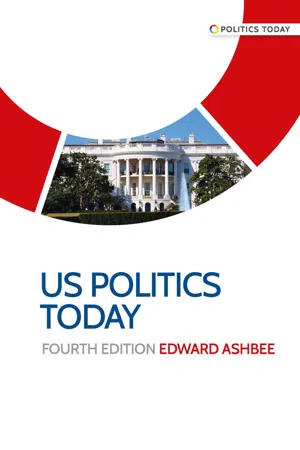
US politics today not only introduces the defining features of contemporary American politics but also considers the strengths and weaknesses of a system that is now under serious strain.
The book is ideal for students, teaching staff and the general reader. It outlines the ways in which the Constitution shapes the politics of today, surveys the role of the presidency, Congress and the federal courts, and examines processes of political participation through elections, organized interests and parties. It pays particular attention to Barack Obama and Donald Trump's turbulent years in office and the ways in which recent decades have reshaped the US political landscape.
US politics today also places the US in a comparative context and considers key theoretical perspectives. In sum, the book not only provides an indispensable introduction to contemporary American politics but establishes a basis for informed commentary and further study.
- 228 pages
- English
- ePUB (mobile friendly)
- Available on iOS & Android
eBook - ePub
About this book
Information
1
The US Constitution
Relatively few Americans have an accurate knowledge of the US Constitution and its provisions. A study conducted in August 2017 by the Annenberg Public Policy Center of the University of Pennsylvania revealed that only about a quarter (26 per cent) of respondents could identify all three branches of the federal government. More than a third (37 per cent) could not point to a single specific right guaranteed under the First Amendment to the Constitution. Meanwhile, 15 per cent asserted to pollsters that, despite the guarantees of religious liberty given in the First Amendment (‘Congress shall make no law respecting an establishment of religion, or prohibiting the free exercise thereof’), atheists do not have the same rights as other citizens, and 18 per cent said Muslims do not (Ziv, 2017). Their views are doubtless driven by strong personal convictions, but they are profoundly mistaken.
Nonetheless, at the same time, polling suggests that large majorities believe that the Constitution plays a very significant part in structuring American political life. A 2010 poll of New York voters found that 76 per cent of respondents believed in the ‘central importance’ of the US Constitution (Lane and Barnette, 2011: 7–13). They are right to say this. The Constitution does indeed provide the basic framework within which political processes take place. Furthermore, although some regard the counter-majoritarian elements in the Constitution (such as the structure of the Senate, which can allow the small states to out-vote the most populous) as evidence of the essentially conservative character of the American Revolution, very few commentators call for its wholesale repudiation. Thus, while the Constitution is often at the centre of political controversy, that debate is for the most part about the interpretation of the principles upon which it is structured rather than the fundamental value of those principles. Proposals for reform or calls for the passage of further amendments are, more often than not, put forward as a means by which the spirit of the Constitution can be more fully implemented.
This chapter outlines the principal features of the US Constitution, considers the institutions that were created on the basis of it, assesses their political character, and surveys the character of debates about the relevance of the Constitution for contemporary US politics.
Origins of the US Constitution
By the eighteenth century, the original settlements that had been established on the eastern seaboard had evolved into thirteen colonies. As such, although some had begun as corporate or religious ventures, they were British possessions. However, despite the appointment of governors by the London authorities, the colonists had a tradition of limited self-government through colonial assemblies. Although the right to participate in civic affairs was, as in Britain, dependent upon the ownership of property, such ownership was more broadly distributed than in Europe (at least among white men), thereby extending participation in politics to significantly greater numbers than in the Old World.
This background, and growing talk of ‘unalienable rights’ and the need for constraints upon the power of government, and growing resentment against British rule laid a basis for protests and eventual rebellion. The 1773 Tea Act, which sparked the protests that were dubbed the ‘Boston Tea Party’, and the 1774 Quebec Act (which extended its boundaries so as to threaten the western expansion of the American colonies) triggered particular hostility. American leaders responded by establishing the First and Second Continental congresses, bringing together delegates from the different colonies. Initially, they were not seeking independence but asserting their rights as ‘freeborn Englishmen’. However, the British spurned compromise and demanded that the colonists recognise the authority of Parliament. The Patriots, as supporters of American interests came to be known, began to organise themselves. Attempts by British troops to disarm them and suppress their activities triggered war. In a celebrated speech to the Virginia legislature, which symbolised the shift from protest to rebellion, Patrick Henry said: ‘Give me liberty, or give me death.’
After eighteen months of fighting, on 4 July 1776, Congress issued the Declaration of Independence. Written principally by Thomas Jefferson, the Declaration went beyond calls for rights within British jurisdiction and offered a justification for the revolutionary repudiation of British rule:
We hold these truths to be self-evident, that all men are created equal, that they are endowed by their Creator with certain unalienable rights, that amongst these are life, liberty and the pursuit of happiness. That to secure these rights, governments are instituted amongst men, deriving their just powers from the consent of the governed. That whenever any form of government becomes destructive of these ends, it is the right of the people to alter or abolish it, and to institute a new government. (quoted in Foley, 1991: 31)
The arguments pursued in the Declaration drew upon the notions of liberty, rights, and limited government that defined classical liberalism and recalled the claims made by figures such as the English philosopher John Locke (1632–1704):
1 All people (and not only Americans) have natural rights, most notably ‘life, liberty and the pursuit of happiness’. These rights were granted by God and could not be taken away. They were thus ‘unalienable’. The claim that men were created equal should not be understood as an egalitarian statement in the modern sense. Instead, it was an affirmation that men (and only white men with at least some property were considered) were equally entitled to particular rights.
2 The purpose of government and the reason why it was created was to protect these rights. There is a social contract between the people and government in which the people accept a duty to obey the government. In return, those in government have an obligation to protect the people’s rights.
3 The people have the right to withdraw that consent and therefore have the right of rebellion if the government fails in its obligation to protect their rights.
4 King George III and the British Parliament had, through acts of oppression, broken their side of the social contract. The people had thereby been denied their ‘unalienable’ rights. The American colonists could in such circumstances justifiably break their side of the contract and deny British authority on American soil.
The Declaration also put forward a list of twenty-seven specific grievances against the British Crown to demonstrate the ways in which the rights of the colonists were being denied. King George III was described in bitter terms: ‘He has plundered our seas, ravaged our coasts, burned our towns, and destroyed the lives of our people … A prince, whose character is thus marked by every act which may define a tyrant, is unfit to be the ruler of a free people’ (quoted in Henretta, Brownlee, Brody, and Ware, 1993: 168).
Although the Declaration and the revolution that followed can be portrayed as an assertion of revolutionary liberty, there are less idealistic depictions. The rebels, it is said, were seeking to pursue economic interests that had been placed in jeopardy by the British authorities. Simon Schama suggests that slaveholders as well as farmers and merchants in the south threw in their lot with the northern colonies and the revolution because of fears that the British might free the slaves and perhaps arm them (Schama, 2006). Furthermore, as noted above, the Declaration of Independence spoke in the name of ‘men’. Women, the native American tribes, and propertyless white people were very largely excluded from the political process. And, whereas the French Revolution was at times in the hands of the Paris mob, the American Revolution was often driven by a fear of the mob. It sought to contain the masses. The war of independence can justly be described as a conservative ‘revolution’.
The British were finally defeated by the Americans, fighting in alliance with the French, in October 1781 at Yorktown in Virginia. The Treaty of Paris, signed in September 1783, recognised American independence.
Articles of Confederation
A year after the writing of the Declaration of Independence, the Second Continental Congress adopted a constitution, the Articles of Confederation. These were not, however, ratified by all thirteen of the former colonies, now states, until 1781.
The Articles rested upon a loose and decentralised system and a very weak national government. Each state maintained ‘its sovereignty, freedom, and independence’, but the Congress, in which each state had one vote, had only limited powers. Important decisions and changes to national law required the backing of nine of the thirteen states. There was, furthermore, no separate executive branch. Given this, decision-making was inevitably a slow, cumbersome, and uncertain process. The powers of the national government were limited because there were different geographical and sectional interests across American territory. There were few who would put their trust in a centralised authority. Furthermore, many of the states jealously guarded their own prerogatives and were unwilling to cede even a limited degree of power.
Although the Articles were eventually ratified, the Confederation faced difficulties from the beginning. These stemmed in part from the limitations on the powers assigned to the Congress; for example, it did not have the authority to raise tax revenue. There was also growing social discontent, as illustrated in 1786 when many farmers took part in Shays’s Rebellion in Massachusetts. The rebellion collapsed but it appeared to be a portent of further strains and tensions. Against this background, there were fears that the newly established nation might fragment. At the least, the differences and tensions seemed to impede development. The states imposed tariffs and duties against each other so as to protect their own immediate commercial interests. There were incipient tensions between the northern and southern states, and in 1783 there was serious discontent and talk of a military coup, the Newburgh Conspiracy, within the army. There were also fears that foreign powers would seek a foothold for themselves within the new republic. Britain, France, and Spain all had possessions on the North American continent, and there were concerns that some of the states might be tempted into alliances with these powers that could break up the Confederation.
Because of these concerns, a constitutional convention of delegates from the states was called in 1787 to amend the Articles. Although the delegates who met in Philadelphia were not directly elected by the people, and one state (Rhode Island) was not represented at all, a new constitution emerged from their deliberations. The opening words were imbued with the belief that although the states retained many of their powers and prerogatives, there was now an American nation that required a sense of common purpose that had been absent in the Articles. This was to be secured through the construction of a ‘a more perfect Union’.
We the People of the United States, in Order to form a more perfect Union, establish Justice, insure domestic Tranquility, provide for the common defence, promote the general Welfare, and secure the Blessings of Liberty to ourselves and our Posterity, do ordain and establish this Constitution for the United States of America.
Philadelphia Convention (1787)
The debate at the convention continued throughout the summer of 1787. The fifty-five delegates, who were celebrated as the ‘Framers’ or ‘Founders’, considered two alternative models of government:
• The larger states supported James Madison’s Virginia Plan. It rested on the ‘supremacy of national authority’, so that the states would lose much of the autonomy that they had been afforded under the Confederation. The national government would draw its authority from the American people rather than the states. There would be a bicameral legislature that would, in part, be directly elected. The legislature would choose those who would head the executive branch.
• The New Jersey Plan was backed by the smaller states, who were fearful that they would lose their powers. Although it also envisaged a greater degree of political centralisation than under the Confederation, it respected the authority of the states by proposing a unicameral legislature based upon the states, which would be allocated equal representation regardless of size. The states would also be able to remove members of the executive branch.
The different factions at the convention agreed upon ‘the Great Compromise’. The larger states favoured a system of government that assigned representation on the basis of population; therefore, the numbers in the lower chamber, the House of Representatives, were to be based upon a state’s population. However, to allay the fears of the smaller states, the Senate was to be based upon equal representation. Each state was to have two senators who until the early twentieth century were appointed by the state legislatures rather than elected.
The Philadelphia Convention also pursued other forms of political accommodation and reconciliation between competing interests. There were differences at the convention between those who talked in terms of ‘the people’, although this often referred only to male property-holders, and those who were acutely fearful of unrestrained democracy or ‘mobocracy’. It was agreed that some form of democracy was required to act as a check on the abuse of power by the executive, but there were claims, particularly among those with much to lose, that unchecked majority rule might trample on the rights of the individual citizen and in particular those with property.
There were also tensions between the free states and the slave states. At the time the Constitution was written there were some anti-slavery sentiments in the northern states and the five southern states would have refused to join the US if slavery had not been permitted. As a consequence, slavery was not addressed, although there was a provision that, for the purposes of representation, slaves would be counted as three-fifths of citizens. This was at the insistence of the free states, who wanted to limit the political influence of the slave states by restricting the number of people counted for the purposes of representation in the House of Representatives and the Electoral College.
There was also a debate between advocates and opponents of a strong, centralised executive branch of government. Some of the Constitution’s authors, most notably Alexander Hamilton, argued that there had to be ‘energy in the executive’ so as to unify the nation. They cal...
Table of contents
- Cover
- Half Title
- Title Page
- Copyright
- Contents
- List of tables
- Preface
- 1 The US Constitution
- 2 The US Congress
- 3 The presidency and the executive branch
- 4 The US Supreme Court
- 5 Political participation: elections
- 6 Political participation: parties and interest groups
- 7 Putting US politics in context: theories and comparisons
- Index
Trusted by 375,005 students
Access to over 1.5 million titles for a fair monthly price.
Study more efficiently using our study tools.
Frequently asked questions
Yes, you can cancel anytime from the Subscription tab in your account settings on the Perlego website. Your subscription will stay active until the end of your current billing period. Learn how to cancel your subscription
No, books cannot be downloaded as external files, such as PDFs, for use outside of Perlego. However, you can download books within the Perlego app for offline reading on mobile or tablet. Learn how to download books offline
Perlego offers two plans: Essential and Complete
- Essential is ideal for learners and professionals who enjoy exploring a wide range of subjects. Access the Essential Library with 800,000+ trusted titles and best-sellers across business, personal growth, and the humanities. Includes unlimited reading time and Standard Read Aloud voice.
- Complete: Perfect for advanced learners and researchers needing full, unrestricted access. Unlock 1.5M+ books across hundreds of subjects, including academic and specialized titles. The Complete Plan also includes advanced features like Premium Read Aloud and Research Assistant.
We are an online textbook subscription service, where you can get access to an entire online library for less than the price of a single book per month. With over 1.5 million books across 990+ topics, we’ve got you covered! Learn about our mission
Look out for the read-aloud symbol on your next book to see if you can listen to it. The read-aloud tool reads text aloud for you, highlighting the text as it is being read. You can pause it, speed it up and slow it down. Learn more about Read Aloud
Yes! You can use the Perlego app on both iOS and Android devices to read anytime, anywhere — even offline. Perfect for commutes or when you’re on the go.
Please note we cannot support devices running on iOS 13 and Android 7 or earlier. Learn more about using the app
Please note we cannot support devices running on iOS 13 and Android 7 or earlier. Learn more about using the app
Yes, you can access US politics today by Edward Ashbee in PDF and/or ePUB format, as well as other popular books in Politics & International Relations & American Government. We have over 1.5 million books available in our catalogue for you to explore.