eBook - ePub
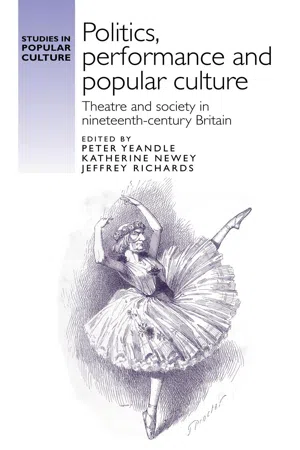
Politics, performance and popular culture
Theatre and society in nineteenth-century Britain
- 279 pages
- English
- ePUB (mobile friendly)
- Available on iOS & Android
eBook - ePub
Politics, performance and popular culture
Theatre and society in nineteenth-century Britain
About this book
This collection brings together studies of popular performance and politics across the nineteenth century, offering a fresh perspective from an archivally grounded research base. It works with the concept that politics is performative and performance is political. The book is organised into three parts in dialogue regarding specific approaches to popular performance and politics. Part I offers a series of conceptual studies using popular culture as an analytical category for social and political history. Part II explores the ways that performance represents and constructs contemporary ideologies of race, nation and empire. Part III investigates the performance techniques of specific politicians – including Robert Peel, Keir Hardie and Henry Hyndman – and analyses the performative elements of collective movements.
Information
PART I
Conceptualising performance, theorising politics
The essays in this section span the century chronologically, and cover the principal genres of popular entertainment in the nineteenth century: melodrama and pantomime. They take us from Manchester in the early nineteenth century, after the final defeat of Napoleon in 1815, to Gladstone’s advocacy for a National Theatre at the end of the nineteenth century – and beyond, into the performative ferment of the campaign for female suffrage. In all these essays, theatre and the theatrical are placed in relationship to political activism, often of an oppositional nature. Taken together, the essays offer a demonstration of Peter Burke’s ‘performative turn’, as they investigate the ways in which political events outside the theatre buildings of England, and political and topical commentary on English stages, can be read against each other.
Rohan McWilliam has written elsewhere of the ‘melodramatic turn’ in cultural and social histories of the nineteenth century. Robert Poole charts the historiography of this approach, using the concept of melodrama as a cultural script to tease out the nuances of feeling in post-Waterloo Manchester radical culture. He argues for the explanatory role of melodrama in this political environment, seeing melodrama as a structuring of the experiences of the struggle against class, rather than the struggle between classes, in a classic Marxist sense. While attentive to Marx’s and Engels’s observations – particularly of Manchester – Poole’s approach is complementary to Caroline Radcliffe’s use of the concept of hierarchy to analyse the organisation of mid- and late-century society, and its approaches to entertainment, in its recourse to early nineteenth-century structures of feeling. Poole demonstrates the ways in which melodrama – that ‘illegitimate’ form which has long been the butt of theatrical jokes – is connected to what is arguably the grand narrative of the nineteenth century in Britain: the struggle for democracy, and freedom from economic deprivation and oppression.
Mike Sanders’s essay pushes this parallel further, arguing that theatre – a ‘primary aesthetic’ form – and principally melodrama within that theatrical culture, contributed to the very conditions which made possible the articulation and communication of the Chartist project. Sanders draws on the defamiliarising model adapted for the twentieth-century theatre by Bertolt Brecht, known as the Verfremdungseffekt (mistranslated into English as the ‘alienation effect’). In the course of his essay, Sanders reminds us that Brecht did not invent the V-effekt, but was drawing on pre-Naturalist approaches to the representation of the subject-citizen. Sanders’s focus on the role of the melodramatic frame in making political protests visible and intelligible to their audiences offers rich possibilities for further work on ideas of reception and spectatorship, using models drawn from performance and theatre studies.
While Poole and Sanders concentrate on melodrama and the melodramatic, Katherine Newey’s essay suggests that pantomime is the necessary complement to the heightened emotional world of melodrama. Pantomime thrived on satirical and topical commentary – indeed, it was expected that the annual Boxing Day entertainment would offer a satirical compendium of the year’s events. Newey continues Poole’s and Sanders’s investigations into a politics of affect in the first half of the nineteenth century, arguing for the inclusion of the knockabout and often violent humour of pantomime clowning in broadening understandings of the political impact of popular entertainment.
Caroline Radcliffe steps off stage to examine the frameworks of value and hierarchy within which theatrical and popular entertainment existed. The nineteenth century was a period of internecine conflict in the entertainment industry, between ‘legitimate’ and ‘illegitimate’ species of popular performance. Looking at the struggles between the theatre and the music hall in the second half of the century, Radcliffe argues that these offer a case study of the operation of hierarchy as a tool of social organisation. Her eschewal of a social analysis based mainly on a Marxist model of class conflict reminds us of the variety of oppositional and radical political activities in the nineteenth century, and of Gareth Stedman Jones’s caution in Languages of Class about viewing nineteenth-century class conflicts uncritically through a post-Marxist lens.
As we argue in the Introduction to this volume, there are moments throughout the nineteenth century when the British theatre stands in for the nation. Anselm Heinrich’s essay offers a detailed account of one such moment, instigated by a personage no less than the Prime Minister, William Gladstone. Heinrich continues Radcliffe’s analysis of British social hierarchy and its role in establishing cultural and aesthetic values. Heinrich’s essay offers an insight into a ‘top-down’ instrumentalist view of cultural value in promoting national unity and order, which might still feel current in early twenty-first-century neo-liberal times. Gladstone’s support of a National Theatre is of a piece in its time with other progressive moves towards universal education, and the general improvement of the working classes. However, it is not difficult to see in this work a tense relationship between such uses of culture and the moves towards universal suffrage after the 1867 Reform Bill. Heinrich’s essay uses the focus of a major reforming Liberal premiership to tease out what are still tensions and conflicts around national cultural policy in the United Kingdom today. In focusing on the other moment of high drama at the end of the nineteenth century – the continuing struggle for female suffrage – Eltis connects theatricality and politics, exploring political action as performance, and performance as politics. By reading suffragists’ involvement in the New Drama, alongside an understanding of the connections between suffrage and spectacle, Eltis makes the case for a highly complex engagement of late Victorian feminism with theatre and public politics. The efficacy of this potent mix of spectacle, energy and creativity is demonstrated when, as Eltis tells us, the wartime government of 1915 engaged the suffragists to stage one more march, claiming female space in public for their ‘right to serve’ in that most spectacular of all theatres, the First World War.
1
‘To the last drop of my blood’: melodrama and politics in late Georgian England
Robert Poole
Men … in periods of revolutionary crisis anxiously conjure up the spirits of the past to their service and borrow from them names, battle cries and costumes in order to present the new scene of the world in this time-honoured disguise and this borrowed language.
Karl Marx1
Melodrama was the dramatic signature of the nineteenth century. In 1965 the theatre historian Michael Booth described it thus:
Melodrama presents an ideal world of courage, love, loyalty and virtue triumphant, a world of starkly elemental morality, a few fundamental, strongly felt emotions, gross humour, and half a dozen sharply differentiated, superficial character types which had to be instantly recognizable. The whole is set in an atmosphere of broad physical action, emotional extremism, and spectacular stage effects.
For Booth, melodrama was ‘romantic and escapist’, offering working-class audiences ‘a dream world inhabited by dream people and dream justice’.2 ‘Melodrama, like the poor, will no doubt always be with us’, sighed the Birmingham Shakespearean Allardyce Nicholl.3 Louis James’s 1977 essay ‘Taking Melodrama Seriously’, however, argued that ‘melodrama was not only the prevailing form of popular entertainment, it was also the dominant modality of all nineteenth-century British life and thought’.4 Other scholars have followed this thread, culminating in Elaine Hadley’s argument for a ‘melodramatic mode’ that rivalled the romantic in scope:
Melodrama’s familial narratives of dispersal and reunion, its emphatically visual renditions of bodily torture and criminal conduct, its atmospheric menace and providential plotting, its expressions of highly charged emotion, and its tendency to personify absolutes like good and evil were represented in a wide variety of social settings, not just on the stage. Indeed, a version of the ‘melodramatic’ seems to have served as a behavioral and expressive model for several generations of English people.5
More widely still, Rohan McWilliam writes that ‘the hallmarks of melodramatic thinking with its repertoire of extreme emotions, hidden conspiracies and grand gestures could be recognised throughout Europe and North America’. McWilliam identifies a ‘melodramatic turn’ in scholarship but warns that this ‘new grand narrative’ has proved so adaptable that it risks losing its explanatory power.6
If there is one area where melodrama has been accorded explanatory power it is politics. Over fifty years ago Kitson-Clark found that theatricality and politics were particularly closely linked in this period: ‘Contemporary oratory ought … to be compared with what was going on on the stage at the time … passionate, sometimes very noisy, with a great deal of violent gesture and action.’7 Social historians began sniffing around melodrama in the early 1980s as class-based explanations of popular politics ran out of track (if not out of steam). In his influential essay ‘Rethinking Chartism’, Gareth Stedman Jones argued that the radical critique of the people against ‘old corruption’ merged smoothly with the Chartist critique of labour against capital, with parasitic cotton lords succeeding aristocratic drones as villains.8 Patrick Joyce noticed that ‘the plot structure of melodrama concerned virtue extant, virtue eclipsed and expelled, virtue tested (in struggle), virtue apparently fallen, and virtue restored and triumphant’, and argued that this provided popular politics with ‘the moral drama of an unequal society’. Melodrama was more deeply rooted than class conflict. 9 Ian McCalman has described how the radical lecturer Robert Taylor performed twice weekly at Richard Carlile’s south London Rotunda to audiences of over a thousand during the long Reform Bill crisis of 1830–32. ‘Melodrama in general gave him many compelling motifs and stage techniques, including spectre-raising (as in Byron’s Manfred); Manichean contrasts between good and evil, light and dark; the coup de théâtre when evil is exposed and virtue triumphs; the violent and emotional language; and even the use of spectacular mechanical props.’10 Lately Marx himself (quoted in the epigraph to this essay) has been conscripted to the cause of melodrama, with Francis Wheen suggesting that Das Kapital ‘can be read as a vast Gothic novel whose heroes are enslaved and consumed by the Monster they created … or as a Victorian melodrama’. ‘Capital comes into the world soiled with gore from top to toe and oozing blood from every pore’, wrote Marx, helpfully anticipating his literary biographer (The Guardian, 8 July 2006).
Such trends go back to the late eighteenth century, when, writes Betsy Bolton, the English state came widely to be viewed as a stage, with an accompanying trend for ‘spectacular nationalism’ in the theatre. With this, however, came the fear that the lower orders in the gallery could control the house as crowd-pleasing politicians courted popular acclaim. Julia Swindells argued for a ‘startlingly direct relationship between theatre and the political life of the period’ 1789–1833, and wrote of ‘the grand theatre of political reform’.11 It was the historian Raphael Samuel who suggested to Anna Clark that ‘Radical political rhetoric incorporated both the themes and styles of melodrama.’12 Clark has since set out more fully than anyone the melodramatic power of the 1820–21 Queen Caroline affair, and has gone on to argue that in political melodramas ‘the victim could stand for a category of the oppressed’ and so politics could be democratised by scandal.13 David Worrall, in his important book Theatric Revolution, argues that theatricality pervaded Georgian culture, linking the stage, the visual arts and the popular press. ‘By the late 1810s’, he writes, ‘drama was the primary literary form mediating between the British people and national issues.’14 Melodrama exalted the restoration of sundered communities at a time when they were being broken up and supplanted by an unholy combination of free-marke...
Table of contents
- Cover
- Half Title
- Title Page
- Copyright
- Contents
- List of illustrations
- Contributors
- Acknowledgements
- Introduction: the politics of performance and the performance of politics Peter Yeandle and Katherine Newey
- I Conceptualising performance, theorising politics
- II Politics in performance
- III The performance of politics
- Index
Trusted by 375,005 students
Access to over 1.5 million titles for a fair monthly price.
Study more efficiently using our study tools.
Frequently asked questions
Yes, you can cancel anytime from the Subscription tab in your account settings on the Perlego website. Your subscription will stay active until the end of your current billing period. Learn how to cancel your subscription
No, books cannot be downloaded as external files, such as PDFs, for use outside of Perlego. However, you can download books within the Perlego app for offline reading on mobile or tablet. Learn how to download books offline
We are an online textbook subscription service, where you can get access to an entire online library for less than the price of a single book per month. With over 1.5 million books across 990+ topics, we’ve got you covered! Learn about our mission
Look out for the read-aloud symbol on your next book to see if you can listen to it. The read-aloud tool reads text aloud for you, highlighting the text as it is being read. You can pause it, speed it up and slow it down. Learn more about Read Aloud
Yes! You can use the Perlego app on both iOS and Android devices to read anytime, anywhere — even offline. Perfect for commutes or when you’re on the go.
Please note we cannot support devices running on iOS 13 and Android 7 or earlier. Learn more about using the app
Please note we cannot support devices running on iOS 13 and Android 7 or earlier. Learn more about using the app
Yes, you can access Politics, performance and popular culture by Peter Yeandle,Katherine Newey,Jeffrey Richards, Peter Yeandle, Katherine Newey, Jeffrey Richards in PDF and/or ePUB format, as well as other popular books in History & Social History. We have over 1.5 million books available in our catalogue for you to explore.