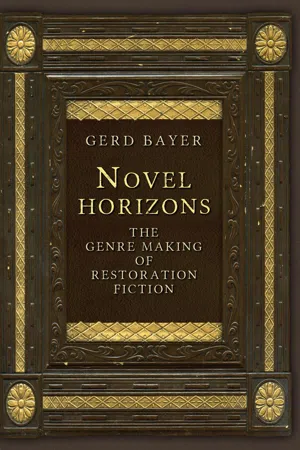
Novel horizons analyses how narrative prose fiction developed during the English Restoration. It argues that after 1660, generic changes within dramatic texts occasioned an intense debate within prologues and introductions. This discussion about the poetics of a genre was echoed in the paratextual material of prose fictions. In the absence of an official poetics that defined prose fiction, paratexts fulfilled this function and informed readers about the budding genre. This study traces the piecemeal development of these boundaries and describes the generic competence of readers through the analysis of paratexts and prose fictions.
Novel horizons covers the surviving textual material widely, focusing on narrative prose fictions published between 1660 and 1710. In addition to tracing the paratextual poetics of Restoration fiction, this book also covers the state of the art of fiction-writing during the period, discussing character development, narrative point of view and questions of fictionality and realism.
- 326 pages
- English
- ePUB (mobile friendly)
- Available on iOS & Android
eBook - ePub
About this book
Information
Topic
LetteraturaSubtopic
Storia del XX secolo Part I
The rise of the novel as genre
1
The novel and its critics
Criticism of the novel begins at whatever date one picks as the birth of the novel. Published during the Restoration period around which the present study circles, Pierre-Daniel Huët’s Traité de l’origine des romans (1670) suggests itself as an inaugural text, whose importance is underlined by the fact that it quickly found its way into other European languages, seeing an English translation in 1672 and a German version in 1682. Huët set out ‘to ennoble the genre with an impeccable pedigree of Greco-Roman precedents and to diffuse its potentially disruptive force by subsuming it within the canons of orthodox neoclassical aesthetics’.1 By resorting to the respected weightiness of the classical age, his account of the novel offered redemption for a genre faced with moral criticism. Clara Reeve followed up with The Progress of Romance in 1785, whose title already strikes an optimistic note. The connection to classical narratives presented in her study denies historical change and instead describes a formal lineage that appears essentially ‘unbroken from antiquity’.2 Reeve’s work was complemented by critical comments at the hands of writers like Fielding but also by critics like Addison, Steele, and Dr Johnson, whose essay on the novel, published in The Rambler 4 (1750), warns of the power of the novel.3
Throughout the nineteenth century, there were histories of the English novel that reached back beyond the eighteenth century, to Elizabethan prose, to Chaucer, to the prose fiction of the Hellenistic world, and to European developments in the early modern age. For instance, John Colin Dunlop has his History of Prose Fiction (1814) progress through trans-European influences and across various subgenres of romance writing. The final chapter in his two-volume chronology is appropriately entitled ‘Sketch of the Origin and Progress of the English Novel’. Clearly unnerved by the novel’s lack of formal coherence, he tried to subsume its generic richness by dividing the corpus into serious, comic, and romantic works.4 Later, Wilbur Cross, in The Development of the English Novel (1899), sketches the history ‘of English fiction from Arthurian romance to Stevenson’.5 Taking a rather generous view of what constitutes novels, he gives pride of place to works like John Bunyan’s The Pilgrim’s Progress and Izaak Walton’s Lives, two texts that for formal reasons later critics only rarely discussed under this rubric. Cross also acknowledged the substantial contributions made by Aphra Behn, Delarivier Manley, and Eliza Haywood, all authors that would go on to be ‘rediscovered’ every few generations. Walter Raleigh’s The English Novel (1899) praises Elizabethan fiction, then becomes somewhat impatient with the subsequent turn to lengthy romances, and becomes interested again in Restoration prose works and the eighteenth-century novel. The author of an impressive ten-volume tome, confidently called The History of the English Novel (1924–39), Ernest Baker ranges widely across the European languages, much like Dunlop before him. In his discussion of the early modern novel, he follows the popularity of John Barclay’s Argenis through its multiple translations and duly acknowledges the impact of both Behn and Defoe.6 All such early efforts in the history of the novel must not obliterate the fact that reading and writing about this genre remained a rarefied taste, if not a vice indulged by many only in secret.
In the early twentieth century, criticism of the novel moved increasingly into the mainstream of literary scholarship. Author–critic E. M. Forster broke a lance in Aspects of the Novel (1927), and Erich Auerbach’s masterful Mimesis (1946) stands as one of the earliest and most lasting contributions to the study of the novel. Yet its rise was delayed further by New Criticism’s preference for poetry. Arnold Kettle’s An Introduction to the English Novel (1951) departs from this tradition by following Marxist lines of enquiry. In doing so, he echoed Georg Lukács, whose Die Theorie des Romans (1920) along with Frankfurt School criticism firmly established a social-materialist tradition of novel criticism that would later develop (sometimes beyond recognition) into cultural studies.
It is at this historical moment that arguably the most influential monograph on the early years of the novel was published, Ian Watt’s The Rise of the Novel (1957). Though Watt’s book frequently restates arguments already found in earlier accounts of the rise of the novel, his focus on the social background as constitutive to this development set his work apart.7 In what has come to be known as his triple-rise theory, Watt presents a sequential development that led from the rise of the middle class to the rise of a new reading public and, ultimately, to the rise of the novel. More recent data suggests that Watt’s smooth trajectory does not quite play out when set against the actual growth of readers at the time, which many agree had only changed minimally;8 the importance he accords to the middle class has also been variously questioned soon after the publication of his book.9 The points scored against Watt are legion, yet his work has retained its prominent position despite (or because of) the ongoing investigations against his work. Watt’s willingness to combine social history, book culture, and textual analysis was shared by other critics working at the time, for instance Alan McKillop and Margaret Schlauch.10
Watt’s work has remained the point of departure for much of the criticism devoted to the rise of the novel. John Richetti in Popular Fiction before Richardson (1969), for instance, departs from Watt’s study in that he takes seriously the historical desire for fiction and as a consequence studies the popular prose works of the early eighteenth century by writers like Behn, Manley, and Haywood. He presents the rise of the novel from the point of view of ‘the emergence of “mass art”’ that ‘provides fantasies which allow pleasurable identification and projection’.11 Despite the fact that he dedicates a whole book to popular works, he remains somewhat apologetic about their lack of aesthetic qualities (without going into the question of what legitimises such qualities). He does point out that much popular writing benefited from the confrontation between the secular and the religious, and he shows how literary figures such as whores and pirates relate to this discursive environment.
In Desire and Domestic Fiction (1987), Nancy Armstrong analyses how the domestic role of women was discursively created by eighteenth-century writing, both fictional and in the shape of conduct books. By showing women in command of the domestic sphere, such works contributed to the shaping of female subjectivity and, as a consequence, contributed to the rise of ‘modern institutional culture’.12 Deborah Ross has further developed Armstrong’s focus on the role of gender in the long-standing conflict between romance and novel. She shows that the perceived difference between these two traditions goes back to a late seventeenth-century tendency within some prose fictions to move from historically and geographically remote settings into the contemporary world and to flesh out these stories with ordinary people.13 Ross argues that many romanciers remained committed to the tradition of French romances and at the same time used realist strategies to comment about the situation of women in their historical present. The texts often reached across the division that gender-based stereotypes had put in place, in effect suggesting that the supposedly categorical difference between men and women was more perceived than actually existent.
Ros Ballaster discusses the literary corpus earlier investigated by Richetti from a point of view that draws more substantially on genre and gender studies. She contends that far from being solely focused on entertainment, amatory fiction by women writers like Behn, Manley, and Haywood deeply engages in questions of gender, class, and ideology, drawing inspiration from French traditions of feminocentric writing. Indeed, the female reader became a dominant force even in such publications as The Tatler and The Spectator, which took social behaviours typically associated with ‘the idle bourgeois lady’ as ideal platforms for discussing the proper place for gentlemanly disinterest in extreme political positioning.14 Such gendered developments contributed significantly to the formal development of the genre of amatory fiction, for instance by influencing how questions of veracity and truth were transformed into constitutive features of literary forms.15
The issue of generic distinction also shapes the discussion in Lennard Davis’s Factual Fictions (1983), which argues that the novel developed in close proximity to journalistic writing, sharing with it what at the time were anything but clear lines of demarcation between factual and fictive mimetic motivation. The question at the heart of Davis’s study, namely which generic tradition provided exactly what to the genesis of the novel, is in fact hotly contested: some see historiography as the decisive point of origin; others tend towards the travelogue; yet others point out that book culture in general needs to be acknowledged as providing a specific environment for the development of the early novel.16
Homer Brown’s Institutions of the English Novel (1997) takes issue with Watt and other critics for failing to see that the novel was institutionalised by the early nineteenth century by the processes of canon formation at the hands of men like Walter Scott.17 Brown contends that the history of the novel, ‘with its genealogies, lines of descent and influence, [and] family resemblances, is itself a fictional narrative – a kind of novel about the novel’.18 For him, the history of the eighteenth-century novel not only starts in the nineteenth century, it specifically takes shape with the publication of anthologies that canonise specific texts, thereby institutionalising the novel as a literary genre.19 Yet, as Brown makes obvious, at the centre of the debate over the history of the novel lies the issue of generic unspecificity, from which in turn arises the very problem of which texts to include as novels.
Brown’s study resonates well with the work of other critics who also bring out the constitutive force of canonisation. J. Paul Hunter shows in Before Novels (1990) that the wish of later critics to separate romance and novel would have been incomprehensible to early modern authors, who worked in an environment where ‘the terms “novel” and “romance” appear cozily together, not to imply a distinction but rather to catch, between them, all known fiction and some long narratives whose factitiousness was uncertain’.20 Hunter goes on to suggest that in order to do justice to the literary development that brought about the novel, it is necessary to take a much more comprehensive look at literary culture in the late seventeenth century. He includes readers as active participants in the creation of the new form and presents experimentation as a crucial feature of this process, leading to a situation where the constitutive markers of the novel ‘are even more uneven and uncertain than in other times’.21 In the end, Hunter’s work suggests, the readers got their wishes, and the novel became the answer to their demand for a literary form that had earlier existed in a nascent stage in travelogues, newspapers, criminal reports, or chapbooks.
William Warner follows a related interest when he approaches the early novel as an object of popular culture. He situates the novel at the historical moment when the system of patronage was taken over by commercial systems of production and distribution. By concentrating on amorous fictions, Warner deliberately blurs the line between more ‘literary’ texts and works written solely for entertainment, seeing in the latter ‘the first formula fiction on the market’,22 that is to say genre fiction in the modern sense. The novel, in effect, appears in Warner’s analysis predominantly as what Claudio Guillén has called an anti-genre.23 Despite the legitimate contribution obviously made by Warner, he simply replaces one group of first ‘great writers’ with another, assuming that the novel, from whatever source and prehistory, was simply presented to the world as if ab ovo. By limiting himself to a small group of ‘major’ writers, he underestimates the complexity of genre formation, and in particular the necessary critical mass of nondescript texts that allow the rare exemplars of literary versions of a genre to excel. Needless to say, the very nature of such privileged texts (in both senses of the word: referring to their quality and the attention awarded them) makes them anything but representative.
Arguably the most substantial revision and ela...
Table of contents
- Cover
- Half Title
- Title Page
- Copyright Page
- Dedication
- Table of Contents
- Acknowledgements
- Note on the transcription of texts
- Introduction: making novel readers
- Part I The rise of the novel as genre
- Part II Paratexts: the genesis of genre
- Part III The Restoration novel
- Conclusion: reading a genre into being
- Endnotes
- Bibliography
- Index
Trusted by 375,005 students
Access to over 1.5 million titles for a fair monthly price.
Study more efficiently using our study tools.
Frequently asked questions
Yes, you can cancel anytime from the Subscription tab in your account settings on the Perlego website. Your subscription will stay active until the end of your current billing period. Learn how to cancel your subscription
No, books cannot be downloaded as external files, such as PDFs, for use outside of Perlego. However, you can download books within the Perlego app for offline reading on mobile or tablet. Learn how to download books offline
Perlego offers two plans: Essential and Complete
- Essential is ideal for learners and professionals who enjoy exploring a wide range of subjects. Access the Essential Library with 800,000+ trusted titles and best-sellers across business, personal growth, and the humanities. Includes unlimited reading time and Standard Read Aloud voice.
- Complete: Perfect for advanced learners and researchers needing full, unrestricted access. Unlock 1.5M+ books across hundreds of subjects, including academic and specialized titles. The Complete Plan also includes advanced features like Premium Read Aloud and Research Assistant.
We are an online textbook subscription service, where you can get access to an entire online library for less than the price of a single book per month. With over 1.5 million books across 990+ topics, we’ve got you covered! Learn about our mission
Look out for the read-aloud symbol on your next book to see if you can listen to it. The read-aloud tool reads text aloud for you, highlighting the text as it is being read. You can pause it, speed it up and slow it down. Learn more about Read Aloud
Yes! You can use the Perlego app on both iOS and Android devices to read anytime, anywhere — even offline. Perfect for commutes or when you’re on the go.
Please note we cannot support devices running on iOS 13 and Android 7 or earlier. Learn more about using the app
Please note we cannot support devices running on iOS 13 and Android 7 or earlier. Learn more about using the app
Yes, you can access Novel horizons by Gerd Bayer in PDF and/or ePUB format, as well as other popular books in Letteratura & Storia del XX secolo. We have over 1.5 million books available in our catalogue for you to explore.