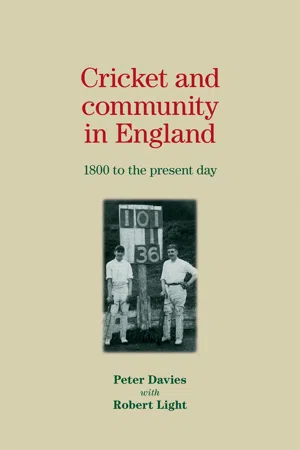
Available in paperback for the first time, Cricket and Community in England: 1800 to the Present Day is a path-breaking enquiry into the social history of the summer game.
It is written by two specialist cricket historians and based on extensive primary research. It traces the history of the sport at grassroots level from its origins right up to the present day. It will appeal to the cricket historian and the general sports enthusiast alike.
The book has two main goals: to provide readers with an accessible introduction to the history of grassroots cricket in England and to supply a clear overview of the different phases of this history.
The structure of book is chronological but also thematic. The six chapters look at such issues as early cricket, the origins of clubs, competition, the two world wars, multiculturalism and cricket in the twenty-first century.
- 180 pages
- English
- ePUB (mobile friendly)
- Available on iOS & Android
eBook - ePub
About this book
Information
Publisher
Manchester University PressYear
2015Print ISBN
9780719082801
9780719082795
eBook ISBN
9781784991692
1 Early sport and cricket
One of the key components in studying sport history is to recognise that sport reflects society. So, by looking at how changes in society influenced the development of modern sport the structure of pre-modern sport can be more clearly explained.
Sport in England underwent massive changes during the nineteenth century. The modern conception of sport was formed during the middle-1800s, and refined over the next fifty years, so that virtually all today’s major sports and types of sporting competition had been formed by the beginning of the twentieth century. These changes in sport were linked to parallel developments in English society, economy and culture.
Three major influences in this process were:
• The reform of the public schools, which were refashioned to provide an education that groomed students for social and imperial leadership. Sport became a major part of this process and was codified to instil a sense of discipline and moral purpose.
• Urban industrialisation: The industrial capitalist economy totally refashioned the way many people lived their lives. In particular, the new work discipline regulated working practices and hours. Also, for many, payment was now made for the value of their labour and not for the goods they produced.
• Rational recreation and Muscular Christianity: To these new movements, many pre-modern or traditional leisure activities contradicted the new values of respectability which were developed during the nineteenth century. So, these and other social and religious groups felt the need to reform the working classes by replacing traditional activities with new ones.
So to examine the shape of pre-modern sport it is important to look at how the social, economic and cultural make-up of British society before the nineteenth century was reflected in contemporary sport and leisure.
Time for leisure: economic influence on sport and leisure
The most fundamental difference between pre-modern and modern sport was related to the availability of free time which could be used for leisure activities. Like the later allocation of free time, such as the Saturday half-day holiday, this was dictated by the contemporary economic structure.
The modern working week was not established until after the 1850s. Before this time the pattern of work, and therefore leisure, was based on the agrarian economy, which in certain areas included cottage industries such as textiles. Consequently, time for leisure was dictated by the agricultural and religious calendar.
This meant that regular spare time was in short supply and, with the exception of the Sabbath, was only available at times of religious holidays or local feasts and festivals. Along with the general religious holidays, such as Christmas, Shrove Tuesday, Lent, Easter and Whitsun, individual Saints days were often days when local feasts and festivals were held. Other holidays marked the beginning or end of the agricultural phases, such as ploughing, sowing, harvesting, sheep shearing and the slaughter of livestock.
Perhaps the most famous example of games being played at these times of year are the folk football matches which were regularly played on public holidays, and in some cases are still played today. Shrove Tuesday was a popular time for folk football, along with other sports such as cockfighting. Wakes weeks were more localised holidays during which blood sports and combat sports were often staged. Most towns and villages also had their own feast at which sports were an integral part of the celebrations, with horse-racing a popular occurrence.
Although sports were banned on the Sabbath, many still used this time for leisure. Consequently, prosecutions for Sabbath-breaking have provided important source material for the study of early sport. Cricket, in particular, has benefited from this source. One of the first known references to the game was at Boxgrove in Sussex in 1622, when several men were prosecuted for playing on Sunday.
Regular time available for playing sport was clearly restricted by local variations and seasonal demands. But another source of leisure time was provided by irregular time away from work. Spontaneous holidays could be relatively common, especially among those employed in the trades and other craft-specific industries where employees were paid on piece rates. Perhaps the most common of these spontaneous holidays was St Monday, whereby production was increased towards the end of the week, on Saturday, and Monday was taken as an unofficial holiday. The cutlery trades in Sheffield were famous for their observance of St Monday. In the mid-nineteenth century a Mr Hutton, who had moved from Sheffield to work in Birmingham, described the practice in his former home town:
In Summer the men ... often sacrifice a Monday afternoon to the exercise of sports, which, at all events, is better than drinking away the Monday, as thousands do in Birmingham.1
The relative autonomy of some trades also meant that time off could occasionally be taken for specific events. These were mostly spectator contests, such as prize fights or cockfights, at which the main attraction was the opportunity to gamble.
Clearly, contemporary economic and social practices obstructed the development of a regulated and rationalised programme of sport before the middle of the nineteenth century. Allied to the difficulties in travel and communications, this meant that in many cases sports remained highly localised and practised as little more than folk customs. However, as the eighteenth and early nineteenth centuries unfolded, continued economic and population growth, especially in London and the emerging urban centres, meant that within these constraints a relatively sophisticated framework of sport was also developed.
One of the most striking characteristics of pre-modern sport was its diversity. One way to understand the structure of sport during this period is to split sporting contests into two distinct categories. First, participation sports, i.e. those events which were primarily staged for the enjoyment of the people who played in them; and second, spectator sports, i.e. those sports which were primarily staged as a form of entertainment.
Participation sports were mainly in the form of folk games. A huge array of events were popular, from folk football and cricket to knur and spell and bull-running. Because the predominantly parochial nature of sport prevented any widespread standardisation, many variants of similar traditional games existed. Cricket provides a good example of this, and while the sport had barely spread outside the south-east of England before the end of the eighteenth century, many similar folk games already existed elsewhere in the country. They included cat and dog, club ball, creag, stool ball, bad and trap ball.
There were two main categories of participation games. First of all, ‘organised’ events. These pre-arranged ‘traditional’ contests usually took place on religious and local holidays. Folk football matches fall into this category and Boxing Day and Shrove Tuesday were the most popular days for annual games. These contests often included large numbers of players with around 1,000 men taking part in the annual game in Derby; a much smaller community such as Sedgefield still staged a game in which 400 men on each side took part.
Blood sports such as ‘throwing at cocks’ were also common at holiday times. In this event stones were thrown at the bird and whoever knocked it over and caught it before it got up, took the animal home to eat. In some places a variety of sports were played at holiday times. Each Easter thousands met at Sancton near Market Weighton ‘for the purpose of horse-racing, football, cudgel playing and other events’.2
The other type of organised sporting events were matches which resulted from a specific challenge. In many cases these contests were primarily spectator events, but in cricket they were also staged for the benefit of participants. In these more social matches the challenge was a means of arranging the fixture to coincide with the availability of the players. While, to some extent, the need to make specific arrangements reflected the irregular nature of working patterns, these matches mainly involved members of the gentry whose main concern was fitting the fixtures into a busy social calendar. The challenge matches were particularly prominent among the eighteenth-century aristocracy and a wager was almost always involved.
One of the earliest examples of such matches being arranged is provided by a letter from Sir William Gage to the Duke of Richmond in 1725. He wrote:
My Lord Duke
I received this moment your Grace’s letter and am extremely happy your Grace intends us ye honour of making one a Tuesday, and will without fail bring a gentleman to play against you ...3
This form of pre-arranged fixture also provides the first examples of cricket matches being played in Yorkshire. Around about the middle years of the eighteenth century, references begin to appear to matches such as this one which appeared in the Leeds Times on 14 May 1776:
Yesterday a cricket match was played on Chapeltown Moor by the gentlemen of the Town for 5 Guineas and a dinner – married men against bachelors, which was won by the latter, as there were six to come in when the game was out.4
The second form of participation sport was played between groups of local working people when free time became available. Although they are less well documented than ‘organised’ participation events, these spontaneous matches were probably more common. Little evidence survives about this form of sport partly because of its spontaneity. Any organised event requires some form of communication, such as the correspondence which was used to arrange the early challenge matches.
The availability of source material relating to these forms of sport also reveals much about the contemporary social structure and its influence upon early sport. Leisure time was more available to those of a higher social standing and this meant that they were able to pre-arrange fixtures in advance. They were also literate and communicated with their opponents through correspondence, which in some cases has survived to provide valuable source material.
Leisure time for the working classes was less freely available and had to be taken when it became possible to do so. Therefore, by necessity, participation in sport was more spontaneous and could not be planned ahead. It is also likely that few working-class people were literate and would not be able to record the events that took place even if they were of note.
This point is supported by the nature of many references to spontaneous cricket matches which have survived. These often come from the reminiscences of professional cricketers, who were by definition working class and learned the game by playing in spontaneous matches.
Allen Hill, the Yorkshire and England player who made his name playing for Lascelles Hall in Huddersfield, provides one such example. His early memories show how work and leisure were closely linked:
We were all weavers, and spent half our time in playing Cricket. The time we spent in practising in the daytime we made up for by sticking to the loom at night.5
Tom Emmett, who captained Yorkshire in the 1880s, learned his cricket in a lane near Illingworth, Halifax, where:
At the entrance to the drive were two stone posts, and it was one of these that we used for our wickets. That was where I was initiated into cricket, and where I first found I could hit the post with a round arm delivery.
Spectator sports or entertainment events
The second main type of pre-modern sporting contests were spectator events. These were often sports in which general participation was not possible, like blood sports (such as cockfighting), or was not desirable, like combat sports (such as prize-fighting). Consequently, the participants were generally accomplished, well-known performers, which added to the attraction of the event, as did the ubiquitous prevalence of gambling. It was through this type of spectacle that sport became a form of popular entertainment. This raised commercial possibilities that attracted the attention of entrepreneurs.
By the middle of the eighteenth century, most towns had at least one cockpit and these could often be found in public houses. Likewise, outdoor arenas for prize-fighting could also be found in many major towns and especially in London. Promoters staged regular events at these venues, which mostly featured professional sportsmen. Men like Jack Broughton, Tom Cribb and Tom Molyneux became well known popular figures through their performances in the ring. Of the less barbarous large-scale spectator events, horse-racing was perhaps the most popular and demand had seen grandstands built at York, Doncaster and Richmond racecourses before the 1780s.
Cricket was perhaps the one sport that crossed the divide between participation and spectator sport. By the middle of the eighteenth century, the rapid growth of stake matches, which were played between teams representing members of the aristocracy, had led to major matches which featured the best players of the day.
These fixtures were called ‘Great Matches’ and led to the employment of professional players, as wealthy backers strove to assemble the best teams possible. They initially took place in London and the south-east of England and also attracted the attention of entrepreneurs. Proprietor-owned grounds were built at which the Great Matches were staged. The events were promoted in the press, and admission charges made for spectators, who could also buy refreshments and lay bets on the result.
One of the earliest of these venues was the Artillery Ground in London, which in 1732 was managed by Christopher Jones who was...
Table of contents
- Cover
- Half Title Page
- Title Page
- Copyright Page
- Dedication
- Contents
- List of tables
- Acknowledgements
- Introduction
- 1 Early sport and cricket
- 2 Origins of clubs
- 3 Organised competition
- 4 The two world wars
- 5 Decline and renewal
- 6 Grassroots cricket in the twenty-first century
- Conclusion
- Bibliography
- Index
Trusted by 375,005 students
Access to over 1.5 million titles for a fair monthly price.
Study more efficiently using our study tools.
Frequently asked questions
Yes, you can cancel anytime from the Subscription tab in your account settings on the Perlego website. Your subscription will stay active until the end of your current billing period. Learn how to cancel your subscription
No, books cannot be downloaded as external files, such as PDFs, for use outside of Perlego. However, you can download books within the Perlego app for offline reading on mobile or tablet. Learn how to download books offline
Perlego offers two plans: Essential and Complete
- Essential is ideal for learners and professionals who enjoy exploring a wide range of subjects. Access the Essential Library with 800,000+ trusted titles and best-sellers across business, personal growth, and the humanities. Includes unlimited reading time and Standard Read Aloud voice.
- Complete: Perfect for advanced learners and researchers needing full, unrestricted access. Unlock 1.5M+ books across hundreds of subjects, including academic and specialized titles. The Complete Plan also includes advanced features like Premium Read Aloud and Research Assistant.
We are an online textbook subscription service, where you can get access to an entire online library for less than the price of a single book per month. With over 1.5 million books across 990+ topics, we’ve got you covered! Learn about our mission
Look out for the read-aloud symbol on your next book to see if you can listen to it. The read-aloud tool reads text aloud for you, highlighting the text as it is being read. You can pause it, speed it up and slow it down. Learn more about Read Aloud
Yes! You can use the Perlego app on both iOS and Android devices to read anytime, anywhere — even offline. Perfect for commutes or when you’re on the go.
Please note we cannot support devices running on iOS 13 and Android 7 or earlier. Learn more about using the app
Please note we cannot support devices running on iOS 13 and Android 7 or earlier. Learn more about using the app
Yes, you can access Cricket and community in England by Peter Davies,Robert Light in PDF and/or ePUB format, as well as other popular books in History & British History. We have over 1.5 million books available in our catalogue for you to explore.