Horror isn't what it used to be. Nor are its Gothic avatars.
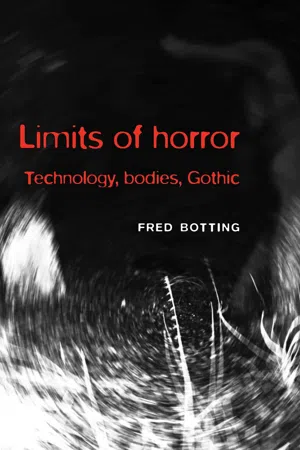
The meaning of monsters, vampires and ghosts has changed significantly over the last two hundred years, as have the mechanisms (from fiction to fantasmagoria, film and video games) through which they are produced and consumed. Limits of horror, moving from gothic to cybergothic, through technological modernity and across a range of literary, cinematic and popular cultural texts, critically examines these changes and the questions they pose for understanding contemporary culture and subjectivity.
Re-examining key concepts such as the uncanny, the sublime, terror, shock and abjection in terms of their bodily and technological implications, this book advances current critical and theoretical debates on Gothic horror to propose a new theory of cultural production based on an extensive discussion of Freud's idea of the death drive.
Limits of horror will appeal to students and academics in Literature, Film, Media and Cultural Studies and Cultural Theory.
- 233 pages
- English
- ePUB (mobile friendly)
- Available on iOS & Android
eBook - ePub
About this book
Information
1
Daddy’s dead
Gun of the father
A YOUNG WOMAN’S PASSION beats in time with the steam engine that hurries her to the ancestral bed of her husband. She pauses to reflect on the mother and the girlhood that her marriage leaves behind. Her imagination flares: ahead is romance, magic and the fairy castle that will be her home. A poor, fatherless girl, she has become a Marquise, lavished with jewels and fine dresses. There are greater luxuries and riches to be enjoyed in the castle itself.
But this is only the beginning of a mock Gothic romance by Angela Carter, the short story entitled ‘The Bloody Chamber’. The husband, of course, will turn out villainous, that much is clear from his three previous wives, his waxen, ageless skin, the ‘carnal avarice’ of his gaze; the fairy castle will be a place of dark secrets and horrible chambers, as well as her prison, her place of execution and her tomb. A Radcliffean heroine whisked away to persecution in an enchanted palace by an evil aristocrat, an ingénue, like Jonathan Harker at the mercy of powers beyond his control in Dracula’s castle, her story spans the entirety of Gothic romance: the death of one of the wives in a boating accident and the disconcerting presence of a housekeeper include Daphne Du Maurier’s Rebecca in the list of the genre heroines. Another wife, an operatic diva, recalls the Phantom, while the last, a Romanian princess, was named Carmilla. The Marquis, a Sadean figure, owns a library of pornography and a working torture museum: this, the ‘bloody chamber’, is the forbidden place entered by the heroine when her husband is conveniently called away on business. There she finds the remains of her predecessors and discovers her fate.
In this world all women are objects, objects to be looked at, to be displayed, to be collected, exchanged and possessed symbolically and physically in marriage, to be enjoyed – and to be disposed of – in sexual and fatal consummation. The gifts of marriage, the exchange of rings and the taking of a new name see a girl transferred into womanhood and from one man to another, a father to a husband. Memories prompted by the smell of smoke from her husband’s fat Romeo y Julietta, readily elide the Marquis and a father who used to embrace her amid the fug of his own Havana cigar. Romantic ideals about love and marriage quickly turn Gothic in the story: Carter’s vampiric, Sadean villain, with his collection of antiquarian pornography and implements of torture, turns romantic dreaming into nightmare, his wealth, refinement and gourmand’s tastes are the luxurious excesses that find their baser counterpart in comparisons with a horse dealer examining new flesh and the housewife prodding goods at the market. The heroine, so she observes, is the fourth to be invited ‘to join this gallery of beautiful women’ (Carter, 1981: 11). She may not be the last Marquise: as the Marquis, on the point of raising the executioner’s axe, reclaims her opal engagement ring, he notes that ‘it will serve me for a dozen more fiancées’ (49). For a serial husband, wives are to be collected and put away like any other valuable items of property.
Even before the heroine discovers his secret, the magic wears off quickly as she finds she has been made an exile through marriage. Carter’s story, however, is not content with disillusioning the romance of marriage by exposing its darker side and turning a critical feminist eye on the patriarchal cruelties underpinning the Gothic tradition. That this tradition involves the exchange, expropriation, exile and execution of women is the given, signalled in the many Gothic allusions of the story. Its ending, however, presents a subversive twist, a telling reversal of expectations and conventions that discloses and opposes the normal symbolic investments of Gothic plots and formulas. With only a blind piano-tuner as company, the helpless heroine is summoned to her death. Then, from her turret window, she glimpses a figure in the distance desperately speeding to her aid. ‘Like a miracle’ a properly romantic ending awaits. However, despite the scene, the urgency and mode of arrival, the figure is not suitably attired:
a horse and rider galloping at a vertiginous speed along the causeway, though the waves crashed, now, high as the horse’s fetlocks. A rider, her black skirts tucked up around her waist so she could ride hard and fast, a crazy, magnificent horsewoman in widow’s weeds. (48)
This should be a shining knight on a white charger rather than an old woman dressed in black. A more significant reversal of conventions becomes apparent as the figure, almost too late to stop the fall of the axe, bursts through the castle gates:
You never saw such a wild thing as my mother, her hat seized by the winds and blown out to sea so that her hair was her white mane, her black lisle legs exposed to the thigh, her skirts tucked round her waist, one hand on the reins of the rearing horse while the other clasped my father’s service revolver and, behind her, the breakers of the savage, indifferent sea, like the witnesses of a furious justice. (50–1)
Thoroughly romantic in setting, timing and posture, the conventional heroism of the rescue is only slightly at odds with the person of the rescuer. The incongruity barely leaves time for a smile, the gap between scene and actor quickly filled as the latter lives up to her demanding heroic responsibilities and unerringly completes her role: ‘Now, without a moment’s hesitation, she raised my father’s gun, took aim and put a single, irreproachable bullet through my husband’s head’ (51). As cool and determined as the happy band of adventurers who storm Dracula’s castle to exact righteous punishment on the object of evil, the heroine’s mother, as right and just as the irreproachable bullet she fires with such accuracy, brings the murderous career of the husband to an end: monsters must die.
Drastic and violent romantic conclusions of this kind sit comfortably with the conventions of Gothic romance. It is only the sex and age of the person who delivers them that has changed. Indeed, the mother impersonates romantic heroism so effectively – particularly in the dispatch of the villain – as to leave romanticism’s conventions intact. Almost. A banal explanation is quickly offered to account for the overblown arrival: having taken a train and reached the isolated station near the castle to find no taxi waiting, she was forced to borrow an ‘old Dobbin’ from a local farmer. Realism undercuts romance. The heroine does not live happily ever after to enjoy her riches and castle and her new, less ideally romantic, love: most of the wealth is given away and she returns to Paris to set up a small music school with her mother and the piano-tuner. A taint of romance remains: a heart-shaped bloodstain is indelibly imprinted on her forehead as a reminder of deluded aspirations to love, social status and wealth.
The return to simple domesticity, recommended in the Gothic romance since Radcliffe, seems to banish the spectres of romantic fancy. With the exposure and expulsion of those fictional spectres comes a more sustained interrogation of the assumptions and illusions supporting familial and social relations. Women become active in the home and in the world, no longer subject to the rule of male exchange. That, painted in Gothic extremes, has become a cruel and insupportable tyranny. The return of the mother, so often absent from the plots of Gothic novels, a return in a heroic role conventionally allotted to males, initiates a reversal of positions allotted to different genders in family and society. The reversal, moreover, which places an unexpected figure at the centre of conventionally male romantic action, divorces gendered person from convention so that ascribed characteristics and attributes no longer appear fixed as natural and unchanging biological features. Anyone can play the role of the hero because it is simply a role. The story’s knowing engagement with and subversion of fictional conventions draws attention to their formality and artifice. Its reversals extend from sexual and marital conventions to social habits and mores, as conventional, artificial and contrived as anything else in the story and thereby as subject to critique, subversion and transformation.
While it exhumes the mother from her early Gothic grave and places her in a determining position at the beginning and end of the narrative, the story does not simply replace a paternal principle with a maternal one. All the mother does is act out a conventionally male role with all its heroic and violent trappings: she impersonates the father, or one of his paternal surrogates (an agent of justice, an officer of the law, a lover, a son-in-law etc.), as an active defender, protector, even saviour, of ‘his’ women. Paternal roles, of course, as the Marquis dramatically demonstrates, extend to darker counterparts: owner, abuser, murderer. In playing roles, however, she discloses paternal artifice, exposing and severing its purely formal association with a male figure. The father becomes just another role, an ideal, a metaphor or figure that is impersonated in turn. Neither form nor structure is identical with the person who takes his or her place, name and bearings within it. The story does not so much celebrate, in place of a dead father and a killed husband, the triumph of the mother and maternal domesticity, for that would merely replicate the same structure with different players: its reversals and substitutions open that structure itself up to scrutiny and disclose the impersonations and impostures of all roles within it. Any figure of paternal authority is ultimately an ‘impostor’ occupying the space vacated by the M/Other (Lacan, 1977a: 310–11). Perhaps this is where, beyond the story’s playful subversion of convention, the strangeness of its effects comes to the fore.
The return of the mother, though something of a miracle and formulaically fortuitous, is not in itself uncanny; nor, in the heroine’s musings, is the recollection of the dead father in the memories evoked by certain spousal habits. Strangeness arises in the appearance of figures where they ought not to be, conventionally and generically speaking: in Gothic fiction the mother is more often than not dead, while the father, for a time at least, remains alive. The reversal and substitution of roles is what engenders reversals in significance, opening up a play of figures in a supposedly closed form. Here, a Derridean play, a dissemination of (gendered) differences, is produced, one that discloses the loss of final truth or fixed meaning: ‘far from presupposing that a virgin substance thus precedes or oversees it, dispersing or withholding itself in a negative second moment, dissemination affirms the already divided generation of meaning’(Derrida, 1981: 268). This affirmation of an originary absence to meaning or truth, sketched in terms of sexuality and reproduction by Derrida (‘virgin substance’, ‘generation’, ‘dissemination’) is linked to the play of the uncanny in Freud, a play in which the meaning of the word ‘unheimlich’ crosses from familiar to strange, homely to unhomely, canny to uncanny. But disseminaton does more than undermine opposed terms within psychoanalysis: it opens the fundamentals of gender division, a difference based on castration and genitalia, to an originary nonorigin:
No more than can castration, dissemination – which entails, entrains, ‘inscribes’, and relaunches castration—can never become an originary, central, or ultimate signified, the place proper to truth. On the contrary, dissemination represents the affirmation of this nonorigin, the remarkable empty locus of a hundred blanks no meaning can be ascribed to, in which mark supplements and substitution games are multiplied ad infinitum. In The Uncanny, Freud – here more than ever attentive to undecidable ambivalence, to the play of the double, to the endless exchange between fantastic and real, the ‘symbolized’ and the ‘symbolizer’, to the process of interminable substitution – can without contradicting this play, have recourse both to castration anxiety, behind which no deeper secret (kein tieferes Geheimnis), no other meaning (kein andere Bedeutung) would lie hidden, and to the substitutive relation (Ersatzbeziehung) itself, for example between the eye and the male member. Castration is that nonsecret of seminal division that breaks into substitution. (268 n. 67)
Castration, which calls up paternal identification and fear in the conferral of sexed identity, which cuts off undecidability with the imposition of a phallic signifier, does not, in the uncanny encounter, secure a single, original meaning. Instead, it discloses an anterior space, an ‘empty locus’ for ‘interminable’ substitutions, multiplying signification beyond the finality of one meaning. A maternal locus shadows the paternal impostures, thwarting phallic authority: the ‘empty locus of a hundred blanks’ is a space of improper metaphorical substitutions; the blanks are shells fired without effect, impostors in the gun disarming the single bullet of meaning. For Hélène Cixous, the absence of any deeper secret in Freud’s ‘Uncanny’ discloses the feeling ‘of resistance to the threat of castration’: nothing lies on the ‘other side’ of castration, ‘“no meaning” other than the fear (resistance) of castration’. This fear re-presents itself repeatedly ‘in the infinite game of substitutions’, a double of castration, acknowledging and screening it off: ‘castration and fear at the blank it discloses’; horror and a hole; resistance and substitution, a host of impostures (Cixous, 536).
That the chosen method of execution in Carter’s story is decapitation, or that the heroine’s lover is blind, are not accidental features, but again point to the questions of sexuality at the heart of the tale, features that implicate Freudian psychoanalysis and its reliance on castration in the structuring of sexual relations and identities in the tradition of Gothic (family) romance. In this respect, and in relation to the issues of uncanniness in the story, the paternal and maternal positions are crucial: their reversal renders the familiarity of family relations strange and opens the absence structuring those relations to view. Where castration stresses the lack of the penis, that is the absence of something and a substitute already projected in its place, dissemination emphasises the priority of absence itself, a blank space resistant to meaning that none the less facilitates and engenders its production, albeit temporarily. Castration and the fear it engenders places an inaugural gap over a prior absence, thereby directing the path of meaning away from the empty locus and its interminable substitutions.
What the uncanny discloses, then, is a locus that gives rise to substitution, symbols, meaning, while refusing fixity and stability. It remains undecidable and ambivalent. Its absence generates an endless process of games of symbolisation, substitution and exchange, one which assumes a Gothic aspect with the appearance of the double and the anxiety-provoking glimpse of the secret absence or absent secret at the centre and origin of systems of meaning. ‘The Bloody Chamber’, in staging its reversals and substitutions touches upon the uncanny in this sense. In filling the space of the father, who previously established his position on the basis of maternal absence, the mother neither closes the gap nor returns to the priority of an originary absence. What is uncanny results from the interplay of the absence of what should be present (the father) and the presence of what should be absent (the mother), an interplay that opens a chasm in the structure of relations whereby the imposture of both figures appear in relation to a double gap.
Ambivalence and undecidability persist, as do the two figures, as figures. In the case of the mother, she has a determining influence in the choices made by her daughter. The latter from the start is marked out for not being overly enamoured of the illusions of romance: she refuses to answer her mother’s question as to whether she is sure she loves her husband. Her subsequent observations suggest two, related motives in which her mother’s past is implicated: she notes her mother’s sigh, ‘as if it was with reluctance that she might at last banish the spectre of poverty from its habitual place at our meagre table’ and goes on to comment that her mother ‘had gladly, scandalously, defiantly beggared herself for love’ and suffered the consequences of impoverished widowhood (Carter, 1981: 8). In not repeating her mother’s mistakes, the daughter rejects romantic notions of marriage for more practical (monetary) reasons. But there is a sense of reluctance, too, that implies her sacrifice of romance is not made out of anything like liberated, selfish desire for wealth and status: it is performed out of filial duty. Her choice of husband, while informed by a refusal of her mother’s romantic attitude (which, of course, saves her at the end), is also shaped by paternal similarity. Though dead, the (ghostly) figure of the father continues to exert effects. The paternal function, moreover, is passed on to the son-in-law in his exercise of unspeakable sovereignty over his bride. It is employed most fully in the trap set for the heroine. On the point of departure, he shows the heroine the keys to the house and itemises the various riches they will unlock. He also singles out one key as that which opens his most private and secret chamber at the same time as he absolutely forbids entry. Obviously, no other or more effective encouragement is required to instil her desire to discover what it contains. Prohibition, the story makes all-too plain, leads inexorably to transgression. While the heroine only belatedly realises the logic, its inevitability has already been heavily marked by the tale. It is, however, a false prohibition in that the villain wants her, counts on her, to transgress. Not only will she, in horror, discover her fate, her transgression will permit, perversely legitimate even, his punishment, thereby allowing him to act on his desire to murder her like the others. Prohibition leads to transgression which, in turn, lets the paternal law enforce its rule and thereby consummate the paternal figure’s most sovereign desire: the power over life and death. Law, then, maintains its limit through excess.
Though the heroism of the mother interrupts the completion of this perverse paternal circuit and exposes its artifice, the story never sets out to entirely escape the bounds of paternal structures, symbols or functions: it remains neither fully trapped nor utterly free, neither inside nor out, sustaining an interstitial position in relation to the empty locus of the uncanny. Written in the 1970s, the story holds to a critical feminism that refuses to advocate easy models of liberation which would overlook the external and internalised power and persistence of prevailing, if weakened, structures and unwittingly repeat their patterns. Perhaps the story’s return to familiarly mundane domesticity is not to be fully embraced as anything resembling a radical challenge to prevailing norms and fictional conventions. For all her heroism and its disruption of conventional assumptions, the actions of the mother replicate the violence of a romantic closure, in many ways a simple assumption of a paternal role. Indeed, as the story underlines through repetition, it is the father’s gun, instrument and symbol of power and violence, that is used in the execution of the paternal surrogate. Even though person is separated from structural position in the disruption of gendered conventions, the structure remains; even though the father is already dead, the paternal principle – and the gun – lives on in its numerous effects: the power of the figure persists though the person that once embodied it is gone. While the space of the father is emptied and nobody seems adequate to the task of filling it, the story does not bemoan this loss, nor is it concerned with anyone ever living up to a paternal ideal. The glorious action of the mother only mocks it, mimicking and parodying its function. In keeping the anoriginal space of substitution open to the end, the story provokes a critical examination of the persistence of paternal, and Gothic, effects.
The father is dead. But that does not matter. It is the principle that counts. It lives, a ghostly paternal figure, in myths, ritual, symbols and signs. Not necessarily embodied by but embedded in the circulation of signs, images, totems constituting cultures, the father remains as metaphor. The father, indeed, is long dead, his death the precondition for metaphorical afterlife, the basis for law and morality. While many Gothic villains, the Lords, Marquis, Counts that assume sovereign sexual and supernatural powers, evoke an archaic paternal position, their inevitable and necessary deaths form the basis for a restoration of law and a renewal of the values temporarily interrupted by an insurgence of untamed energies. The father’s death allows the foundation of the laws, bonds and rituals of culture to be formed: crime gives birth to law, guilt to morality, symbolic repetition of the act of murder becoming the basis of communal rites. In Totem and Taboo, the father of psychoanalysis turns to Darwin for a picture of the first father: humans once lived in small groups presided over by the strongest male who kept all the females to himself and expelled the sons as they approached maturity. This is the father of the ‘primal horde’. The male offspring, of course, were far from happy with the situation. So, speculates Freud,
one day the brothers who had been driven out came together, killed and devoured their father and so made an end of the patriarchal horde. United, they had the courage to do and succeeded in doing what would have been impossible for them individually. (Some cultural advance, perhaps, command over some new weapon, had given them a sense of superior strength.) (Freud, 1984: 203)
Gothic villains, in the eyes of heroines at least, often manifest the terrifying return of such a primal father. Dracula, with the ‘crew of light’ uniting to drive the vampire away from their women, and using various technological aids to chart his downfall, fits this pattern well. In ‘The Bloody Chamber’, the father’s gun is the ‘advance’ that evens the odds between mother and villain.
Freud’s account of the father does not end with his murder. The psychological and cultural consequences of the act are extensive. Having killed and eaten the object of fear and envy, the sons’ identification with him is complete. They, however, repeat the act symbolically: a totem meal, ‘mankind’s earliest festival’, commemorates the crime and constitutes the beginnings ‘of social organisation, of moral restriction and of religion’ (203). To unravel the subsequent developments of the process Freud alludes to Oedipus and the father-complexes of the young in which hate for a person blocking their path to power and sexual satisfaction is mixed with the love and admiration that underpins their identification with him. As a result, the murder induces feelings of guilt to the extent that ‘the dead father became stronger than the living one had been’ (204). Belatedly, through the prohibitions introduced by the sons, the father’s rule is instituted as law: the killing of the totem is forbidden along with sexual promiscuity. Father still rules: the enjoyment which prompted the act remains prohibited after its completion. Laws against murder and incest emerge from committing the former with the intent to commit the latter. In the rituals that commemorate the murder, the father figure lives on to be killed and eaten again in order that both triumph and guilt reinforce the laws binding communal organization, thus preventing what happened to the father happening to ...
Table of contents
- Cover Page
- Title Page
- Copyright Page
- Contents
- Acknowledgements
- Introduction: Horror now and then
- 1 Daddy’s dead
- 2 Tech noir
- 3 Dark bodies
- 4 Beyond the Gothic principle
- References
- Index
Trusted by 375,005 students
Access to over 1.5 million titles for a fair monthly price.
Study more efficiently using our study tools.
Frequently asked questions
Yes, you can cancel anytime from the Subscription tab in your account settings on the Perlego website. Your subscription will stay active until the end of your current billing period. Learn how to cancel your subscription
No, books cannot be downloaded as external files, such as PDFs, for use outside of Perlego. However, you can download books within the Perlego app for offline reading on mobile or tablet. Learn how to download books offline
Perlego offers two plans: Essential and Complete
- Essential is ideal for learners and professionals who enjoy exploring a wide range of subjects. Access the Essential Library with 800,000+ trusted titles and best-sellers across business, personal growth, and the humanities. Includes unlimited reading time and Standard Read Aloud voice.
- Complete: Perfect for advanced learners and researchers needing full, unrestricted access. Unlock 1.5M+ books across hundreds of subjects, including academic and specialized titles. The Complete Plan also includes advanced features like Premium Read Aloud and Research Assistant.
We are an online textbook subscription service, where you can get access to an entire online library for less than the price of a single book per month. With over 1.5 million books across 990+ topics, we’ve got you covered! Learn about our mission
Look out for the read-aloud symbol on your next book to see if you can listen to it. The read-aloud tool reads text aloud for you, highlighting the text as it is being read. You can pause it, speed it up and slow it down. Learn more about Read Aloud
Yes! You can use the Perlego app on both iOS and Android devices to read anytime, anywhere — even offline. Perfect for commutes or when you’re on the go.
Please note we cannot support devices running on iOS 13 and Android 7 or earlier. Learn more about using the app
Please note we cannot support devices running on iOS 13 and Android 7 or earlier. Learn more about using the app
Yes, you can access Limits of horror by Fred Botting in PDF and/or ePUB format, as well as other popular books in Literature & Gothic, Romance, & Horror Literary Criticism. We have over 1.5 million books available in our catalogue for you to explore.