This book offers an original analysis of the problem of the authority of the state in democracies. Unlike many discussions of democracy that treat authority as a problem primarily of domestic politics or normative values, this book puts the international economy at the centre of the analysis.
This volume shows how changes in the international economy from the inter-war years to the end of the twentieth century impacted upon the success and failures of democracy. It makes the argument by considering a range of different cases, and it traces the success and failure of democracies over the past century. It includes detailed studies of democracies in both developed and developing countries, and offers a comparative analysis of their fate.
It will appeal to all those interested in democracy, the future of the state and the impact of the international economy on domestic politics.
eBook - ePub
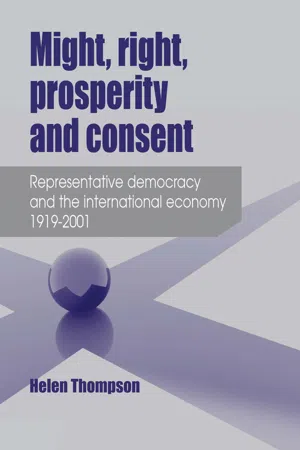
Might, right, prosperity and consent
Representative democracy and the international economy 1919–2001
- 291 pages
- English
- ePUB (mobile friendly)
- Available on iOS & Android
eBook - ePub
Might, right, prosperity and consent
Representative democracy and the international economy 1919–2001
About this book
Information
Publisher
Manchester University PressYear
2013Print ISBN
9780719097294
9780719077500
eBook ISBN
9781847797148
1
The modern democratic nation-state
For Machiavelli and his heirs, reason of state was prudent politics for princes and republics in competition for territory and power at home and abroad using violence. By the time the first aspects of what were to become modern democratic nation-states were emerging during the late eighteenth and nineteenth centuries, the domestic and external conditions in which the authority and power of any state had to be realised were very different. That change began with the gradual emergence of the modern state when several European monarchs sought to establish a monopoly over legitimate violence, and to exclude external legal intrusion in their affairs. In doing so, the most successful created states that claimed to rule as single sovereign entities, large territories inhabited by vast numbers of subjects divided by class, religious faith and mores. Out of the problems this generated, those who led them eventually turned to the idea of representative democracy and nationhood, only to discover that authority grounded in the idea of a national people and letting subjects choose representatives to govern generated a whole new set of difficulties for states.
The modern state
The modern state emerged in contrast to the multiple and fragmented sites of power that had characterised most of Europe after the fall of the western Roman empire. This predominantly Christian world had taken its clearest shape from the late eleventh century after the Papacy started to press a claim to direct political authority, asserting that Christendom was a universal entity in which spiritual and temporal laws were one. The Pope, the Vatican proclaimed, ruled Christendom as an inheritance of St Peter, the Holy Roman Emperor ruled the same territory by delegation from the Pope, and the regional kingdoms of Christendom were ultimately subordinate to a universal legal order sanctioned by God. Within each of the kingdoms of Christendom, the crown shared power with the church, feudal barons and estates and parliaments.1
Over the course of three centuries, the English and French crowns attacked this political settlement at home and created a very different kind of rule. In doing so, their apologists used the term ‘the state’ for the first time specifically to distinguish a legal and constitutional order independent of any particular ruler.2 During the fifteenth century both the English and French crowns tried to establish the sole authority to use violence. Henry VII destroyed the armies of the feudal barons and enforced new laws against retaining, giving the English crown an effective monopoly of legitimate violence. French monarchs were less immediately successful. Whilst the French king in 1429 advanced the principle that only the king had the right to recruit troops, only, after 1653, when it had put down a second uprising within five years by the provincial aristocracy, did the French crown succeed in stripping the nobles of their armies.
Against the backdrop of the splintering of Christendom by the Reformation, the English and French crowns similarly asserted the distinctiveness of their own legal and political authority against the extraterritorial claims of the Holy Roman Emperor and the Pope. England’s claim to be author of its own laws and its rejection of the edicts of others came when, by the 1533 Act of Appeals, the English crown denied any papal or Holy Roman jurisdiction over England, after the Pope refused to grant Henry VIII a divorce from the emperor’s aunt. In France, the crown had by the fourteenth century already asserted French sovereignty against the emperor and provoked the Pope to condemn Gallic ‘pride’, which ‘pretended to recognise no higher authority’.3 Two centuries later, Henri IV’s proclamation of the Edict of Nantes, which granted qualified liberty to Protestants, effectively stated the political authority of the French state to be secular and independent of Rome. In sharp contrast to the fiercely Catholic Spanish crown, first Henri IV and then Louis XIII’s chief minister, Cardinal Richelieu, defined the interests of the state as French, not Catholic.
The claim of states to external sovereignty against the old regime of the Papacy and the Holy Roman Emperor took its shape most clearly against the backdrop of the Thirty Years War and the Peace of Westphalia. In 1555, after years of violence, the Peace of Augsburg established the principle of religious equality within the empire between Catholics and Lutherans so that each prince could decide on the religion of his own subjects. In 1618, after the Catholic Ferdinand II acceded to the throne of Protestant Bohemia, war broke out within the Habsburg-led empire between the Evangelical Union and the Catholic League. After Bohemia was crushed and catholicised by the imperial forces, first Denmark and then Sweden intervened to defend the Protestants. In 1635, France joined the anti-imperial forces and declared war on Spain, bringing the Netherlands into the war. By 1648, both the empire and Spain were defeated. The Peace of Westphalia gave assets to treaties worked out at Osnabrück between the empire and Sweden, and at Münster between the empire and France and their respective confederates and allies. Westphalia legally dismissed any idea of the supra-national international authority of the Pope, and strengthened the authority of the princes and free cities within the empire against the Habsburgs, by granting them the right to sign foreign treaties and re-establishing the principle that the religion of the principalities and free cities was a local affair. But, despite persistent assertion otherwise, it did not propagate a doctrine of external state sovereignty per se. To the contrary, it gave Sweden and France the effective right to intervene within the principalities and free cities of the empire to ensure that both the provisions for religious minorities and the privileges of princes and free cities were upheld and maintained.4 What Westphalia introduced as international convention between states was the sovereignty of the powerful and the right of those states to impose conditions of statehood on defeated and aspiring states. It was this conception of state sovereignty that became the historical norm, upheld at the Congress of Vienna in 1815, the Congress of Berlin in 1878, at Versailles in 1919 and imposed on Japan by economic restrictions after the Meiji restoration.5
In asserting their unique authority to command legitimate violence and their sovereignty against external legal agents, the English and French crowns also increasingly claimed the sole right to administer and legislate within their respective kingdoms. Previously in England, Magna Carta in 1215 had established the principle that the crown had to operate within the law and that no free person could be punished except by lawful judgement of his equals or according to the common law of the land. Henry VIII and Thomas Cromwell transformed the Star Chamber into a new judicial court, which was not bound by common law, and used Parliament to make the English Reformation enforceable by law. Henry and Cromwell turned Parliament into an instrument of royal policy and in so doing established the sovereignty of the king in Parliament. In effect, the crown now created the law of the land through Parliament and administered that law through the judiciary. In France, Henri IV simply governed over the will of the estates and the local parlements and brought the duchies and provinces that had maintained a more or less independent political status under the authority of the crown. After the assassination of Henri IV in 1610 threatened more violent conflict, Richelieu centralised power further, and the defeat of the aristocratic rebels by his successor, Mazarin, in 1653 laid the basis for the absolutist rule of Louis XIV. As they centralised authority and power, the English and French crowns replaced indirect administrative rule through feudal relationships with direct bureaucratic rule, imposing uniform laws and administrative arrangements over the whole territory. In doing so, they massively increased the resources available to rulers. By fortifying their coercive power, they enhanced their capacity to tax and fund their own armies.6
Those who justified this new kind of state repudiated the rhetoric of Christendom. Given its most forceful theoretical shape by Jean Bodin and Thomas Hobbes, the political language of the modern state centred on the idea of sovereignty as a site of supreme and indivisible authority. For Hobbes, where there was no sovereignty within existing territorial borders, passionate, self-interested and self-righteous individuals would ensure there was no security or peace. Alone in the moral and political pluriverse, individuals could rationally agree to grant each other a natural right to self-preservation even if they chose to forebear their own. A sovereign commanding exclusive power, preferably but not necessarily a monarch, could by fear sustain the security on which any peaceful life depended. The state constructed on this basis was by definition impersonal.7 As Hobbes put it, the commonwealth was not formed to take ‘notice’ of ‘this or that individual citizen’.8 No government would, of course, ever think of ruling in this way. But rhetorically, the idea of the impersonal sovereign was a political asset. Since it did not ask subjects to recognise anything of themselves in the state beyond their interest in security, rulers had an argument to justify authority over large territories containing very diverse interests and religious beliefs.
Seen as a whole, the modern state, as Max Weber later explained, became a relationship of rule by human beings over human beings in an explicitly demarcated territory resting on the sovereign application of law and in the final instance on a successful claim to a monopoly of legitimate violence.9 To maintain the modern state’s authority those who led such states needed to accumulate and retain sufficient coercive power to enforce laws and control the arms available to their subjects. To defend the modern state’s external sovereignty, leaders needed to defend their state’s territory against invasion and any foreign claims to legal jurisdiction. Within these terms, some states were always likely to be more successful than others. But nowhere was such a state established without a bloody political contest. The English and French monarchs could have been defeated at various times in their attempts to establish this kind of state, at home by the aristocratic barons and abroad by the Catholic Habsburg powers still allied to the Papacy, or in some instances, as in the threats to the Tudor regime during Elizabeth I’s reign, by a compact between them. Neither, once instituted, could either the internal authority or external sovereignty of such a state be taken for granted. Like all other forms of political order that had preceded it, the modern state had to be defended by deliberate action, alert to domestic rebellion and external intervention.
Nonetheless, compared to monarchs after the demise of imperial Rome, those who commanded the power of modern states had very considerable advantages in maintaining rule. For the monarchs of the Middle Ages, the means of intimidating subjects were, in Macaulay’s words, ‘very scanty’.10 Resistance to an established government was therefore very easy. Would-be rebels could quickly raise an army of potentially more men than were available to the crown. And since none could readily command obedience from local barons, every monarch was vulnerable to losing territory to other crowns if domestic rebels allied with foreign enemies. But once monarchs achieved a monopoly of force, their subjects could only hope to mount a military challenge to the state if the crown’s standing army joined them in rebellion or they were led by a foreign power. Once subjects were tamed and stripped of the capacity to use their own weapons, the durability of a modern state at home could in good part depend on the effective exercise of violence.
The modern state and the mercantile economy
The primary menace to modern states came from beyond their own borders. A king whose judgement about foreign threats was as wretched as England’s Charles I’s could as easily throw away his crown and precipitate a revolution as any earlier monarch. But as wealth accumulated and science developed, the external world also spawned new kinds of dangers. By the late seventeenth century, the distinct populations ruled over by modern states were becoming commercially connected. Some, most clearly in the United Provinces, Britain and France, saw that commercial society could be used to increase the power of the state. As mercantilists, they believed that future political and military power had an economic basis and that material resources had to be won in a zerosum competition for trade and trading routes. If a state lost material resources to others, it would eventually lose military power too, threatening its internal authority. States, therefore, had good reason to encourage exports and discourage imports, to support domestic industries and activities that enhanced military power, to build a strong merchant marine, and to create institutions by which they could borrow money to finance these activities. Those that were most successful in this competition were rewarded with unprecedented levels of state revenue. But, as nowhere previously in a large state, mercantilism turned trade and national prosperity into a reason of state, and tied the stability and durability of monarchical rule to international economic success.11
Within this context, the external sovereignty and power of states depended on the ability of governments to structure the economy to the demands of commercial competition with other states as well as the efficacy of military resources and alliances. In competing for resources and power, governments increasingly turned towards large-scale borrowing. To sustain their creditworthiness, governments had to maintain the erratic confidence of those that endlessly bought and sold their debt. If governments failed to make the payments demanded, they risked, in David Hume’s words, ‘poverty, impotence, and subjection to foreign powers’.12 Many, like Hume, were horrified at what they took to be this Faustian bargain: for the sake of deferring taxation, the state had handed direct power over its future to those who had no interest in its survival.
Paths to representative democracy
By the last years of the eighteenth century the internal authority and external power of the European modern states were indeed waning. As national debts mounted to unsustainable levels, states desperately tried to extract more revenue in taxes to finance their war machines. But Britain’s attempt to tax the American colonies and that of France to tax its own subjects without granting some political representation, induced rebellion. In the subsequent crises either side of the Atlantic different aspects of a new kind of political entity first took their shape. On the western side, the new state that was designed in 1787 was a self-conscious attempt to create a representative republic over a large territory on new federalist principles. On the eastern side, in 1789, came the argument, most forcefully articulated by the Abbé Sieyès, that the entities of political rule should be defined by common membership of a unitary nation and that those who exercised power should be the representatives of that nation. Over the next century, out of the muddled and sometimes contradictory interaction of the practices and rhetoric of a reworked republicanism and a new imaginative notion of nationhood came a form of rule that can be described as the modern democratic nation-state.13 Within such states in Europe the new rules of rule divided power territorially and between executive and legislatures in different ways, some monarchs retained formal authority and some were eliminated, and the principle of representation held several meanings. But increasingly this fo...
Table of contents
- Cover
- Half Title
- Title Page
- Copyright
- Contents
- Preface
- Introduction
- 1 The modern democratic nation-state
- 2 The crises of the inter-war years
- 3 The Bretton Woods rescue
- 4 Crises and non-crises: financial liberalisation and the end of the Cold War
- 5 Conclusions
- Bibliography
- Index
Trusted by 375,005 students
Access to over 1.5 million titles for a fair monthly price.
Study more efficiently using our study tools.
Frequently asked questions
Yes, you can cancel anytime from the Subscription tab in your account settings on the Perlego website. Your subscription will stay active until the end of your current billing period. Learn how to cancel your subscription
No, books cannot be downloaded as external files, such as PDFs, for use outside of Perlego. However, you can download books within the Perlego app for offline reading on mobile or tablet. Learn how to download books offline
Perlego offers two plans: Essential and Complete
- Essential is ideal for learners and professionals who enjoy exploring a wide range of subjects. Access the Essential Library with 800,000+ trusted titles and best-sellers across business, personal growth, and the humanities. Includes unlimited reading time and Standard Read Aloud voice.
- Complete: Perfect for advanced learners and researchers needing full, unrestricted access. Unlock 1.5M+ books across hundreds of subjects, including academic and specialized titles. The Complete Plan also includes advanced features like Premium Read Aloud and Research Assistant.
We are an online textbook subscription service, where you can get access to an entire online library for less than the price of a single book per month. With over 1.5 million books across 990+ topics, we’ve got you covered! Learn about our mission
Look out for the read-aloud symbol on your next book to see if you can listen to it. The read-aloud tool reads text aloud for you, highlighting the text as it is being read. You can pause it, speed it up and slow it down. Learn more about Read Aloud
Yes! You can use the Perlego app on both iOS and Android devices to read anytime, anywhere — even offline. Perfect for commutes or when you’re on the go.
Please note we cannot support devices running on iOS 13 and Android 7 or earlier. Learn more about using the app
Please note we cannot support devices running on iOS 13 and Android 7 or earlier. Learn more about using the app
Yes, you can access Might, right, prosperity and consent by Helen Thompson in PDF and/or ePUB format, as well as other popular books in Politics & International Relations & Economic History. We have over 1.5 million books available in our catalogue for you to explore.