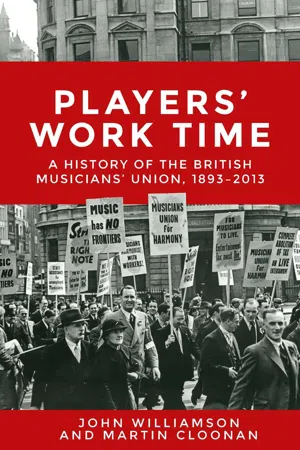
eBook - ePub
Players' work time
A history of the British Musicians' Union, 1893–2013
- 272 pages
- English
- ePUB (mobile friendly)
- Available on iOS & Android
eBook - ePub
Players' work time
A history of the British Musicians' Union, 1893–2013
About this book
This is about musicians' working lives in Britain from the late Victorian era to the present day. Using the Musicians' Union as a prism through which to explore those lives, the book illuminates the key factors which shape musicians' working lives including such things as changes in technology, law and the music industries, while also considering matters of nationality, gender and genre. Anyone interested in music and the people who make it will be interested in this history.
Information
Publisher
Manchester University PressYear
2016Print ISBN
9781526113948
9781784991326
eBook ISBN
9781526108296
1
Musicians’ organisations before 1893
We begin by contextualising the work and organisation of musicians in Britain prior to the formation of the AMU in 1893.1 To do so, we consider the challenges facing those working as musicians. These have long centred on the low pay and social status conferred upon professional musicians. Indeed, the very notion of music as work has often proved problematic, and work as a full-time (and adequately paid) musician has generally been attainable for only a small, elite group of musicians. The others have formed an often itinerant, insecure, and flexible labour force within which the supply of qualified players has frequently outstripped the demand for their skills.
Embedded within this predicament are the reasons for musicians organising in the first instance. Initially, musicians’ organisations sought to offer forms of benevolence – making up for a lack of other provision elsewhere for times of hardship, illness, and old age – and to provide some form of entry to the profession via accreditation. However, as time progressed organisations were formed that also addressed the terms and conditions under which musicians were employed.
To begin, these were secondary to the main purposes of early musicians’ organisations – to confer professional status on musicians and control entry to the profession. We examine these chronologically, starting with the first documented musicians’ organisations in the fourteenth century and explaining the profession’s journey towards trade unionism in three parts. First, we examine the historical precedents for organising musicians in Britain. Second, we pay particular attention to the wider socio-political changes in Britain in the nineteenth century concerning trade unions, employment, and working conditions. Finally, we discuss the formation of the AMU in 1893, emphasising not only the differences between it and previous musicians’ organisations, but also the lingering splits and differing attitudes towards trade unionism within the profession, as illustrated by the formation – also in 1893 – of the (London) Orchestral Association (LOA).2
Origins
The organisation of musicians in Britain can be seen as a progression from very loose, localised groups of court musicians to organised trade unions, growing in power and militancy between the fourteenth and nineteenth centuries, with the formation of the AMU being the culmination of this journey. Indeed, the changing names of such organisations illustrates their evolving nature: fraternities and brotherhoods in the fourteenth and fifteenth centuries, fellowships in the sixteenth and seventeenth centuries, benevolent societies3 and protection associations in the late eighteenth and nineteenth centuries. While space prevents a detailed discussion of the history of the music profession in the UK, or of all the individual organisations representing musicians, it is fruitful to examine the changes in the nature of the profession, the bargaining power of musicians, and the various organisations that emerged.
To get a sense of the historic organisation of musicians in Britain it is important to consider the nature and geographic spread of musical work from the Middle Ages. Most professional musical activity was in London and centred around the royal court, with musicians surviving on royal patronage. There were also a small number of independent musicians (or minstrels) who were not directly dependent on court favours. Thus, while the main focus of the music profession was in London, Loft mentions early minstrel activity in the provinces in places such as Chester and Staffordshire (1950: 222). However, as late as the eighteenth century there were few opportunities for professional musicians in the provinces. According to Ehrlich these amounted to ‘perhaps a few hundred rather tenuous jobs’ (1985: 19).
As the music profession grew through the Middle Ages, town waits became the most significant group of musicians outside the court. Although they were primarily musicians, the exact nature of their role has been problematised by Rastall (2009), and Woodfill notes that they appear to have had several roles beyond music (1953: 33, 45–6). Their importance here is that they formed a significant group of employed musicians who were outside the court but were also tied to the State, albeit on a local level.
Accounts of musicians’ organisations in this period are inevitably incomplete, speculative, and often contradictory (Wilson 2001). Here we focus on those aspects of their work that were of subsequent importance. Three things are of note. First, there was never one organisation that represented all musicians. Second, such organisations served primarily to offer benevolence to members in need. Third, they took on increasingly protectionist functions, wherein they sought to exclude non-members and ‘foreigners’4 from undertaking work that might impact on those already working in the profession. The significance of all this lies in the reoccurrence of such themes throughout the story of the MU some 500 years later.
These are also evident in the first of the musicians’ organisations specifically named by Loft: the Fraternity of Minstrels in London, which he dates to 1350. It was established ‘among ordinary, non-court players’ in the City of London and had a limited purview, making ‘no attempt to establish or enforce specific conditions of work in the craft’. Indeed, its most significant feature was the retention of ‘a common treasury for the purposes of mutual aid’, which looked after members in need – something characteristic of most subsequent organisations (Loft 1950: 216).
By the fifteenth century, splits in the profession and the increasing emphasis on protecting its workers were evident. A separate organisation representing the King’s Minstrels (The Brotherhood of the King’s Minstrels) had achieved guild status by 1449.5 Loft characterises the decree as offering the King’s Minstrels the power to ‘protect the monopoly’ of ‘not only the court-players but also the general body of minstrels in England as a whole’ (1950: 224). A subsequent charter granted to the Brotherhood in 1469 returned to the issue of competition from ‘rude countryfolk and workers at various crafts in our kingdom of England (who) have pretended to be minstrels’ (225), and sought to ensure that only trained, licensed musicians performed as minstrels throughout the kingdom. A further condition was that ‘every professional musician is required to belong to the guild’ (228).
While acknowledging the difficulties involved in tracing the lineage of the various musicians’ organisations in the fourteenth and fifteenth centuries, Loft also notes the existence of an organisation called the Fellowship of Minstrels and Freemen in London in 1500, speculating that it was ‘a continuation or at least an outgrowth of the 1469 group’ (1950: 230), perhaps involving ‘the civic musicians or ‘waits’ of London’ (231). However, Wilson (2001) suggests otherwise, describing this as a separate grouping who ‘occupied themselves with disputes with foreigners’ but generally ‘avoided disputes with the King’s Minstrels’.
What is of importance, however, is that by the sixteenth century different groups of musicians had begun to organise in separate bodies, depending on the nature of their work. All these organisations seemingly shared an interest in controlling the supply of labour in the profession, albeit with generally limited success. In the first instance, they focused on the number of apprentices each member of the Fellowship could employ6 and the control of ‘foreign’ musicians. According to Loft, these attempts at control failed miserably, and by 1574, the Fellowship had effectively disintegrated.7 Thus, even where they existed, musicians’ organisations were limited in scope, wealth, and power.
During the seventeenth century the end of the Tudor dynasty was the catalyst for the first substantive change in musicians’ organisations in the wider context of what Loft describes as a ‘period of extensive incorporation of the many crafts and trades’ (1950: 236). In 1604, James I granted a charter to the (former) Fellowship of Minstrels under the title of the ‘The Master, Wardens and Commonality of the Art or Science of the Musicians of London’.8 This granting of a Royal Charter to what was previously the Fellowship of Minstrels and was now the Commonality of the Art or Science of the Musicians of London incorporated the new organisation as a guild with extended powers, described by Loft as a ‘monopolistic authority over the craft’ (238), albeit with the exception of the King’s musicians, whose own brotherhood received a new Royal Charter in 1635. Three other things of later importance emerged as a result of the new Charter and its attempts to control membership of the profession. The first was the introduction of the right to examine both existing and potential new members for ‘sufficiency and skill in the said art or science’, the second was the creation of a minimum size of ensemble, and the third a rule preventing members from having any dealings with ‘foreigners’ (Worshipful Company of Musicians 1915: 33).
These can be viewed as protective measures designed to maximise the amount of work available to a relatively small number of musicians. By insisting that a minimum of four players be engaged for ‘weddings, feasts, banquets, revels or other assemblies or meetings within the city of London’ (Loft 1950: 39), Loft claims that the Commonality acted as a ‘guard against underselling in the music trade’ (248). Thus, as early as the seventeenth century, many musicians were employers of other musicians (their apprentices) whose interests were seen as being best served by the exclusion of ‘foreign’ musicians. However, the guild was still insufficiently strong to be able to police such regulations, and the dilution of the profession by non-members – with the consequent undercutting of rates – became another perennial characteristic of the music profession.
The eighteenth century heralded a number of changes in both the nature of musical work and the organisation of musical workers. At its commencement there was still a relatively small number of professional musicians and much of the demand remained in London.9 However, the importance of the town waits decreased as the century progressed and there was a shift of emphasis from a patronage system to one that was increasingly reliant on the market – beginning what Ehrlich calls ‘the gradual commercialisation of music’ (1985: 3). Evidence of this came in the form of the growing number of music teachers, the launch of a number of subscription concerts, and the employment of musicians by larger theatres and opera companies. However, the profession remained relatively small in number, fragmented, vulnerable, and lacking ‘sufficient coherence to form protective associations’ (Ehrlich, 1985: 25). Such as it did, it was organised around a reconstituted version of one of the old organisations (the London Commonality) and an important new society (the Fund for the Support of Decayed Musicians).
Although the London Commonality had gone into decline in the late seventeenth century and apparently did not hold a meeting after 1679,10 it re-emerged in 1700, when a new Act widened its scope to include ‘dancing masters’ as well as musicians (Loft 1950: 260). This reinforced the previous monopolies by insisting that only freemen of the City of London could be musicians or ‘dancing masters’ in the city, and furthermore it prevented its members from joining any other workers’ association. The Commonality was reconstituted as the Worshipful Company of Musicians in 1750, though this too lost control of the profession because of a lack of resources to enforce both its rules and the desired monopoly. By the end of the century it ‘was in a curious condition’ (Loft 1950: 265) as a result of its membership policies. Desperately trying to boost its finances, it opened membership to non-musicians who wanted the associated right to work in the City of London. According to Ehrlich, of the 700 new members admitted between 1743 and 1769 only nineteen were musicians. While it survived – and remains as one of the traditional livery companies of the City of London11 – its functions are largely ceremonial, and by the end of the century it had ‘lost completely its old function as an arbiter in the music industry’ (Ehrlich 1985: 268).
The other eighteenth-century musicians’ organisation that has survived was formed in 1738 as the ‘Fund for the Support of Decayed Musicians or their families’. A mutual aid society, it was established after three London musicians saw two destitute boys whom they recognised as the orphaned sons of a formerly successful colleague (Ehrlich 1985: 28). Initially, benefits from the fund were available only to full-time professional musicians, thus effectively excluding the majority...
Table of contents
- Cover
- Half Title
- Title Page
- Copyright Page
- Dedication
- Table of contents
- List of figures
- Acknowledgements
- Notes on archives and other sources
- List of abbreviations
- Introduction
- 1 Musicians’ organisations before 1893
- 2 Early days: the Amalgamated Musicians’ Union, 1893–1918
- 3 Boom and bust: 1919–1933
- 4 The politics of dancing: 1934–1945
- 5 Worlds of possibilities: 1946–1955
- 6 The beat generation: 1956–1970
- 7 The John Morton years: 1971–1990
- 8 Disharmony: 1991–2002
- 9 Beginning again: the MU in the twenty-first century
- Conclusion
- References
- Index
Trusted by 375,005 students
Access to over 1.5 million titles for a fair monthly price.
Study more efficiently using our study tools.
Frequently asked questions
Yes, you can cancel anytime from the Subscription tab in your account settings on the Perlego website. Your subscription will stay active until the end of your current billing period. Learn how to cancel your subscription
No, books cannot be downloaded as external files, such as PDFs, for use outside of Perlego. However, you can download books within the Perlego app for offline reading on mobile or tablet. Learn how to download books offline
Perlego offers two plans: Essential and Complete
- Essential is ideal for learners and professionals who enjoy exploring a wide range of subjects. Access the Essential Library with 800,000+ trusted titles and best-sellers across business, personal growth, and the humanities. Includes unlimited reading time and Standard Read Aloud voice.
- Complete: Perfect for advanced learners and researchers needing full, unrestricted access. Unlock 1.5M+ books across hundreds of subjects, including academic and specialized titles. The Complete Plan also includes advanced features like Premium Read Aloud and Research Assistant.
We are an online textbook subscription service, where you can get access to an entire online library for less than the price of a single book per month. With over 1.5 million books across 990+ topics, we’ve got you covered! Learn about our mission
Look out for the read-aloud symbol on your next book to see if you can listen to it. The read-aloud tool reads text aloud for you, highlighting the text as it is being read. You can pause it, speed it up and slow it down. Learn more about Read Aloud
Yes! You can use the Perlego app on both iOS and Android devices to read anytime, anywhere — even offline. Perfect for commutes or when you’re on the go.
Please note we cannot support devices running on iOS 13 and Android 7 or earlier. Learn more about using the app
Please note we cannot support devices running on iOS 13 and Android 7 or earlier. Learn more about using the app
Yes, you can access Players' work time by John Williamson,Martin Cloonan,John Callan Williamson,Martin Cloonan in PDF and/or ePUB format, as well as other popular books in Social Sciences & Music. We have over 1.5 million books available in our catalogue for you to explore.