This study explores the theory and practice of authority during the later sixteenth century, in the religious culture and political institutions of the city of Nantes, where the religious wars traditionally came to an end with the great Edict of 1598.
The Wars of Religion witnessed serious challenges to the authority of the last Valois kings of France. Through detailed examination of the municipal and ecclesiastical records of Nantes, the author considers challenges to authority, its renegotiation and reconstruction in the city during the civil war period. The book surveys the socio-economic structures of the city, details the growth of the Protestant church, assesses the impact of sectarian conflict and the early counter reform movement on the Catholic Church, and evaluates the changing political relations of the city council with the population and with the French crown. Finally, Tingle focuses on the Catholic League rebellion against the king and the question of why Nantes held out against Henry IV longer than any other French city.
eBook - ePub
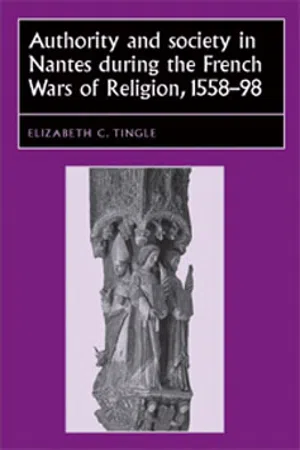
Authority and society in Nantes during the French Wars of Religion, 1558–1598
- 230 pages
- English
- ePUB (mobile friendly)
- Available on iOS & Android
eBook - ePub
Authority and society in Nantes during the French Wars of Religion, 1558–1598
About this book
Information
1
Introduction: authority and society in sixteenth-century Nantes
At 6 o’clock on the evening of 13 April 1598, Henry IV rode through the Saint-Pierre gate into Nantes. There was no formal royal entry. Henry entered not as a guest but as a general, for after ten years of rebellion, Nantes was the final Catholic League city to capitulate to the crown. The king and his bodyguard passed straight into the old ducal château, where the cathedral chapter and the municipality came to pay their respects. Shops were ordered to be closed and the inhabitants warned not to fire their arquebuses.1 Two weeks later, the king issued the famous edict of toleration for the Protestants of France that allowed them legal rights of worship and coexistence in the state. Nantes would henceforth be associated with the religious freedom of Huguenots and to be remembered as the place where the French wars of religion came to an end.
The aim of this study is to explore the city context of these events, the motives for Nantes’ participation in the religious wars and for its revolt against the crown in 1589, and why the Catholic League rebellion lasted longer here than in any other town. This is not a simple narrative of Nantes’ experiences of the religious wars. The central focus is on authority, its theoretical construction, its institutional embodiment, its reception and negotiation, and changes within these over time. During the religious wars the understanding and exercise of many different levels of authority came under close scrutiny by contemporaries, and the nature and legitimacy of authority were questioned. This book offers a study of city governance in a period of pressure and change. It combines examination of the changing relationship of the city government and the royal state with analysis of the experience of authority within the urban community.
For historians of the late nineteenth and early twentieth centuries, such as Lucien Romier and H.-J. Mariéjol, the French wars of religion were primarily political in causation and perpetration. At their heart lay struggles between factions of great aristocratic families, and their conflicts with the crown. The Bourbons, Montmorencies and Guises used religion as a cloak to disguise their essential purpose, which was to control more closely the king and the state. Conflict arose after the death of Henry II in 1559 left the monarchy weakened by the accession of two boy kings and a female regency under Catherine de’ Medici.2 The wars ended when a party of politiques or moderates, for whom the unity of the state was more important than religious conflict, cast aside confessional differences and turned to Henry IV to restore peace and order.3 Provincial and urban societies such as Nantes had little part to play in this ‘top down’, centrist approach to the civil wars.
In the first half of the twentieth century, there was a reaction against the history of great men and political events, particularly associated with the Annales school of historians, which was influenced by Marxism and structuralism. They privileged social and economic explanations of religious conflict and war. Historians such as Henri Hauser and Lucien Febvre interpreted Protestantism as the ideological refuge of merchants, lawyers and artisans. Civil conflict was part of their struggle against the social and political dominance of the feudal land-holding nobility and church.4 From the 1950s onwards in Anglo-Saxon scholarship, there was a growing interest in the Protestant movement and politics, with works such as those by Robert Kingdon and Nicola Sutherland.5 Out of an intellectual concern with ‘history from below’, and a growing interest in the sociological and anthropological methodologies of Émile Durkheim’s followers, historians such as Emmanuel Leroy Ladurie, Natalie Davis, Richard Gascon and Janine Estèbe turned to socio-cultural examinations of sixteenth-century society. They interpreted the religious wars as part of a profound social and cultural crisis affecting all French social groups.6 Since the 1980s, a new orthodoxy has emerged, arguing that the wars were ‘a conflict fought primarily over the issue of religion … [which] was … the fulcrum upon which the civil wars balanced’, with religion defined as a community of believers rather than a body of beliefs.7 Above all, in his seminal work on religious culture, Denis Crouzet has argued for the centrality of religion to the conflicts that took place after 1560, to the exclusion of other factors.8
Penny Roberts has observed that changing perspectives on the nature and causes of the French civil wars arose from a shift in historians’ interests, away from central government to the provinces and to local experiences of events.9 Jean-Marie Constant has identified three issues particularly favoured by historians writing at the turn of the twentieth and twenty-first centuries: firstly, the study of social groups and communities, particularly the nobility; secondly, the history of social relations, networks, forms of sociability and clientage; and thirdly, city life and government, the relationships between different urban social groups and their relations with the countryside, nobility and crown.10 Above all, the study of cities has provided a fuller understanding of how religious change and civil conflict affected the lives and experiences of ordinary people. Although only 15 per cent of the French population lived in urban communities in the sixteenth century, towns were ‘the centre of social relations, power, wealth, a more supervised and civilised world than the countryside’.11 They were nodal points of religious and political culture. Their importance in the realm was marked by a constant symbolic interchange between kings and urban elites, through patronage and formal royal entries.12 P. Benedict’s work on Rouen, N. Davis on Lyon, W. Kaiser on Marseille, R. Descimon and B. Diefendorf on Paris for example, have shown that religious change and divisions affected townspeople and led to strife, independent of the actions of the royal government.13 Similarly, political activity was not confined to the king and noble elites but took place in all communities.14 Annette Finley-Croswhite has even argued that the French religious wars were in large part an urban conflict and ended when Henry IV reopened ‘the dialogue between crown and the towns, enhancing his authority and the power of the crown in the process’.15
What has emerged from local urban studies is the interdependence of political, social and religious factors in causing and defining the course of the religious wars: that all communities were affected by a complex interplay of local and ‘national’ issues and events.16 Despite this, Stuart Carroll observes that the political history of the French civil wars has been unfashionable. While religion has received much attention, the study of political culture is less advanced, yet their inter-relatedness is clear: ‘religious divisions of the sixteenth century permeated all levels of society and introduced an ideological element to politics. During the civil wars, religion and politics, both at court and in the localities, became inter-twined.’17 A number of doctoral students have begun to rectify this with studies of regional politics, such as the work of R. Souriac on the Comminges region, Tim Watson on Lyon and Philip Conner on Montauban.18
This study of Nantes is about the impact of the religious wars on the exercise and understanding of authority in the city, principally that of the municipal government. Five questions have framed the work. Firstly, what impact did religious change in the form of the growth of Protestantism have upon the urban community of Nantes, particularly with regard to conceptions and acceptance of authority within the city, and how were the new problems resolved? The emergence of the new religion led to disorder, which made day-to-day administration more difficult for the urban authorities, while royal religious policy strained the city government’s relations with the crown. The resolution of these tensions forms the core of the first half of this work. Secondly, what was the impact of confessional change and conflict upon the religious and cultural life of the majority of Nantes’ inhabitants, particularly the practice of Catholicism? Changes within the institutional church and devotional practices were marked features of the years after 1560. The rebuilding of Catholic authority and identity during the wars of religion had a great impact on urban politics during these years. Thirdly, under scrutiny is the impact of conflict upon the relationship between the crown and Nantes’ city government. Problems of royal authority after 1560 led to changes in the constitutional and institutional relationship between the city and the king, which were responsible for the creation of a formal municipality in Nantes in 1565 and for the rebellion of the city against Henry III in 1589. A fourth question is that of the impact of religious and political change upon relations between elites and popular groups within Nantes, particularly the poor. Finally, the importance of regional identity will be assessed. Nantes was the largest city of Brittany, until 1532 a separate duchy within the French kingdom. Nantes’ inhabitants were proud of their provincial identity and privileges. Here, the tensions between provincial particularism and central power in the later sixteenth century are examined. Comparisons with other cities of northern France are also made, for it is essential to ask whether Nantes’ experiences were typical, whether there was a separate ‘history’ of western and middling-rank urban communities for this period, or the experiences of the wars of religion were common to all.
The main research basis for the study of Nantes is the surviving archive of the city government. The registers of the deliberations of the city council are almost complete for the period 1554 to 1598, with the exception of the years of the Catholic League administration. Records of the city’s treasurer, the bourgeois militia and those concerned with security of the city are also rich if not complete.19 Less full are the sources for religion, social and cultural life. Nantes was badly damaged by Allied bombing in 1943 and 1944, during which the city’s notarial records and the archive of the cathedral and chapter were largely destroyed. However, Nantes benefited from voluminous works by historians in the eighteenth and nineteenth centuries, notably the Abbé Travers and Dom H. Morice, who summarised and reproduced many primary sources which are now lost. Extensive use has been made of these studies and collections, in what has sometimes amounted to an ‘archaeology’ of the history of the religious wars. Surviving evidence has determined the primacy given to municipal government and governance, and to the exercise of authority in the early modern town.
Structures of authority and mod...
Table of contents
- Cover Page
- Title Page
- Copyright Page
- Dedication
- Contents
- List of figures and tables
- Acknowledgements
- List of abbreviations
- 1 Introduction: authority and society in sixteenth-century Nantes
- 2 Setting the scene: the city and its people in the mid-sixteenth century
- 3 Challenges to authority: the development of Protestantism in Nantes, 1558–72
- 4 City governance in crisis: crown, conseil and municipality in the early religious wars, 1559–74
- 5 Taxation, war and rebellion: Nantes and Henry III, 1574–89
- 6 The authority of tradition: Catholicism in Nantes, 1560–89
- 7 Nantes and the Catholic League rebellion, 1589–98
- 8 Conclusions: authority and society in Nantes during the religious wars
- Select bibliography
- Index
Trusted by 375,005 students
Access to over 1.5 million titles for a fair monthly price.
Study more efficiently using our study tools.
Frequently asked questions
Yes, you can cancel anytime from the Subscription tab in your account settings on the Perlego website. Your subscription will stay active until the end of your current billing period. Learn how to cancel your subscription
No, books cannot be downloaded as external files, such as PDFs, for use outside of Perlego. However, you can download books within the Perlego app for offline reading on mobile or tablet. Learn how to download books offline
Perlego offers two plans: Essential and Complete
- Essential is ideal for learners and professionals who enjoy exploring a wide range of subjects. Access the Essential Library with 800,000+ trusted titles and best-sellers across business, personal growth, and the humanities. Includes unlimited reading time and Standard Read Aloud voice.
- Complete: Perfect for advanced learners and researchers needing full, unrestricted access. Unlock 1.5M+ books across hundreds of subjects, including academic and specialized titles. The Complete Plan also includes advanced features like Premium Read Aloud and Research Assistant.
We are an online textbook subscription service, where you can get access to an entire online library for less than the price of a single book per month. With over 1.5 million books across 990+ topics, we’ve got you covered! Learn about our mission
Look out for the read-aloud symbol on your next book to see if you can listen to it. The read-aloud tool reads text aloud for you, highlighting the text as it is being read. You can pause it, speed it up and slow it down. Learn more about Read Aloud
Yes! You can use the Perlego app on both iOS and Android devices to read anytime, anywhere — even offline. Perfect for commutes or when you’re on the go.
Please note we cannot support devices running on iOS 13 and Android 7 or earlier. Learn more about using the app
Please note we cannot support devices running on iOS 13 and Android 7 or earlier. Learn more about using the app
Yes, you can access Authority and society in Nantes during the French Wars of Religion, 1558–1598 by Elizabeth C. Tingle in PDF and/or ePUB format, as well as other popular books in History & French History. We have over 1.5 million books available in our catalogue for you to explore.