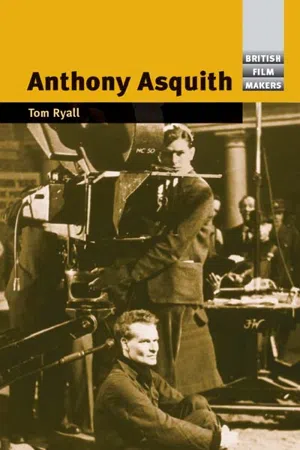
This is the first comprehensive critical study of Anthony Asquith. Ryall sets the director's work in the context of British cinema from the silent period to the 1960s, examining the artistic and cultural influences which shaped his films.
Asquith's silent films were compared favourably to those of his eminent contemporary Alfred Hitchcock, but his career faltered during the 1930s. However, the success of Pygmalion (1938) and French Without Tears (1939), based on plays by George Bernard Shaw and Terence Rattigan, together with his significant contributions to wartime British cinema, re-established him as a leading British film maker. Asquith's post-war career includes several pictures in collaboration with Terence Rattigan, and the definitive adaptation of Oscar Wilde's The Importance of Being Earnest (1951), but his versatility is demonstrated in a number of modest genre films including The Woman in Question (1950), The Young Lovers (1954) and Orders to Kill (1958).
- 200 pages
- English
- ePUB (mobile friendly)
- Available on iOS & Android
eBook - ePub
Anthony Asquith
About this book
Information
Subtopic
Film & Video1 Introduction
It is impossible to think of the history of British cinema without thinking of Anthony Asquith. (Dilys Powell)1
Dilys Powell’s acknowledgement of Asquith’s significance to the British cinema was written as part of a tribute to the director and published in 1968 by the British Film Institute shortly after his death. The tribute, understandably effusive in the context of a commemorative publication, has not quite been echoed by those who have written about the history of British cinema in the years since Asquith’s death in 1968. One film historian has suggested that he is ‘perhaps the most underrated director in British film history’;2 yet it may be closer to the mark to suggest that Asquith has not really received the critical attention that would enable a rating of his work in terms of the British cinema as yet. Although not ignored by scholars and critics, his work has certainly not had anything like the attention enjoyed by his most distinguished contemporary, Alfred Hitchcock, and neither has it had the consideration devoted to figures such as Michael Powell and David Lean. The riposte to that, of course, may be that his achievement is not as great as Hitchcock, Powell, and others, and, indeed, with a handful of exceptions, his work has not been highly regarded in the context of modern Film Studies. At best, his films have inspired local admiration for specific titles as in Raymond Durgnat’s comment that Asquith’s ‘best films aren’t vaporized by the sternest comparison – with Ophuls’.3 At worst he has been dismissed in somewhat harsh terms as in David Thomson’s caustic entry in his biographical dictionary of cinema, where Asquith is characterised as ‘a dull journeyman supervisor of the transfer to the screen of proven theatrical properties’.4 In the context of critical neglect, one of the aims of this study is simply to fill a gap, to provide an account of Asquith’s films – thirty-five features and a handful of shorter films – and to draw attention to the varied body of work with which he is associated. The study also aims to position the work in relation to the various directions taken by the British film during the period of his career. Asquith was a film director in the British cinema for almost forty years, serving his apprenticeship in the last years of the silent period and making his final film, The Yellow Rolls-Royce (1964), during the ‘swinging sixties’. The remainder of this chapter is devoted to a career overview as a preparation for the subsequent more detailed attention to the various phases in his career.
Early years
Asquith entered the film industry in the mid-1920s, towards the end of the troubled silent period when the production industry in Britain was in decline in the face of competition from the American film. Hollywood dominated the British screen and its films were highly popular with the British public but the domestic industry struggled to find a position in the market and seemed to many on the brink of extinction. There was considerable pressure for government action to halt the decline and this resulted in the quota legislation of the late 1920s. The 1928 Cinematograph Films Act effectively laid the foundations for a British production industry by, amongst other provisions, requiring exhibitors to screen a number of British films as part of their annual schedules. Asquith’s early films were made during a period of optimism generated by the quota arrangements; new companies were starting up, new studios were being built, and British films had an assured place on the nation’s cinema screens. It was also a period marked by ‘a lively engagement with issues of film criticism and aesthetics’.5 This engagement was stimulated in part by the new adventurous films from Germany, France, the Scandinavian countries, and the Soviet Union, and it formed the basis for the development of a thriving intellectual film culture in Britain manifested in the formation of film societies and specialist cinemas, and the development of serious reflection on the medium in journals such as Close Up.
Asquith was one of what Rachael Low refers to as ‘the new generation of well-connected, well-educated young men, who, unlike their parents, were prepared to take films seriously’.6 He was eminently well-connected as the son of the former Liberal Prime Minister, Herbert Asquith, and his mother, Margot, was a ‘writer and brilliant society figure’,7 a prominent member of the metropolitan social and cultural circles. Asquith had a traditional upper-middle-class education at Winchester public school and Oxford University, which was where he began to take an interest in the cinema. After graduating he spent a short time in Hollywood ‘as a guest of Douglas Fairbanks and Mary Pickford, and watched some of the great directors of the American silent cinema at work’.8 His American experience left its mark; in particular, he met and befriended Charles Chaplin who provided him with a potent and influential sounding board for his developing views on the art of cinema. Writing about his experiences some years later he was to recollect: ‘I realise now, far more than I did at the time, what a tremendous experience it was for me – a green, filmstruck undergraduate – to be able to talk for hours on end with the greatest artist the cinema has produced.’9
In 1926 he joined Harry Bruce Woolfe’s British Instructional Films, then part of the Stoll organisation, the largest British producer of the early 1920s. This began his practical apprenticeship, providing him with a varied experience of film production. For example, on Sinclair Hill’s Boadicea (1926), in addition to contributing to the scenario, he also acted as ‘Property Master, Assistant make-up Man, Assistant Cutter and Stunt Man’.10 He was also involved in a film called Thou Fool (1928), mainly as an editor. However, in Asquith’s own words, ‘I even directed a shot for it, taken from Chelsea Bridge. It was of Lotts Road Power Station, shot on a misty November afternoon.’11 In a sense this was a minor rehearsal of sorts for a subsequent film – Underground (1928) – which featured more extensive location shooting at the power station as the backdrop for its dramatic denouement.
Asquith had joined British Instructional at a time when the company was rethinking its production strategies and responding, no doubt, to the new opportunities for British films anticipated as a consequence of the forthcoming quota legislation. The company was best known for its documentary reconstructions of the First World War battles with films such as The Battle of Jutland (1921) and Zeebrugge (1924), and had also developed the celebrated Secrets of Nature natural history series. However, the firm was reorganised and relaunched as a public company in 1927 and fiction films were to be central to its future plans. In fact, the first film announced in this change of direction was an adaptation of Tell England, a best-selling novel set in the First World War, written by Ernest Raymond and published in 1921.12 In the event, the Tell England project was delayed, and the first venture into fiction film by the company was to be Shooting Stars (1928). The film, based upon an original Asquith scenario, is usually regarded as his first picture as director, though it is credited to A. V. Bramble, an experienced director brought in by British Instructional to work with the novice film-maker. Asquith was then promoted to sole directing credit on his next films – Underground (1928) and The Runaway Princess (1928). Both had romantic themes though in somewhat contrasting social settings. Underground is a story of romance set in a working-class milieu whereas in The Runaway Princess, an Anglo-German co-production shot mainly in Berlin, the romance is set in a royal milieu. Both films, however, used London-based location sequences and those in The Runaway Princess prompted one reviewer to suggest that ‘the London settings are used to much more advantage than most British directors have yet put them’.13 Asquith’s final silent film was A Cottage on Dartmoor (1930) though, as with many films in production in 1929, a sound-on-disc musical component was provided together with some dialogue sequences. Indeed, its importance as a film on the boundary between the silent and sound eras has been compared to Hitchcock’s much-venerated Blackmail (1929).14 Though an Anglo-Swedish co-production, the film was made at British Instructional’s newly completed Welwyn studios.
Tell England (1931), the much-delayed project about the Gallipoli campaign during the First World War, was to be Asquith’s first sound film proper, though, as with Shooting Stars, he was to work in collaboration with another experienced figure. His co-director, Geoffrey Barkas, was brought in for his specialist expertise in location shooting as a good deal of the film was to be shot abroad with Malta standing in for the Dardanelles. Inevitably, its status as a sound film was somewhat compromised by its long gestation from the initial silent project. British Instructional had acquired the screen rights to the novel in 1925 and, according to Asquith:
It was bought as a picture subject for Walter Summers who made the ‘Battles of Coronel and Falkland Islands.’ When he was due to commence turning the Raymond story into a picture the powers that be felt that war films were no longer doing well at the box office. So the project was shelved for the time being.15
In fact, the film had been advertised in the trade press late in 1927 with a release date of September 1928, and the project ‘launched’ at a dinner at the Savoy addressed by the novelist John Buchan, a member of the British Instructional board.16 The film betrayed its silent roots; the location work in particular was filmed silent with sound added later, and it also retained the use of intertitles from the silent period. Yet the film which finally emerged prompted comparisons with distinguished war pictures such as Pudovkin’s The End of St. Petersburg (1926) and Milestone’s All Quiet on the Western Front (1930). Paul Rotha selected the landing and battle sequences shot by Barkas and edited by Asquith for special praise though he was critical of the fictional story element of the film;17 the Evening News critic judged the film to be ‘one of the two or three outstanding British talkies made so far’;18 and, in a much later assessment, Peter Cowie suggests that ‘the massacre on the Gallipoli beaches has taken its place as one of the most compelling and cinematic war sequences ever made’.19 In one sense Tell England marked the end of Asquith’s apprenticeship; he had established a reputation as an inventive silent film-maker with two films from his own screenplays and he had also adapted the work of others; he had worked abroad on a co-production and he had made the transition to the sound film. The subject matter of his first five films was diverse – the world of filmmaking, working-class life, middle-Europea...
Table of contents
- Cover Page
- Title Page
- Copyright Page
- Contents
- Series Editors’ Foreword
- Acknowledgements
- 1 Introduction
- 2 The formative years
- 3 The 1930s
- 4 Wartime British cinema
- 5 Post-war films 1 – genre and British cinema
- 6 Post-war films 2 – adaptation and the theatre
- 7 The ‘international’ film
- 8 Asquith and the British cinema
- Filmography
- Select Bibliography
- Index
Trusted by 375,005 students
Access to over 1.5 million titles for a fair monthly price.
Study more efficiently using our study tools.
Frequently asked questions
Yes, you can cancel anytime from the Subscription tab in your account settings on the Perlego website. Your subscription will stay active until the end of your current billing period. Learn how to cancel your subscription
No, books cannot be downloaded as external files, such as PDFs, for use outside of Perlego. However, you can download books within the Perlego app for offline reading on mobile or tablet. Learn how to download books offline
Perlego offers two plans: Essential and Complete
- Essential is ideal for learners and professionals who enjoy exploring a wide range of subjects. Access the Essential Library with 800,000+ trusted titles and best-sellers across business, personal growth, and the humanities. Includes unlimited reading time and Standard Read Aloud voice.
- Complete: Perfect for advanced learners and researchers needing full, unrestricted access. Unlock 1.5M+ books across hundreds of subjects, including academic and specialized titles. The Complete Plan also includes advanced features like Premium Read Aloud and Research Assistant.
We are an online textbook subscription service, where you can get access to an entire online library for less than the price of a single book per month. With over 1.5 million books across 990+ topics, we’ve got you covered! Learn about our mission
Look out for the read-aloud symbol on your next book to see if you can listen to it. The read-aloud tool reads text aloud for you, highlighting the text as it is being read. You can pause it, speed it up and slow it down. Learn more about Read Aloud
Yes! You can use the Perlego app on both iOS and Android devices to read anytime, anywhere — even offline. Perfect for commutes or when you’re on the go.
Please note we cannot support devices running on iOS 13 and Android 7 or earlier. Learn more about using the app
Please note we cannot support devices running on iOS 13 and Android 7 or earlier. Learn more about using the app
Yes, you can access Anthony Asquith by Tom Ryall in PDF and/or ePUB format, as well as other popular books in Media & Performing Arts & Film & Video. We have over 1.5 million books available in our catalogue for you to explore.