In a theatre which self-consciously cultivated its audiences' imagination, how and what did playgoers 'see' on the stage? This book reconstructs one aspect of that imaginative process. It considers a range of printed and documentary evidence - the majority previously unpublished - for the way ordinary individuals thought about their houses and households. It then explores how writers of domestic tragedies engaged those attitudes to shape their representations of domesticity. It therefore offers a new method for understanding theatrical representations, based around a truly interdisciplinary study of the interaction between literary and historical methods.
The plays she cites include Arden of Faversham, Two Lamentable Tragedies, A Woman Killed With Kindness, and A Yorkshire Tragedy.
eBook - ePub
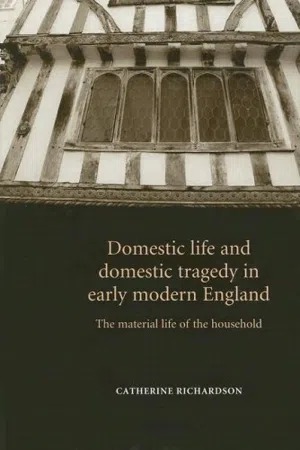
Domestic life and domestic tragedy in early modern England
The material life of the household
- 235 pages
- English
- ePUB (mobile friendly)
- Available on iOS & Android
eBook - ePub
Domestic life and domestic tragedy in early modern England
The material life of the household
About this book
Information
Subtopic
Social History1
‘My narrow-prying neighbours blab’:
moral perceptions of the early
modern household
IN LATE SIXTEENTH-CENTURY ENGLAND, domestic life became the subject of scrutiny: just what was the household, how might it be made to further God’s intentions for the world, what ideals should govern conduct within it?1 Early modern society responded to these questions eagerly, insistently and at length. Homilies, political tracts, sermons, advice literature, ballads, jests and of course plays sought, and questioned, the answers. The results of such investigations informed the moral standards which underpinned legal interest in appropriate behaviour, especially the anxieties about moral honesty and personal reputation which structured the concerns of the ecclesiastical courts.2
The broad outline of these debates is well known.3 A sophisticated discourse of the power relations of the household within society was developed, one which saw a metaphorical connection between different kinds of authority and their several spheres of operation. As the king ruled the country, so the husband ruled his household. His authority there was absolute, and those who lived under his roof owed him loyalty and allegiance just as he owed them protection and the wisdom of his government. This system fitted within the larger scheme of patriarchy reasonably neatly.4 Domestic inequality, like the other discriminations which underpinned society, was seen as fundamentally productive of order: ‘For as in a citie, there is nothing more unequall, then that every man should bee like equall: so it is not convenient, that in one house every man shuld be like and equall together. There is no equality in that citie, where the private man is equal with the Magistrate, the people with the Senate, or the servants with the master, but rather a confusion of all offices and authoritie.’5 In order to ensure that an unambiguous sense of hierarchy prevented such confusion, household relations were to be modelled on more complex systems of social organisation. As Richard Brathwaite put it, ‘As every man’s house is his Castle, so is his family a private Commonwealth, wherein if due government be not observed, nothing but confusion is to be expected’.6 The idea of commonwealth expresses the seditious potential of family rebellion; the idea of castle articulates the fundamental difference between the household and other social groups: its physical separation and seclusion from the eyes of the community.
Almost as familiar as this structure of domestic authority, however, are the contradictions inherent within it. Although the husband was supreme head of the household, he was also an equal before God with his wife. A wife’s place, as Gouge put it, ‘is indeed a place of inferiority and subjection, yet the neerest to equality that may be: a place of common equity in many respects, wherein man and wife are, after a sort, even fellowes and partners’.7 Negotiating the times when equality gave way to subjection was always fraught with social, personal and ideological tensions. Marriage could be discussed metaphorically as a yoke shared by a pair of oxen who, as a result of their equal stature, might make great headway in the furrow of domestic production.8 But it could also be envisaged, in the image favoured by St Paul, as a union comparable to that of the head and the body: the married couple incorporated into one form, where the male part of the pair represented the reasonable and reasoning head, served by his female lower members.9 Although both metaphors aim to express intimacy and common purpose, the difference between the equal oxen and the hierarchised head and body epitomises the problematic connection between the political ideology of household government and the patriarchal organisation of social power. As Gouge points out, the couple are ‘yoak-fellowes in mututal familiarity, not in equall authority’.10
The household manuals, from which come the most detailed evidence for the working out of domestic theories, were keen to stress the fact that they dealt primarily with ideals. Writers acknowledged that their advice about subjection was very hard to follow: ‘I know this dutie goes against the haire’ Whately says to women, ‘though it be so plaine, as it cannot be denied, yet it is withall so hard, that it can hardly bee yeelded unto.’ But these ideals were nevertheless goals which could be aimed at, and as such domestic subordination was part of the wider responsibilities of Christians to improve the human condition: ‘we must remember that this is no more difficult than divers other duties in other cases required of a Christian; and that it is no excuse from our dutie in any case to say it is hard, and who can do it?’11
But such ideals were intended to be models for, rather than absolutes of, behaviour, and the manuals expounded proscriptions for daily life which were grounded in practice, not theory. Advice is given, for instance, about the appropriate division of tasks between household members; about the way superiors might chastise inferiors to encourage them to change their ways; and about the forms of speech and gesture appropriate to authority and submission. Often, advice is presented in the traditional rhetorical form of a dichotomised pairing which attempts to draw clear distinctions between different roles.12 The roles of husband and wife, for instance, are described in contradistinction to one another: ‘The dutie of the husband is, to get goods: and that of the wife to gather them together, and save them. The dutie of the husband is, to travell abroad to seeke living: and the wives dutie is to keep the house … The dutie of the husband is, to deale with many men: and of the wives, to talke with few … The dutie of the man is, to bee skilfull in talke: and of the wife, to boast of silence … The dutie of the husband is, to dispatch all things without doore: and of the wife, to oversee and give order for all things within the house.’13
These dichotomised proscriptions for behaviour turned on three major divisions. There was the distinction between authority and subjection, where ‘household’ was envisaged as a set of power dynamics between masters and servants, parents and children, husbands and wives. There was the division between the house and the community, by which the duties of the householder were circumscribed: for instance Cleaver claims that many tried to ‘complaine that their children and servants are disordered, and corrupted abroad, when in trueth they were disordered and are still corrupted, and mard at home’. The final division was that between the spiritual and the material comforts of the household, where the family ‘must seeke to have Holinesse found in their habitation, whereby God may be glorified, as wel as riches, whereby they may be comforted’.14 Whereas the distinction between authority and subjection involved distinguishing between different types of behaviour, the other two generate their meaning from the firm distinction between inside and outside, and between the material and the non-material. In other words they are intimately concerned with the fabric of the house itself and with the physical qualities of everyday life as boundaries upon and analogies for behaviour.
The texts imagine the household in two different senses; as a physical space which is closed off from the community and therefore controllable, and as a series of interpersonal relationships with their individual dynamics of authority and submission which cohere into a functioning unit of production and consumption. These two aspects are inseparable, and they are defined by one another: people form a household when they are gathered into the same living space, and buildings function as houses when they are inhabited by a family.15 The two aspects of the household are also used, metaphorically, to explain one another. Rifts within the social fabric of the house produce shocking and irreparable physical results: ‘As a kingdome cannot stand, if it be divided: so a house cannot stand, if it be divided: for strife is like fire, which leaves nothing … but dust, smoke and ashes behinde it.’16 Such vivid images of physical threat to the house give form to the crucial importance of the ties which should bind its inhabitants.
Despite the familiarity of this material, two questions crucial to my argument here have yet to be fully explored. The first concerns those relationships between these two meanings of ‘household’, the physical and the familial: how exactly did understanding of the material qualities of the household impinge upon the relationships between its inhabitants, and vice versa? Although we are by and large studying the textuality of proscription, we do so at least partly in order to reach an understanding of the way it was interpreted in practice. Henri Lefebvre has pointed up the connections and the tensions inherent in different aspects of the spaces within which life is lived: the ‘dialectical relationship’ between ‘the perceived, the conceived, and the lived’.17 Hanson and Pratt argue that subjectivity is negotiated through ‘the traffic between symbolic and concrete spaces’.18 Understanding the way didactic literature uses the materiality of the house itself to negotiate its human relationships of subjection and authority is suggestive of the connections between mental and physical space.
The second question also grows out of an interest in practice, as it involves the relevance of these textual constructs of behaviour to daily life. This issue has received considerably more attention from historians, who have concerned themselves with the extent to and the circumstances under which these ideals impinged upon domestic practice. It has become clear that, although the literature admonished wives to stay within the household and to speak seldom, the demands of the domestic economy for those of low and even middling status necessitated wives’ frequent trips to market to sell their wares aggressively.19 It is equally plain that, although husbands were to negotiate the complexities of social and financial credit in order to provide for their families, harsh economic conditions, particularly towards the end of the sixteenth century, made this ideal so hard to sustain that for a proportion of the population even the provision of household space itself was under threat.20
Alexandra Shepard says that her evidence ‘suggests a routine acceptance of a household ideology far less differentiated by gender than that proposed by Dod and Cleaver’ in their manual A godlie forme of householde government. Instead, issues such as social credit were ‘gender-related, rather than genderspecific’; individuals worked creatively with gendered notions of the household, which could be ‘selectively applied and invoked’.21 Laura Gowing quotes a slander case which is richly suggestive of this process of selective invocation of ideals. The incident in question is recorded by ‘Agnes Franklin, an armourer’s wife of St Andrew Holborn’, who testified, ‘that with a group of women in an upper chamber of her house she had heard Henry Smith, the minister and preacher of household order, standing by her window in his yard, call Eleanor Hedge, who was standing inside her window about ten yards away looking into the same yard, a whore’. Franklin was presumably aware of what he preached, and enjoyed setting this against what he practised. Gowing sees such a creative reference to the disparity between ideal and practice as a more general feature of her material. ‘Street talk’, she says, ‘reflected and manipulated prescriptions for female behaviour.’22
In the context of communal disharmony, recent scholarship has suggested, both men and women were liable to hold up practice for comparison against moral absolutes. Although daily life may not have been lived in selfconscious relation to such fixed ideas, conflict was likely to sharpen perceptions and make individuals hyper-sensitive to moralised readings of everyday situations. My second concern here, then, is to attend to the points at which such ideals were invoked. In practice, this means looking for the familiar and meaningful tropes through which they were expressed in different kinds of literature. This will not give direct access to a ‘reality’ to set against ideals, but it will indicate the contexts and forms in which the latter were brought to bear upon the complexities of daily existence. Such a project makes meaning out of the relationships between different stories about similar subjects, whether those stories were produced as fact or fiction; whether they adopt a tone of high moral seriousness, or the ‘throwaway’ flippancy of a cheap joke.23
In addition to the prescriptive literature studied here, the responses of a socially diverse, although essentially ‘middling’, range of men and women to the connection between moral lapses and household spaces is investigated through the depositions they gave in the ecclesiastical courts. These courts were extensively used in the period, and they gave a high profile to the disputes they heard and the line they drew between acceptable and unacceptable behaviour.24 Their disputes were ‘centrally concerned with the spatial organization of the household’.25 Conduct manuals and court depositions have very different moral intentions, approaching as they do the relationship between ideal and practice in different ways, and they operate within distinct sets of ‘generic’ constraints.26 The differences ...
Table of contents
- Cover Page
- Title Page
- Copyright Page
- Dedication
- Contents
- List of illustrations
- Acknowledgements
- Note on the text
- Introduction
- 1 ‘My narrow-prying neighbours blab’: moral perceptions of the early modern household
- 2 ‘Choose thee a bed and hangings for a chamber; Take with thee everything that hath thy mark’: objects and spaces in the early modern house
- 3 Arden of Faversham
- 4 Two Lamentable Tragedies
- 5 A Woman Killed With Kindness
- 6 A Yorkshire Tragedy
- Conclusion
- Appendices: Statistical information on the material culture of the household
- Bibliography
- Index
Trusted by 375,005 students
Access to over 1.5 million titles for a fair monthly price.
Study more efficiently using our study tools.
Frequently asked questions
Yes, you can cancel anytime from the Subscription tab in your account settings on the Perlego website. Your subscription will stay active until the end of your current billing period. Learn how to cancel your subscription
No, books cannot be downloaded as external files, such as PDFs, for use outside of Perlego. However, you can download books within the Perlego app for offline reading on mobile or tablet. Learn how to download books offline
Perlego offers two plans: Essential and Complete
- Essential is ideal for learners and professionals who enjoy exploring a wide range of subjects. Access the Essential Library with 800,000+ trusted titles and best-sellers across business, personal growth, and the humanities. Includes unlimited reading time and Standard Read Aloud voice.
- Complete: Perfect for advanced learners and researchers needing full, unrestricted access. Unlock 1.5M+ books across hundreds of subjects, including academic and specialized titles. The Complete Plan also includes advanced features like Premium Read Aloud and Research Assistant.
We are an online textbook subscription service, where you can get access to an entire online library for less than the price of a single book per month. With over 1.5 million books across 990+ topics, we’ve got you covered! Learn about our mission
Look out for the read-aloud symbol on your next book to see if you can listen to it. The read-aloud tool reads text aloud for you, highlighting the text as it is being read. You can pause it, speed it up and slow it down. Learn more about Read Aloud
Yes! You can use the Perlego app on both iOS and Android devices to read anytime, anywhere — even offline. Perfect for commutes or when you’re on the go.
Please note we cannot support devices running on iOS 13 and Android 7 or earlier. Learn more about using the app
Please note we cannot support devices running on iOS 13 and Android 7 or earlier. Learn more about using the app
Yes, you can access Domestic life and domestic tragedy in early modern England by Catherine Richardson in PDF and/or ePUB format, as well as other popular books in Media & Performing Arts & Social History. We have over 1.5 million books available in our catalogue for you to explore.