eBook - ePub
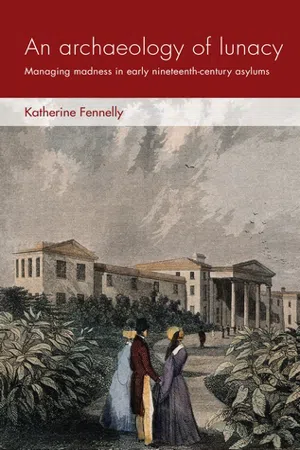
An archaeology of lunacy
Managing madness in early nineteenth-century asylums
- 177 pages
- English
- ePUB (mobile friendly)
- Available on iOS & Android
eBook - ePub
About this book
An archaeology of lunacy is a materially focused exploration of the first wave of public asylum building in Britain and Ireland, which took place during the late-Georgian and early Victorian period. Examining architecture and material culture, the book proposes that the familiar asylum archetype, usually attributed to the Victorians, was in fact developed much earlier. It looks at the planning and construction of the first public asylums and assesses the extent to which popular ideas about reformed management practices for the insane were applied at ground level. Crucially, it moves beyond doctors and reformers, repopulating the asylum with the myriad characters that made up its everyday existence: keepers, clerks and patients. Contributing to archaeological scholarship on institutions of confinement, the book is aimed at academics, students and general readers interested in the material environment of the historic lunatic asylum.
Information
Table of contents
- Cover
- Half Title
- Title Page
- Copyright
- Dedication
- Contents
- List of figures
- List of tables
- Preface
- Acknowledgements
- Table of legislation
- 1 Introduction
- 2 Management
- 3 Administration
- 4 Movement
- 5 Conclusions
- References
- Index
Trusted by 375,005 students
Access to over 1.5 million titles for a fair monthly price.
Study more efficiently using our study tools.
Frequently asked questions
Yes, you can cancel anytime from the Subscription tab in your account settings on the Perlego website. Your subscription will stay active until the end of your current billing period. Learn how to cancel your subscription
No, books cannot be downloaded as external files, such as PDFs, for use outside of Perlego. However, you can download books within the Perlego app for offline reading on mobile or tablet. Learn how to download books offline
We are an online textbook subscription service, where you can get access to an entire online library for less than the price of a single book per month. With over 1.5 million books across 990+ topics, we’ve got you covered! Learn about our mission
Look out for the read-aloud symbol on your next book to see if you can listen to it. The read-aloud tool reads text aloud for you, highlighting the text as it is being read. You can pause it, speed it up and slow it down. Learn more about Read Aloud
Yes! You can use the Perlego app on both iOS and Android devices to read anytime, anywhere — even offline. Perfect for commutes or when you’re on the go.
Please note we cannot support devices running on iOS 13 and Android 7 or earlier. Learn more about using the app
Please note we cannot support devices running on iOS 13 and Android 7 or earlier. Learn more about using the app
Yes, you can access An archaeology of lunacy by Katherine Fennelly in PDF and/or ePUB format, as well as other popular books in Social Sciences & Medical Theory, Practice & Reference. We have over 1.5 million books available in our catalogue for you to explore.