This book, now available in paperback after selling out in record time in its initial hardback release, provides a range of unique insights into the issues surrounding peacebuilding, delivered by major international figures with direct experience in this area at the highest level, including Bill Clinton, Hillary Clinton, Kofi Annan and Garret Fitzgerald. Based on a series of lectures on the theme of peacekeeping and peacebuilding in the contemporary world, each lecture is presented here with an introduction placing it in its proper context within the discourse on peacemaking.
Edited and introduced by Nobel Laureate John Hume, this volume makes an invaluable contribution to the study of peace and conflict studies, international history, international relations and international politics.
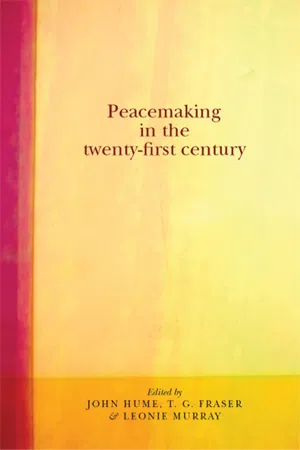
eBook - ePub
Peacemaking in the twenty-first century
- 214 pages
- English
- ePUB (mobile friendly)
- Available on iOS & Android
eBook - ePub
Peacemaking in the twenty-first century
About this book
Information
Publisher
Manchester University PressYear
2016Print ISBN
9780719096891
9780719087936
eBook ISBN
9781526111685
1
Peacemaking – challenges for the new century
Introduction
The pursuance of peace as a philosophy and of peacemaking as an activity, contrary to the suppositions of those who would call them ‘modern’ preoccupations, has a long and richly textured history.1 Since the earliest times during which human beings organised themselves into social groupings there has been violent conflict, to which the 9,100 year old vestiges of fortress walls around the ancient city of Jericho attest, and there is no shortage of great minds to tell us of the innately aggressive and bellicose nature of ‘man’: St Augustine, Hobbes, Rousseau and Freud, to name but a very few. The adage that ‘history is written by the victors’ highlights the salient fact that until relatively recently in human historiography, history has been about, or in some way revolved around, war and violent conflict. It is hardly surprising that a cursory glance at this ‘history’, then, would produce the conclusion that it is one of discord and bloodshed. For if history is written by victors then it follows that it is written by those concerned with victory; by those whose primary focus is contest not conciliation.
However, the human ‘instinctive imperative’ towards peace and peacemaking can be traced back to prehistory and beyond to our primate ancestors, which have an instinct for peaceful coexistence and engage in peacemaking activities in the face of conflict and tension.2 Equally because, and in spite, of the frequency of conflict, both biogenetic and cultural imperatives ensured that the maximising of peace emerged as a social good.3 From ancient times, people in social groups, large and small, have promoted peace and been actively involved in arbitration of violent disputes. Consequently, that humans also possess just as natural an inclination towards peace can be as strongly affirmed.
Whilst it is undoubtedly true that our past as a species is replete with conflict and although it may have seemed so at times, the world has not been at war without end for millennia; there have been extended periods of peace and harmonious coexistence. Therefore, it is possible to suggest that ours is, in fact, a tale of two realities: one of war and the other, less well explored, of peace. The purpose of this chapter is to walk a little while along that road less-travelled with the aim of clarifying for the reader such efforts as have been made to date in the area of peacemaking, placing our volume within the context of that ongoing endeavour. It will also outline the terms of greatest significance in this volume – peace and peacemaking – and introduce the reader to some of the key themes of importance in what is at once both an intellectual and practical project. Peacemaking in the twenty-first century looks to the complex nature of contemporary conflicts and the global nature of the forces exerted on them; to root causes, sub and supra state structures and multi-level challenges. The global nature of the twenty-first-century peace challenge requires a cosmopolitan-multicultural, universal-globalist response that focuses on accepting diversity and transcends conflict and division through progress on common goals and recognition of common humanity.
This chapter will address the normative challenge of twenty-first-century peacemaking, define the terms used herein and explore notions of negative and positive peace in historical context before moving on to discuss three key themes in this century’s peacemaking project: the root causes of conflict, its complex and global nature and the requirements of a universal-globalist response.
The normative challenge
It is possible to describe the pursuance of peace as a perpetual human project: a ‘peace project’ that encompasses all human activity designed to achieve peace in all of its forms, be it political, religious, civil or academic. The one thing that links the diverse, multi- and inter- disciplinary nature of those involved in the ‘peace project’ (statespersons, IGO and NGO representatives, practitioners, civil activists, scholars) and something that has attracted criticism, certainly in the academic sphere, is an agreement on the normative basis of the project: that peace is the ideal state for humanity to inhabit. As Ramsbotham, Woodhouse and Miall confirm, for its scholars, it is a ‘proactive peacemaking project’ that is ‘normatively associated with the promotion of peace’.4
For others peace is ‘worth the risks’ in the getting, as President Bill Clinton acknowledged in his dialogue; a point elevated by Hillary Clinton even further to the ‘most essential and noble goal’. Indeed, Taoiseach Bertie Ahern saw peace and its realisation as the ‘triumph of humanity and cooperation over division and despair’. Still, peace partners from most quarters would view the peace project in the twenty-first century from the perspective taken by Dr Maurice Hayes who precisely encapsulated the goal of the venture in the contemporary world when he affirmed that ‘no problem which results in a continuance of human suffering can be simply left to fester’.
Such is the contemporary mission: problems that result in human suffering give rise to a deficit of peace and since peace is the ideal, the role of the twenty-first-century peace project is to find solutions. A judgement has been made and unashamedly so, and it is this judgement that divides it from a purely academic pursuit and draws in statespersons, international civil servants and activists and NGO practitioners from around the world; it is what brought every one of our contributors to the task of peacemaking, from which combined experience this volume draws its lessons for peace.
The lexicon
What, then, exactly does this volume mean by peace and, indeed, by the peacemaking of its title? Peace as a concept is extremely difficult to capture in the abstract and as a result it is often defined as the absence of conflict, violent or otherwise. It is not within the parameters of this chapter to accurately bring such a multi-layered and nebulous idea to a satisfactory definition; however, what is important is our acceptance of what Johan Galtung (1964) crystallised as the distinction between ‘negative’ and ‘positive’ peace.5 Negative peace describes the absence of violent conflict, but not necessarily all conflict. Neither does it say anything about the presence of balance, justice, equality, etc. As Rodgers and Ramsbotham (1999) state, the ‘absence of war could obscure deep injustices which made a mockery of notions of peace’; this is the ‘oppressive peace’ model first established, in recorded history, in Pharaonic Egypt and which became the pattern, perhaps exemplified in the Pax Romana, so expertly described by Roman historian Tacitus that variants of his well-known idiom can be found in most writings on the subject.6 In such a context: ‘they made a wasteland and called it peace’.7
A condition of positive peace, by contrast, contains those elements of a harmonious society that negative peace cannot ensure and whose absence give rise to the underlying causes of violent conflict. Negative peace may be characterised as the absence of direct violence, but might still witness indirect violence or structural violence, such as uneven development, poverty, gendered social violence and inequality, economic, social and political injustice and environmental degradation. For positive peace to exist, therefore, a holistic approach to the overall equity and justice of society, domestic and international, must be under-taken, over-and-above safeguarding from direct violence. In this sense, although negative peace has been achieved in many conflict situations around the world, it can be argued that few, if any, societies have yet managed to achieve true peace in the positive sense.
It follows, then, that contemporary peacemaking may be concerned with any and all of these positive and negative factors, which brings us on to the term peacemaking itself. In specificist peace and conflict resolution literature peacemaking tends to refer to a tailored response to a particular stage of conflict intervention; top-down, elite-centred settlement of armed conflict.8 In broader discursive circles (and often involving the same range of academics and practitioners, as well as policymakers) it is regularly used to describe the gamut of activities associated with mitigation, management, resolution, settlement and transformation or transcendence of conflict and creating and promoting both negative and positive peace and reconciliation in and across divided societies. In fact, in this present volume peacemaking can be seen to refer to all of these aspects.
In the sense that all contributors to this volume have acted as elite peacemakers of some form or other, the activities in which they engaged can be described as peacemaking in the specificist sense. Each has, however, also been involved in peacemaking in the broader sense and their discussions incorporate and reflect a diversity of peacemaking activities and, therefore, the broader discursive definition also applies. In short, peacemaking herein refers to the whole range of activities directed at making peace, which includes, but is not limited to, elite settlement of armed conflict.
A potted history of peace: negative and positive peace explored
A burgeoning interest among peace project confederates in putting together the pieces of humanity’s historical record in the areas of peace and peacemaking, as an antidote to centuries of history focused almost exclusively on war, has produced some refreshing scholarship and can be claimed as a feature of the twenty-first-century peace project whilst the following exploration of negative and positive peace in history firmly embeds the writings of this volume within the broader context of peacemaking in the twenty-first century.9
Although what we would now describe as negative peace certainly pre-existed modern politics by centuries, its achievement has been the main focus of rulers, politicians and those primarily concerned with advancing peace as a project since Napoleon’s late eighteenth-century European outing. In the ancient and classical worlds there were periods of extended negative peace; an ideal sought by rulers in ancient Mesopotamia and Sumeria.10 In Ancient Egypt, one of the Pharaoh’s most central functions was the preservation of peace on earth, for which purpose a Philanthropia or ‘state of peace’ was sought and habitually imposed; that negative or ‘oppressive peace’ through which he most often ruled and which set the standard for many future negative peace’s.
Members of Ancient Greece’s Amphictyonic or Delphic League made pledges to each other to abstain from mutual attack and in some ways progressively surpassed the League of Nations more than three thousand years later, in that offenders, be they members or not, faced collective attack if they contravened the League’s rubric.11 The League centred around the famous Oracle of Delphi, to which rulers came from near and far to seek the means of ending conflicts, one such instance of which, it is said, resulted in the foundation of the Olympic Games. The ruling tenets of the Games contained clear peacemaking elements as every four years combatants were required to lay down their weapons in order to participate in the sporting events.12 Negative peace leagues also existed in Classical Greece: the Peloponnesian, Hellenic and Delian Leagues were usually dominated by a stronger state (Sparta) and designed to produce military unity rather than peace, per se. However, members pledged not to fight one another and to use diplomacy rather than the threat of force in their relations.
Perhaps an interesting insight into the Pax Romana, or (negative) ‘Peace of Rome’ may be found in the linguistic origins of the Latin ‘pax’, which evolved from the initial sense: a pact in which the defeated surrendered to the will of the victor, to a ‘social condition devoid of war’.13 What this sublimation meant in practice was Romanisation for those who capitulated and enslavement for those who did not; nonetheless, the Peace of Rome was aspired to as a beacon of order and civilisation, perhaps, by nearly as many as those who laboured under its barbarism and cruelty. Whilst the Greeks and Romans were caught up in a seemingly endless round of war and peace, so, too, were the peoples of the Ancient ‘East’ caught in their own cycles. In the ancient Chinese Dynastic tradition, peace and prosperity were avidly sought by rulers and during the Zhou Dynasty, for example, prolonged periods of warfare and discord meant that the ruler had offended the god of heaven and so, despite otherwise ‘divine’ status, could be rightfully replaced in the cause of guaranteeing (negative) peace.14
Both Judeo-Christian and Islamic histories and traditions contain strong combative elements.15 Nevertheless, peacemaking as a duty is central to all three religions and the avoidance of war was often an overwhelming enough prospect, though there are significant positive peace elements in all three traditions also. In Judaism, peace (negative) was recognised as a guiding practice and in time acquired important social and political connotations and after expulsion from the ‘Holy Land’, Jews who inhabited Christian or Islamic societies tended to be strong peace advocates and could be found to occupy peacemaking roles throughout their kingdoms. In terms of negative peace in Islam, the Qur’an contains quite specific instructions regarding war, peace and peacemaking. Whilst war is permitted when necessary, there are a whole host of qualifications. If peace is offered or peacemaking attempted, it must be accepted, and if enemies will not fight peace must also be made since in such a case ‘Allah has not given … a way against them’.16 Indeed, the Prophet Mohammed him...
Table of contents
- Cover
- Half Title Page
- Title Page
- Copyright Page
- Contents
- List of contributors
- Preface
- Introduction: My philosophy of peace
- 1 Peacemaking – challenges for the new century
- 2 Thomas P. ‘Tip’ O’Neill Jr.: the honour of public service
- 3 Peacemaking
- 4 The European Union: a force for peace in the world
- 5 Europe and peace
- 6 Europe as a force for creative reconciliation
- 7 Peace and reconciliation in the modern world
- 8 Learning the lessons of peacebuilding
- 9 Europe’s role in world peace
- 10 Security in the twenty-first century
- 11 Between facts and fantasies: sources of anti-Americanism
- 12 All peace is local
- 13 From peace to reconciliation
- 14 Moving out of conflict
- 15 Peace, multiculturalism and development
- Conclusion
- Index
Trusted by 375,005 students
Access to over 1.5 million titles for a fair monthly price.
Study more efficiently using our study tools.
Frequently asked questions
Yes, you can cancel anytime from the Subscription tab in your account settings on the Perlego website. Your subscription will stay active until the end of your current billing period. Learn how to cancel your subscription
No, books cannot be downloaded as external files, such as PDFs, for use outside of Perlego. However, you can download books within the Perlego app for offline reading on mobile or tablet. Learn how to download books offline
Perlego offers two plans: Essential and Complete
- Essential is ideal for learners and professionals who enjoy exploring a wide range of subjects. Access the Essential Library with 800,000+ trusted titles and best-sellers across business, personal growth, and the humanities. Includes unlimited reading time and Standard Read Aloud voice.
- Complete: Perfect for advanced learners and researchers needing full, unrestricted access. Unlock 1.5M+ books across hundreds of subjects, including academic and specialized titles. The Complete Plan also includes advanced features like Premium Read Aloud and Research Assistant.
We are an online textbook subscription service, where you can get access to an entire online library for less than the price of a single book per month. With over 1.5 million books across 990+ topics, we’ve got you covered! Learn about our mission
Look out for the read-aloud symbol on your next book to see if you can listen to it. The read-aloud tool reads text aloud for you, highlighting the text as it is being read. You can pause it, speed it up and slow it down. Learn more about Read Aloud
Yes! You can use the Perlego app on both iOS and Android devices to read anytime, anywhere — even offline. Perfect for commutes or when you’re on the go.
Please note we cannot support devices running on iOS 13 and Android 7 or earlier. Learn more about using the app
Please note we cannot support devices running on iOS 13 and Android 7 or earlier. Learn more about using the app
Yes, you can access Peacemaking in the twenty-first century by John Hume,T.G. Fraser,Leonie Murray,T.G. Fraser,Leonie Murray, John Hume, T.G. Fraser, Leonie Murray in PDF and/or ePUB format, as well as other popular books in Politics & International Relations & International Relations. We have over 1.5 million books available in our catalogue for you to explore.