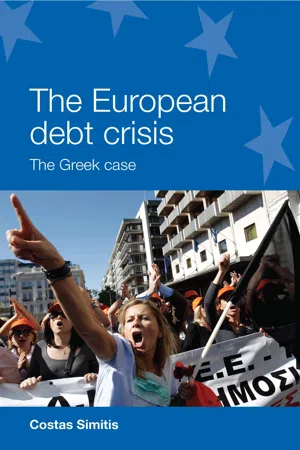
In this book, former Greek Prime Minister Costas Simitis examines the European debt crisis with particular reference to the case of Greece. Greece was the first Eurozone country to face an enormous deficit, which reached 15% of GDP in 2009. As the Greek crisis unfolded, other Eurozone countries displayed identical symptoms, albeit in varying degrees of severity. From a strictly Greek predicament the debt crisis quickly turned into a problem for the European Union as a whole. This first English language translation investigates the causes of this spillover and chronicles the policy responses to combat it. It also discusses Greece's troubled political economy, the country's difficulties in adjusting to the demands of its creditors and the vehement social and political reactions to the policy of austerity.
Through his comprehensive and authoritative analysis, Simitis provides valuable insights into the crucial interconnection between Greece's own economic troubles and the wider European search for macroeconomic stability and sustainable economic growth. As such, the book appeals well beyond those with a narrow academic interest in Greece. This is very much a discussion about the future of the Eurozone and the European Union as a whole.
- 349 pages
- English
- ePUB (mobile friendly)
- Available on iOS & Android
eBook - ePub
About this book
Information
Publisher
Manchester University PressYear
2016Print ISBN
9780719095788
9780719095795
eBook ISBN
9781526112002
How we arrived at the first Memorandum
1
Was Greece ready for the euro?1
The argument widely advanced across Europe was that the cause of the Greek debt crisis lay in the absence of the prerequisites to participate in the single-currency project. Greece was not ready.
From the mid-1990s Greece had launched an intense effort to satisfy the convergence criteria. All available financial tools were used: fiscal policy, monetary policy, taxation and redistribution, and the privatisation of banks and public sector companies. However calculated, the state deficit was reduced by 10 percentage points, from 12.5% of gross domestic product (GDP) in 1993, to 2.5% by 1999, the year in which assessment to gauge Greece’s suitability for participation in the Eurozone was undertaken. Progress towards meeting the other criteria for nominal convergence (rate of inflation, long-term interest rates, public debt and exchange rates) was equally positive. The European Council’s decision taken at Santa Maria da Feira in June 2000 to include Greece was based on detailed scrutiny of the performance of the Greek economy, by the European Commission, the European Central Bank and the Economic and Financial Committee. It is worth noting that, despite the tight fiscal and monetary policy at the time, absolutely necessary in order to reduce the state deficit and the rate of inflation, the rate of growth in GDP in Greece had begun to improve. From a negative rate in 1993, it grew to an annual 4% by the end of the 1990s, and this continued until 2007. Private investment and an influx of foreign capital in Greece did much to fuel this growth. This was made possible only by the falling inflation rates and interest rates, now at single figures after two double-digit decades.
The supposed tampering with the 1999 Greek statistics
Those who maintain that Greece should not have been admitted to the Economic and Monetary Union (EMU) usually present the argument that the country tampered with its economic figures in order to satisfy the convergence criteria.
The New Democracy2 administration elected in 2004, four years after the data for Greece’s admission had been approved, faced the unfortunate demand to change the way in which defence expenditures were recorded, in order to lighten the fiscal burden for the period over which it was to govern. The desire to present balanced books led to a restructuring of the recording of payments. Expenditure on defence equipment, previously recorded at the point of receipt, was retroactively registered at the date of purchase. Thus the expenses were reallocated to previous budgets. The transfer of part of the deficit to the previous government allowed New Democracy to reduce the expenditure recorded during its own administration. This restructuring of payments made more capital available for immediate expenditure while Greece remained inside the 3% budget deficit cap prescribed by the Union. This change in the recording methodology increased the level of deficits prior to 2004. The change in the structure of Greek accounting fuelled the defamation of Greece across the continent. Other figures were also questioned, including those related to the deficits of the public services and social security system, as well as transactions between the state and public sector companies. The latter differences were known and they were being examined in cooperation with Eurostat (the Statistical Office of the European Communities). They were not the result of false reporting of data. In any case, the decisive factor affecting the new assessments was the scale of the deficit accrued through military expenditure.
The mantra that ‘Greece was admitted to the Eurozone on falsified figures’ received global coverage. It was unfortunately adopted by many politicians inside the Eurozone, and is still widely propagated today. This charge, however, ignores the facts.3 Even with the change in recording methodology and with the revised figures, the state deficit for the decisive year (1999) is 3.1% of GDP, up from 2.5%. To be exact, it is 3.07% according to Eurostat figures from the annual macroeconomic database (AMECO). This deficit remains lower than the corresponding revised deficits of other ‘first wave’ countries which were evaluated on data for 1997. Figures on AMECO’s website clearly indicate that other member states entered the Eurozone with deficits higher than 3.1% of GDP. Spain’s and France’s deficits were 3.3% of GDP, while Portugal’s was 3.4%.
As in the case of Greece, the deficit figures of the other countries emerged only after repeated reappraisals of government expenditure by Eurostat. However, the slanderous charge of ‘creative accounting’ was reserved for Greece alone.4 Only Greece was continually discussed in such terms in global media coverage and political discourse, despite the challenges and irregularities both Spain and Portugal presented. It was in Greece alone that the government of the day systematically blamed its predecessor for deceiving and misleading the European Union (EU) and international public opinion.5
Responsibility for what happened rests surely on the shoulders of the New Democracy administration of the period in question. However, responsibility also lies with Eurostat and the EU, which adapted the fiscal data received from the new Greek government. Accusations of a lack of due diligence are justified when one considers that the input of neither the Bank of Greece nor of the previous Minister of Finance was sought. What happened next was completely illogical. In 2006 Eurostat deemed that the correct method for recording expenditure on military equipment was when taking delivery of it,6 as Greece had done prior to 2004. From 2005 onwards all member states not already recording expenditure in this fashion, including Greece for the period after 2004, were obliged to do so. However, despite this decision, Eurostat did not proceed to adjust Greece’s deficit for 1999 to reflect this. The prior correction of the deficit at 3.07% of GDP was held, and not adjusted in line with the change in policy. The insignificant 0.07% of GDP deviation from the Treaty limit, uncritically imposed on the Eurozone, was thus pounced upon to discredit a monumental effort at fiscal adjustment in Greece.7
Recently, new efforts to slander Greece have been propagated; these concern a routine currency swap transaction between the Greek Ministry of Finance and the Goldman Sachs bank at the end of 2001. This transaction is not distinct from hundreds of others undertaken by other countries in the same period. While other member states’ activities are framed in the discourse of public debt management, the actions of Athens are vilified as reckless and malign. Greece exchanged bonds denominated in yen for those in euro denomination, in order to mitigate exchange rate risks. The euro is its currency, and the country also participates – through the European Central Bank – in determining its value. All the euro countries were seeking to convert their debts into euros at the time. Greece was once again subjected to pejorative claims, with accusations that the government was manipulating the figures to satisfy membership criteria. As was the case with reconstruction of accounting methodology discussed above, despite such practices occurring across the continent, it was Greece that made front-page news and dominated political discourse. No significance whatsoever was attached to the fact that these transactions were undertaken in 2001, two years after Greece was assessed for compliance with the convergence criteria and a whole year after the decision to admit Greece was taken by the European Council at Santa Maria da Feira. Nor is it mentioned that, according to the European Statistical Service, the 2001 swap was in full accordance with the Union regulations for that period.8
The real tampering with statistical data in 2009
On 4 October 2009, elections were to be held to elect a new Parliament. On 30 September 2009 the New Democracy administration of the day sent incomplete tables of data to Eurostat, missing all data for 2008 and 2009. It was obvious that the government did not wish to reveal data which would highlight its own shortcomings. On 2 October a new communication to Eurostat was sent, which claimed that the budget deficit was estimated at 6% of GDP. This calculation did not bear any relation to the figures produced by the various departments of the Statistical Service. An analysis of the corresponding data indicates a deficit of 12.5% of GDP, more than twice that claimed by New Democracy. This was the deficit that the new government, led by the Panhellenic Socialist Movement (PASOK), informed Eurostat of. In further revision of the figures by Eurostat the deficit for 2009 was determined to be 15.4%. While New Democracy contested the 15.4% figure for the 2009 deficit, it did not counter claims that it had overseen the deficit’s rise to 12.5% of GDP, despite its prior assessment of 6%. This development rekindled discourse over the ‘false’ data for 2004, and offered further ammunition to those seeking to question the credibility of Greek statistics. In both 2004 and 2009 it was the same attitude of the conservatives that provoked the problem. What was expedient and beneficial for the party determined how the country would execute its commitments.
The excessive level of Greek sovereign debt
The second argument used by the Eurozone to explain the causes of the Greek problem was the external level of Greek sovereign debt. When Greece became a member of the EMU, its sovereign debt was much higher than the maximum 60% of GDP prescribed by the Eurozone. In 1999 it stood at 93.3%. In 1997, when they were deemed fit for Eurozone membership, both Italy and Belgium had a level of sovereign debt exceeding 100% of GDP.9 By the end of 2003 Greek sovereign debt had reached €168 billion, 97.4% of GDP. Under the oversight of the New Democracy administration, this trend continued.10
The excessive budget deficit
From 2004 onwards, Greece was under almost continual fiscal supervision, in accordance with the Treaties, because of its failure to adhere to the 3% cap. Supervision was overseen by the European Commission. The objective was to closely monitor all developments and provide advice on how best to conform to EU rules. This supervision should have flagged up the warning signs and the failures in terms of compliance much sooner than it did. If these worrying trends had been highlighted at this juncture, the crisis would have been unlikely to reach the magnitude it did. However, in the case of Greece there proved to be a measure of ‘friendly’ collaboration between the European Commission and the conservative government, particularly during the pre-election periods of 2007 and 2009. The European Commission failed to show either the objectivity or the diligence it should have. Had it intervened in time, the Greek sovereign debt problem would not have led to the major crisis that followed. However, it would still have posed challenges for the Eurozone as a whole.
The reasons for the current sovereign debt crisis in Europe are not confined to the fiscal deficits and the high levels of sovereign debt of certain countries. It was the fact that Greece was the first country to fall into trouble that led to the prevailing view that the crisis was fiscal.11 Spain, which did not have deficits exceeding the limit of 3% of GDP and whose sovereign debt in 2006 was just 31% of its GDP, also finds itself in crisis today. The reason for the challenges currently faced by Spain lies in the explosive, unsustainable growth of the construction industry. The subsequent collapse of real estate prices, the realisation of the high levels of toxic debt on the balance sheets of Spanish banks, and the drastic fall in competitiveness owing to the inflation brought about by the real estate ‘bubble’ were the cause of Spain’s economic demise. The state’s intervention to save the banks and to limit the effects of the crisis became inevitable.
Similarly in Ireland, annual government deficits did not exceed 3% of GDP, and sovereign debt fluctuated at acceptable levels. Irish banks, however, lent without due diligence or consideration. Upon the realisation that the banks had accrued balance sheets they did not have the capital to honour, the state intervened and took on their loans in order to save the banking system. Sovereign debt increased dramatically as a result, to 120% of GDP.
The main causes of the crisis12
There is a much more serious reason for the explosion of sovereign debt in the countries of the Union’s Periphery aside from the incompetence of their governments.13 This reason is endogenous to the single-currency area created by the EMU. It is the level of divergence in terms of growth rates between the North and the South, the reduced competitiveness of the peripheral countries, and the large deficits in their balance of payments. The South buys high-quality and technologically advanced industrial products from the North. It also buys agricultural products, such as flowers or meat, which, owing to technological developments, are produced more cheaply in Germany or the Netherlands. The North buys considerably less from the South. As a result, structural trading deficits emerge, to the benefit of the Core and the cost of the Periphery. During the period 2000–07, Greece’s annual trade deficit was 8.4% on average and Portugal’s 9.4%, while Germany’s surplus was 3.2% and that of the Netherlands 5.4%. To cover these deficits the peripheral countries have been obliged to borrow. Once the crisis fuelled an increase in the cost of borrowing in the private sector, states were obliged to step in and borrow themselves, so as to avoid a lack of liquidity and the suffocation of the market. This movement from private to public debt occurred in Greece without due care or diligence. Those responsible never stopped to think what limits they should set to avoid future problems.
The minimum interest rate on loans set by the European Central Bank (ECB), which applies to all states, irrespective of national rates of inflation, compounded negative developments. The ECB interest rate was based upon, and suited to, the German model of low rates of growth and inflation. However, the ECB interest rate was too high for many states. It prolonged the recession. For Greece, the same ECB interest rate was low, due to Greece’s higher level of inflation, which fluctuated around the level of the interest rate. In addition, it was much lower than the interest rate prevailing before Greece’s entrance to the EMU. The consequence was a high demand for credit and a flourish in economic activity fuelled by the increased availability of credit, which drove higher rates of growth and a fall in levels of unemployment. Foreign banks, particularly the German and French ones, saw an opportunity for profit. They made credit both widely available and easily accessible. As money supply in the economy increased, salaries, which had been curtailed in order to achieve entry into the EMU, grew exponentially. During the period 2000–09, Greece saw the largest relative increase in salaries across the Eurozone. The effects on the Greek economy’s competitiveness were negative. It fell after 2005, and worsened drastically from 2007 onwards. The immediate result was a rise in imports, a fall in exports an...
Table of contents
- Cover
- Half Title Page
- Title Page
- Copyright Page
- Contents
- Preface
- The main Greek political parties
- List of abbreviations
- Part I How we arrived at the first Memorandum
- Part II The Memorandum’s first year of implementation
- Part III Debt restructuring and power games
- Part IV Coalition government, private sector involvement and the second Memorandum
- Part V Elections of 6 May and 17 June 2012
- Part VI The future of Greece and the European Union
- Appendix: Key meetings and decisions of the institutions of the European Union relating to the financial crisis
- Trajectory of the Greek financial crisis
- Index
Trusted by 375,005 students
Access to over 1.5 million titles for a fair monthly price.
Study more efficiently using our study tools.
Frequently asked questions
Yes, you can cancel anytime from the Subscription tab in your account settings on the Perlego website. Your subscription will stay active until the end of your current billing period. Learn how to cancel your subscription
No, books cannot be downloaded as external files, such as PDFs, for use outside of Perlego. However, you can download books within the Perlego app for offline reading on mobile or tablet. Learn how to download books offline
Perlego offers two plans: Essential and Complete
- Essential is ideal for learners and professionals who enjoy exploring a wide range of subjects. Access the Essential Library with 800,000+ trusted titles and best-sellers across business, personal growth, and the humanities. Includes unlimited reading time and Standard Read Aloud voice.
- Complete: Perfect for advanced learners and researchers needing full, unrestricted access. Unlock 1.5M+ books across hundreds of subjects, including academic and specialized titles. The Complete Plan also includes advanced features like Premium Read Aloud and Research Assistant.
We are an online textbook subscription service, where you can get access to an entire online library for less than the price of a single book per month. With over 1.5 million books across 990+ topics, we’ve got you covered! Learn about our mission
Look out for the read-aloud symbol on your next book to see if you can listen to it. The read-aloud tool reads text aloud for you, highlighting the text as it is being read. You can pause it, speed it up and slow it down. Learn more about Read Aloud
Yes! You can use the Perlego app on both iOS and Android devices to read anytime, anywhere — even offline. Perfect for commutes or when you’re on the go.
Please note we cannot support devices running on iOS 13 and Android 7 or earlier. Learn more about using the app
Please note we cannot support devices running on iOS 13 and Android 7 or earlier. Learn more about using the app
Yes, you can access The European debt crisis by Costas Simitis in PDF and/or ePUB format, as well as other popular books in Economics & Political Economy. We have over 1.5 million books available in our catalogue for you to explore.