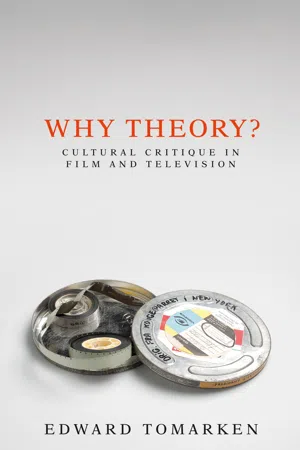
Edward Tomarken's previous book, Filmspeak, was a study of literary theory in relation to contemporary mainstream films. Some of the abstruse ideas of early literary theorists (1950–70) had in fact permeated our thinking to such an extent that both films and theories enriched and shed light upon one another. One early response to Filmspeak was the question 'Why theory?', a remark that provides the title of this new and exciting exploration of literature.
In pursuit of an answer, Tomarken turns to the 'second generation' of critics (1970–2000), and analyses television programmes as well as films. He considers scholars such as Clifford Geertz and Martha Nussbaum who saw themselves as working in the field of cultural studies. Why theory? thus has a dual focus – on both culture and literary theory. The result of integrating cultural ideas with media interpretation sees Tomarken grapple with the question of the title: theory has become a part of our cultural life.
- 182 pages
- English
- ePUB (mobile friendly)
- Available on iOS & Android
eBook - ePub
About this book
Information
Publisher
Manchester University PressYear
2017Print ISBN
9781784993115
9781784993108
eBook ISBN
9781526118028
1Clifford Geertz: thick description
I begin this study with the work of Clifford Geertz because he articulates what he calls the ‘interpretive turn’ in his field of anthropology from science to the humanities, in particular to the mode of textual analysis used in literary criticism. Geertz emphasises that in his discipline science provides a thin description using rules and laws that explain little about the specific situation. For a ‘thick description’ Geertz turns to literary-critical practice. These two terms, the interpretive turn and thick description, will be key throughout this study. Geertz points to three aspects of culture that would profit from the thick description of literary analysis: serious game theory, sidewalk drama, and behavioural text. Each of these topics is the subject of a section of this chapter. With regard to serious game theory I analyse Quartet and The Best Exotic Marigold Hotel. The next section, on sidewalk drama, looks at Salmon Fishing in the Yemen and Spider-Man 2. In the final section, on behavioural text, my focal points are Iron Man 2 and Iron Man 3. The central thesis of this book is that the phase of literary theory that emphasised cultural critique was the direct result of the interpretive turn to thick description.
In the period from 1970 to 2000, the focus of much literary theory turned to the realm of cultural studies. I begin my study of this shift with Clifford Geertz, Professor at the Princeton University Advanced Institute from 1970 until his death in 2006, because he explains with admirable clarity that cultural studies needs to adopt the methods of literary criticism: ‘Believing with Max Weber, that man is an animal suspended in webs of significance he himself has spun, I take culture to be those webs, and the analysis of it to be therefore not an experimental science in search of law but an interpretive one in search of meaning’ (Richter, 1368). Geertz uses two phrases that will be important for this study, the ‘interpretive turn’ and ‘thick description’. The ‘interpretive turn’ refers to the move in cultural studies from a social science seeking laws to a humanistic project with the aim of interpretation. The second phrase, ‘thick description’, makes clear that the kind of interpretation Geertz has in mind resembles that pursued by the literary critic. An article in The Observer on 11 May 2014 entitled, ‘After the Crash We Need a Revolution in the Way We Teach Economics’ may help explain the difference between thin and thick description. The subtitle provides further clarification: ‘Students who claim that economics courses fail to explain the 2008 crash are gaining support from British business. Here, two Cambridge academics, Ha-loon Chang and Jonathan Aldred, say it’s time for a change’. The article goes on to explain that Chang and Aldred believe that the problem with the present method of teaching economics is that it resorts to laws that apply to everything and therefore explain nothing.
The most important thing about mainstream economics today – and a source of pride among many of its supporters – is that it is not limited to the study of anything in particular. It is defined by its tools of analysis (mathematical models mostly) rather than the object of inquiry. This is why so many recent popular economics books have claimed to be about ‘everything’ (15).
Clearly, students of economics are frustrated by ‘thin’ omniscient descriptions that offer no help in understanding a specific crisis. And yet it seems very likely that when these students graduate they will be confronted in a job interview with the question of how they would avoid a crash like that of 2008.
The Observer is suggesting that economics, like Geertz’s discipline of anthropology, may have to give up its claim to being a social science and turn to the methods of humanistic interpretation to explain particular but crucial problems like the banking crisis of 2008. Thickness is Geertz’s way of locating the kind of depth of texture that is the mark of literary commentary; avoiding reduction of the text, the literary critic endeavours to do justice to the work of art in concrete and detailed terms with little interest in placing the art object within some larger category, such as a law or abstract principle. In the past, Geertz admits, social scientists have been wary of literary interpretation because it seems subjective, simple assertions of opinions without evidence. Geertz believes that the best evidence for an interpretation is the specifics of the cultural situation, which entails treating that situation in the way a literary critic approaches a text, pointing to the language and structure as evidence for an interpretation.
In fact, Geertz asserts that the turn to the humanities, or what he calls ‘the interpretive turn’, represents a major change in how we think about how we think. The opening chapter of possibly his most famous book, Local Knowledge, is entitled ‘Blurred Genres: The Refiguration of Social Thought’, and the use of the literary term ‘genre’ is no accident. Here, Geertz advances three main ideas towards the goal of ‘thick description’:
The recourse to the humanities for explanatory analogies in the social sciences is at once evidence of the destabilization of genres and of the rise of ‘the interpretive turn’ and their most visible outcome is a revised style of discourse in social studies. The instruments of reasoning are changing and society is less and less represented as an elaborate machine or a quasi-organism and more as a serious game, a sidewalk drama, or a behavioral text (23).
These last three phrases provide focal points for Geertz’s argument that anthropology is turning away from objective science and towards humanistic interpretation. Accordingly, serious game theory, drama analysis, and behavioural text will serve as the topics of the three sections of this chapter. Each of these phrases will be explained at the beginning of the section devoted to it.
Serious games: Dustin Hoffman’s Quartet (2012) and John Madden’s The Best Exotic Marigold Hotel (2011)
Game theory, Geertz explains, involves serious games, that is, not just playfulness for amusement but also contexts for competition with rules and regulations in schools, workplaces, and on social occasions. Of course sports are where most of us first confront games and their rules, and sports commentary is, we tend to forget, often very ‘thick’ in Geertz’s sense, so involved in the specifics that those who do not understand or follow the sport may be as puzzled as general readers are by specialised literary analysis. And that is Geertz’s point: analysis of games, be they sports or serious games, must imitate the literary critic and become immersed in the specifics in order to offer an interpretation or explanation of victory or defeat. Serious game theory, according to Geertz, derives from three main sources:
Wittgenstein’s conception of forms of life as language games, … ‘following a rule’ … Huizinga’s ludic view of culture, … play as the paradigm form of collective life … and von Neumann’s and Morgenstern’s … [notion] of social behavior as a reciprocative maneuvering toward distributive payoffs (24).
Geertz emphasises the elements common to all three:
What connects them all is that humans are less driven by forces than submissive to rules, that the rules are such as to suggest strategies, the strategies are such as to inspire actions, and the actions are such as to be self-rewarding – pour le sport. As literal games – baseball, or poker, or Parcheesi – create little universes of meaning, in which some things can be done and some cannot (you can’t castle in dominoes) so too do the analogical ones of worship, government, or sexual courtship (you can’t mutiny in a bank) (25).
Language is here the key factor: from the referee’s or umpire’s decision to the interoffice memo, the world of games, from playful to serious, is subject to rules communicated by way of language (both body and verbal) that has its own rules. For Geertz, the goal of this new method of social game analysis is to understand other cultures while maintaining the integrity of our own. He insists that we need to understand the games of other cultures, for in that way we enter the fabric of a way of life different from our own. I think of Robin Williams describing cricket as baseball on Librium.
The primary quest for any cultural institution anywhere, now that nobody is leaving anyone else alone and isn’t ever going to, is not whether everything is going to come seamlessly together or whether contrariwise, we are going to persist sequestered in our separate prejudices. It is whether human beings are going to continue to be able, in Java or Connecticut, through law, anthropology or anything else, to imagine principled lives they can practicably lead (Geertz 234).
Serious games in Quartet
The serious game in Quartet is the ‘restaging’ of the vocal quartet from Rigoletto for the purpose of raising enough money at the yearly Verdi Gala to support the retirement home where all the characters in the film reside. The selection from the opera and most of the other musical pieces are actually performed by professional singers and musicians while, for the most part, the actors and actresses mime their parts. In this sense, the audience plays its part in the game, a sort of cinema opera game, although the ‘principled purpose’, by which Geertz means something more serious than mere personal diversion, is not the same for us as for the residents/actors. The game for the audience becomes most overt at the end of the film when we see that in fact almost all of the actors are at or near retirement age. The credits show what the actors and actresses – now well beyond their prime – did in their heyday, at the high points in their careers. Seasoned performers, we are reminded, have just finished playing and playing at being seasoned performers. The serious purpose of the game for us is to show how these accomplished performers cope with ageing, playing histrionic games, competing with and joshing one another like members of a large family. In short, there is a certain element of reality in their being at Beecham House, a retirement home. That the game they play is a serious one is most poignantly clear for Billy Connolly who announced recently that he has been diagnosed with Parkinson’s disease. Yet he continues to struggle on with his earthy sense of humour, punctuated in the movie by moments of vertigo, and in his daily life by the challenges of his illness.
The central game of the film, however, is confronted with a problem, a real problem. Two members of the quartet who were once married are now estranged, barely on speaking terms. After great effort on the part of the other residents, these two agree to sing together again, which in turn results in their being reconciled as a couple. The games in this film are multilevelled, and each level has a different aim while contributing to the larger goal. On one level, the actors rehearse the scene from Rigoletto to save their retirement home. The game here is not only that the performance is mimed but also that the performers, now elderly, cannot be expected to perform up to their old standards. On another level, they re-produce the quartet that brings the estranged lovers back together again, serving another goal than their immediate one, knowing, as Wilf (Billy Connolly) points out, that Reg (Tom Courtney) and Jean (Maggie Smith) are still in love with one another. On still another level, we see and hear a sort of opera or musical comedy about the trials of old age, the interpersonal relations of public performers who must learn to live together in a community founded – rather embarrassingly, as Jean points out – on charity. Our interest is aroused by the fascinating acting of those playing the part of gaming, or playing at acting – Maggie Smith and Tom Courtney are particularly brilliant – and how successful they are at convincing us that ultimately for them, that is, for the characters they portray, the game is real. In the end it matters less whether or not we believe that Reg and Jean are in love than that they can pull it off as actors in a sort of comic opera/fantasy, a marriage proposal delivered and accepted while entering the stage for a performance. After all, it will be, if it is to be, a marriage of consummate actors, another performance. The ultimate reality here is that of actors ageing with grace and vertigo, competitive humour and companionable affection.
As veteran actors and singers they make the games more overt than the reality. In fact, they occasionally need to be reminded of the reality that is not theatrical. For example, when Jean (Maggie Smith) initially refuses to take part in the quartet, Cissy (Pauline Collins) brings her flowers in an attempt to convince her to participate. Losing her temper, Jean throws the flowers at poor Cissy, who reverts temporarily to a childlike state of senility. Later Jean apologises, realising that her ‘hard to get’ attitude had serious consequences, but she redeems herself later when Cissy, immediately prior to the performance of the quartet, reverts again to senility, believing she must return home to her parents. Instead of contradicting Cissy as the others try in vain to do, Jean humours her, leading the way to pack their bags, mentioning unobtrusively that the trip is to take place in a few weeks, thereby providing time for the performance, rather than directly contradicting Cissy.
Quartet is a film about the game or games of a retirement community, a group of people trying to keep their minds and bodies active by doing what they like doing or once did. For those who enjoy the film – and judging from my friends not all do – we enter a community of old actors and actresses who are brilliant at playing what they in fact are: oldsters struggling with old age. Perhaps the game here, the acting of ourselves, provides a perspective encouraging humour about ourselves that helps us be more companionable to one another. In any event, the games here all have cultural significance. And Reg, in his opera classes for local young students, is able with tact and delicate self-deprecation to discover how to relate rap to opera. Cleverly, he encourages a young would-be rapper to perform a sort of rap opera that establishes rapport (to be a bit punny) between Reg and the young people, and we next see a number of them in the audience at the opera. The rap opera could be described from the point of view of those familiar with pop rather than classical music as a thick description of opera. Moreover, the relationship between these two musical genres leads to a mutually informative conversation between Reg and the rapper and between the young students and the retirees. In Geertz’s terms, the genres of classical opera and rap singing have become blurred, suggesting not just a mixing but also a mutual understanding between two different cultures. The marriages, however, at the end of the film between Jean and Reg and between rap and opera leave us wondering if this conclusion is merely a histrionic gesture, something great actors can bring off on screen but that is not likely to happen in reality. Geertz, of course, has in mind the world beyond the walls of the movie theatre.
Serious games in The Best Exotic Marigold Hotel
The Best Exotic Marigold Hotel makes very clear that the differences between individuals are but microcosms of the differences between cultures. The cultural element of the game is much more prominent in this film since the main cast of British actors is, after a brief introduction, transported to a retirement hotel in India. The contrast between the two cultures is made manifest by the fact that Sonny (Dev Patel), the manager, has misrepresented his hotel as a paradise for retirees when it is in fact struggling financially and dilapidated. The games involve each individual with their specific needs and desires coping with and learning to adapt to the rules of Indian culture. Muriel (Maggie Smith) gradually comes to tolerate, even enjoy living among people of colour whom she had previously regarded as her inferiors; Evelyn (Judi Dench), a widowed housewife, discovers how to use her communication skills and express her affection; Graham (Tom Wilkinson), a retired High Court judge, comes to terms with his homosexuality.
The principled or serious – Geertz uses the terms interchangeably – results of these games are comically surprising. Having experience looking after household expenses, Muriel believes she knows how to make the hotel a going concern: discovering a new tolerance, even affection for the ‘natives’, she decides to take up permanent residence in India. Evelyn helps train local telephonists and begins a new love relationship. Graham makes peace with the man he loved in his youth who he finds, to his delight, has not been ostracised for his homosexuality. The merging of the cultures of east and west is by no means one-sided. Sonny, for example, refuses to marry a partner to be chosen by his mother and eventually convinces her to accept his ‘modern’ girlfriend as his wife. Indeed, each of the characters gradually learns how to combine or reconcile elements of both cultures, the most prominent example being the arranged marriage of Graham’s lover enabling him, unlike the British judge, to enjoy a respectable marriage with a woman.
Each relationship in the film suggests different ways in which the two cultures clash, merge, and lead to new kinds of interrelations. To begin with the most negative, Jean (Penelope Wilton) remains in her room, alienated by all that is different, allowing her husband Douglas (Bill Nighy) to experience the new culture on his own. In fact, Jean is more attracted to the High Court judge Graham (Tom Wilkinson) than to her husband but is humiliated when he admits to being gay. Of all the characters, Jean is the only one who ends up alone, estranged from her husband, a sad but predictable resolution for someone who has refused to open herself to the ‘foreign’ culture of India, vividly manifest in her insisting on giving orders to the hotel staff in a raised, exasperated voice. Douglas, like all the other guests at the hotel, goes out into the new culture, discovers new beauties and horrors and begins a relationship with Evelyn (Judi Dench). What attracts him to Evelyn is her interest in Indian culture. She teaches the young women at the call centre how to speak on the telephone to British retirees like herself and in turn learns about young Indian women. She bargains with local merchants and, after at first being taken advantage of, develops into a good businesswoman. Even here the results are two-sided; she must learn to haggle but also makes friends with the merchants. Similarly, Muriel (Maggie Smith) in spite of her prejudices begins to become attached to one of the maids at the hotel and to Dev (Sonny Kapoor) struggling to keep the hotel afloat. Graham also ventures out beyond the hotel looking for the Indian man he loved in his youth. The result here is also reciprocal. Graham is relieved that his youthful liaison had not ruined the young man, but he also realises that his Indian friend leads a freer and happier lifestyle than he ever experienced in his prestigious position in England. Even the cynical Madge (Celia Imrie), who seems to care about little else but finding a rich husband or lover, ventures into the new culture, unleashing her insatiable desire...
Table of contents
- Cover
- Half Title
- Title Page
- Copyright Page
- Dedication
- Contents
- Acknowledgements
- List of films and television programmes cited
- Introduction
- 1 Clifford Geertz: thick description
- 2 Hayden White and history as mixture of fact and fiction
- 3 Julia Kristeva: the female perspective on culture
- 4 Homi K. Bhabha: post-colonial hybridity
- 5 Pierre Bourdieu and sociological theory
- 6 Martha Nussbaum: : ethics and literary theory
- Conclusion: the strands of the web of culture
- Bibliography
- Index
Trusted by 375,005 students
Access to over 1.5 million titles for a fair monthly price.
Study more efficiently using our study tools.
Frequently asked questions
Yes, you can cancel anytime from the Subscription tab in your account settings on the Perlego website. Your subscription will stay active until the end of your current billing period. Learn how to cancel your subscription
No, books cannot be downloaded as external files, such as PDFs, for use outside of Perlego. However, you can download books within the Perlego app for offline reading on mobile or tablet. Learn how to download books offline
Perlego offers two plans: Essential and Complete
- Essential is ideal for learners and professionals who enjoy exploring a wide range of subjects. Access the Essential Library with 800,000+ trusted titles and best-sellers across business, personal growth, and the humanities. Includes unlimited reading time and Standard Read Aloud voice.
- Complete: Perfect for advanced learners and researchers needing full, unrestricted access. Unlock 1.5M+ books across hundreds of subjects, including academic and specialized titles. The Complete Plan also includes advanced features like Premium Read Aloud and Research Assistant.
We are an online textbook subscription service, where you can get access to an entire online library for less than the price of a single book per month. With over 1.5 million books across 990+ topics, we’ve got you covered! Learn about our mission
Look out for the read-aloud symbol on your next book to see if you can listen to it. The read-aloud tool reads text aloud for you, highlighting the text as it is being read. You can pause it, speed it up and slow it down. Learn more about Read Aloud
Yes! You can use the Perlego app on both iOS and Android devices to read anytime, anywhere — even offline. Perfect for commutes or when you’re on the go.
Please note we cannot support devices running on iOS 13 and Android 7 or earlier. Learn more about using the app
Please note we cannot support devices running on iOS 13 and Android 7 or earlier. Learn more about using the app
Yes, you can access Why theory? by Edward Tomarken in PDF and/or ePUB format, as well as other popular books in Literature & Literary Criticism. We have over 1.5 million books available in our catalogue for you to explore.