eBook - ePub
Europe on the move
Refugees in the era of the Great War
- 335 pages
- English
- ePUB (mobile friendly)
- Available on iOS & Android
eBook - ePub
Europe on the move
Refugees in the era of the Great War
About this book
Mass population displacement affected millions of Europe's civilians across the different theatres of war in 1914–18. At the end of the war, a senior Red Cross official wrote 'there were refugees everywhere. It was as if the entire world had to move or was waiting to move'. Europe on the move: refugees in the era of the Great War, 1912–23 is the first attempt to understand their experiences as a whole and to establish the political, social and cultural significance and ramifications of the wartime refugee crisis. Drawing on original research by leading specialists from more than a dozen countries, it will become the definitive work on the subject and will appeal to anyone who wishes to understand how governments and public opinion responded to refugees a century ago.
Information
Publisher
Manchester University PressYear
2017Print ISBN
9781526139351
9781784994419
eBook ISBN
9781526106001
Topic
HistoireSubtopic
Histoire de l'Europe
1
Population displacement in East Prussia during the First World War
Ruth Leiserowitz
Introduction
As a region bordering the Russian Empire, East Prussia was, apart from Alsace-Lorraine, the only part of the German Empire to be directly affected by the military operations of the First World War. There had been no military actions in this region since the Napoleonic wars. Forced migration was hitherto unknown, and the refugee crisis in 1914 found everyone totally unprepared. In August 1914 two distinct waves of forced migration took place in opposing directions. In the first of these the population of various provincial towns fled westwards, away from the advancing Russian army. Most of those who sought refuge returned to East Prussia by 1916. The second movement concerned German civilians who had remained in the region but who were subsequently seized by the occupying Russian forces and taken to provinces in the interior of Russia, close to the Volga and Yenisei rivers. There they were housed together in the vicinity of prisoner of war camps. These deportees only began to return to their homes in 1919, but their repatriation came to a standstill during the Russian revolution and the ensuing civil war.
At the beginning of the war, the population displacements and resulting drama were broadly publicised in the media, provoking a surge of solidarity among the German public. By 1916, the media further promoted East Prussia as the only German region touched by the war. At this point, material reconstruction came to the fore, whereas the fate that befell human beings faded from view.
As yet, there exists no research regarding the flow of refugees from East Prussia. This neglect reflects the fact that these events were overshadowed by the far greater and more enduring consequences of the Second World War. Although the Königsberg historian Fritz Gause had published a book in 1931 about the Russian occupation, such accounts were completely overlaid by the developing myth of the ‘Battle of Tannenberg’, the first great success of the German army in the First World War.1 This myth, alongside the hero worship of Paul von Hindenburg, allowed no room for the subject of refugees. Besides, Germany was flooded with postcards showing the cities and communities that had been rebuilt, thereby crowding out any other images. The refugees of the First World War appeared marginally in the work of Andreas Kossert and other scholars.2 As to those East Prussians who were transported to Russia, except for contemporaneous publications, only a memoir with an introduction and commentary by Lothar Kölm is available.3 There is likewise a lack of an appraisal of the reaction in German politics to the events of 1914. What, for example, caused the government to transfer the then governor of the province, Ludwig von Windheim, to Hannover in September 1914 and replace him with Adolf von Batocki?
This is not to say that extant sources are unavailable. There are the records from the State Commissioner for Refugees (Staatskommissar für Flüchtlinge), along with contemporary writings from Albert Brackmann to the head of the Königsberg Archive, as well as articles from numerous periodicals. With the help of these sources, questions regarding the representation of displacement, assistance to refugees and their return may be answered. On such a basis, this German refugee group can then be placed within the context of broader European displacement events in the First World War.
The causes and dynamics of population displacement
To the great surprise of the German supreme command, by the middle of August, Russian troops – the Neman army under General Paul von Rennenkampf and the Narev army under General Aleksandr Samsonov – had already advanced on the East Prussian territory.4 The German army failed to halt the Russians at the battle of Gumbinnen and the enemy soon stood only 40km from Königsberg. On 18 August, the governor announced that ‘movement into Königsberg from without may not be possible’, and advised that the sick, elderly and children should be evacuated, because finding adequate nourishment could be difficult in case of a siege.5 A few days later, on 22 August, came the official order to send harvested grain and livestock to the western bank of the Vistula or to military collection points at Heiligenbeil, Wormditt and Mohrungen. This helped to encourage the mass movement of civilians in a largely uncontrolled fashion, but some saw no possibility of leaving East Prussia in good time, while others deliberately lingered, in part to defend their assets.6
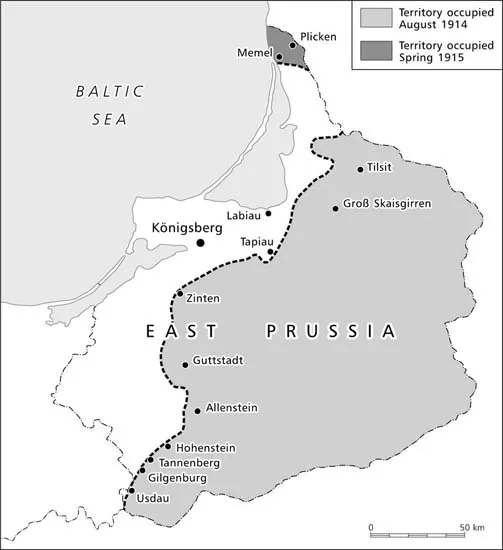
Map 1.1 The First World War in East Prussia.
In the first wave of attack the remaining local residents were generally spared systematic persecution by the Russian occupying forces. The rural population to the north of the Neman river and in the south-east of East Prussia fared worse; at least a thousand people were taken to Siberia.7 At the end of August, the Eighth Army under command of Hindenburg and his chief of Staff, Erich von Ludendorff, defeated the Russian forces at the Battle of Tannenberg. Accordingly, the first group of displaced residents returned to their homes. In October, Russian troops once more advanced on East Prussia, and this assault provoked the rapid departure of approximately 350,000 people in the wake of systematic abuse.
Between November 1914 and January 1915, peace prevailed on the Eastern Front. The winter battle of February 1915 in Masuria culminated in the defeat of the Russian army, bringing a close to the hostilities in East Prussia. Most refugees delayed returning. It should not be forgotten that other civilians had lost their homes as a result of the fighting but remained in the province; many of them were in need of aid for a number of years and had to wait until long after the war for their houses to be rebuilt.
In short, there were two main waves of flight in the direction of the west, taking place in August and October of 1914. Each was accompanied by smaller movements within the province, and by two waves of deportation to Russia.
What explains this state of affairs? The local civil administration and the German army utterly underestimated the emergency situation. No arrangements were made for an orderly evacuation of the border districts, and calls for the removal of livestock were seldom observed. The commander of the XX Army Corps, General Friedrich von Scholtz, made the following announcement on 10 August:
Among the population, the view is widely held that the Russian soldiers, upon entering Prussian land, will plunder and pillage. It has been made known with certainty here that the Russian command authorities have given a strict order, as long as the inhabitants leave their localities in peace, neither to plunder nor to set the settlements alight … It must therefore be assumed that the Russians have the sincere will to carry out war according to conventions for civilised peoples. Consequently I direct to the non-fighting population a serious appeal to prudence, and hope that this announcement will contribute to stemming the headlong flight from the approaching Russian troops and other panic actions, which have unfortunately already come to light.8
However, a series of hasty directives during the second half of August fomented fear and panic in the population, and led ultimately to a sort of domino reaction. The governor of the province of East Prussia, Ludwig von Windheim, who held office until September 1914, was not mentioned in this context at all. His successor, Adolf von Batocki, the former president of the Chamber of Agriculture in the province, was appointed in October and immediately embarked on numerous efforts to regulate the issue of the refugees and the later re-building of the province. As Russian forces invaded anew, von Batocki and his officials were determined to call a halt to the flight of refugees and hoped that unfavourable winter weather would deter them. The East Prussian administration were particularly concerned that the refugees would not return, potentially leading to a depopulation of the province. They also took the view that the refugee movements were ‘gravely detrimental in moral respects’ as they promoted the ‘unscrupulous transfer of moveable property’.9
Nonetheless, the flow of refugees could not be stemmed. In total, according to one contemporary observer, ‘more than 870,000 people … during the [Russian] invasion left house and home … followed by some 300,000 during the second invasion. They needed to be housed outside the province of East Prussia in temporary accommodation’.10 Many of them were taken on special trains to Pomerania, Schleswig, Lüneburg, Frankfurt/Oder, Potsdam, Osnabrück and Westphalia.11
Adding to the dire situation was the fact that East Prussia was a markedly agrarian province. In some districts affected by the invasion of the enemy army, the percentage of those working in agriculture reached 70 per cent, many of whom were farmers for whom livestock was a crucial resource.12 The aforementioned appeal on 22 August to drive the livestock to safety, that is to the other side of the Weichsel, encouraged the owners to accompany their valuable animals. If farmers initially thought that the cows or goats would make the journey more tolerable because they had milk available to them along the way, it soon became clear that the flight was made significantly more difficult, indeed actually hindered by the livestock. The Königsberger Volkszeitung (26 August 1914) carried a story headed ‘The flight of the country residents of East Prussia’, in which an eyewitness reported that he had seen ‘a vast line of wagons and carts, with livestock and horses driven along. From time to time one could see lambs and foals that had got separated from their mothers and were now astray’.13
It is not at all surprising that, prior to the second wave of refugees, a yellow placard carried the following message from the provincial governor: ‘I ask the residents of the districts of East Prussia now under threat from the enemy, in order to avoid significant losses, to immediately and carefully read what follows and to take note of it before they make up their minds’. There followed a list of instructions ‘to act with a clear head and calm deliberation’ as well as cautioning refugees not to load the wagons too heavily. The instructions also expressly forbade them to bring their livestock with them.14 When they encountered refugees who refused to give up their horse-drawn wagons, refugee commission officials insisted that in view of the current weather conditions at least the women and children should be sent on ahead by train.15
The areas where the refugees were sent had limited capacity to accommodate livestock and horses, and consequently the ow...
Table of contents
- Cover
- Half Title
- Title Page
- Copyright
- Contents
- List of illustrations
- List of maps and tables
- Notes on contributors
- Preface
- Introduction – Peter Gatrell
- 1 Population displacement in East Prussia during the First World War – Ruth Leiserowitz
- 2 ‘A mass which you could form into whatever you wanted’: refugees and state building in Lithuania and Courland, 1914–21 – Klaus Richter
- 3 Refugees from Polish territories in Russia during the First World War – Mariusz Korzeniowski
- 4 ‘Human waves’: refugees in Russia, 1914–18 – Irina Belova
- 5 Ukrainian assistance to refugees during the First World War – Liubov Zhvanko and Oleksiy Nestulya
- 6 ‘Cities of barracks’: refugees in the Austrian part of the Habsburg Empire during the First World War – Martina Hermann
- 7 Between refugees and the state: Hungarian Jewry and the wartime Jewish refugee crisis in Austria-Hungary – Rebekah Klein-Pejšová
- 8 Beyond the borders: displaced persons in the Italian linguistic space during the First World War – Marco Mondini and Francesco Frizzera
- 9 Belgian refugees during the First World War (France, Britain, Netherlands) – Michaël Amara
- 10 Citizenship on the move: refugee communities and the state in France, 1914–18 – Alex Dowdall
- 11 Golgotha: the retreat of the Serbian army and civilians in 1915–16 – Danilo Šarenac
- 12 The refugee question in Bulgaria before, during and after the First World War – Nikolai Vukov
- 13 From imperial dreams to the refugee problem: population movements during Greece’s ‘decade of war’, 1912–22 – Emilia Salvanou
- 14 Becoming and unbecoming refugees: the long ordeal of Balkan Muslims, 1912–34 – Uğur Ümit Üngör
- Index
Trusted by 375,005 students
Access to over 1.5 million titles for a fair monthly price.
Study more efficiently using our study tools.
Frequently asked questions
Yes, you can cancel anytime from the Subscription tab in your account settings on the Perlego website. Your subscription will stay active until the end of your current billing period. Learn how to cancel your subscription
No, books cannot be downloaded as external files, such as PDFs, for use outside of Perlego. However, you can download books within the Perlego app for offline reading on mobile or tablet. Learn how to download books offline
Perlego offers two plans: Essential and Complete
- Essential is ideal for learners and professionals who enjoy exploring a wide range of subjects. Access the Essential Library with 800,000+ trusted titles and best-sellers across business, personal growth, and the humanities. Includes unlimited reading time and Standard Read Aloud voice.
- Complete: Perfect for advanced learners and researchers needing full, unrestricted access. Unlock 1.5M+ books across hundreds of subjects, including academic and specialized titles. The Complete Plan also includes advanced features like Premium Read Aloud and Research Assistant.
We are an online textbook subscription service, where you can get access to an entire online library for less than the price of a single book per month. With over 1.5 million books across 990+ topics, we’ve got you covered! Learn about our mission
Look out for the read-aloud symbol on your next book to see if you can listen to it. The read-aloud tool reads text aloud for you, highlighting the text as it is being read. You can pause it, speed it up and slow it down. Learn more about Read Aloud
Yes! You can use the Perlego app on both iOS and Android devices to read anytime, anywhere — even offline. Perfect for commutes or when you’re on the go.
Please note we cannot support devices running on iOS 13 and Android 7 or earlier. Learn more about using the app
Please note we cannot support devices running on iOS 13 and Android 7 or earlier. Learn more about using the app
Yes, you can access Europe on the move by Peter Gatrell,Liubov Zhvanko,Lyubov Zhvanko, Peter Gatrell, Liubov Zhvanko in PDF and/or ePUB format, as well as other popular books in Histoire & Histoire de l'Europe. We have over 1.5 million books available in our catalogue for you to explore.