Challenging received opinion and breaking new ground in Kipling scholarship, these essays on Kipling's attitudes to the First World War, to the culture of Edwardian England, to homosexuality and to Jewishness, bring historical, literary critical and postcolonial approaches to this perennially controversial writer.
The Introduction situates the book in the context of Kipling's changing reputation and of recent Kipling scholarship. After the perspectives of Chesterton (1905), Orwell (1942) and Jarrell (1960), newer contributions address Kipling's approach to the Boer war, his involvement with World War One, his Englishness and the politics of literary quotation. Different aspects of Kipling's relation to India are explored, including the 'Mutiny', Eastern religions, his Indian travel writings and his knowledge of 'the vernacular'.
This collection, whose contributors include Hugh Brogan, Dan Jacobson, Daniel Karlin and Bryan Cheyette, is essential reading for academics and students of Kipling, Victorian and Edwardian English literature and cultural history.
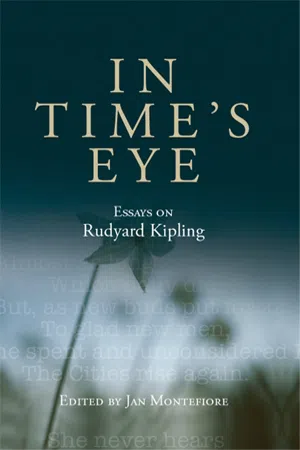
- 298 pages
- English
- ePUB (mobile friendly)
- Available on iOS & Android
eBook - ePub
About this book
Information
Publisher
Manchester University PressYear
2016Print ISBN
9781526106933
9780719095757
eBook ISBN
9781526111289
1
Introduction
Cities and Thrones and Powers
Stand in Time’s eye
Almost as long as flowers
Which daily die.1
K ipling’s brief elegy for the vanity of human deeds brings together three themes of this collection of essays: the subjection of his own work and reputation to those processes of time and change of which his poem warns; his relationship to historical institutions of rule and dominance named as ‘Thrones and Powers’; and his many-sided artistry, manifested in this ironic vision of the fall of ancient empires mediated through echoes of Milton and Herrick.2
An account of Kipling ‘in Time’s eye’ necessarily begins with the changes in his reception, here represented in capsule form by the first three essays from G.K. Chesterton (1905), George Orwell (1942) and Randall Jarrell (1961). His reputation has been notoriously changeable since he arrived in London in 1890 as the young genius from India who in one year had had ‘more said about his work, over a wider extent of the world’s surface, than some of the greatest of England’s writers in their whole lives’,3 in 1895 was sounded out as a possible successor to Tennyson as Poet Laureate,4 and whose near-death from pneumonia in 1899 was headline news in three continents. Praise was never undiluted: his ‘vulgarity’ was mocked by Oscar Wilde and attacked by Robert Buchanan and, more devastatingly, Max Beerbohm;5 and as Kipling’s imperialist opinions became more strident after the Boer War he lost the esteem of British literary intellectuals, whom he in turn despised (his close friends included no fellow writer except Rider Haggard, author of thrillingly mythopoeic imperialist fantasy novels). Though Kipling was awarded the Nobel Prize in 1907 for his contribution to world literature, was immensely popular in Britain and the USA and much admired in France, the beginning of his declining reputation at home can be seen in G.K. Chesterton’s brief but telling 1905 critique which, while taking Kipling’s importance for granted, finds his vision profoundly flawed by its fascination with the seductive machinery of power and speed. This decline increased after the First World War; Kipling’s identification with right-wing patriotism did him no good with the disillusioned ex-soldiers Edmund Blunden and Siegfried Sassoon who, as Harry Ricketts shows here, received both his History of the Irish Guards and his war poems less than enthusiastically, while his stories’ contribution to the post-war literature of mourning was largely ignored. Although the Jungle Books, the Just-So Stories, the ‘Puck’ books and Kim continued to be widely read and loved by British middle-class children throughout the twentieth century, Kipling’s work for adults was increasingly read in terms of ‘plain man’ conservatism, and the sermonising or demotic poetry which had made him a national institution in late Victorian England became a standing joke to intellectuals. Virginia Woolf mocked his ‘Sowers who sow the Seed, and Men who are alone with their Work, and the Flag’;6 T.S. Eliot’s more complex views ranged from mockery and affectionate parody to creative engagement with the numinous stories, and an edited anthology of Kipling’s poems with a long preface deliberating on his status as a writer, concluding equivocally that his ‘great verse’ occasionally rose to poetry.7 Orwell’s response to Eliot’s anthology indicates how low Kipling was rated in the early 1940s; arguing that for fifty years ‘every enlightened person has despised him, and at the end of that time nine-tenths of those enlightened persons are forgotten and Kipling is in some sense still there’, his critical but even-handed discussion of Kipling’s politics ends by defining him as a ‘good bad poet’ whose virtues and faults belong to popular culture rather than literature. (Orwell has little to say about Kipling’s fiction apart from criticising its ‘crudity’).
Kipling’s literary reputation began to recover once critics turned their attention to his prose.8 Reappraisals of Kipling published around the centenary of his birth focus not on his success or failure as an ideologue but on his achievement as a writer of stories. Randall Jarrell’s preface to his 1961 selection of Kipling’s stories, ‘On preparing to read Kipling’, praises Kipling’s extraordinary imagination and verbal finish, discussing him as an artist comparable with Chekhov and Goya; the same point was made, less flamboyantly, in the title of J.M.S. Tompkins’ The Art of Rudyard Kipling (1959), and repeated with variations by C.A. Bodelsen (1964), and Andrew Rutherford (1964),9 who all emphasise Kipling’s achievement as a writer of imaginative prose, as does Elliott Gilbert’s study of his stories The Good Kipling (1972).10 Jarrell also made a persuasive post-Freudian case for reading Kipling’s conscious identification with authority as the effect of a traumatised childhood, an approach followed a generation later in Sandra Kemp’s study of his stories (1988) and Zohreh Sullivan’s psychoanalytic account of his Indian fiction (1993).11 The critics of the 1960s all emphasised Kipling’s standing as a major literary figure because they couldn’t take this for granted. Twenty-first-century readers on the whole do; none of the contributors to this book, whether or not they approve of Kipling’s politics, feels it necessary to make a literary case for him. (Hugh Brogan’s defence of his poetry in the First World War, the sole apparent exception, is concerned with not with Kipling’s literary artistry but with his political intelligence.)
But Kipling’s changing reputation is only one aspect of his place in history, the overriding theme of this book. Unlike Caroline Rooney’s and Kaori Nagai’s 2010 collection of post-colonial readings of Kipling’s work which relate the ‘imperialist nostalgia’ of his work to the politics of globalisation, or the collective overviews of Kipling’s oeuvre in The Cambridge Companion to Rudyard Kipling edited by Howard Booth (2011),12 the recent and new essays in this book read Kipling’s work in terms of his relation to different aspects of history. These include his response to and understanding of colonial and pre-colonial India, addressed in different ways by Lisa Lewis, Harish Trivedi, Charles Allen and me; his views of the South African War, discussed by Dan Jacobson, and of the First World War, by Hugh Brogan; his apprehension of the traditions of rooted Englishness, approached in different terms by Harry Ricketts and Daniel Karlin; the cultural politics of his literary awareness and of his ideal of masculinity analysed respectively by Kaori Nagai and Howard Booth; and Bryan Cheyette’s analysis of the relation between the racial prejudice against Jews that appears in his work and the fortunes of British imperial power in his lifetime. All draw in different ways on the previously uncollected and/or unpublished work which has become available since the mid-1980s thanks to the ongoing work of editors, especially Thomas Pinney (whose three-volume edition of Kipling’s poetry by Cambridge University Press is about to come out as I write in 2012). Andrew Rutherford’s 1985 edition of Kipling’s Early Verse showed the youthful Kipling as an unexpectedly playful, literary and self-conscious as well as prolific poet; Pinney’s editions of his early journalism in Kipling’s India (1986), of Something of Myself (1990) with unpublished autobiographical material, and especially of the six volumes of Kipling’s letters (1990–2004),13 give invaluable new information about Kipling’s experiences, relationships and opinions. It is now possible to compare Kipling’s own account of his ‘Seven years’ Hard’ in India as a young journalist with contemporary evidence of his opinions and movements. The later letters to Rupert Gwynne, Max Aitken and Lord Milner reveal a great deal about his engagement with public events, notably the Boer War and the First World War, sometimes in ways Kipling’s admirers may not welcome; Kipling’s bald statement to Max Aitken – quoted here by Bryan Cheyette about ‘Gehazi’, his allegorical satire on Rufus Isaacs’ insider dealing in the Marconi Affair – that ‘I wrote it for that Jew-boy on the Bench’ nails the poem as incontrovertibly anti-Semitic.14 These letters, and the increased knowledge of Kipling’s historical, family and political context and of his contemporary critical reception made available in recent biographies by Andrew Lycett (1999) and others,15 have been crucial for historicist and post-colonial readings of Kipling’s work and its relationship with contemporary debates and power struggles. To be aware, for instance, that the Indian National Congress first met and named itself in December 1885, which happens to be the month when Kipling published ‘The Strange Ride of Morrowbie Jukes’, and that the furore aroused three years later by Kipling’s intensely hostile report of the Congress’ meeting in December 1888 in the Pioneer helped to prompt his departure from India in 1889,16 points up the political anxiety implicit in the characterisations of the sinister Gunga Dass in ‘Morrowbie Jukes’ and the more subtly comic Hurree Babu of Kim (which is not, of course, to say that either is simply reducible to his creator’s fear and anger at Indian nationalism).17 The discussions by Dan Jacobson of Kipling’s responses to the Boer War and its implications for the British Empire, by Howard Booth of his conceptions of sexual identity and of masculine friendship, by me of the ‘Letters of Marque’, and by Bryan Cheyette of the attitudes to Jews in Kipling’s fiction throughout his lifetime, all draw on this new evidence, especially that of the letters.
The movement towards historicised readings of Kipling’s work is, of course, itself part of much broader changes in biographical writing and literary historiography. The difference between Carrington’s fairly reticent authorised biography (1955) and the new accounts of Kipling’s life by Lycett, Ricketts and others belong to a general turn by British biographers since 1980 towards detailed, deeply contextualised, sexually candid life-writing, while recent biographies of Kipling’s mother and her sisters, his son John and his wife Carrie18 are part of a widely based move to retrieve the stories of marginalised lives. Kipling has also been the subject of what Max Saunders calls ‘biografiction’,19 sympathetically in Jane Gardam’s poignant re-working of Kipling’s story ‘Baa Baa Black Sheep’ in her novel Old Filth (2004) and, less subtly but probably more influentially, in David Haig’s 1997 play My Boy Jack,20 which casts Kipling as an Oedipal stage villain in the form of a jingo father blindly destroying the son in whom he invests his hopes. These are not scholarly works (as Hugh Brogan points out, Haig distorted the facts to suit his own version of the Kiplings’ family history), but the play’s success on the stage and TV has doubtless influenced popular perceptions. It is a poignant irony that the man who wrote the accusatory couplet for the war dead ‘If any question why we died / Tell them, because our fathers lied’,21 should have been known to viewers only as the self-deceiving embodiment of his own epigram.
Another change in the interpretations of Kipling’s work is a new emphasis on its relations with modernism, especially in the stories he wrote during the first decades of the twentieth centur...
Table of contents
- Cover
- Half Title
- Title Page
- Copyright
- Contents
- List of contributors
- Foreword and acknowledgements
- 1 Introduction
- 2 Rudyard Kipling (1905)
- 3 Rudyard Kipling (1942)
- 4 On preparing to read Kipling (1961)
- 5 Kipling in South Africa
- 6 The Great War and Rudyard Kipling
- 7 ‘A Kipling-conditioned world’: Kipling among the war poets
- 8 Actions and Reactions: Kipling’s Edwardian summer
- 9 Rikki-Tikki-Tavi and Indian history
- 10 The young Kipling’s search for God
- 11 Vagabondage in Rajasthan: Kipling’s North Indian travels
- 12 Kipling’s ‘vernacular’: what he knew of it – and what he made of it
- 13 Quotations and boundaries: Stalky & Co.
- 14 Kipling, ‘beastliness’ and Soldatenliebe
- 15 ‘A race to leave alone’: Kipling and the Jews
- Select bibliography
- Index
Trusted by 375,005 students
Access to over 1.5 million titles for a fair monthly price.
Study more efficiently using our study tools.
Frequently asked questions
Yes, you can cancel anytime from the Subscription tab in your account settings on the Perlego website. Your subscription will stay active until the end of your current billing period. Learn how to cancel your subscription
No, books cannot be downloaded as external files, such as PDFs, for use outside of Perlego. However, you can download books within the Perlego app for offline reading on mobile or tablet. Learn how to download books offline
Perlego offers two plans: Essential and Complete
- Essential is ideal for learners and professionals who enjoy exploring a wide range of subjects. Access the Essential Library with 800,000+ trusted titles and best-sellers across business, personal growth, and the humanities. Includes unlimited reading time and Standard Read Aloud voice.
- Complete: Perfect for advanced learners and researchers needing full, unrestricted access. Unlock 1.5M+ books across hundreds of subjects, including academic and specialized titles. The Complete Plan also includes advanced features like Premium Read Aloud and Research Assistant.
We are an online textbook subscription service, where you can get access to an entire online library for less than the price of a single book per month. With over 1.5 million books across 990+ topics, we’ve got you covered! Learn about our mission
Look out for the read-aloud symbol on your next book to see if you can listen to it. The read-aloud tool reads text aloud for you, highlighting the text as it is being read. You can pause it, speed it up and slow it down. Learn more about Read Aloud
Yes! You can use the Perlego app on both iOS and Android devices to read anytime, anywhere — even offline. Perfect for commutes or when you’re on the go.
Please note we cannot support devices running on iOS 13 and Android 7 or earlier. Learn more about using the app
Please note we cannot support devices running on iOS 13 and Android 7 or earlier. Learn more about using the app
Yes, you can access In Time's eye by Jan Montefiore in PDF and/or ePUB format, as well as other popular books in Literature & Latin American & Caribbean History. We have over 1.5 million books available in our catalogue for you to explore.