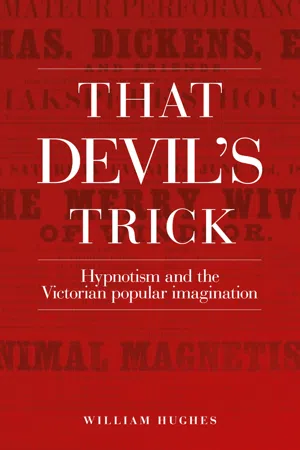
That devil's trick is the first study of nineteenth-century hypnotism based primarily on the popular – rather than medical – appreciation of the subject. Drawing on the reports of mesmerists, hypnotists, quack doctors and serious physicians printed in popular newspapers from the early years of the nineteenth century to the Victorian fin de siècle, the book provides an insight into how continental mesmerism was first understood in Britain, how a number of distinctively British varieties of mesmerism developed, and how these were continually debated in medical, moral and legal terms.
Highly relevant to the study of the many authors – Charles Dickens, George Eliot, Bram Stoker and Conan Doyle among them – whose fiction was informed by the imagery of mesmerism, That devil's trick will be an essential resource for anybody with an interest in the popular and literary culture of the nineteenth century, including literary scholars, medical historians and the general reader.
- 246 pages
- English
- ePUB (mobile friendly)
- Available on iOS & Android
eBook - ePub
About this book
Information
Publisher
Manchester University PressYear
2015Print ISBN
9781526127143
9780719074837
eBook ISBN
9781526101983
Topic
PsychologieSubtopic
Sozialgeschichte1
The epoch of Mesmer
The history of mesmerism falls conveniently into three epochs marked by the names of three men who have taken a leading part in studying and practicing it. The first epoch is that of Mesmer, the second that of Braid, and the third that of Charcot.
Quarterly Review (July 1890)1
THE MERE NAMES of the great exponents of any theory or doctrine can never adequately contain the theories and practices they rhetorically claim as their own. The veracity of such claims, the implicit integrity that links an individual with the processes and practices that bear his or her name in the public domain, is arguably subject to constant interrogation. This is true even at those times when ostensibly pioneering individuals – the biographical co-ordinates of derivative generic appellations such as mesmerism or Braidism – appear to have become successfully established as stable landmarks in the systematic definition of the phenomena they nominally encompass. The demarcated, but still linear, history advanced by the anonymous contributor to the Quarterly Review, above, is thus potentially as fragile as the three individual reputations it alludes to. The history of mesmerism may not always be so clear cut, so easily divisible into eras whose characteristics can be typified through the application of an evocative name alone.
Other commentators, writing both before and after the mesmeric genealogy envisaged by the Quarterly Review, were on occasion notably unconvinced by the claims to originality which had, in their day, already accrued to the names of Mesmer and Braid. In 1843, a mere twenty-eight years after his death, Mesmer was depicted by The Penny Satirist, a popular newspaper, as the mere discoverer of ancient knowledge, and ‘not the inventor of the treatment that goes by his name’.2 In 1887, twenty-seven years after the death of Braid, the slightly more salubrious pages of The Leisure Hour opined that ‘there was nothing new in Braid’s discovery’ of hypnotism.3 The account rendered by the Quarterly Review some three years later is, perhaps, a little less blunt with regard to the achievements of Mesmer and Braid, merely intimating in passing that the former ‘undoubtedly felt’ the influence of contemporary theories of the mind, and the latter, though initially trained by another practitioner, produced clinical phenomena ‘precisely similar to those of Mesmer’.4 Its conclusions regarding Charcot – still active, in 1890, at the Salpêtrière – are, however, reminiscent of the dismissals of Mesmer and Braid by The Penny Satirist and The Leisure Hour. ‘Charcot’, the article suggests, ‘rediscovered mesmerism exactly 100 years after the original discoverer’.5
For the Quarterly Review to proclaim Charcot a mere revivalist rather than a true pioneer is for it to paradoxically undermine the progressive model of history through which its survey of a century of mesmerism has hitherto been channelled. In the non-specialist gaze associated with popular publications such as newspapers and monthly journals, Mesmer, Braid and Charcot may all seemingly be viewed as participants in the traditions established by others as much as they are pioneers in their own right. In such publications there is characteristically none of the precision associated with clinical periodicals engaged in demarcating similar chronologies. The latter’s conventional reliance upon observation and detail would characteristically enforce the subtle differences between practitioners, and thus perpetuate methodological subdivisions such as magnetism, mesmerism, Braidism or hypnotism, even where the nomenclature of one of these may be appropriated for a time to cover the whole conceptual field. The same is not true of non-clinical accounts of mesmerism, which would seem to perpetuate the imprecision of the whole in order to aid both the readership’s continued recognition of a familiar practice and its characteristic problems and controversies. In the case of the chronology advanced by the Quarterly Review, the evocative concept of mesmerism perversely survives this attempt to fragment it into meaningful, successive and discrete epochs because none of the three practitioners named may popularly be considered to have either satisfactorily explained its inconsistencies or comprehended entirely its abiding mysteries. As the article concludes, ‘None of the modern theories cover all the ground, nor would they explain the essence of the thing even if they did’.6 The ‘essence of the thing’ is its evocative continuity rather than any Absolute that might make for an explanation which terminates its perpetual newsworthiness or ongoing controversy. This is arguably the central difference between clinical (or practitioners’) accounts of mesmerism and those advanced in the popular press. The former strive to demarcate, the latter are inclined to perpetuate. For non-clinical accounts of mesmerism, the issue normally is less one of ‘proving’ the possibility of the phenomena, and more a matter of evoking the debate that has formed the constant companion to mesmerism.
That debate far exceeds the question of the demonstrable existence of mesmeric phenomena that preoccupied the mainstream British medical journals of the mid-nineteenth century. The ethical dimensions of mesmeric practice are arguably less dependent upon mesmerism itself than they are premised upon the simple belief in magnetism held by those who wield, and those who yield to, its alleged or proposed powers. Upon this belief hang the predominant preoccupations of popular reportage and fiction, as well as the secondary concern of the medical establishment. The ethical behaviour of practitioners, and the responsibility and integrity associated with those who submit to, or are placed, under mesmeric control, are central to those persistent allegations of abuse, quackery and charlatanism, and diminished responsibility which allow a phenomenon originally scheduled as a medical panacea to fall within the purlieu of criminal law and abnormal psychology.
Though those issues preoccupy both popular and clinical accounts of mesmerism from the mid-nineteenth century, and are central also to the unease evoked by those Victorian fictions which deploy the magnetist as a central character, their roots lie in the eighteenth century. The figure of Mesmer, part doctor and part showman, an altruistic practitioner and a grasping charlatan, is arguably the paradigm upon which later perceptions of the magnetist are premised. Mesmer is, as it were, the perfect embodiment of the contradictions associated with both the theory and the movement that came to bear his name throughout the nineteenth century.
Historians of hypnotism have, as a consequence of their conventional drive towards constructing a linear history of practice from the eighteenth century to the present, tended to evoke Mesmer solely through summaries of eighteenth-century accounts of his demeanour, behaviour or practice. He was, according to Robin Waterfield, ‘a man of contrasts’, who by 1781 had achieved ‘a reputation as a crank’ through his ‘arrogant and paranoid’ reactions to criticism and investigation.7 Derek Forrest, in his considerably more detailed account of the same historical period, depicts Mesmer as ‘fat but muscular’ and ‘not a man to be easily overlooked’, but concludes after quoting from the doctor’s own writing that he was ‘an arrogant man who was making inordinate claims for his discovery and who appeared to be suffering from a persecution complex’.8 Mesmer, in both accounts, is a figure bound up very much in his French contemporaries’ hostile response to both his claims and his mannerisms. But Mesmer is also, however, a discrete though minor figure in nineteenth-century British consciousness, a practitioner whose attitudes and techniques continued to be reported and interpreted both in their own right and in conjunction with later developments in mesmerism and hypnotism. All three epochs envisaged by the Quarterly Review are thus, in a sense, simultaneously a single epoch pervaded by Mesmer in the guise of the practitioner as well as in his functional role as pioneer or first populariser. To read mesmerism in a truly nineteenth-century context, therefore, it is necessary to consider Mesmer himself as the nineteenth century both envisaged and interpreted him. Mesmer’s place in the British popular consciousness of the nineteenth century, indeed, is arguably somewhat different to the positioning which he has historically received at the hands of historians of hypnotism.
‘Mesmer, in a coat of lilac silk’: The wizard, the doctor and the consulting room
In twentieth-century histories of hypnotism, Franz Anton Mesmer is more often deployed in the manner of a rhetorical device than advanced in the guise of a historical figure. His perceived character is customarily presented in these ostensibly historical accounts in such a way as to enforce a necessary distinction between the spectacular phenomena of unregulated eighteenth-century magnetism and more recent professional therapeutic practice. The obvious contrast between the unprovable, fluid-based, magnetism of Mesmer and modern, theoretically premised and experimentally supported, psychological explanations for hypnotic states ought, surely, in itself to be sufficient for this rhetorical purpose. However, the singular figure of Dr Mesmer, typified by elaborate clothing, exaggerated or mystical gestures and eccentricities of manner, almost without exception accompanies and undermines any modern exposition of his theory. In this way, an apparent distance is progressively established between this egotist showman, the ‘Doctor Mystery’ of his day, and the more recognisable institutional figures of the sober, black-suited late Victorian physician and the white-coated twentieth-century clinician.
George Owen’s 1971 account of a mesmeric séance in the rue Montmartre, Paris, is not atypical. It bears no specific date, lacks any reference to contextual documentation or scholarly publication, and presents the whole occasion as a sort of speculative drama, where those present form an audience which is gradually incorporated into the cast, and where the plot leads inevitably to a climactic denouement or, to borrow from Mesmer’s terminology, a crisis. Of Mesmer’s patients, Owen writes:
Listening to music, they awaited the effects, often dramatic, of the magnetism. Mesmer, in a coat of lilac silk and carrying an iron wand, would walk among the patients, accompanied by d’Eslon and assistants chosen for their youth and comeliness. He would touch the bodies of the patients with the wand, or ‘magnetize’ them with his eyes, fixing his gaze on theirs … the process was repeated until the subject was ‘saturated with the magnetic fluid’ and was transported with pain or pleasure.9
Raymond E. Fancher’s colourful 1979 account of what may well be the same magnetic séance has similar implications. Fancher writes:
The lighting was dim, and Mesmer, in an adjoining room, played soft music on his glass harmonica. When the stage was properly set, he emerged, dressed in a flowing lilac-colored robe, and began pointing his finger or an iron rod at the various patients. Some of them invariably began to experience tinglings and peculiar bodily sensations which quickly passed into a crisis state. Soon other patients followed suit.10
Both of these accounts explicitly evoke the atmosphere of the theatre rather than that of the clinic. Each is a public performance – and, with its music, a melodrama almost – but both may implicitly function in the manner of a farce when presented to a modern reader who, sceptical or otherwise, understands contemporary therapeutic hypnotism to be a sober practice conducted in private and without undue indignity.11 In the t...
Table of contents
- Cover
- Half Title Page
- Title Page
- Copyright Page
- Contents
- Acknowledgements
- Preamble: Animal magnetism – a farce?
- 1 The epoch of Mesmer
- 2 Medical magnetism
- 3 Surgical hypnotism
- Conclusion: ‘This is that devil’s trick – hypnotism!’
- Bibliography
- Index
Trusted by 375,005 students
Access to over 1.5 million titles for a fair monthly price.
Study more efficiently using our study tools.
Frequently asked questions
Yes, you can cancel anytime from the Subscription tab in your account settings on the Perlego website. Your subscription will stay active until the end of your current billing period. Learn how to cancel your subscription
No, books cannot be downloaded as external files, such as PDFs, for use outside of Perlego. However, you can download books within the Perlego app for offline reading on mobile or tablet. Learn how to download books offline
We are an online textbook subscription service, where you can get access to an entire online library for less than the price of a single book per month. With over 1.5 million books across 990+ topics, we’ve got you covered! Learn about our mission
Look out for the read-aloud symbol on your next book to see if you can listen to it. The read-aloud tool reads text aloud for you, highlighting the text as it is being read. You can pause it, speed it up and slow it down. Learn more about Read Aloud
Yes! You can use the Perlego app on both iOS and Android devices to read anytime, anywhere — even offline. Perfect for commutes or when you’re on the go.
Please note we cannot support devices running on iOS 13 and Android 7 or earlier. Learn more about using the app
Please note we cannot support devices running on iOS 13 and Android 7 or earlier. Learn more about using the app
Yes, you can access That devil's trick by William Hughes in PDF and/or ePUB format, as well as other popular books in Psychologie & Sozialgeschichte. We have over 1.5 million books available in our catalogue for you to explore.