This book examines the birth of punk in the UK and its transformation, within a short period of time, into post-punk. Deploying innovative concepts of 'critical mass', 'social networks' and 'music worlds', and using sophisticated techniques of 'social network analysis', it teases out the events and mechanisms involved in punk's 'micro-mobilisation', its diffusion across the UK and its transformation in certain city-based strongholds into a variety of interlocking post-punk forms. Nick Crossley offers a detailed review of prior work in this area, a rich exploration of new empirical data and a highly innovative and robust approach to the study of 'music worlds'.
Written in an accessible style, this book is essential reading for anybody with an interest in either UK punk and post-punk or the impact of social networks on cultural life and the potential of social network analysis to explore this impact.
eBook - ePub
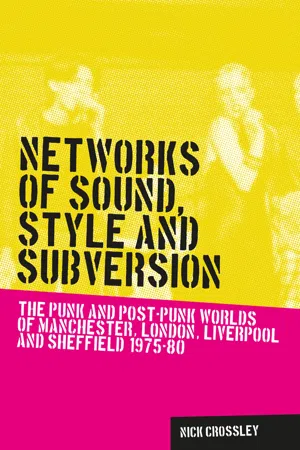
Networks of sound, style and subversion
The punk and post–punk worlds of Manchester, London, Liverpool and Sheffield, 1975–80
- 268 pages
- English
- ePUB (mobile friendly)
- Available on iOS & Android
eBook - ePub
Networks of sound, style and subversion
The punk and post–punk worlds of Manchester, London, Liverpool and Sheffield, 1975–80
About this book
Information
Publisher
Manchester University PressYear
2015Print ISBN
9780719088650
9780719088643
eBook ISBN
9781847799920
Subtopic
English Literary Criticism1
Introduction
When I was 10 years old I was introduced to a ‘music world’ (on ‘worlds’ see below and Chapter 2) which had a huge impact upon me. The excitement I experienced in relation to punk gave me a lifelong passion for music. It established music as a key element in my identity and relationships, wedding me to practices of record-buying, gig-going and rudimentary music-making which I still participate in with passion today. Moreover, beyond music, punk aroused my interest in politics, the society I lived in and various fascinating political and aesthetic undercurrents of that society, perhaps even spurring me in the professional direction I eventually took as a sociologist. It changed the way in which I thought about myself and oriented to the world.
Year zero, in my case, was 1978, by which time most of punk’s pioneers were declaring it dead and a new, more heterogeneous beast was beginning to take shape. ‘Post-punk’, interrupted by the occasional return to punk, would occupy me throughout my teenage years, generating much the same excitement as punk had and at a time when I was becoming old enough to more fully engage with what was going on. I spent a few years enjoying the final years of the first wave of punk before I switched to post-punk, however; long enough to make it my first musical love.
For the pioneers and early risers punk and post-punk demystified music. Their rallying cry was ‘do-it-yourself’ (DIY) and many did, enjoying the sense of empowerment that engendered. For me and my friends, however, perhaps because we were younger, perhaps because we were playing ‘catch up’ during our early years of involvement and perhaps also because we lived in a small town, a good distance from either of the two closest big cities where things were really happening (Liverpool and Manchester), punk and post-punk were clouded in mystery – and were all the more exciting for that. Grotty bars that we read about in the music press assumed the status of sacred spaces in our shared imaginings, and Johnny Rotten, Siouxsie, Kirk Brandon and the Ians, Curtis and McCulloch, to name only a fraction of the main cast, seemed every bit as exotic as the stars overthrown in the punk revolution. They were so far removed from anybody we ever met in our daily lives that they may as well have fallen to earth from another planet, like David Bowie. Where did these fabulous and exotic beings, their styles and ideas come from? Why not our town? How did it happen that the Sex Pistols, the Clash, the Damned, the Banshees and others all appeared around the same time, doing very similar things? How did the punks hear about punk? And why in London? Why were all the exciting clubs we heard about in Liverpool or Manchester? How did all of this come about?
The naivety of youth is apparent in some of this puzzlement but it does raise genuine sociological questions. Why and how did punk and then post-punk emerge, when, where, in the way and involving the people they did? These are some of the questions that drive this book. Specifically, I analyse:
1 The formation of the punk ‘world’ in London between January 1975 and December 1976.
2 The process whereby this world expanded to encompass Manchester in the latter half of 1976 and much of the rest of the UK at the close of the year.
3 The transformation of punk into various forms of post-punk in Manchester, Liverpool and Sheffield between 1977 and 1980 – again focusing primarily upon the structure and dynamics of emergent music worlds.
The book is not only an attempt to satisfy the curiosity of my adolescent self, however. Punk and post-punk were important episodes in British post-war cultural and especially musical history. They had a significant impact, not least upon national and regional identities. Punk in particular, as Hesmondhalgh (1998: 255) notes, enjoys a ‘widely accepted status as a watershed in British music-making’.
That punk and the Sex Pistols were featured in the opening ceremony of Britain’s 2012 Olympic Games illustrates some of this significance, as do the numerous television retrospectives devoted to punk and its aftermath. Punk has become a symbol of Britain. Likewise, living and working in Manchester I am struck by the role which its musical history, particularly the post-punk music of Joy Division, the Smiths and the Fall, play within its identity. Overseas students and colleagues know the city in a way they do not know other British cities (apart from Liverpool) and want to know more because of this heritage. The identity of the city is its history, as known both from within and without, and punk and post-punk are central to that history.
Punk and post-punk occupy this place, both nationally and locally, because they made a difference to popular music and popular culture more widely. Punk was genuinely provocative; exciting many, terrifying others. It incited young people to rebel and authority figures to condemn it and defend their position. It could not be ignored by the powers that be in the way that popular music currents so often are. Whatever the motivations of individual pioneers, which were varied, punk generated debate about moral, political and aesthetic ideas, challenging the apparent preference of many powerful players in the music industry to limit their role to entertainment (though punk was certainly entertaining too), and doing so in a direct and democratic manner which challenged the pretentions and elitism of the rock aristocracy. Punk made music matter and that is why it is important and valued. Moreover, it inspired many of those who followed in its wake, many post-punks, to treat music similarly, according it an importance and a role which many would like to deny it.
Punk was a catalyst, battering a hole in the walls of the popular music world, creating opportunities and encouraging widespread participation. It persuaded people who would never have believed they could form a band to do so, and others to promote gigs, write fanzines and form independent record labels. It gave rise to an alternative music world on the margins, unconstrained or at least less constrained by the commercial imperatives of the mainstream. And in the context of post-punk in particular, this facilitated a flourishing of new, sometimes experimental and often exciting ways of making, performing and appreciating music: new forms of what Christopher Small (1998) calls ‘musicking’. Punk and post-punk may not have changed the world but they did cultivate a desire to do so, and they changed the music world, at least for a while, establishing a high-profile and provocative protest camp at its perimeter. Moreover, they changed their participants – some of whom now run the institutions they once rebelled against – in enduring ways, giving rise to a musical and political ‘generation’ whose decisions in some ways still betray their punk origins.
Even if punk and post-punk were not significant topics in their own right, however, the dynamics of their emergence and diffusion would be. If we abstract from their concrete content, the punk and post-punk worlds and their emergence manifest processes and mechanisms of collective action and mobilisation which are common across a range of social worlds and movements, from political insurgencies and social movements through criminal underworlds to the conspiratorial circles of what Mills (1956) used to call ‘the power elite’. Each of these types of collective activity has its own unique elements and dynamics of course, and individual cases will vary too. The story of the emergence and rise of punk is not identical to that of Motown or rock ‘n’ roll, let alone of feminism or an international drug-trafficking ring. However, in so far as each entails the formation of networks, whose members act collectively and generate, by way of their interaction, a distinctive culture, it is reasonable to assume that there will be some overlap in the mechanisms and processes involved. And these mechanisms and processes are sociologically significant.
In seeking to explain punk and post-punk, therefore, I am exploring processes and mechanisms which might help to explain much else in social life, contributing to the general project of sociology. Punk and post-punk are important case studies of collective action, as well as fascinating and important phenomena in their own right. But what do we mean by ‘punk’ and ‘post-punk’?
Defining punk and post-punk: from styles to worlds
Punk and post-punk are sometimes defined as musical and visual ‘styles’ (e.g. Hebdige 1988), a concept which implies stylistic ‘conventions’; that is, shared ways of doing things which distinguish certain artists, works and performances from others, giving them an identity (Meyer 1989, 2000). In traditional Western musicology such conventions are conceived in terms of harmonic, melodic and rhythmic structures, alongside the more elusive quality of timbre. Ethnomusicologists, who study non-Western and folk musical forms, however, have argued that these variables reflect the preoccupations of Western art-music and have called for a much broader approach to the mapping of styles, incorporating such things as the time and place of performance, the ways in which musical competence is acquired and the typical relations between audience and performers, where they are distinguished (Lomax 1959). Even this more encompassing approach is insufficient for purposes of defining punk and post-punk, as I explain below. However, it is useful and it would be instructive to spell out some of the key stylistic conventions of punk, both sonic and visual, at this point.
Punk music was raw and basic, a characteristic amplified by a DIY ethos which encouraged everyone to have a go, irrespective of their (lack of) musical experience and training. It was (electric) guitar-based and akin to rock but inflected with an aggressive and confrontational attitude uncommon in much rock, such that lyrics, whose content was often provocative, were spat out or shouted rather than sung, to musical accompaniment which had a harsh timbre and often a jagged, choppy rhythm. And this aggression was matched in audiences, whose dancing often involved them jumping up and down, shaking their heads and banging into one another (the pogo), and who often showed their appreciation for bands by spitting at them.
These characteristics were often pitted in opposition to the mellow approach of the hippies and this opposition was evident in relation to clothing also. Although the DIY ethic was evident here too, generating some diversity, hair was often cut short and made spiky, in direct opposition to the long hair of the hippies. Likewise trousers: in contrast to hippy flares they were either straight-legged or tight. There was also an emphasis upon using old clothing, bought from jumble sales, which were then modified with paint and household items, most notably the safety pin, which was used both to hold (sometimes deliberately) ripped clothing together and as an item of jewellery (e.g. an earring). Moreover, under the influence of Malcolm McLaren and Vivienne Westwood, the trappings of sexual fetishism (bondage, bumflaps, leathers, etc.) were often incorporated into the punk look, as were confrontational symbols such as the swastika, the inverted crucifix and the circled letter ‘A’ of anarchism.
In addition, particular artistic and graphical techniques, including provocative and subversive montages and the cut-out newspaper lettering popularly associated with ransom notes, became common, initially on shop-bought T-shirts and record sleeves but then spreading to homemade designs too. The record sleeves and promotional posters which Jamie Reid designed for the Sex Pistols are key examples. His promotional poster for the Pistols’ ‘God Save the Queen’ single had a picture of the monarch with a safety pin through her lip, while his cover for ‘Pretty Vacant’ involved two buses whose destinations were identified as ‘Nowhere’ and ‘Boredom’ respectively.
This description of stylistic conventions is useful for giving us a feel of what punk was like. However, it is indicative rather than definitive. Not every punk subscribed to every convention and some of the conventions are not specific to punk. Moreover, conventions evolve over time, even within a style, and may vary between clusters of works. They are certainly important to the identity of a style but more in the manner of what Wittgenstein (1953) calls ‘family resemblance’, each work within the style having something in common with certain of the others but without any one stylistic convention being both sufficiently widely shared and sufficiently exclusive to serve a demarcation function.
If it is difficult to pin punk down to a style, however, it is even more so for post-punk. There were many distinctive styles within the post-punk camp, from the synthesiser-based ‘futurism’ of Cabaret Voltaire, John Foxx, Orchestral Manoeuvres in the Dark and the Human League, through the retro-inflected, guitar-based psychobilly of the Cramps, the Meteors and the Inca Babies, to the reappropriation of traditional instruments and song structures in the largely acoustic folk-punk of the Pogues, the Men They Couldn’t Hang and the Violent Femmes. From the neo-psychedelic sound of the Fall, Echo and the Bunnymen, Wah! and the Teardrop Explodes, through goth and ska to the neo-funk of the Pop Group and Gang of Four. From the dark, angst-ridden minimalism of Joy Division, Theatre of Hate and their many copyists to the self-consciously superficial glamour of the new romantics. In many respects these styles couldn’t be more different and yet they are all, by common agreement, strands of ‘post-punk’ (Reynolds 2005), and ‘post-punk’ designates something meaningful; a coherent musical phenomenon and not simply a catch-all category for everything that happened after punk (ibid.).
Genre classification as a social process
Punk and post-punk are difficult to pin down to definitive stylistic conventions because they are not academic categories, rooted in the analytic concerns and based on the variables of the musicologist or sociologist and imposed from outside. Like many genre labels they were devised in the heat of the action, by participants, on the basis of practical interests. And we must work with them as such.
A useful source for these purposes is Paul DiMaggio (1987). He suggests that genres and schools are typically defined (acquiring symbolic existence) through one or more of four basic processes (see also DiMaggio 2011):
1 Administrative classification. This is classification by agencies of the state, national or local. States may wish to classify art for the purposes of funding or censorship and their criteria will reflect these interests.
2 Commercial classification. In the case of popular music this is classification by record labels, shops and journalists. It is motivated by their des...
Table of contents
- Cover
- Half Title
- Title Page
- Copyright
- Dedication
- Contents
- List of figures and tables
- Acknowledgements
- 1 Introduction
- 2 Music worlds
- 3 Explaining punk: a review of existing accounts
- 4 Theorising micro-mobilisation: critical mass, collective effervescence, social networks and social space
- 5 Micro-mobilisation and the network structure of the London punk world
- 6 The evolution of the London network
- 7 Punk goes national: broadcast networks, media and moral panics
- 8 From punk to post-punk: a tale of three cities
- 9 Joining the dots: post-punk worlds as networks
- 10 The small world of British post-punk
- 11 Conclusion
- References
- Videography and discography
- Index
Trusted by 375,005 students
Access to over 1.5 million titles for a fair monthly price.
Study more efficiently using our study tools.
Frequently asked questions
Yes, you can cancel anytime from the Subscription tab in your account settings on the Perlego website. Your subscription will stay active until the end of your current billing period. Learn how to cancel your subscription
No, books cannot be downloaded as external files, such as PDFs, for use outside of Perlego. However, you can download books within the Perlego app for offline reading on mobile or tablet. Learn how to download books offline
We are an online textbook subscription service, where you can get access to an entire online library for less than the price of a single book per month. With over 1.5 million books across 990+ topics, we’ve got you covered! Learn about our mission
Look out for the read-aloud symbol on your next book to see if you can listen to it. The read-aloud tool reads text aloud for you, highlighting the text as it is being read. You can pause it, speed it up and slow it down. Learn more about Read Aloud
Yes! You can use the Perlego app on both iOS and Android devices to read anytime, anywhere — even offline. Perfect for commutes or when you’re on the go.
Please note we cannot support devices running on iOS 13 and Android 7 or earlier. Learn more about using the app
Please note we cannot support devices running on iOS 13 and Android 7 or earlier. Learn more about using the app
Yes, you can access Networks of sound, style and subversion by Nick Crossley in PDF and/or ePUB format, as well as other popular books in Media & Performing Arts & English Literary Criticism. We have over 1.5 million books available in our catalogue for you to explore.