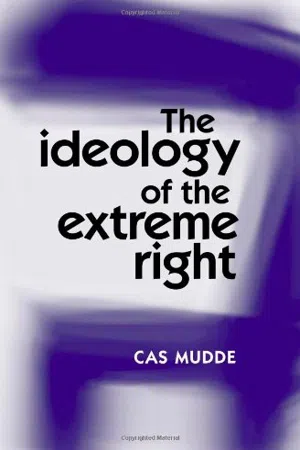
A comprehensive and detailed analysis of the five main parties of the extreme right in the Netherlands, Belgium and Germany. Using primary research - including internal party documents - the author concludes that the core ideology of these parties is xenophobic nationalist.
- 224 pages
- English
- ePUB (mobile friendly)
- Available on iOS & Android
eBook - ePub
The ideology of the extreme right
About this book
Information
1
The extreme right party family
Studies of political parties have been based on a multiplicity of both scholarly and political theories, and have focused on a variety of internal and external aspects. As is common within the scientific community, complaints have been voiced about the lack of knowledge in particular areas of the field, such as party (as) organisations (Mair 1994), party ideology (Von Beyme 1985), and minor or small parties (Fischer 1980; Müller-Rommel 1991). However, even though a lot of work certainly remains to be done, political parties do constitute one of the most studied fields in political science in general, and comparative politics in particular (Katz and Mair 1992; Janda 1993).
Studies of political parties focus primarily either on the whole group of political parties or on different subgroups within the larger group. The former studies are aimed at determining what characteristics all political parties have in common. They mainly focus on constructing a (general) theory and definition of political parties. Even though many theories have been developed during the past decades, ‘there has been no dominant theoretical perspective in the study of political parties’ (Crotty 1991: 145). This also holds true for the second group, which deals with defining the political party. There is a wide variety of definitions, based on an almost as wide variety of criteria, but none can claim general acceptance in the field. However, a consensus can be found in the fact that the political party is to be defined primarily on the basis of its function(s). It is also on this basis that the political party will be defined in this study, namely as any political group identified by an official label that places candidates for public office through elections (see also Sartori 1976: 63). Although such definitions have sometimes been criticised for being (too) narrow (see Janda 1993), and although this criticism might be valid in certain cases, a ‘minimal definition’ serves the purposes of this study, i.e. identifying the object.
The concept of the party family
In addition to the group of scholars that study characteristics that are part of all political parties, a large(r) group centres on the distinction of different subgroups within the larger group. This is generally done by constructing typologies or classifications of political parties. The construction of classifications forces researchers to structure their knowledge and information of the subject at hand, which again helps them to gain a greater understanding and control of that subject (Lazarsfeld and Barton 1951). What variable is chosen as the theoretical basis of the classification, or combination of variables in the case of a typology, depends on the interest and research question of the author (e.g. Mair 1990).
One of the most popular classifications is that of the so-called party family, in which political parties are grouped across countries predominantly on the basis of their ideology. Although this idea has been elaborated at the theoretical level only relatively recently, it has been part implicitly of several of the older studies in the field, going back to the classical studies of Michels (1911/78), Duverger (1951:64) and Lipset and Rokkan (1967). The idea of the party family is not one of the most rigorously tested classifications in political science, however; and, for the most part, it has its vagueness and ‘common sense’ to thank for its wide usage. However, the distinction of political parties on the basis of ideology has both theoretical and practical merits (see Mair and Mudde 1998).
One of the most authorative sources on party families is Von Beyme’s Politische Parteien in Westeuropa (1984; English translation in 1985). In this book he constructs several typologies, based on different criteria, of which the most important criterion is to be found at the ideological level: that of the familles spirituelles. It is these ideological ‘families’ that are compared on the basis of the other criteria. Although his main typology is based on ideology, Von Beyme writes that he has constructed the different types on the basis of Rokkan’s famous historical–sociological study of the four critical lines of cleavages (Von Beyme 1985: 23). Where Rokkan distinguishes ten ‘ideological groups’ on the basis of four major conflicts (cleavages) in Western Europe (Rokkan 1970), Von Beyme specifies only nine ‘spiritual families’: (i) liberal and radical parties; (ii) conservative parties; (iii) socialist and social democratic parties; (iv) christian democratic parties; (v) communist parties; (vi) agrarian parties; (vii) regional and ethnic parties; (viii) right-wing extremist parties; and (ix) the ecology movement.
The classification of individual parties into these nine party families is done on the basis of two ‘ideological’ criteria: the name of the party, and, when this is not (or no longer) satisfactory, the voters’ perception of party programmes and ideological position (Von Beyme 1985: 3; my italics).1 Although party ideology is said to be the most important criterion for classification, it is used only in an indirect way, i.e. through the eyes of the party itself (party name) or of the voters. Thus it is not the researcher who assesses the ideology of the different parties. This is also true for the assessment of the content of the party ideologies, as the attention in the book is predominately directed at the ideology of the different familles spirituelles, not at that of the different member parties. Moreover, whether the ideology of a certain party family is identical to that of all its member parties, or whether the individual parties are classified correctly on the basis of (one of) these indirect criteria, is not discussed by the author. His main interest is clearly in the party family as a whole, especially its development, rather than in the individual members that constitute the family.
More recently, Gallagher et al. have listed three criteria on the basis of which different party families in Western Europe can be distinguished: (i) ‘genetic’ origin, (ii) transnational federations and (iii) policies (1995: 181). With a shared genetic origin the authors mean that parties mobilised either in similar historical circumstances or with the intention of representing similar interests. As examples of these families they name socialist (or social-democratic) and agrarian parties. This criterion seems most strongly influenced by Rokkan’s cleavage approach.
For the classification of political parties in general and the group of parties that is the concern of this study – (alleged) extreme right parties of the 1980s – in particular, the ‘genetic’ criterion is of limited use. Although these parties by definition mobilised in similar historical circumstances, Western Europe of the 1980s, they are not the only (group of) parties of this historical period; the green parties, for instance, also mobilised during this period. Nor does the criterion of (the intention of) representing similar interests apply to this specific group. It has been argued that Lipset’s thesis of middle-class extremism, originally developed for the pre-war Nationalsozialistische Deutsche Arbeiterpartei (German National Socialist Workers Party, NSDAP), is also valid for the post-war extreme right parties (Lipset 1960; Kühnl et al. 1969). However, this thesis has come under increasing attack in the last decades (Childers 1983; Falter 1991) and electoral studies have shown that the electorates of modern extreme right parties of the second (Herz 1975; Husbands 1981) and third ‘wave’ of post-war right-wing extremism are too diverse to speak of middle-class extremism (Betz 1994; Kitschelt 1995).
The second criterion Gallagher et al. mention is based on pragmatic rather than theoretical considerations, i.e. the cross-national linkages that parties have developed among themselves. These linkages are chosen by the parties themselves, and are generally based on (the assumption of) a shared ideology. The most important examples of official organisations of parties from different countries are (i) the party groups in the European Parliament (EP) and (ii) the transnational party federations. Both are primarily organised on the basis of (the assumption of) shared ideological principles (Pridham and Pridham 1979a, 1979b; Bardi 1994).
From the very beginning of the establishment of some form of EP, various groupings of parties have been in place. In the first period only three party groups were represented in the then Common Assembly of the European Coal and Steel Community: the socialists, the christian democrats and the liberals. Since the 1980s, there seems to be a trend towards a closer cooperation between national parties within the existing party groups, on the one hand, and towards competition between these groups instead of between the various national parties, on the other hand. In addition to the three original groups the green parties also form a relatively well organised party group in the EP. Looser coalitions are formed by various regionalist parties in the Rainbow Coalition and during the years 1984–9 and 1989–94 by extreme right parties. This notwithstanding, not all political parties represented in the EP are members of a party group (or ‘official’ party family) and not every party family is represented as a party group in (every term of) the EP. Moreover, not all political parties that can be described as ‘relevant’ in the Sartorian sense (Sartori 1976) at the national level are represented at the European level.
Except for the party groups in the EP there are a number of transnational party federations that reach beyond the geographical boundaries of the European Union (EU). In his handbook on political parties of the world Day notes a ‘growing inclination of political parties throughout the world to construct or join international organisations of like-minded formations’ (Day 1988: ix). Some examples of world-wide federations are the Socialist International (primarily socialist and social-democratic parties), the Socialist Fourth International (Trotskyist parties), and the Liberal International. Even though most of these transnational federations are older than the party groups in the EP, the latter seem to be of bigger importance in the possible foundation of transnational, most likely Euro-, parties (Bardi 1994). However, it will still be a long time before transnational parties will become as relevant as national parties.
Though the criterion of transnational federations has the obvious advantage of being based on clear and open relations between parties, it has severe shortcomings when applied to classifying small parties in general and to the group of extreme right parties of the 1980s in particular. Although there exist several cross-national linkages between parties within the latter group, most of these are neither official nor at the party level. Various linkages are ad hoc or only at the individual level. And, although there have been extreme right party groups in the EP, they have always involved only a few of the parties generally considered extreme right (as most of them never made it into the EP). On top of this, the party groups differed considerably in member parties and were highlighted by disputes both within and between the various parties (e.g. Osterhoff 1997; Veen 1997; Fennema and Pollmann 1998). The particular situation of a ‘contaminated’ family name, finally, makes the more successful parties often cautious to use it, and they often even distance themselves from ‘family members’ abroad (Pfahl-Traughber 1994).
This leaves us with the third criterion, i.e. policies, or to be more precise ‘the extent to which the policies pursued by one party in a country are similar to those pursued by another party in another country’ (Gallagher et al. 1995: 181). The authors warn that this criterion has the disadvantage that it naively assumes that the same policy means the same thing in different countries. Seiler even went so far as to state that the use of the criterion of ‘policies really implemented by political parties’ in cross-national research would in practice lead to a typology of countries rather than of parties (1985: 81). The question is how to solve this problem of cross-national comparability. While authors like Seiler have decided to ignore the criterion, Gallagher et al. state that ‘to ignore professed policies altogether when looking for similarities between parties would clearly be to stick our heads in the sand’ (1995: 181).
The problem of cross-national comparability can be circumvented by focusing on the ideology of the parties. Ideologies function as the normative bases of the pursued policies of political parties and have the advantage of being more generally formulated than the more nationally centred policies that are pursued (Christian and Campbell 1974; Sainsbury 1980). Even though the aspect of ideology has been ignored somewhat within the study of party politics, most scholars in the field do accept the importance of it (LaPalombara and Weiner 1966; Janda 1993). This is especially the case in comparative studies, as ‘[i]deology and program are … a convenient vehicle for bringing some kind of intellectual order out of what would otherwise be the chaos of competing political groups’ (Alexander 1973: xix).
The study of extreme right parties
The rise of right-wing extremist parties comes in waves, as authors have observed for several West European countries (see Knütter 1991; Zimmermann and Saalfeld 1993; Buijs and Van Donselaar 1994). According to some authors these waves are similar in all or at least most of the countries (e.g. Von Beyme 1988; Stouthuysen 1993; Epstein 1996), whereas others believe that they are for the largest part country specific (e.g. Veen 1997). Buijs and Van Donselaar argue that what seems to be a European development might be no more than a ‘temporary and accidental coming together of the national development of a number of countries’ (1994: 30). As they state, however, at the moment there is insufficient empirical evidence to support this, in their own words, relativising view (though see Husbands 1996).
Not only do extreme right parties rise in waves, but so do the studies on the subject, with a slight delay. This conjunctural development of scholarly studies on right-wing extremism has been written on and warned against (e.g. Backes 1990a). The recent ‘high’ in literature on extreme right parties is in line with this development. As extreme right parties either win or maintain their position in the various West European party systems, the number of writings on the phenomenon is exploding. Most of the literature is of a primarily descriptive nature, portraying (the history of) either one extreme right party or extreme right parties in one country. Only fairly recently have some truly comparative studies been undertaken in the field of party ideology (Gardberg 1993; Mudde 1995) and on explanations of the current electoral success of extreme right parties (Betz 1994; Kitschelt 1995).
The study of the third wave, 1980–2000
The ‘third wave’ of post-war right-wing extremism (Von Beyme 1988) is without a doubt the most successful period in both the electoral and ideological sense for such parties in almost every West European country (see Suleiman 1995; Taggart 1995). Even though they are still regarded as pariahs in most countries, some extreme right parties have established themselves, at the least, as politically important pariahs, as, for instance, the French Front National (National Front, FN) and the Belgian Vlaams Blok (Flemish Block, VB). In Italy the Alleanza Nazionale (National Alliance, AN) was the first West European extreme right party of the post-war period to make it into government. The extreme right has become a relevant factor in West European politics both within the party system and outside of it (as, for example, the extreme right linked violence in Germany, Austria and elsewhere).
The importance of extreme right parties is also visible in the field of research. Not only has the number of studies on the subject exploded, but also the number of scholars active in the field and the theoretical approaches applied to the field has expanded enormously (see Mudde 1996). Probably the most important development since the early 1980s has been the influx of scholars that originally worked outside the field of right-wing extremism (and historical fascism). This has, on the one hand, brought valuable insights from the study of, for instance, political parties in general and left-libertarian parties in particular (see, most notably, Betz 1994; Kitschelt 1995). On the other hand, it has incorporated the study of extreme right parties into the wider study of political parties, thereby providing useful insights for, among others, the study of small and new parties (e.g. Ignazi 1996). However, these developments have not only made the field broader in volume, but also the number of debates have increased. In comparison to the situation some ten years ago, we now know far more about extreme right parties, yet seem to agree on far less. In particular, there is increasing disagreement on which parties might be properly regarded as extreme right.
Which parties?
Though formal definitions or derivations based on the history of ideas largely failed to provide a convincing concept for ‘right-wing extremism’, research work on political parties of the right has not had serious problems in selecting appropriate cases. (Von Beyme 1988: 3)
Von Beyme’s observation is valid for most party families: we seem to know who they are even though we do not exactly know what they are. However, there are some special circumstances for this particular family that make the implications of the remark more serious. First, various other parties have (part) of the family name in their own party name, a feature which is especially obvious in the case of some left-wing families (notably communist and green). This is not true for the right-wing extremist parties, however, which not only reject the term extremist, some even object to the term right-wing (Verbeeck 1994), as is evident, for example, in the case of the two Dutch Centreparties. Second, most other party families have some sort of transnational federation in which the various national parties cooperate, whereas this is missing for the extreme right parties.
The ‘appropriate cases’ that are selected without serious problems by the various researchers involved in the field are listed in appendix A. The political parties listed are those generally considered ‘extreme right’, which contested national elections at least once in the 1980–95 period. Clearly, not every West European country is mentioned as there is no extreme right party in, for example, Iceland and Ireland that meets the election requirement. Nor is every party mentioned studied with equal care and attention. Parties like the FN and the German Die Republikaner (The Republicans, REP) belong to the better-known and studied political parties in Western Europe, while parties such as the Dutch Centrumpartij’86 (Centre Party’86, CP’86) and the Swiss Schweizer Demokraten (Swiss Democrats) are virtually unknown beyond (and even within) their own national boundaries.
The fact that German extreme right parties (not only the REP) are studied so intensively shows that electoral significance is not the only or even main reason for scholarly attention. Even though they have had some electoral success at the Land (state) level and once at the European level, the German parties are of mediocre size at the national level in comparison to many of their European counterparts. Still, the REP has been studied by both German and non-German scholars more than, for instance, the almost equally successful Dutch Centrumdemocraten (Centre Democrats, CD). The prime reason for this is, of course, the legacy of the past. On top of that and also because of this legacy there are more scholars from Germany working in the field of right-wing extremism than from other countries (Roberts 1994).
A practical reason for the difference in scholarly attention is language. As Müller-Rommel has noted this is a restraining factor in the study of all small parties, especially when primary sources are involved:
...Table of contents
- Cover Page
- Title Page
- Copyright Page
- Contents
- Preface
- Acronyms
- 1 The extreme right party family
- Part I Germany: ‘Deutschland den Deutschen!’
- Part II Flanders: ‘Eigen volk eerst!’
- Part III The Netherlands: ‘Nederland voor de Nederlanders!’
- Appendix A List of extreme right parties in Western Europe
- Appendix B Ideological features and themes
- Bibliography
- Index
- Footnotes
Trusted by 375,005 students
Access to over 1.5 million titles for a fair monthly price.
Study more efficiently using our study tools.
Frequently asked questions
Yes, you can cancel anytime from the Subscription tab in your account settings on the Perlego website. Your subscription will stay active until the end of your current billing period. Learn how to cancel your subscription
No, books cannot be downloaded as external files, such as PDFs, for use outside of Perlego. However, you can download books within the Perlego app for offline reading on mobile or tablet. Learn how to download books offline
Perlego offers two plans: Essential and Complete
- Essential is ideal for learners and professionals who enjoy exploring a wide range of subjects. Access the Essential Library with 800,000+ trusted titles and best-sellers across business, personal growth, and the humanities. Includes unlimited reading time and Standard Read Aloud voice.
- Complete: Perfect for advanced learners and researchers needing full, unrestricted access. Unlock 1.5M+ books across hundreds of subjects, including academic and specialized titles. The Complete Plan also includes advanced features like Premium Read Aloud and Research Assistant.
We are an online textbook subscription service, where you can get access to an entire online library for less than the price of a single book per month. With over 1.5 million books across 990+ topics, we’ve got you covered! Learn about our mission
Look out for the read-aloud symbol on your next book to see if you can listen to it. The read-aloud tool reads text aloud for you, highlighting the text as it is being read. You can pause it, speed it up and slow it down. Learn more about Read Aloud
Yes! You can use the Perlego app on both iOS and Android devices to read anytime, anywhere — even offline. Perfect for commutes or when you’re on the go.
Please note we cannot support devices running on iOS 13 and Android 7 or earlier. Learn more about using the app
Please note we cannot support devices running on iOS 13 and Android 7 or earlier. Learn more about using the app
Yes, you can access The ideology of the extreme right by Casse Mudde in PDF and/or ePUB format, as well as other popular books in Social Sciences & Sociology. We have over 1.5 million books available in our catalogue for you to explore.