Ballads and songs of Peterloo is an edited collection of poems and songs written following the Peterloo Massacre in 1819. This collection, which includes over seventy poems, were published either as broadsides or in radical periodicals and newspapers. Notes to support the reading of the texts are provided, but they also stand alone, conveying the original publications without diluting their authenticity.
Following an introduction outlining the massacre, the radical press and broadside ballad, the poems are grouped into six sections according to theme. Shelley's Masque of Anarchy is included as an appendix in acknowledgement of its continuing significance to the representation of Peterloo.
This book is primarily aimed at students and lecturers of Romanticism and social history.
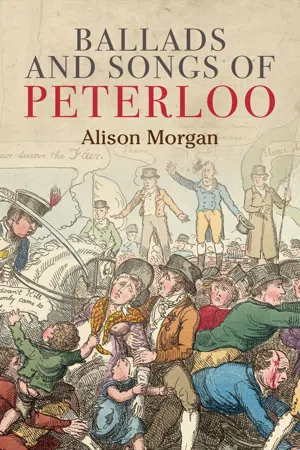
- 238 pages
- English
- ePUB (mobile friendly)
- Available on iOS & Android
eBook - ePub
Ballads and songs of Peterloo
About this book
Information
Publisher
Manchester University PressYear
2018Print ISBN
9781526144294
9781784993122
eBook ISBN
9781526132482
1

‘Rise Britons, rise now from your slumber’: the revolutionary call to arms
Rise like lions after slumber
In unvanquishable number –
Shake your chains to earth like dew
Which in sleep had fallen on you –
Ye are many – they are few.1
Shelley’s famous refrain in The Masque of Anarchy, written furiously and frantically in the ten days following his receipt of news from Manchester, is undoubtedly the most famous piece of poetry associated with Peterloo. Described by Robert Poole as ‘perhaps the most powerful of all political poems’, in Salford this verse can still be seen on Transport House, the former regional headquarters of the Transport and General Workers’ Union.2 Echoes of this invocation can also be found in the socialist anthem, ‘The International’, written by a transport worker, Eugene Pottier, after the crushing of the Paris Commune by the French government in 1871:
Arise ye workers from your slumbers
Arise ye prisoners of want
For reason in revolt now thunders
And at last ends the age of cant3
What is less well known is that Shelley and Pottier are, consciously or otherwise, utilising a trope that features in ballads and broadsides dating back to the sixteenth century.4 This chapter begins by briefly examining the historical provenance of this trope and its significance within radical culture prior to Peterloo, as well as those written in the immediate aftermath of the massacre, thereby highlighting the intertextual dialogue between the poems which is illustrated not only by an ideological unity but also by the commonality of motifs, forms, styles and even tunes. The urging of the people to wake from their apathy and subjugation to rise against their oppressors became part of the radical discourse in late 1819 and early 1820. The urge to act against the intolerable oppression of the Liverpool administration captured the zeitgeist of the months following Peterloo when, it was truly believed, revolution would occur.5 The hoped-for revolution did not come to pass but the poems gathered here evince a powerful sense of collectivity and common purpose with the repeated exhortations to arise and awaken redolent of those turbulent times.
Another famous use of the awakening and arising trope features in Milton’s Paradise Lost, first published in 1667. In the first book, following their expulsion from Heaven, Satan calls upon his Angels to ‘Awake! – arise! – or be forever fallen’, appealing to them with the possibility of re-entering Heaven or founding a new kingdom.6 When Richard Carlile pirated Shelley’s 1812 Declaration of Rights, containing Satan’s exhortation, in the Republican on 24 September 1819, its contemporaneous resonance with the readership would not have been missed.7
The earliest example of an exhortatory ballad that I have discovered dates to 1557. Arise and Awake was to be sung to the tune of ‘Rogero’:
Aryse and wak, for Christi’s sake,
Aryse, I say again;
Awake, all ye that synfull be,
Awak, for fear of payn.8
Here the speaker urgently seeks to awaken the sleeper from the dangers of sleep. The repetition of ‘aryse’ and ‘awak’ creates a sense of desperation and implies that unconscious sleep is dangerous and safety will come with consciousness. The poems in this chapter depict sleep as compliance with tyranny and call on the people to awaken in order to act, as shown in ‘Address to Britons’:
Too long beneath an abject yoke
We basely bowed nor dar’d complain.9
During the English Revolution of the 1640s, there are examples of the trope of awakening being used on both sides of the conflict. ‘A New Ballad, Called a Review of the Rebellion, in Three Parts’ to the tune of ‘When the King Enjoys His Rights Again’ was written by the well-known ballad writer, Martin Parker, and published in 1647. As would be expected from a Royalist, Parker calls upon the British to wake from the sleep they have been lulled into by the Parliamentarians and return to an absolute monarchy under Charles I:
Britaines, awake from your six yeares dreame,
And listen to this deare bought theame,
Which shewes how you fast asleep were lulled,
And by what magick spells so gulled.10
This lengthy ballad narrates an exclusively Royalist view of the revolution before concluding that the only course of action is:
Then must king Charles alone
Be set upon his throne.11
Two years later Charles was dead and Cromwell’s Commonwealth had replaced the monarchy. However, there was still resistance to the landowning gentry, notably by the Diggers, led by Gerrard Winstanley. The Diggers opposed the enclosure of common land and, in 1649, they occupied an area of wasteland at St George’s hill, using it as a platform to argue for the equitable redistribution of land. ‘The Digger’s Song’, written by Winstanley in 1649, exhorts the people to ‘stand up now’ against the Cavaliers and gentry and reclaim the land unjustly taken from them:
With spades and hoes and plowes stand up now,
Your freedom to uphold, seeing Cavaliers are bold
To kill you if they could, and rights from you to hold.
Stand up now, Diggers all.12
The command to ‘stand up’ implies that the Diggers needed to assert their presence and, in parallel with the command to rise, suggests emergence from a state of compliance. The reference in the poem above to ‘spades and hoes and plowes’ not only alludes to the agrarian activities of the Diggers but also carries the implication that these farming tools could quickly become weapons in what was rapidly becoming a class war.
The appeal to defend ancient or natural rights permeates the poems of the 1790s and 1810s and can be seen in several of the poems in this chapter, including ‘Patriotic Song’, in which the chorus declaims:
Steady, boys, steady
We claim all our rights and we’ll have them again.13
However, calling on the people to rise is not just the province of English radicals. Charles Mackay includes ‘Welcome, Charlie, O’er the Main’ in his 1861 collection, Jacobite Songs and Ballads of Scotland from 1688–1746; the song had also been published in the Scots Magazine in 1817, although its championing of ‘Royal Charlie’ suggests it was written around the time of the 1745 Jacobite Rebellion in which Charles Edward Stuart, the Young Pretender, marched his troops to within a hundred mil...
Table of contents
- Cover
- Half Title
- Title Page
- Copyright
- Contents
- List of illustrations
- Preface
- Acknowledgements
- Introduction
- 1 ‘Rise Britons, rise now from your slumber’: the revolutionary call to arms
- 2 ‘Ye English warriors’: radical nationalism and the true patriot
- 3 ‘Base brat of reform’: the victimisation of mother and child
- 4 ‘Your memorials shall survive the grave’: elegy and remembrance
- 5 ‘Those true sons of Mars’: chivalry, cowardice and the power of satire
- 6 ‘Freeman stand, or freeman die’: liberty and slavery
- Appendix
- Select bibliography
- Index of poem titles
- Index
Trusted by 375,005 students
Access to over 1.5 million titles for a fair monthly price.
Study more efficiently using our study tools.
Frequently asked questions
Yes, you can cancel anytime from the Subscription tab in your account settings on the Perlego website. Your subscription will stay active until the end of your current billing period. Learn how to cancel your subscription
No, books cannot be downloaded as external files, such as PDFs, for use outside of Perlego. However, you can download books within the Perlego app for offline reading on mobile or tablet. Learn how to download books offline
Perlego offers two plans: Essential and Complete
- Essential is ideal for learners and professionals who enjoy exploring a wide range of subjects. Access the Essential Library with 800,000+ trusted titles and best-sellers across business, personal growth, and the humanities. Includes unlimited reading time and Standard Read Aloud voice.
- Complete: Perfect for advanced learners and researchers needing full, unrestricted access. Unlock 1.5M+ books across hundreds of subjects, including academic and specialized titles. The Complete Plan also includes advanced features like Premium Read Aloud and Research Assistant.
We are an online textbook subscription service, where you can get access to an entire online library for less than the price of a single book per month. With over 1.5 million books across 990+ topics, we’ve got you covered! Learn about our mission
Look out for the read-aloud symbol on your next book to see if you can listen to it. The read-aloud tool reads text aloud for you, highlighting the text as it is being read. You can pause it, speed it up and slow it down. Learn more about Read Aloud
Yes! You can use the Perlego app on both iOS and Android devices to read anytime, anywhere — even offline. Perfect for commutes or when you’re on the go.
Please note we cannot support devices running on iOS 13 and Android 7 or earlier. Learn more about using the app
Please note we cannot support devices running on iOS 13 and Android 7 or earlier. Learn more about using the app
Yes, you can access Ballads and songs of Peterloo by Alison Morgan in PDF and/or ePUB format, as well as other popular books in Literature & British History. We have over 1.5 million books available in our catalogue for you to explore.