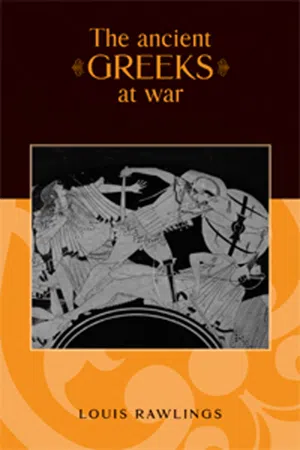
The ancient Greeks experienced war in many forms. By land and by sea, they conducted raids, ambushes, battles and sieges; they embarked on campaigns of intimidation, conquest and annihilation; they fought against fellow Greeks and non-Greeks.
Drawing on a wealth of literary, epigraphic and archaeological material, this wide-ranging synthesis looks at the practicalities of Greek warfare and its wider social ramifications. Alongside discussions of the nature and role of battle, logistics, strategy, and equipment are examinations of other fundamentals of war: religious and economic factors, militarism and martial values, and the relationships between the individual and the community, before, during and after wars. The book takes account of the main developments of modern scholarship in the field and engages with the many theories and interpretations that have been advanced in recent years, in a way that is stimulating and accessible to both specialist readers and a wider audience.
- 262 pages
- English
- ePUB (mobile friendly)
- Available on iOS & Android
eBook - ePub
The ancient Greeks at war
About this book
Information
Chapter 1
War and peace in ancient Greece
War and peace: definitions and representations
What is war? How does one go about attempting to define something as varied, as brutal and as wasteful as war? In broad terms, the condition of war can be characterised as organised violence produced by rival groups, communities or states. It is a bloody and terrible human activity that is imbued with suffering and accompanied by a riot of emotional responses and traumas. War is also culturally defined. The conduct, objectives and outcomes of wars are subject to the expectations and value-systems of their participants and organisers. Both sides in a conflict may have similar outlooks on what wars mean and what constitutes victory and defeat, or they may not.
The Greek word for war, polemos, often retained the physical resonance of fighting, combat or battle (Shipley 1993, 2–3; Liddell and Scott s.v. polemos). But the Greeks recognised that war was much more than just the act of violence; it was the organisation of men and resources for combat and the provision of equipment, training and logistical support. It was the decision-making and planning to achieve political, economic or other aims. It was the designation of another group, community or region as enemy and the persuasion of people, usually men, to enter into a condition of murderous antipathy with those so defined. It manifested in many varied ways, from brief raiding expeditions to long-term campaigns of conquest and assimilation. It varied in intensity from border scuffles with only a handful of casualties, to the annihilation of whole communities and extensive looting, bloodletting and enslavement. The Greeks were familiar with all these aspects of war and, for many Greeks, war, or the threat of war, was a harsh fact of life (Shipley 1993, 18).
The Greeks thought of war as an activity that the gods themselves engaged in and approved of. Hesiod’s Theogony (630–721, 820–67) includes myths of wars and violent struggles fought between the gods and against other divine beings such as Titans. The gods were ‘Deathless’, however, and although some were defeated and cast into Tartarus, for the most part violence was not a serious threat to their continued existence. Similarly in the Iliad, the gods fought one another and even mortal heroes, but without ever being seriously threatened. At one point in the poem, as Achilles was rampaging among the fleeing Trojans, Apollo led him away from the rout by posing as Hector; eventually he turned, saying, ‘Son of Peleus, why are you chasing me with all your swiftness, when you are mortal and I an immortal god … You will never kill me for I am no creature of fate’ (Il. 22.8–9, 13). When the gods engaged in war in the Iliad, a strong contrast was made between the trivial wounds they received and the suffering and death of men and their families. When Aphrodite was wounded by the hero Diomedes, the other goddesses mocked her: ‘Cypris must have been coaxing some Achaean girl to run away to the Trojans, who are now such favourites of hers, and when caressing one of these Achaean women in their lovely dresses she must have scratched her pretty hand on a golddress pin’ (Il. 5.422–5). But her mother, Dione, comforted her by reminding her of Diomedes’ mortality:
The son of Tydeus doesn’t understand that life is not long for a man who fights against immortals; for him no homecoming from war’s grim struggle to have his children climb into his lap with cries of ‘Daddy!’ So now the son of Tydeus should take care that nobody greater than you will meet him in battle or else good Aegialea, Adrestus’ daughter, strong wife of horse-taming Diomedes, may rouse her fond household from their sleep with her long lamentation, crying for the loss of her husband. (Iliad 5.406–15)
The all too fatal conflict of men, of course, served to emphasise their humanity and bravery in risking their precious lives in battle. At one point Sarpedon tells Glaucus that ‘if away from this battle we were forever to be ageless and immortal, neither would I myself fight amid the foremost-fighters, nor would I send you into battle where men win glory; but since the fates of death surround us, innumerable fates, which no mortal may escape or avoid – then let us go forward, until we give glory to another, or he to us’ (Il. 12.322–8). The compensation for being mortal, in Sarpedon’s view, was that men had the opportunity to win glory (Vernant 1991a, 57). The search for a glorious reputation was for some men so important that Achilles, for example, chose a short life of violence and fame to one that would have been long, peaceful and obscure (Il. 9.410–16). War was a means to a good reputation, a way of living in glory, since all men were to die.
War could also give some men gratification. Odysseus, posing as the son of Castor, explained how ‘labour in the field was never to my liking, nor the care of a household, which rears goodly children, but oar-swept ships and wars, and pitching spears with treated hafts and arrows, dismal things that are shuddering and bitter to other men, to me were sweet; a god put them in my heart; for different men take joy in different works’ (Od. 14.223–8). One Spartan remarked that during war ‘nothing is more enjoyable or honourable than to be dependent on no one, but to live on booty taken from enemies that provides sustenance and renown’ (Xen. Hell. 5.1.16). Similarly, for a free-living citizen of a polis at war, ‘nothing equals the sheer delight of routing, pursuing and killing an enemy’ (Xen. Hiero 2.15).
For many Greeks, war was god-given. Isocrates (4.84) claimed that some god had caused the Persian Wars so that the quality of those who fought in it should not remain unknown. It is unsurprising, therefore, that war was seen to be part of the natural order of things. Heraclitus (frg. 53) claimed that ‘War is the father of all and king of all’, while ‘one should understand that war is common and justice is strife …’ (frg. 80). It was also recognised, however, that war was an evil. For Thucydides (3.82.2, see p. 214) ‘War is a violent teacher’, while in Homer, war was predominantly characterised as ‘wretched’, ‘tearful’, ‘bad’ and ‘painful’. Even the son of Castor, who delighted in violent acts, recognised that these were ‘dismal things that are shuddering and bitter to other men’ (Od. 14.226–7). Despite men’s lust for battle (charmē), it was the agony, exhaustion and grief produced by war that was given prominence by Homer (e.g. Il. 22.405–515).
Xenophon, who in his life experienced his share of warfare, suggested that although ‘it is fated by the gods that wars should exist, man should be cautious about beginning them and anxious to end them as soon as possible’ (Xen. Hell. 6.3.6). Such a sentiment was echoed by other Greeks: Euripides’ Suppliant Women (949–54) exhorted ‘mortals to live quietly and to cease from the toils of battle, since life is so short’.
The difference between war and peace, Herodotus (1.87) observed, was that ‘In peace, sons bury their fathers; in war, fathers bury their sons.’ In Aristophanes’ comic play Acharnians, the contrast was brought out in a pair of characterisations drawn by the chorus. War (Polemos) was represented as an evil table companion, drunk and always brawling:
When we were prosperous he burst upon the scene,
Committed crimes, upended and wasted everything.
He’d fight and when we said, ‘sit down and have a sip;
Let’s drink a friendly toast to our good fellowship,’
Instead he’d turn more violent, set fire to our vines,
And tramp them till he’d squeezed out every drop of wine.
(Aristophanes, Acharnians 980–6)
By contrast, Reconciliation (Diallagē) was a desirable bride (Newiger 1980, 225), described in agricultural metaphors of sex and procreation:
If we embraced, I could still pull you down three times,
I’d first shove in a long hard row of tender vines,
And then alongside fresh fig-shoots I’d bed
And finally some grapes – I, old bald-head.
And all around the plot a stand of olive-trees,
So we could oil ourselves for every New Moon Feast.
(Aristophanes, Acharnians 995–9)
War destroys vines with his tramping feet, while Reconciliation provides the opportunities to get back to planting them.1 The plot of the play concerns an Athenian farmer, Dicaeopolis, who became so exasperated with the Athenian assembly, which failed to debate the issue of peace sensibly, that he came to private terms with the enemy. The contrast between the ongoing war and his personal peace was made in scenes that were richly comic and allegorical (Newiger 1980, 223). Lamachus, a general who denounced Dicaeopolis’ private truce, was made to march off and winter in the passes of Attica to guard against a Boeotian incursion, while Dicaeopolis set off to attend a banquet (Ach. 1143–9). Lamachus returned injured in the arms of two soldiers; Dicaeopolis staggered home drunk, carried by a couple of girls (1214–17). Peace enabled Dicaeopolis to open a private market and acquire sexual gratification (763 ff.) and a variety of foodstuffs (870–94) from the enemy. But there is little social concern in Dicaeopolis’ ‘I’m alright Jack’ attitude or actions; he selfishly denies the benefits of his peace to his fellow citizens (1018–39).2
Despite a general recognition that peace was preferable to war, there was very little in the way of pacifism in the Acharnians. The deal that the gods brokered for Dicaeopolis with the Peloponnesians came in the form of a choice of treaties of differing duration. Each was represented as a type of wine:
AMPHITHEUS This here’s a five-year treaty. Have a sip.
DICAEOPOLIS Yuk.
AMPHITHEUS What’s the matter?
DICAEOPOLIS I can’t stomach this.
It smells of pitch and warship construction.
AMPHITHEUS OK then, here’s a ten-year treaty. Try it.
DICAEOPOLIS But this one smells like embassies to the allies,
A sour smell, like someone being bullied.
AMPHITHEUS Well, this one’s a treaty lasting thirty years
By land and sea.
DICAEOPOLIS Sweet feast of Dionysus!
This treaty smells of nectar and ambrosia,
And never hearing ‘get your three days’ rations’.
It says to my palate ‘go wherever you like’,
I accept it; I pour it in libation; I drink it down.
I tell the Acharnians3 to go to hell!
For me it’s no more hardships, no more war:
It’s home to the farm and a feast for Dionysus!
(Aristophanes, Acharnians 188–202)
The image drew its strength from the word for truce, spondai, which referred to the libations (spondai) of wine poured during its agreement. Dicaeopolis chose a thirty-year truce, which appears to have alluded to the agreement made between Athens and Sparta in 446/5 BC (Thuc. 1.115). It was a feature of Greek international relations that some peace agreements and truces were set to expire after a certain time. In the negotiations conducted by Nicias (421 BC), which brought an end to the first phase of the Peloponnesian War (often termed the ‘Archidamian War’, 431–421 BC), the Spartans and Athenians made a fifty-year peace, to be renewed annually (Thuc. 5.24.3), while at the same time the Boeotians and Athenians had a truce that was renewed merely every ten days. Indeed, Thucydides regarded the peace as just an interlude in his account of twenty-seven years of war between the Athenians and Spartans:
Only a mistaken judgment can object to including the interval of this treaty in the war. Looked at by the light of facts it will be found that it cannot be rationally considered a state of peace, for neither party either gave or got back all that they had agreed, not to mention the violations of it which occurred on both sides in the Mantinean and Epidaurian wars and other instances, and the fact that the allies in the direction of Thrace were in as open hostility as ever. (Thucydides 5.26)
Athens and Sparta continued their provocations; by 416 BC both sides were raiding one another openly, and, in 414/13 BC, Sparta was prepared to declare war again (Thuc. 7.18).
Thucydides’ view has been lauded by many scholars as a candid appraisal of Greek international relations, apparently revealing an underlying reality of almost constant hostility among rival poleis.4 From such a perspective, it seems as if the Greeks were always in a state of undeclared war with their neighbours, which they often converted into open hostility and military action, and only briefly suspended with limited periods of truce (e.g. Keil 1916; de Romilly 1968). Indeed, support for this view has been found in a statement, put into the mouth of a certain Cleinias by Plato in the Laws (625e–626a), that ‘[a Cretan Lawgiver] condemned the stupidity of the mass of men in failing to perceive that all are involved ceaselessly in a lifelong war against all States … For (as he would say) “peace”, as the term is commonly employed, is nothing more than a name, the truth being that every State is, by a law of nature, engaged perpetually in an informal war with every other State.’ It is, however, worth observing that Cleinias admitted that ‘the mass of men’ was not aware of...
Table of contents
- Cover Page
- Title Page
- Copyright Page
- Contents
- Acknowledgements
- Abbreviations
- Introduction
- 1 War and peace in ancient Greece
- 2 Early Greek warfare
- 3 The makers of war
- 4 The patterns of war
- 5 Battlefield engagements in the age of the hoplite
- 6 Naval warfare
- 7 Siege warfare
- 8 War and economy
- 9 War and religion
- 10 War, the individual and the community
- Conclusion: the ancient Greeks at war
- Bibliography
- Index
Trusted by 375,005 students
Access to over 1.5 million titles for a fair monthly price.
Study more efficiently using our study tools.
Frequently asked questions
Yes, you can cancel anytime from the Subscription tab in your account settings on the Perlego website. Your subscription will stay active until the end of your current billing period. Learn how to cancel your subscription
No, books cannot be downloaded as external files, such as PDFs, for use outside of Perlego. However, you can download books within the Perlego app for offline reading on mobile or tablet. Learn how to download books offline
Perlego offers two plans: Essential and Complete
- Essential is ideal for learners and professionals who enjoy exploring a wide range of subjects. Access the Essential Library with 800,000+ trusted titles and best-sellers across business, personal growth, and the humanities. Includes unlimited reading time and Standard Read Aloud voice.
- Complete: Perfect for advanced learners and researchers needing full, unrestricted access. Unlock 1.5M+ books across hundreds of subjects, including academic and specialized titles. The Complete Plan also includes advanced features like Premium Read Aloud and Research Assistant.
We are an online textbook subscription service, where you can get access to an entire online library for less than the price of a single book per month. With over 1.5 million books across 990+ topics, we’ve got you covered! Learn about our mission
Look out for the read-aloud symbol on your next book to see if you can listen to it. The read-aloud tool reads text aloud for you, highlighting the text as it is being read. You can pause it, speed it up and slow it down. Learn more about Read Aloud
Yes! You can use the Perlego app on both iOS and Android devices to read anytime, anywhere — even offline. Perfect for commutes or when you’re on the go.
Please note we cannot support devices running on iOS 13 and Android 7 or earlier. Learn more about using the app
Please note we cannot support devices running on iOS 13 and Android 7 or earlier. Learn more about using the app
Yes, you can access The ancient Greeks at war by Louis Rawlings in PDF and/or ePUB format, as well as other popular books in History & Greek Ancient History. We have over 1.5 million books available in our catalogue for you to explore.