- 268 pages
- English
- ePUB (mobile friendly)
- Available on iOS & Android
eBook - ePub
Historical epistemology and the making of modern Chinese medicine
About this book
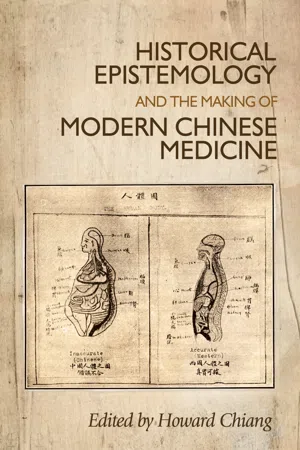
This collection expands the history of Chinese medicine by bridging the philosophical concerns of epistemology and the history and cultural politics of transregional medical formations. Topics range from the spread of gingko's popularity from East Asia to the West to the appeal of acupuncture for complementing in-vitro fertilisation regimens, from the modernisation of Chinese anatomy and forensic science to the evolving perceptions of the clinical efficacy of Chinese medicine. The individual essays cohere around the powerful theoretical-methodological approach, 'historical epistemology', which challenges the seemingly constant and timeless status of such rudimentary but pivotal dimensions of scientific process as knowledge, reason, argument, objectivity, evidence, fact, and truth. In studying the globalising role of medical objects, the contested premise of medical authority and legitimacy, and the syncretic transformations of metaphysical and ontological knowledge, contributors illuminate how the breadth of the historical study of Chinese medicine and its practices of knowledge-making in the modern period must be at once philosophical and transnational in scope.
Information
II
Objects
2
Within the lungs, the stomach, and the mind: convergences and divergences in the medical and natural histories of Ginkgo biloba
Kuang-chi Hung
This tree’s leaf which from the Orient
Is entrusted to my garden
Lets us savor a secret meaning
As to how it edifies the learned man.
Johann Wolfgang von Goethe
Introduction
Goethe would never have known that the tree “entrusted to” his garden, Ginkgo biloba, would help to found a global industry.1 According to a survey conducted in 2007, ginkgo and ginseng are among the most popular herbs in the world.2 Particularly in the United States, many people who feel that their memory is fading purchase ginkgo tablets to strengthen their recall abilities. Various catchphrases and summaries describing the products probably enhance this convention, as a brief search of the website Amazon.com, for example, proves: “Extracts of Ginkgo biloba leaves have been used in China for almost 5,000 years as a natural way to support memory and mental sharpness.”3 Professional journals have also been trumpeting the merits of these products. A 1997 essay published in the Journal of the American Medical Association (JAMA) reports that “in a substantial number of cases,” ginkgo products appear to “stabilize and improve the cognitive performance and the social functioning of demented patients for 6 months to 1 year.”4 Partly because of ginkgo’s likely positive effects on the brain, those who suffer from dementia or Alzheimer’s disease frequently embrace ginkgo products when regular treatments prove ineffective. Taken altogether, it seems fair to say that ginkgo is one of the most socially acceptable, commercially successful, and culturally accepted herbs in the contemporary world and constitutes a rather peculiar case in the history of pharmacy.
Goethe might have been quite startled if he could have learned that the leaves he mused about as being “single and twofold” – a symbol for cultural harmony – would stir fiery debates. Ginkgo first appeared in the pharmaceutical market in West Germany in the 1960s. With its claimed efficacies in treating arterial disease and brain syndromes in the elderly, the so-called GBE (Ginkgo biloba extract) won stellar success in the decades that followed. In the late 1980s, however, when The Lancet reported that in 1988 alone, German doctors wrote 5.24 million prescriptions for GBE, an American doctor responded furiously in an essay entitled “How to waste 200 million dollars a year!” “[T]here is little proof that GBE is effective,” he exclaimed, adding that “the manufacturers have also made every effort to suppress critical evaluation of the drug by threatening legal action against anyone publishing negative information.”5 Regardless, GBE found its way to the United States as a “medical supplement,” and soon its sales surpassed those of its European counterparts. Anxieties thrived among medical professionals.6 In November 2008, an article published in the JAMA claimed that a “randomized controlled trial” would, for the first time, clarify ambiguities surrounding Ginkgo biloba. After six years of surveys that followed thousands of patients who were regularly treated with GBE, it remarked, the results showed that ginkgo products did not help to reduce “either the overall incidence rate of dementia or Alzheimer’s disease (AD) incidence in elderly individuals with normal cognition or those with mild cognitive impairment (MCI).”7
The conclusion proved controversial. For one thing, major media (Time, The New York Times, and the Los Angeles Times, for example) eagerly commented on the discovery, highlighting such assertions as “this study puts a period on the debate … ginkgo does not work in spite of [what] anybody trying to sell it says.”8 For another, the American Botanical Council (ABC), an independent non-profit research organization, cast doubts on the JAMA paper in a press release dated December 28, 2009. The council criticized the research’s methodological shortcomings, limited sample sizes, and utterly obscure results, claiming that “more recent publications [on GBE] have demonstrated an improvement in cognitive performance.”9 It would seem that the JAMA essay is nowhere near a convincing testimony against current applications of ginkgo products.
This chapter does not aim at resolving such controversies. Instead, in the view of the history of medicine, the debates on GBE reveal a compelling question: Why have westerners, during the past decades, grown increasingly fond of an herb despite so little expert evidence? Indeed, if we trace ginkgo’s medical history, we will be startled by the inconsistency among different societies’ contemplations of ginkgo’s therapeutic efficacies. For example, when Chinese in the seventeenth century argued that ginkgo could cure disorders of the lungs, their counterparts in Edo Japan (1603–1868) were convinced of ginkgo’s efficacy in promoting digestion. How can an herb affect the body so differently if bodies everywhere are supposedly the same?
In many ways, ginkgo is a perfect object for such inquiries. As botanists have told us, Ginkgo biloba has been the only surviving species under the division of Ginkgophyta – that is to say, the samples of ginkgo distributed in early modern China, Edo Japan, and modern Euro-America are taxonomically identical. Unlike many popular herbs (for example, ginseng and rhubarb, which cover numerous species), ginkgo has an unusual natural history helping historians to minimize – but not to ignore – biological factors, and to single out what matters in the medicalization of an object. In light of recent studies on “things that talk,” biographies of things, and the material culture of science, this chapter highlights a different way of associating the history of medicine with that of the body.10 We have had provoking studies on how exchanges and consumption of objects generate scientific knowledge.11 In the history of medicine, historians have begun paying close attention to how convergences and divergences – rather than differences and distinctions – take shape chronologically and synchronically.12 This chapter manages to bridge those fertile fields. As we will see, by delving into a botanical’s various movements and into its various representations in agronomic treatises of Ming China (1368–1644), in the folklore of Edo Japan, and in traveling accounts of nineteenth-century western explorers, historians can greatly broaden their examination of notions of the body and the mind, health and illness, mainstream and alternative medicine, and more importantly, humans and the earth where they dwell and coexist with other living beings.
A package from the south
Sometime in 1053, in Kaifeng (開封), the capital city of Song China (960–1279), the famed poet and essayist Ouyang Xiu (歐陽修, 1007–72) received a package. It was wrapped up poorly, and weighed so little that it appeared to contain nothing. Opening it, Ouyang found a handful of ginkgo nuts lying inside. He was touched. He knew that the package was from Mei Yaochen (梅堯臣, 1002–60), his close friend in a distant southern town called Xuancheng (宣城). Inspired, he set out to compose a thank-you letter in the form of a poem. At first glance, he wrote, these tiny, snowy nuts resembled goose feathers, a symbol for lightness and cheapness. But when he came to examine them, Ouyang continued, he could almost see Mei wandering among the ginkgos, selecting and processing the nuts. He assured Mei that if he dared to despise the package for its humbleness, he would hardly deserve Mei as both a friend and a learned person of his day.13
Mei was heartened when reading Ouyang’s reply. He often felt isolated, though Xuancheng, his hometown, was definitely one of China’s most magnificent cities, known for its exuberant intellectual atmosphere in Jiangnan (江南, “the south of the river,” referring to the southern part of the Yangtze Plains). The fact was that he had spent most of his adult life in the north, particularly in the capital, Kaifeng, to pursue his dreams and to serve his country. In the late 1040s, when he gradually orbited the zenith of his career, disasters struck. In 1049, he was informed that his father had passed away. With a saddened acknowledgment of absence, he dashed home, away from Kaifeng, away from the learned communities with which he had intimately associated. During his stay in Xuancheng, Mei began sending packages northward. Each package, as did the one Ouyang received, contained ginkgo nuts. “I am now too old to compose a letter,” he told a correspondent. He groaned that he was now literally and figuratively disarticulated with the intellectual center and that he at times considered himself no longer competent as an author – he was one whose works were no longer worthy of his northern friends’ attention. Mei told his friend, however, that an alternative to sending texts had occurred to him: there was a tree – the yajiao (鴨腳, literally “duck foot”) – that could be found only in Jiangnan and whose nuts, when roasted, tasted as delicious as carp. Taste these yajiao nuts, Mei urged his friend: “you will feel as though I were still there.”14
Diligently preparing ginkgo nuts for friends in the north, the isolated Mei was hardly aware that his treasured ginkgo had gradually spread over the vast plain between the Yangtze River and the Yellow River, seeding itself in Kaifeng. Among those who helped the species undertake its great migration was Li Taibo (李太博), the...
Table of contents
- Cover
- Half Title
- Title Page
- Copyright Page
- Dedication
- Table of Contents
- List of Figures
- Notes on contributors
- Acknowledgments
- Note on transliteration
- I Introduction
- II Objects
- III Authority
- IV Existence
- Index
Trusted by 375,005 students
Access to over 1.5 million titles for a fair monthly price.
Study more efficiently using our study tools.
Frequently asked questions
Yes, you can cancel anytime from the Subscription tab in your account settings on the Perlego website. Your subscription will stay active until the end of your current billing period. Learn how to cancel your subscription
No, books cannot be downloaded as external files, such as PDFs, for use outside of Perlego. However, you can download books within the Perlego app for offline reading on mobile or tablet. Learn how to download books offline
Perlego offers two plans: Essential and Complete
- Essential is ideal for learners and professionals who enjoy exploring a wide range of subjects. Access the Essential Library with 800,000+ trusted titles and best-sellers across business, personal growth, and the humanities. Includes unlimited reading time and Standard Read Aloud voice.
- Complete: Perfect for advanced learners and researchers needing full, unrestricted access. Unlock 1.5M+ books across hundreds of subjects, including academic and specialized titles. The Complete Plan also includes advanced features like Premium Read Aloud and Research Assistant.
We are an online textbook subscription service, where you can get access to an entire online library for less than the price of a single book per month. With over 1.5 million books across 990+ topics, we’ve got you covered! Learn about our mission
Look out for the read-aloud symbol on your next book to see if you can listen to it. The read-aloud tool reads text aloud for you, highlighting the text as it is being read. You can pause it, speed it up and slow it down. Learn more about Read Aloud
Yes! You can use the Perlego app on both iOS and Android devices to read anytime, anywhere — even offline. Perfect for commutes or when you’re on the go.
Please note we cannot support devices running on iOS 13 and Android 7 or earlier. Learn more about using the app
Please note we cannot support devices running on iOS 13 and Android 7 or earlier. Learn more about using the app
Yes, you can access Historical epistemology and the making of modern Chinese medicine by Howard Chiang in PDF and/or ePUB format, as well as other popular books in History & Chinese History. We have over 1.5 million books available in our catalogue for you to explore.