- 352 pages
- English
- ePUB (mobile friendly)
- Available on iOS & Android
eBook - ePub
About this book
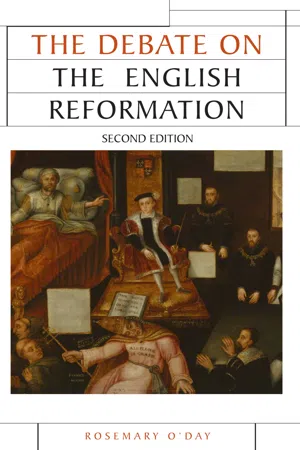
Extensively revised and updated, this new edition of The debate on the English Reformation combines a discussion of successive historical approaches to the English Reformation with a critical review of recent debates in the area, offering a major contribution to modern historiography as well as to Reformation studies. It explores the way in which successive generations have found the Reformation relevant to their own times and have in the process rediscovered, redefined and rewritten its story. It shows that not only people who called themselves historians but also politicians, ecclesiastics, journalists and campaigners argued about interpretations of the Reformation and the motivations of its principal agents. The author also shows how, in the twentieth century, the debate was influenced by the development of history as a subject and, in the twenty-first century, by state control of the academy. Undergraduates, researchers and lecturers alike will find this an invaluable and essential companion to their studies.
Information
1
Historiography contemporary to the English Reformation, 1525–70
Introduction
On the face of it, it might seem that the Reformation, of its nature, rejected history. And so in a sense it did, or at least the force of recent precedent. After all, the new religion involved a break with that recent past – denial of tradition as an authority for religious dogma, practice and doctrine; a denial of papal authority. But it is no less true that the English Reformation used history – an interpretation of the past – to justify its existence, its goals and its actions. It created its own historiography.1
In examining the way in which history was used by the reformers it is important to distinguish between the attitudes of the ‘religious’ reformers (those who saw the Reformation as the fulfilment of the Church’s need for renewal) and the ‘official’ reformers (those who saw the Reformation as serving the needs of the monarchy or, at least, the English body politic). This distinction is far from easy to make: the body politic was part of Christendom and, no matter what the perspective of the reformer, the relationship between the two was a major issue. Reformers as a group looked to the past to justify the act of reformation. Their interpretation of that past, however, varied sufficiently for us to admit that there was no single Reformation use of history. Reformers, after all, used the past to score differing debating points. The manner in which their differing interpretations informed their actions, and vice versa, is of supreme interest to the historian. In large part the task before the modern commentator is that of discovering any individual’s position with respect to the relationship between Church and state.
The reformers had been reared in a tradition of historical literature that influenced them considerably. Their understanding of the process of history governed their interpretation of what had happened in Reformation England and what was about to happen. With what sort of history were educated Tudor men and women acquainted? The influence of the Italian humanist historians – Valla and Biondo – was certainly felt. There was some awareness of historical change, of the importance of the historical context in which events occurred. However, the emphasis upon biography found in Bruni and Polydore Vergil had a far more telling impact. English thinkers, whatever their position on relations between Church and state, saw historical developments as the result of dynastic and personal activity. The prince was his people. Edward Hall’s The Union of the Two Noble and Illustre Famelies of Lancastre and York (1548) is a good example of native writing that assumed that dynamic monarchs caused change. Shakespeare’s history plays and his tragedies also provide good examples of this approach. The inclination of contemporaries to dramatize their history – to put it on the stage – accentuated this tendency to display characters as more acting than acted upon. Contemporary literature also illustrates the nationalistic framework of English historical writing of the late fifteenth and sixteenth centuries.
Reformation writers were concerned to use history in support of their own cause. They, too, adopted a nationalistic and, often, a biographical approach. The obsession of lay historians with fifteenth-century history was transferred to a religious context. Monarchs, religious teachers and individuals of learning and pious life were portrayed as the moving forces of the English Reformation. The social, economic and geographic underpinnings went unrecognized.
Above all, the reformers urged that theirs was the historically accurate Christianity. William Tyndale (c. 1494–1536), pupil of John Colet, stood in the tradition of humanist textual criticism exemplified by Lorenzo Valla, Desiderius Erasmus and Martin Luther. Tyndale’s New Testament aimed to display a pure original text without accretions. In 1523 he spoke of his motivations:
I perceived . . . how that it was impossible to establish the laypeople in any truth except the scripture were plainly laid before their eyes in their mother tongue, that they might see the process, order, and meaning of the text. For else, whatsoever truth is taught them, these enemies of all truth quench it again, partly with the smoke of their bottomless pit, that is, with apparent reasons of sophistry and traditions of their own making, founded without ground of scripture; and partly in juggling with the text, expounding it in such sense as is impossible to gather of the text, if thou see the process, order and meaning thereof . . . This thing only moved me to translate the new testament.2
Other Protestants shared his conviction that the Scriptures contained the key to the primitive church. Tyndale translated the Scriptures; some selected other means to prove the historical pedigree of reformed Christianity. The anonymous author of the preface to the Gospels in Anglo-Saxon urged: ‘The Religoon presently taught and professed in the Church at thys present, is no new reformation of thinges laterly begonne, which were not before but rather a reduction of the Church to the pristine state of olde conformitie’.3 Humanist scholarship, with its rigorous emphasis upon precise translation, became the handmaiden of early English Protestant argument.
In this chapter we shall examine the most important Protestant interpretations of the Reformation and its history penned in the sixteenth century, culminating in the works of John Foxe. Such an exercise is important not simply because the interpretations offered are intrinsically interesting, nor even because we should be aware of contemporaries’ views of the Reformation as revelatory of their historical sense, but also because the Protestant view of the Reformation produced during its birth and infancy provided, in large measure, the parameters of the debate about the English Reformation from that day to this.
Exiled reformers in the reign of Henry VIII
Between 1525 and 1535 a number of English reformers were living in exile in Europe, unwelcome in Henrician England. Some of their works espoused a rather simple view of history. The writers – Simon Fish, Jerome Barlow and William Roye – took over, lock, stock and barrel, the teaching of the English Lollards and, with it, their view of the iniquities of the fifteenth-century Church. This was more than late Lollard propaganda. It was an attempt, and a successful one, to give the English Reformation a history – and a national one at that. Their interpretation of the past was Wycliffite: the wealth and power of the Church on earth was but recently acquired and a fundamental denial of the essence of the primitive church, which had set no store on pomp and had maintained simple and pure doctrines based upon scripture alone. Wyclif had called for a return to the ways of the young, pristine and primitive church. Later Lollard congregations had continued this plea. The early Protestants made this argument part of the English Reformation tradition. This history was later presented to the nation by John Foxe in a more detailed form but it was there, in essence, in the writings of Frith, Roye, Barlow and, above all, Tyndale.
The Antwerp writers believed that there had once existed a golden age which had been subverted by the clergy. They added little, if anything, to the complaints of the Lollards against the clerical estate. Their view of the ‘golden age’ of England was no more subtle than their explanation of how it had been brought down:
First when England was in his floures
ordered by the temporal governoures
knowenge no spiritual iurisdiction
Then was ther in eche state and degree
Haboundance and plentuous prosperitie
Peaceable welthe without affliction.
Noblenes of blood was had in price
Vertuousnes avaunced, hated was vyce,
Princes obeyed with due reverence.4
ordered by the temporal governoures
knowenge no spiritual iurisdiction
Then was ther in eche state and degree
Haboundance and plentuous prosperitie
Peaceable welthe without affliction.
Noblenes of blood was had in price
Vertuousnes avaunced, hated was vyce,
Princes obeyed with due reverence.4
All this had been destroyed when the Crown of England fell under clerical influence. William Tyndale (1494–1536), in his Obedience of a Christian Man (1528), outlines the simple but long-drawn-out contest between the clergy and the Crown. King John, for example, is shown in dispute with the papal legate; Henry V is portrayed not as a national hero but as a monarch under the thumb of the clergy, who spilt English blood in France to preserve clerical liberties. The Church that held England’s kings in thrall was, moreover, heretical; it kept the Scriptures from the people in an effort to exalt itself.
So these early Antwerp Protestants cast the English monarch as the dupe of the clergy and, potentially, as the saviour of the Church. In A Supplicacyon for the Beggars (1529) Simon Fish described the excesses of the clergy and showed them to be seditious. He prescribed a political remedy – a medicine to be administered by the Crown. In his chapter on Antichrist, William Tyndale made a similar appeal to Christian kings to save the Church from the clergy. By this time, however, Tyndale was aware that kings might not view the Reformation in the same light – Henry VIII had refused to provide the people with the vernacular Scriptures. Tyndale sighed: reform would be possible ‘if they [kings] were Christians, which is seldom seen, and is a hard thing verily, though not impossible’.5
William Tyndale was, in fact, coming to appreciate that the Lollard interpretation of recent religious catastrophe as a result of clerical conflict with and triumph over English monarchs was a gross and unfortunate oversimplification. Here he owed much of his sophistication and awareness to his readings of Luther and Erasmus. Tyndale’s The Practyse of Prelates of 1530 drew upon Erasmus’s Julius Exclusus for its view of the Pope deliberately playing off princes one against the other. Kings were often not in opposition to the clergy – more often than not they were the willing dupes of the popes and the bishops. When Tyndale edited the Examinacion of the Lollard John Oldcastle, he cast Henry IV as the villain of the trial, acting with Antichrist (the clergy) against Christ’s true disciples (the Lollard knights). The translator’s interpretation of what happened as a result of this oppression was more simplistic. The activities of Antichrist were repaid by the active vengeance of God – civil wars, social disorder, plague. Jonah’s dire warnings applied to England in 1531 as much as they did to ancient Israel.6
William Tyndale set the whole of the Henrician ‘official’ Reformation against this scenario of a king duped by and acting with the clergy to oppress the followers of Christ. The reformers were sceptical of Henry’s intent when he did act to ‘reform’ the Church. If Henry oppressed the adherents of the new religion, the sword of God would in consequence be turned against him and his government. The patterns of history repeated themselves. Henry – the oppressor – could not escape the wrath of God. For Tyndale the study of history had demonstrated that kings could not reform the Church. Instead the church’s hopes for renewal lay with individual Christians and their determination to divert her paths back to those of righteousness. In Tyndale we have an early example of the reluctance of Protestant historians to accept the ‘official’ reformation instigated by Henry VIII and his successors as a reformation at all. For Tyndale, the blood of the martyrs was indeed the seed of the Church. Without it, no reformation flowers would bloom.
For Tyndale, in exile, to declare the true reformation to be one from below was simple, to deny the validity of Henry’s official reformation merely bold. For those reformers who remained in England, and especially for those in Henry’s service, the expression of such sentiments would have been nothing short of foolhardy. The issue of authority in the religious reformation presented a thorny problem for reformers in England from the Reformation Parliament onwards. The struggle to reconcile the duty of obedience towards the monarch with that towards God was the central concern of many.
When thrust out of the state, religious writers were released – albeit temporarily – from the predicament. In a position of opposition to the state, Tyndale was able to shake off the chains of royal policy and interpret the origins and development of the English Reformation as he saw them – although at his peril. For Robert Barnes, taken into the King’s service in 1531, the predicament was more pressing. How did he resolve it? The essence of Barnes’s argument was the traditional view that the temporal and spiritual powers had entirely separate jurisdictions. In the past, the clergy had constantly overstepped their rightful jurisdiction. Barnes’s Supplication unto the most gracyous prynce Henry VIII in 1534 protested that the clergy, by violating this distinction and meddling in temporal matters, had always constituted a subversive element. He then demonstrated in Vitae Romanorum Pontificum (1536) that the very decline of the Church of Rome was owing in large part to the papacy’s usurpation of temporal powers. But did this mean that a monarch could or should rule the Church? Not at all. The king’s jurisdiction was also strictly limited. He might defend the faith – by banishing the clerical estate to its own sphere. The form of religion, on ...
Table of contents
- Cover
- Half Title Page
- Title Page
- Copyright Page
- Contents
- Preface
- General editor’s foreword
- Abbreviations
- Introduction
- 1 Historiography contemporary to the English Reformation, 1525–70
- 2 Interpretations of the Reformation from Fuller to Strype
- 3 Historians and contemporary politics, 1780–1850
- 4 The Church of England in crisis: the Reformation heritage
- 5 The Tudor revolution in religion: the twentieth-century debate
- 6 The Reformation and the people: discovery
- 7 The Church: how it changed
- 8 The debate in the age of peer review
- 9 The place of the Reformation in modern biography, fiction and the media
- Conclusion: Reformation: reformulation, reiteration and reflection
- Further reading
- Index
Trusted by 375,005 students
Access to over 1.5 million titles for a fair monthly price.
Study more efficiently using our study tools.
Frequently asked questions
Yes, you can cancel anytime from the Subscription tab in your account settings on the Perlego website. Your subscription will stay active until the end of your current billing period. Learn how to cancel your subscription
No, books cannot be downloaded as external files, such as PDFs, for use outside of Perlego. However, you can download books within the Perlego app for offline reading on mobile or tablet. Learn how to download books offline
Perlego offers two plans: Essential and Complete
- Essential is ideal for learners and professionals who enjoy exploring a wide range of subjects. Access the Essential Library with 800,000+ trusted titles and best-sellers across business, personal growth, and the humanities. Includes unlimited reading time and Standard Read Aloud voice.
- Complete: Perfect for advanced learners and researchers needing full, unrestricted access. Unlock 1.5M+ books across hundreds of subjects, including academic and specialized titles. The Complete Plan also includes advanced features like Premium Read Aloud and Research Assistant.
We are an online textbook subscription service, where you can get access to an entire online library for less than the price of a single book per month. With over 1.5 million books across 990+ topics, we’ve got you covered! Learn about our mission
Look out for the read-aloud symbol on your next book to see if you can listen to it. The read-aloud tool reads text aloud for you, highlighting the text as it is being read. You can pause it, speed it up and slow it down. Learn more about Read Aloud
Yes! You can use the Perlego app on both iOS and Android devices to read anytime, anywhere — even offline. Perfect for commutes or when you’re on the go.
Please note we cannot support devices running on iOS 13 and Android 7 or earlier. Learn more about using the app
Please note we cannot support devices running on iOS 13 and Android 7 or earlier. Learn more about using the app
Yes, you can access The Debate on the English Reformation by Rosemary O'Day,Rosemary O’Day in PDF and/or ePUB format, as well as other popular books in History & Early Modern History. We have over 1.5 million books available in our catalogue for you to explore.