Bringing together leading authorities on Irish women and migration, this book offers a significant reassessment of the place of women in the Irish diaspora. It compares Irish women across the globe over the last two centuries, setting this research in the context of recent theoretical developments in the study of diaspora. This collection demonstrates the important role played by women in the construction of Irish diasporic identities, assessing Irish women's experience in Britain, Canada, New Zealand and the United States. This book develops a conversation between other locations of the Irish diaspora and the dominant story about the USA and, in the process, emphasises the complexity and heterogeneity of Irish diasporan locations and experiences.
This interdisciplinary collection, featuring chapters by Breda Gray, Louise Ryan and Bronwen Walter, will appeal to scholars and students of the Irish diaspora and women's migration.
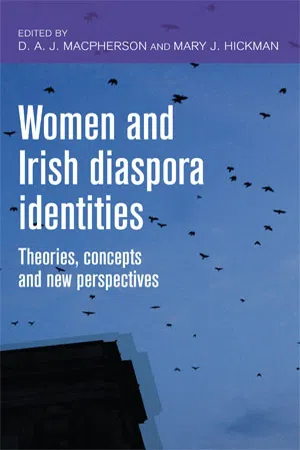
eBook - ePub
Women and Irish diaspora identities
Theories, concepts and new perspectives
- 188 pages
- English
- ePUB (mobile friendly)
- Available on iOS & Android
eBook - ePub
Women and Irish diaspora identities
Theories, concepts and new perspectives
About this book
Information
PART I
Concepts and theories
1
Irish women and the diaspora: why they matter
Mary E. Daly
Resolving to do something to better the circumstances of her family, the young Irish girl leaves her home for America. There she goes into service, or engages in some kind of feminine employment. The object she has in view – the same for which she left her home and ventured to a strange country – protects her from all danger, especially to her character: that object, her dream by day and night, is the welfare of her family, whom she is determined, if possible to again have with her as of old. From the first moment she saves every cent she earns – that is, every cent she can spare from what is absolutely necessary to her decent appearance. She regards everything she has or can make as belonging to those to whom she has unconsciously devoted the flower of her youth, and for whom she is willing to sacrifice her woman’s dearest hopes. To keep her place, or retain her employment, what will she not endure? Sneers at her nationality, mockery of her peculiarities, even ridicule of her faith.1
The poor Irish emigrant girl may possibly be rude, undisciplined, awkward – just arrived in a strange land, with all the rugged simplicity of her peasant’s training: but she is good and honest. Nor, as she rapidly acquires the refinement inseparable from an improved condition of life, and daily association with people of cultivated manners, does she catch the contagion of the vices of the great centres of wealth and luxury. Whatever her position – and it is principally among the humble walks of life the mass of the Irish are still to be found – she maintains this one noble characteristic – purity. In domestic service her merit is fully recognised.2
Women have featured, albeit intermittently, in writings about Irish emigration long before historians – inspired by second-wave feminism – began to focus their scholarly efforts in that direction. However in the past Irish women emigrants were commonly found in the records of poorhouses, charities, or in censorious accounts depicting poverty or a lifestyle deemed unacceptable to the norms of respectable womanhood, bare-breasted, drunken, brawling, slatternly women. John Francis Maguire’s account, written in 1868, can be seen as an attempt to provide a more positive alternative version. Maguire set out to examine how the Irish emigrants were faring in America, given the conflicting reports that were reaching Ireland; whether Irish-Catholic emigrants were abandoning religious practice, and how the Irish in America regarded the British government. Like many of his successors, he was concerned about the moral and physical dangers associated with city life, especially for young women, and with the consequences of a predominantly Catholic peasantry migrating to a country where Catholicism was a minority religion. Maguire wrote of the moral dangers that emigration presented for Irish women – both on the long sea passage, and when they reached America. He recounted how ‘a young and handsome Irish girl who was lately trapped into hiring, in a Western city, with a person of infamous character’, was rescued by an older, wiser Irish woman and taken to a refuge run by the Sisters of Mercy.3 Despite trumpeting the virtue of Irish women – one bishop described them as the ‘salt of the earth’ – he conceded that ‘in some, yet comparatively few, places in America a certain percentage of women of bad repute are necessarily of Irish origin’.4 However as further proof of their virtue and their contribution to the Catholic Church he wrote at length about the role of Irish religious sisters in founding and running Catholic hospitals, providing expert nursing care – including the care of soldiers during the civil war – and their involvement in Catholic schools and orphanages.
By the mid-twentieth century the locus of most descriptions of Irish emigrants had moved from North America to Britain: Britain was the principal destination for Irish emigrants from the 1880s, and with the introduction of restrictions on US immigration in the 1920s and the onset of the great depression in 1929, emigration to the USA fell sharply. Yet until the 1960s the profile of Irish women emigrating to Britain was not dramatically different to that of Irish emigrant women in the United States almost a century earlier: they continued to be concentrated in domestic service and hotel work (also mentioned by Maguire), though a growing number were migrating in order to train and work as nurses. In the mid-twentieth century Irish parents continued to dispatch daughters in their mid-teens to a foreign country in the expectation that their remittances would help support the family back home, and church and state continued to express fears at the moral dangers facing young Irish women living and working in alien cities. Maguire’s ‘person of infamous character’ was now succeeded by the unmarried Englishman who lured an unsuspecting Irish girl into a job as a children’s nurse, in a home that turned out to lack both wife and child.5 Whereas Maguire wrote of the need for congressional legislation to protect female passengers from sexual advances during the transatlantic crossing,6 Irish clergy were demanding that the Irish government should ban the emigration of young women under sixteen years of age.7
By the middle of the twentieth century, however, there was growing criticism within Ireland directed at the numbers of young single women who were emigrating and their motives for leaving. Insofar as emigrants had been criticised within Ireland in earlier times, the criticism did not specify gender, or it was directed towards men. By the mid-twentieth century however, while the ‘angels’ described at length by Maguire hadn’t entirely disappeared, the category was increasingly reserved for Irish nurses or religious sisters. Politicians, senior officials and clergy regularly expressed concern about the moral dangers to female emigrants, and many of these statements showed little confidence that these young women had the capacity to withstand these temptations.8 Part of this growing concern reflects a greater awareness of some of the more distressing aspects of emigration: English Catholic charities made Irish politicians and the Irish Catholic hierarchy fully aware of the numbers of single Irish women who travelled to England to give birth in search of anonymity, and these charities also made the Irish authorities fully aware of the costs of caring for these women and their infants.9 Another source of concern was the sharp fall in the numbers of women in rural Ireland: in 1951 there were 868 women per 1000 men, and the ‘flight of the girls’ was often blamed for the low rate of marriage.10 The gratitude that Maguire had expressed for the personal sacrifice made by many female emigrants was increasingly replaced by critical comments as to their motives. There was a growing opinion that Irish female emigrants were leaving for personal fulfilment, career ambitions or perhaps marriage. The Commission on Emigration summarised the position as follows:
Although female emigration, like male, is the result of a variety of causes, the purely economic cause is not always so dominant. For the female emigrant improvement in personal status is of no less importance than the higher wages and better conditions of employment abroad and some of the evidence submitted to us would suggest that the prospect of better marriage opportunities is also an influence of some significance. Large numbers of girls emigrate to domestic service in Great Britain because they consider that the wages, conditions of work and also the status of domestic service in this country are unsatisfactory. Many others emigrate because of the opportunities of obtaining factory or office work are better than here, and in the nursing profession numbers leave the country because the remuneration, facilities for training, pension schemes and hours of work in this country are considered to be unattractive.
This rather academic summary does not reflect the much more forthright views expressed by some members of the Commission during the course of collecting evidence. When members were taking oral evidence from the Irish Housewife’s Association, statistician Roy Geary interjected ‘it is probably true that large numbers of men are forced through unemployment and poverty to emigrate. In the case of women, emigration is largely just the result of a desire for change’. When Stanley Lyon, another statistician and member of the Commission, visited a dancehall in England frequented by many Irish emigrants, he was horrified to see that many men and some women were under the influence of drink; he described the women as coming from ‘very low stratums of life’, ‘mostly from the west’. At another point during his visit to England he noted that the men were ‘all of good type’, the girls of ‘much lower class’. This stereotyping was not unique to Irishmen: an official of the British Ministry of Labour in Lancashire reported that ‘while Irish men gave little trouble, girls were either very good or very bad; there was no middle way’.11 The impressionistic evidence given above, which straddles two centuries and both sides of the Atlantic, shows that descriptions of Irish female emigrants are replete with gender, religious and racial discourse, and furthermore that women’s emigration is viewed somewhat differently to emigration by men. So, one key question that must be addressed is what were/are the differences? And, second, what does this tell us about Irish women’s lives, Irish diasporas and perceptions of Irish womanhood?
Emigration is one of the central and enduring realities of modern Ireland. The origins of modern mass emigration can be traced to the early eighteenth century; Ireland, unique among modern nations underwent approximately one century of sustained population decline, which was caused by emigration. In 1881 40 per cent of those born in Ireland were living outside the country; in 1911 the proportion was 33 per cent.12 Women have accounted for up to half of Irish emigrants since the mid nineteenth century, and they have formed a significant cohort of emigrants irrespective of destination.13 Donald Akenson has used the term, ‘The great unknown’ for the title of a chapter on Irish female emigration, where he identified six distinct categories of female emigrants, each reflecting specific strategies of emigration and different stages in a female lifecycle: widows with dependent children; married women emigrating with husband and children; married women with a spouse but no children; young dependent single women emigrating with one or more family members; single adult women of marriageable age; and older single women.14 Whereas Jewish women – the only other ethnic community with roughly equal numbers of men and women emigrating during the late nineteenth century – generally travelled as part of a family group – as wives, daughters or sisters, and many of them as dependent children15 – by the 1870s Akenson notes that the majority of Irish female emigrants could be classified as single adult women of marriageable age, generally travelling alone. Between 1855 and 1914 the proportion of emigrants to North America aged 15–24 ranged from one-third to 44 per cent and girls tended to emigrate at a somewhat earlier age than boys.16 It is arguably this long-established pattern of Irish single women emigrating and commonly leaving their family behind that gives unique significance and colour to their history, and it also opens up considerable scope for analysis of their motivation and the moral hazards which they might face.Yet despite much recent historical research, many aspects of women and the diaspora continue to justify Akenson’s description of ‘the great unknown’; most specifically the difficulties in tracking second and subsequent generations of Irish women (and indeed men) in Britain, especially the descendants of those who emigrated prior to 1914. This chapter does not claim to make known the unknown; neither does it profess to provide a comprehensive overview of Irish women and the diaspora. Drawing on extant research into Irish f...
Table of contents
- Cover
- Half Title Page
- Title Page
- Copyright
- Contents
- Figures and tables
- Abbreviations
- Notes on contributors
- Introduction: Irish diaspora studies and women: theories, concepts and new perspectives
- Part I: Concepts and theories
- Part II: Irish women and the diaspora in Britain
- Part III: Irish women and the diaspora in the British world
- Index
Trusted by 375,005 students
Access to over 1.5 million titles for a fair monthly price.
Study more efficiently using our study tools.
Frequently asked questions
Yes, you can cancel anytime from the Subscription tab in your account settings on the Perlego website. Your subscription will stay active until the end of your current billing period. Learn how to cancel your subscription
No, books cannot be downloaded as external files, such as PDFs, for use outside of Perlego. However, you can download books within the Perlego app for offline reading on mobile or tablet. Learn how to download books offline
Perlego offers two plans: Essential and Complete
- Essential is ideal for learners and professionals who enjoy exploring a wide range of subjects. Access the Essential Library with 800,000+ trusted titles and best-sellers across business, personal growth, and the humanities. Includes unlimited reading time and Standard Read Aloud voice.
- Complete: Perfect for advanced learners and researchers needing full, unrestricted access. Unlock 1.5M+ books across hundreds of subjects, including academic and specialized titles. The Complete Plan also includes advanced features like Premium Read Aloud and Research Assistant.
We are an online textbook subscription service, where you can get access to an entire online library for less than the price of a single book per month. With over 1.5 million books across 990+ topics, we’ve got you covered! Learn about our mission
Look out for the read-aloud symbol on your next book to see if you can listen to it. The read-aloud tool reads text aloud for you, highlighting the text as it is being read. You can pause it, speed it up and slow it down. Learn more about Read Aloud
Yes! You can use the Perlego app on both iOS and Android devices to read anytime, anywhere — even offline. Perfect for commutes or when you’re on the go.
Please note we cannot support devices running on iOS 13 and Android 7 or earlier. Learn more about using the app
Please note we cannot support devices running on iOS 13 and Android 7 or earlier. Learn more about using the app
Yes, you can access Women and Irish diaspora identities by D.A.J Macpherson,Mary J. Hickman, D. A. J. MacPherson,Mary Hickman in PDF and/or ePUB format, as well as other popular books in Social Sciences & Social Policy. We have over 1.5 million books available in our catalogue for you to explore.