- 250 pages
- English
- ePUB (mobile friendly)
- Available on iOS & Android
eBook - ePub
About this book
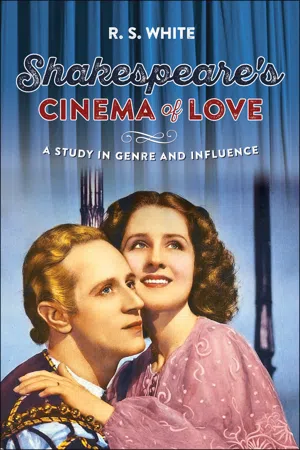
This engaging and stimulating book argues that Shakespeare's plays significantly influenced movie genres in the twentieth century, particularly in films concerning love in the classic Hollywood period. Shakespeare's 'green world' has a close functional equivalent in 'tinseltown' and on 'the silver screen', as well as in hybrid genres in Bollywood cinema. Meanwhile, Romeo and Juliet continues to be an enduring source for romantic tragedy on screen. The nature of generic indebtedness has not gained recognition because it is elusive and not always easy to recognise. The book traces generic links between Shakespeare's comedies of love and screen genres such as romantic comedy, 'screwball' comedy and musicals, as well as clarifying the use of common conventions defining the genres, such as mistaken identity, 'errors', disguise and 'shrew-taming'. Speculative, challenging and entertaining, the book will appeal to those interested in Shakespeare, movies and the representation of love in narratives.
Information
Publisher
Manchester University PressYear
2016Print ISBN
9781526143624
9780719099748
eBook ISBN
9781526107817
Subtopic
Shakespeare Drama 1
‘Madly mated’: The Taming of the Shrew and odd-couple comedy
There are enough movie versions of The Taming of the Shrew to show that its plot played a vigorous role in film history from the early days, and therefore it is not debatable as a Shakespearean contribution to cinema genres. One way or another, in immediately recognisable versions or forcibly adapted, in English or another language, The Taming of the Shrew has in its own right been filmed anew in virtually every year of the medium’s history.1 This is actually quite odd, since it is one play that appears to be unredeemably Elizabethan, its reliance on patriarchy and domestic violence apparently beyond the pale even to earlier decades in the twentieth century. It seems to come from an earlier, less enlightened tradition than the kind of romantic comedy perfected by Shakespeare under Elizabeth I in the 1590s. As Diana E. Henderson writes, ‘Of all Shakespeare’s comedies, The Taming of the Shrew most overtly reinforces the social hierarchies of its day’, having ‘an anachronistic plot premised on the sale of women’ that would seem to disqualify it from modern consumption.2 And yet the play has been constantly played on the stage and filmed, for different social purposes, which even include revealing progressive possibilities. At times it is used to reinforce sexist views, while at others the film versions have sought to present the conflict between Petruccio and Katherina as a battle of the sexes with no winner, and occasionally they even turn it into a feminist statement of equality.3 Films always reflect the concerns of the decade and culture in which they are made, and Shrew revivals can, for example, focus on issues of domesticity when this becomes a national priority (as in the 1950s), or on the more unruly and subversive nature of ‘gender wars’ in libertarian generations. In her chapter, Henderson summarises the cultural agendas that lie behind particular versions, and we shall see some of them at work in this chapter.
Right from the silent days, Shakespeare’s play with its own name has been filmed: in 1908, 1923, 1929, 1966 (restored version of the 1929 one), 1967, and 1999. Non-English versions have appeared in Italy (1908, 1913, 1942, 1980, 2004 in animation), France (1911), Germany (1919/20, 1930, 1943, 1955, 1962), India (1932, 1955), Hungary (1943), Mexico (1946, 1947, 1949, 1953), Spain (1955), Russia (1960), and no doubt many others, while the United States has kept pace with Britain for the play in English. The number of television versions (1939, 1956, 1973, 1975, 1976, 1980, 1983, 1988, 1993, 2003 (as The Shrew in the Park)) reflects the underlying closeness of Shakespeare’s plot to television family ‘sitcoms’, where husbands and wives are conventionally expected to fight each other as much as they make up. A single adaptation could have a significant afterlife. Cole Porter’s musical Kiss Me, Kate first played on Broadway in 1948 and ran in different theatres for over 1,000 performances from the 1970s until the twenty-first century. The original 1948 Broadway stage version was filmed in 1953 and later in television adaptations. Picking up the pun used in a nineteenth-century stage performance by J. A. Sterry, Katherine and Petruccio, or The Shaming of the True, various twists on the acknowledged plot reveal themselves in titles such as The Cowboy and the Shrew (1911), where the woman is presumably likened to a horse to be lassoed into submission, The Framing of the Shrew (1929, with a black cast), and He Flew the Shrew (1951). Several other Westerns based on Shakespeare’s play have recently been traced and closely analysed by Elinor Parsons, alongside other ‘reframings’.4 10 Things I Hate About You appeared in 1999 and was rapidly parodied in 2001 as Not Another Teen Movie, whose working title in the United States was Ten Things I Hate About Clueless Road Trips When I Can’t Hardly Wait to Be Kissed. There are other examples completely unrecognisable from their titles, such as The Iron Strain (1915) in which a spoilt heiress is kidnapped, tamed, and married by a ‘wild man’ from Alaska, and more recently Deliver Us from Eva (2003), set unpromisingly in the Los Angeles Health Department.
It does appear to be the case that at any one time, somewhere in the world, under some title or other, The Taming of the Shrew is being re-adapted. At the very least, then, it is clear that this play has been a continuing and prominent cultural presence in film history, and it begins to look less like a hypothesis and more like a certainty that, for better or worse, it has had a continuing significance for film genres. Given the extraordinary exposure in the modern world of a play that many might regard as objectionable, some feminists have claimed the play is used as blatant propaganda for misogynistic social practices. However, the fact that invariably a strong female lead is chosen, and represented as equally spirited and dominant as the male, indicates that the effect of the play is usually more complex than a straight underwriting of patriarchy, particularly since Shakespeare has painted Petruccio as far from an admirable hero but rather a bizarrely dressed and disruptive fortune-hunter. Moreover, there is an argument that, whatever Shakespeare’s intentions (and we can never truly know them), The Shrew has the potential to be performed to support married love as companionate, if mutually abrasive, since it provides in its sub-plot a parodic critique of a more conventional, decorous, but dubious courtship. Marriage itself is the event that changes Katherina into a cooperative partner but puts her sister Bianca into a questionable light as the new ‘shrew’. In this sense the play can be placed instead in a genre more generally renamed ‘the battle of the sexes’. The Internet Movie Database has enshrined a genre called ‘Shakespeare’s-Taming-of-the-Shrew genre’, just as I will later propose a ‘Shakespeare’s-Romeo-and-Juliet genre’, alongside other, more composite comic genres innovated by Shakespeare that have entered the history of film. My own choice here is ‘odd-couple comedy’.
Furthermore, as was his custom when he found a plot strand that worked, Shakespeare himself was the first to adapt it. In Much Ado About Nothing the abrasive ‘battle of the sexes’ is played out between Beatrice and Benedick alongside the more conventionally romantic yet insecure wooing of Claudio and Hero. This time, as if foreseeing that audiences might in the future object to the brutal metaphor of ‘taming’ a woman or at least training her into the role of an attack falcon for the man (4.1.174–95), Shakespeare strengthens the woman and makes her genuinely an equal to the man and an agent for emotional independence. She is a template for Congreve’s Millamant, who will negotiate to marry only on her own terms, after testing more stringently a man who is less bluff and manipulative than Petruccio. In this sense films based on Much Ado might be added as rather less ideologically fraught versions of the same genre, as can Antony and Cleopatra where the ‘shrew’ is once again depicted alongside a man who, like Benedick, is seen as less effective in his ‘taming’ than Petruccio. Although it is clear that Shakespeare, in revising the formula, strengthened the woman and weakened the man, yet his ‘repeats’ are contributions to a ‘Taming-of-the-Shrew genre’ in movies. As some feminist critics like Kathleen Rowe can argue, the formula, apparently paradoxically, can allow the opposite of the play’s misogyny and patriarchalism, and denote instead ‘the transgressive woman’ shown in ‘female resistance to masculine authority … through what might be called the topos of the unruly woman or the “woman on top”’.5 The teen movie 10 Things I Hate About You (1999) was hailed by publicists and reviewers as a remake of The Shrew but, apart from the recognisable names – Padua High School, Kat, Patrick, and Bianca – and the initial situation in which Bianca cannot ‘date’ until her apparently man-hating older sister does, in fact the way the plot unfolds is actually more comparable to Much Ado. Like Beatrice, Kat is tricked into thinking Patrick is genuinely interested in her, while Patrick, initially as antisocial as Kat and a fortune-hunter like Petruccio, comes to resemble Benedick in falling in love with Kat against his inclinations. The writers of this film may have come to Shakespeare’s conclusion, that the ‘taming’ metaphor to describe courtship and marriage is less appealing to audiences than a romantic comedy genre, where the expectations are more directed towards the creation of a loving couple and a spirit of social harmony stemming mainly from a rebellion against the senex, a repressive father. Shakespeare helps at other times in the movie, providing romantic quotations and a sub-plot involving a girl smitten with his works, and overall it is not exclusively an adaptation of The Shrew so much as an example of the time-honoured strategy of using Shakespeare to give respectability to a movie that is aimed at college students studying his plays.
No matter how popular The Taming of the Shrew is in the theatre and in movies, it has rarely been a favourite with critics. This is partly because it lacks the wit and lyrical poetry of the romantic comedies, owing more to the stereotypical characters of Italian commedia dell’arte and the broad, farcical effects of native English comedy than to the conventions of romance, but it is also due to an innate reservation many hold about the subject matter. Even before feminists raised consciousness to the extent of objecting to the brutal treatment of Katherina and the play’s apparently unquestioning endorsement of male supremacy, its basic premises of radical inequality between men and women and of the unrestrained right of a father to dispose of his daughters in arranged or coerced marriages were so immediately and powerfully negated by Shakespeare himself in other plays. His ‘strong’ romantic heroines like Portia, Beatrice, and Rosalind, by contrast, give The Shrew the air of a much older tradition. Noah’s wife, who is not in the Bible but in the morality cycle plays of Shakespeare’s boyhood, was portrayed as a shrew who did not take seriously her husband’s prediction of the devastation to be dealt to the earth in the Flood. Also more or less contemporary was the Italian commedia dell’arte ‘Punch and Judy’ (or at that time in England, Joan) in which Punch is dressed in the motley of a jester rather like Petruccio – even his name may be an echo of the original Pulcinella – and spends a lot of his time beating his wife. In Protestant England at the time when Shakespeare was writing, on the other hand, marriage based on companionship above all was historically becoming the norm.6 For all these reasons critics have been embarrassed by the play, sometimes apologetic about what they see as its distasteful sexual morality and crude comedy. But the fact remains that the play is embedded firmly in the popular repertory and in countless film adaptations, always reflecting some attitudes to equality and inequality current at the time of performance.
There are various possible explanations for the popularity. The politics of the medium of film vis-à-vis ‘legitimate theatre’ is one. Film-makers have always had an ambiguous love-hatred for Shakespeare since, on the one hand, he can stand as a conservative figure from high culture, confirming the plebeian roots of the new medium and casting doubt on its artistic legitimacy. On the other hand, adaptations into film of Shakespeare’s plays could lend the respectability of ‘classics’ in theatrical tradition to the new, popular form. Furthermore, if a play itself can be represented as still having popular appeal, then this power struggle has a different dimension again, showing Shakespearean drama as having an abiding popularity that is equal to the movies’ contemporary appeal. Paradoxically, not only can films claim serious cultural capital by invoking Shakespeare, but, equally, early practitioners could claim that Shakespeare really ‘belongs’ as comfortably in the popular medium as in the Victorian theatres with their wealthier patrons. In this rather complicated dynamic between different cultural forms, The Taming of the Shrew was particularly useful, because it adds legitimacy to the film industry while underwriting an ideology of sexual politics that has in the past generally been associated, however wrongly, with working-class rather than middle-class communities. In short, The Shrew at one stroke opens up many possibilities, making acceptable the new technology as a vehicle for a conservative ideology of marriage, or a polemical representation of relations between men and women more generally at times when issues such as equality and ‘the new woman’ were becoming openly discussed in society. As an over-simplification of a complex history of reception, one response from benighted male movie-goers might have been: ‘Look, not only is Shakespeare entertaining but he allows us to treat our wives badly.’ However, correlatively some readings redeem the play from condemnation by turning ‘Kate the curst’ into a strong, modern, and independent woman with a mind of her own, and in regarding more critically the contrasting wooing behaviour of her sister, Bianca. In this sense, films based on the ‘Shrew genre’ have been vehicles for such powerful and individual movie actresses as Carole Lombard, Irene Dunne, Jean Arthur, and Katharine Hepburn, who could hold their own with male stars of their time.
If the film history of The Taming of the Shrew exemplifies in the film industry tensions between social conservatism, populism, and egalitarian attitudes, so also does it contain its own potential contradictions as a play. Shakespeare’s mingling of different forms of source material creates three plot structures that in many ways contrast with each other – Petruccio and Kate, the Bianca sub-plot, and the trick played in the ‘Induction’ by a nobleman on the drunken pedlar Christopher Sly, who perhaps surprisingly does not reappear at the end of Shakespeare’s The Shrew. He does come back at the end of the play that may or may not have been its source published in quarto, The Taming of a Shrew, and here he claims to have been taught in a dream ho...
Table of contents
- Cover
- Half Title
- Title Page
- Copyright Page
- Contents
- Acknowledgements
- Introduction: Shakespeare shaping modern movie genres
- 1 ‘Madly mated’: The Taming of the Shrew and odd-couple comedy
- 2 Dreams in the forest: romantic comedy
- 3 ‘The guy’s only doing it for some doll’: musical comedy
- 4 Of errors and Eros: a brief digression on twins
- 5 Comedy of disguise and mistaken identity
- 6 ‘Star-crossed lovers’: Romeo and Juliet and romantic tragedy
- Conclusion
- Bibliography
- Index
Trusted by 375,005 students
Access to over 1.5 million titles for a fair monthly price.
Study more efficiently using our study tools.
Frequently asked questions
Yes, you can cancel anytime from the Subscription tab in your account settings on the Perlego website. Your subscription will stay active until the end of your current billing period. Learn how to cancel your subscription
No, books cannot be downloaded as external files, such as PDFs, for use outside of Perlego. However, you can download books within the Perlego app for offline reading on mobile or tablet. Learn how to download books offline
Perlego offers two plans: Essential and Complete
- Essential is ideal for learners and professionals who enjoy exploring a wide range of subjects. Access the Essential Library with 800,000+ trusted titles and best-sellers across business, personal growth, and the humanities. Includes unlimited reading time and Standard Read Aloud voice.
- Complete: Perfect for advanced learners and researchers needing full, unrestricted access. Unlock 1.5M+ books across hundreds of subjects, including academic and specialized titles. The Complete Plan also includes advanced features like Premium Read Aloud and Research Assistant.
We are an online textbook subscription service, where you can get access to an entire online library for less than the price of a single book per month. With over 1.5 million books across 990+ topics, we’ve got you covered! Learn about our mission
Look out for the read-aloud symbol on your next book to see if you can listen to it. The read-aloud tool reads text aloud for you, highlighting the text as it is being read. You can pause it, speed it up and slow it down. Learn more about Read Aloud
Yes! You can use the Perlego app on both iOS and Android devices to read anytime, anywhere — even offline. Perfect for commutes or when you’re on the go.
Please note we cannot support devices running on iOS 13 and Android 7 or earlier. Learn more about using the app
Please note we cannot support devices running on iOS 13 and Android 7 or earlier. Learn more about using the app
Yes, you can access Shakespeare's cinema of love by R.S. White,R. S. White in PDF and/or ePUB format, as well as other popular books in Media & Performing Arts & Shakespeare Drama. We have over 1.5 million books available in our catalogue for you to explore.