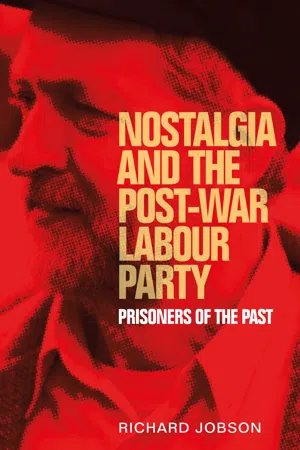
This book examines the impact that nostalgia has had on the Labour Party's political development since 1951. In contrast to existing studies that have emphasised the role played by modernity, it argues that nostalgia has defined Labour's identity and determined the party's trajectory over time. Jobson outlines how Labour, at both an elite and a grassroots level, has been and remains heavily influenced by a nostalgic commitment to an era of heroic male industrial working-class struggle.
This commitment has hindered policy discussion, determined the form that the modernisation process has taken and shaped internal conflict and cohesion. More broadly, Labour's emotional attachment to the past has made it difficult for the party to adjust to the socioeconomic changes that have taken place in Britain. In short, nostalgia has frequently left the party out of touch with the modern world. In this way, this study offers an assessment of Labour's failures to adapt to the changing nature and demands of post-war Britain and will be of interest to both students and academics working in the field of British political history and to those with a more general interest in Labour's history and politics.
- 208 pages
- English
- ePUB (mobile friendly)
- Available on iOS & Android
eBook - ePub
About this book
Information
Publisher
Manchester University PressYear
2018Print ISBN
9781526113313
9781526113306
eBook ISBN
9781526113337
1
Revisionism and the battle over Clause IV, 1951–63
Within the party, the 1950s were characterised by conflict between Labour’s fundamentalist and revisionist wings. Labour’s fundamentalists were led by the charismatic and oratorically brilliant, but politically volatile, figure of Aneurin Bevan. Throughout his political career, Bevan argued that public ownership remained integral to the implementation of socialism.1 Hugh Gaitskell, who became Labour leader in 1955, was the political figurehead of Labour’s revisionists.2 As Stephen Haseler has detailed, the party’s revisionists stated that British capitalism had changed in fundamental ways since the 1920s and 1930s.3 They argued that such changes meant that the implementation of widespread public ownership was no longer a necessary prerequisite to the obtainment of socialist goals.4
On 8 October 1959, Labour suffered its third successive defeat at a General Election. In the aftermath of this defeat, Hugh Gaitskell declared that the party needed to revise Clause IV of its 1918 constitution. Clause IV committed Labour to securing ‘the workers by hand or by brain the full fruits of their industry, and the most equitable distribution thereof that may be possible, upon the basis of the common ownership of the means of production and the best obtainable system of popular administration and control of each industry or service.’5
Historians have noted the emotional nature of the party’s response to the proposed revision of Clause IV.6 It has been suggested that, within the party, Clause IV represented something akin to an irrational ‘myth’.7 There has also been a sense that Labour’s attachment to the past shaped the dispute’s outcome. Lawrence Black has declared that ‘The ghosts of the past were an everyday presence’ for Labour in the 1950s and that ‘This was never more evident than during Gaitskell’s attempts to annul Clause IV.’8 Yet, in general, there has been a tendency to see the battle over the party’s commitment to public ownership as ideological.9 In contrast, this chapter explores the role played by nostalgia in the revisionist versus fundamentalist debates of the 1950s and, more specifically, during the 1959–60 battle over Clause IV.10
The fundamentalist appeal
Aneurin Bevan’s book In Place of Fear was published in 1952. In this text, Bevan stated that socialism could not be achieved without public ownership.11 He stressed the role that state intervention had played previously in the development of the British economy.12 The vision of the present that Bevan outlined was acutely informed by the past. In order to support his analysis, he described how Britain’s industrial workers ‘had a long tradition of class action behind us stretching back to the Chartists’.13 He also mobilised memories of the heroic struggles that had taken place at Peterloo in 1819, Tolpuddle in 1834 and during the 1926 Miners’ Strike.14 In this manner, he justified his beliefs through an overtly nostalgic discourse.
More broadly, Bevan emphasised the similarities between British society in the late nineteenth and early twentieth centuries and in the early 1950s.15 There was little acknowledgement of the social and economic changes that were taking place in Britain. Instead, in terms of the substantive examples that he used to develop his arguments, Bevan deployed memories of a time when ‘Idle looms, deserted pits and silent steelworks mocked at the claims of capitalist economics.’16 Journalists seized upon this historical orientation. The Economist described Bevan as ‘the [Labour] party’s emotional conservative … He insists that the world is pretty much as he always thought it was’ and suggested that his ideas ‘reflect the common experience on which the growth of the Labour movement was based.’17 The Times argued that Bevan’s ‘autobiographical passages are, however, even less revealing than the political language which Mr. Bevan uses. It is out-of-date language.’18
Yet Bevan’s ideas were popular amongst Labour’s rank-and-file. As the Manchester Guardian noted in 1955, Bevanism was ‘a throw-back to the Socialist Fundamentalism of forty years ago’ and its ‘attraction to the constituency Labour parties (who put pressure on their MPs) lies in its beautiful sentimental vagueness’.19 Bevan’s frequent references to ‘the philosophies that the pioneers of this Movement laid down’ resonated with party members.20 Indeed, when presenting the case for public ownership, members on the Left of the party often echoed his language and they made statements like ‘The pioneers of our Movement, led by Keir Hardie, had no doubts as to what means should be used to achieve that end. The means were the nationalisation of the basic industries and on that policy the Party was built.’21 Furthermore, there was often an explicitly restorative dimension to this nostalgia. Writing in the Fabian Society’s journal in 1952, Barbara Castle, a leading Bevanite and future Cabinet Minister, declared that ‘Labour must turn the clock back.’22
The rise of revisionism
Contributing to New Fabian Essays in 1952, Anthony Crosland outlined many of the ideas that would become associated with revisionism. He argued that capitalism had been fundamentally altered by ‘statism’ and that the relationship between capitalism and the means of production had changed. He believed that the collapse of capitalism, as envisaged by Marxists, would not take place.23 Moreover, Crosland stated that ‘it is now clear that capitalism is undergoing a metamorphosis into a quite different system, and that this is rendering academic most of the traditional socialist analysis’ and he declared that Labour’s political thought was in danger of becoming outdated.24 Specifically, he suggested that the effects of public ownership ‘in an economy already ruled by government controls and high taxation, are not enormous, and although the long-run case for it remains extremely strong it cannot … be the main line of advance.’25
Crosland described how living standards had risen amongst the working class in a way that had not been envisaged by socialists in the early to mid-twentieth century.26 He argued that British society had become less defined by the class divisions that had characterised the 1920s and 1930s and he highlighted the importance of the ‘rise of the technical and professional middle class’.27 Above all, he emphasised the need for Labour to move on from its past: ‘Most of the unbearable social tensions which have afflicted capitalism will have disappeared; there will be no repetition of Jarrow and Ebbw Vale, dole queues and hunger-marches, to inspire violent feelings and actions in the working class, whose relative gains are, indeed, significantly large.’28
In this way, Crosland’s analysis represented a rejection of the contemporary applicability of the memories of male traditional industrial working-class struggle that were central to Bevan’s analysis. He challenged the idea that these struggles would be recreated in the future: ‘There will be no revival of the angry dynamic of revolt against the obvious miseries and injustices of capitalism. The temper of the people will be more contented and therefore more conservative.’29 This rejection of the past was significant. The Times proclaimed that there were now revisionists within Labour who ‘recognize in their own writings, they cannot expect – pace Mr. Bevan – to find the authority for these principles in past Socialist thought or, still less, in past Labour deeds’.30
Crosland’s ideas were by no means unique. Written by Allan Flanders and...
Table of contents
- Cover
- Half-Title
- Title
- Copyright
- Contents
- Acknowledgements
- Introduction
- 1 Revisionism and the battle over Clause IV, 1951–63
- 2 ‘White heat’ and the Labour Party, 1963–70
- 3 Labour’s Alternative Economic Strategy, 1970–83
- 4 Reinventing the Labour Party, 1983–92
- 5 The New Labour era, 1992–2010
- 6 Back to the past? Labour’s return to opposition, 2010 to the present
- Conclusion
- Select bibliography
- Index
Trusted by 375,005 students
Access to over 1.5 million titles for a fair monthly price.
Study more efficiently using our study tools.
Frequently asked questions
Yes, you can cancel anytime from the Subscription tab in your account settings on the Perlego website. Your subscription will stay active until the end of your current billing period. Learn how to cancel your subscription
No, books cannot be downloaded as external files, such as PDFs, for use outside of Perlego. However, you can download books within the Perlego app for offline reading on mobile or tablet. Learn how to download books offline
Perlego offers two plans: Essential and Complete
- Essential is ideal for learners and professionals who enjoy exploring a wide range of subjects. Access the Essential Library with 800,000+ trusted titles and best-sellers across business, personal growth, and the humanities. Includes unlimited reading time and Standard Read Aloud voice.
- Complete: Perfect for advanced learners and researchers needing full, unrestricted access. Unlock 1.5M+ books across hundreds of subjects, including academic and specialized titles. The Complete Plan also includes advanced features like Premium Read Aloud and Research Assistant.
We are an online textbook subscription service, where you can get access to an entire online library for less than the price of a single book per month. With over 1.5 million books across 990+ topics, we’ve got you covered! Learn about our mission
Look out for the read-aloud symbol on your next book to see if you can listen to it. The read-aloud tool reads text aloud for you, highlighting the text as it is being read. You can pause it, speed it up and slow it down. Learn more about Read Aloud
Yes! You can use the Perlego app on both iOS and Android devices to read anytime, anywhere — even offline. Perfect for commutes or when you’re on the go.
Please note we cannot support devices running on iOS 13 and Android 7 or earlier. Learn more about using the app
Please note we cannot support devices running on iOS 13 and Android 7 or earlier. Learn more about using the app
Yes, you can access Nostalgia and the post-war Labour Party by Richard Jobson in PDF and/or ePUB format, as well as other popular books in Politics & International Relations & Modern British History. We have over 1.5 million books available in our catalogue for you to explore.