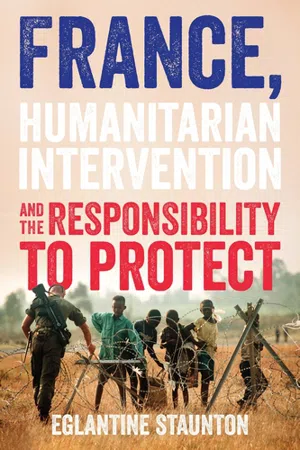
Since the end of the Cold War, the protection of human life has been a key priority of the international community. Though France has been at the forefront of these humanitarian efforts – steering debates at the United Nations and standing in opposition to wars and conflicts worldwide – its role has been overlooked and its international role in and long-standing commitment to human protection underestimated. Eglantine Staunton offers a compelling corrective to the prevailing assumptions about France's foreign policy, examining its relationship to the dominant international principles established by the humanitarian intervention of the 1990s and the UN's Responsibility to Protect doctrine in 2005.
Combining case studies of the interventions in Kosovo, Rwanda and Iraq, among others, and interviews with key actors including Gareth Evans and Bernard Kouchner, Staunton's innovative theoretical framework offers a valuable tool for understanding the interplay between domestic and international norms.
- 206 pages
- English
- ePUB (mobile friendly)
- Available on iOS & Android
eBook - ePub
France, humanitarian intervention and the responsibility to protect
About this book
Information
Publisher
Manchester University PressYear
2020Print ISBN
9781526167026
9781526142405
eBook ISBN
9781526142429
1
Theorising the tale of two norms
As explained in the Introduction, investigating France's relationship to human protection over time requires analysing a tale of two norms where the first is France's domestic norm of human protection, and the second is the dominant international principle or norm of human protection at the time – humanitarian intervention during the 1990s and R2P since the 2000s. Although fascinating, this task is quite challenging from a theoretical and methodological point of view for two reasons. First, it calls for a framework that allows the investigation of the emergence and influence of both domestic and international principles or norms rather than focusing on the development of one international norm in two different contexts (the domestic and the international). Second, it requires theorising the evolving historical relationship between these interconnected yet distinct principles or norms as they evolved.
In order to do this, this book builds on the respective work of Finnemore and Sikkink (1998) and Acharya (2004; 2011; 2013; 2015) to develop an innovative framework defined by four key stages: entrepreneurship, localisation, subsidiarity and internalisation. Because norms are not static, these stages are likely to recur as the international context evolves and/or new forms of contestation emerge, but the framework put forward can be used to analyse these developments. Before exploring it in more depth, this chapter first investigates some of the key factors that have influenced France's conception of, and contribution to, human protection over the years.
Making sense of France's conception of, and contribution to, human protection
Identifying what influences a specific aspect of a state's foreign policy is not an easy task, because many factors are at play. Nevertheless, when it comes to France's conception of, and contribution to, human protection over time, four factors are particularly important: the international normative context, France's domestic norm of human protection and its link to key components of its identity, the obsession of the various executives with France's rank, and how the executive at the time perceived the international and domestic contexts. It would be mistaken to argue that only these four factors have influenced France's conception and practice of human protection over the years. For instance, as mentioned in the Introduction, the composition of the French executive at the time has been particularly important. However, it is essential to emphasise the importance of these specific factors because they have played a central role over the years, regardless of the composition of the executive at the time.
The international normative context
First, France's conception of, and contribution to, human protection cannot be fully analysed without taking into account the international normative context. The section “Theorising the tale of two norms” below investigates the process by which international principles and norms can impact a state like France, but before this, it is important to discuss the extent of the impact these international principles and norms can have. Human rights norms provide a valuable example.
The rationalist literature sees norms and international institutions as “the bargain forged between (powerful) states” (Barnett 2010, 6). For instance, Mearsheimer argues that “realists maintain that institutions are basically a reflection of the distribution of power in the world. They are based on the self-interested calculations of the great powers, and they have no independent effect on state behaviour” (1994, 7). In regard to human rights and humanitarian intervention, this understanding of norms and institutions has led Krasner to argue that “the content of human rights issues … reflected the concerns of those states which possessed a preponderance of economic and military power” (1995, 166). Similarly, Pape puts forward the concept of “pragmatic humanitarian intervention” to explain that a state should intervene when the risk of casualties is close to nil since it maximises the benefits received from intervening (2012, 43).
Even though this literature is useful for explaining some of the opportunities and constraints experienced by states, it overlooks the constitutive attribute of norms. Norms indeed influence identity and interests by being “standards of appropriate behavior for actors with a given identity” (Sikkink 1998, 518). As Finnemore explains, “the international system can change what states want. It is constitutive and generative, creating new interests and values for actors. It changes state action, not by constraining states with a given set of preferences from acting, but by changing their preferences” (1996b, 5–6).
Risse and Sikkink (1999, 17–35) provide a good example of the constitutive power of norms with their ‘spiral model’, which deepens our understanding of how human rights norms have become internalised – or ‘taken for granted’1 – in the domestic affairs of states. They identify five phases in order to show how political leaders end up internalising and implementing norms even though they originally did not plan to do so: (1) repression and activation of network, (2) denial, (3) tactical concessions, (4) prescriptive status and (5) rule-consistent behaviour. They argue that this outcome can be explained by the fact that the opposition – with the support of the international community – has means (such as shaming) to either make sure that the leader of a country implements the norm, or is replaced by a new leader who will. Additionally, the internalisation process takes place by linking the state's identity to human rights since they are “part of the yardstick used to define who is in and who is outside of the club of liberal states” (Sikkink 1998, 520). This is not to say that there will no longer be violations of human rights, but rather that it becomes harder for new administrations to not promote them.
As illustrated by the spiral model and as explained in more depth in the section “Theorising the tale of two norms” below, the more robust an international norm becomes, the stronger its impact will be. Consequently, it is essential to take into account the influence of the international normative context and more specifically, in light of this book's objective, the impact of both humanitarian intervention and R2P – at the various stages of their development – on France.
The domestic normative context
Even though it is necessary to take into account the influence of the international normative context, this is not enough. The domestic normative context also needs to be analysed. More specifically, and as demonstrated throughout this book, France's domestic norm of human protection has had a strong impact on the various French executives over the years and is key to making sense of France's conception of, and contribution to, human protection. The norm contends that France has a special role to play in human protection in light of its history, values and rank.
This book argues that the domestic norm emerged in the late 1980s thanks to the work of the norm entrepreneurs Bernard Kouchner and Mario Bettati,2 and to the endorsement of key members of the executive at the time (see also Staunton 2018, 372–374). As mentioned in the Introduction, this endorsement and the rapid development of France's domestic norm of human protection can partly be explained by the fact that it is directly linked to key components of France's identity, which have remained fairly stable over the years.3 The importance of these ideational factors is not surprising since, as argued by the constructivist literature, identity informs interests, which in turn informs action (Hopf 1998, 175).
The first component is the idea that France is the ‘homeland of human rights’ and as such has a special duty to promote them (in particular, the right to life). This aspect of France's identity has often been traced back to the French Revolution and has been promoted by French leaders over many decades, regardless of their political affiliation (see Macleod and Voyer-Legér 2004, 80; Treacher 2000, 23). For instance, Charles de Gaulle declared, “the vocation of France is human, to serve the cause of the human being, the cause of freedom, the cause of the dignity of the human being” (in El Moustaoui 2011, 291).4 As the following chapters show, the presidencies of François Mitterrand, Jacques Chirac, Nicolas Sarkozy and François Hollande were no exceptions. As explained in more depth in the next section, the second influential ideational factor is the notion of rang (rank), or prestige and grandeur.
France's rank
While the will to promote France's rank is an important part of the domestic norm of human protection and, consequently, of the reasons why France has been involved in human protection, it also deserves to be discussed as a single factor because it has influenced – or rather, obsessed – French leaders such as Louis XIV, Napoleon III or de Gaulle for centuries. As Grosser argues, “elsewhere, prestige is considered as a tool allowing to better reach political or economic ends. For [France], prestige constitutes an end in itself” (1995, 64). Similarly, Smouts talks about a “worship of ‘rank’” and explains that “France, ‘because it is France’, claims to have a global vocation. It must express itself on, and intervene in, world affairs. The worst criticism the French can make of their leaders’ foreign policy is not that it is expensive and hazardous, but that it is flat and lacking in style” (Smouts 1998, 7; see also Bozo 2012, 7; Macleod 2004; Treacher 2000, 23–24).
While the reasons put forward to promote...
Table of contents
- Cover
- Half-title page
- Title page
- Copyright page
- Dedication
- Contents
- List of figures, graphs and tables
- Preface
- Acknowledgements
- Abbreviations
- Introduction
- 1 Theorising the tale of two norms
- 2 France, a norm entrepreneur of humanitarian intervention (1987–1993)
- 3 France and humanitarian intervention in a climate of contestation (1994–1999)
- 4 From norm entrepreneur to ‘part of the problem’: France and the emergence of the responsibility to protect (2000–2004)
- 5 France and the development of the responsibility to protect: consolidator or threat (2005–2011)?
- 6 France and the responsibility to protect in a post-Libya era (2012–2017)
- Conclusion
- Appendix: France’s presidents, prime ministers and ministers of foreign affairs (1981–2017)
- References
- Index
Trusted by 375,005 students
Access to over 1.5 million titles for a fair monthly price.
Study more efficiently using our study tools.
Frequently asked questions
Yes, you can cancel anytime from the Subscription tab in your account settings on the Perlego website. Your subscription will stay active until the end of your current billing period. Learn how to cancel your subscription
No, books cannot be downloaded as external files, such as PDFs, for use outside of Perlego. However, you can download books within the Perlego app for offline reading on mobile or tablet. Learn how to download books offline
Perlego offers two plans: Essential and Complete
- Essential is ideal for learners and professionals who enjoy exploring a wide range of subjects. Access the Essential Library with 800,000+ trusted titles and best-sellers across business, personal growth, and the humanities. Includes unlimited reading time and Standard Read Aloud voice.
- Complete: Perfect for advanced learners and researchers needing full, unrestricted access. Unlock 1.5M+ books across hundreds of subjects, including academic and specialized titles. The Complete Plan also includes advanced features like Premium Read Aloud and Research Assistant.
We are an online textbook subscription service, where you can get access to an entire online library for less than the price of a single book per month. With over 1.5 million books across 990+ topics, we’ve got you covered! Learn about our mission
Look out for the read-aloud symbol on your next book to see if you can listen to it. The read-aloud tool reads text aloud for you, highlighting the text as it is being read. You can pause it, speed it up and slow it down. Learn more about Read Aloud
Yes! You can use the Perlego app on both iOS and Android devices to read anytime, anywhere — even offline. Perfect for commutes or when you’re on the go.
Please note we cannot support devices running on iOS 13 and Android 7 or earlier. Learn more about using the app
Please note we cannot support devices running on iOS 13 and Android 7 or earlier. Learn more about using the app
Yes, you can access France, humanitarian intervention and the responsibility to protect by Eglantine Staunton in PDF and/or ePUB format, as well as other popular books in Politics & International Relations & French History. We have over 1.5 million books available in our catalogue for you to explore.