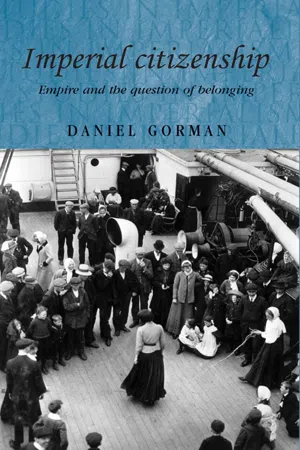
This is the first book-length study of the ideological foundations of British imperialism in the twentieth century. Drawing on the thinking of imperial activists, publicists, ideologues, and travelers such as Lionel Curtis, John Buchan, Arnold White, Richard Jebb and Thomas Sedgwick, this book offers a comparative history of how the idea of imperial citizenship took hold in early twentieth-century Britain, and how it helped foster the articulation of a broader British world. It reveals how imperial citizenship as a form of imperial identity was challenged by voices in both Britain and the empire, and how it influenced later imperial developments such as the immigration to Britain of 'imperial citizens' from the colonies after the Second World War.
A work of political, intellectual and cultural history, the book re-incorporates the histories of the settlement colonies into imperial history, and suggests the importance of comparative history in understanding the imperial endeavour. It will be of interest to students of imperialism, British political and intellectual history, and of the various former dominions.
- 243 pages
- English
- ePUB (mobile friendly)
- Available on iOS & Android
eBook - ePub
About this book
Information
CHAPTER ONE
Imperial citizenship
So the tribune came and said to him, ‘Tell me, are you a Roman citizen?’
And he said, ‘Yes.’ The tribune answered, ‘I bought this citizenship for a large sum.’
Paul said, ‘But I was born a citizen.’ So those who were about to examine him withdrew from him instantly; and the tribune also was afraid, for he realized that Paul was a Roman citizen and that he had bound him.
(Act 22: 27–9)
As all early twentieth-century British schoolchildren knew, Great Britain presided over an Empire upon which the sun never set. Yet the Empire itself was not a unified state, the solid red on imperial maps belying the dizzying array of political identities which existed under the Union Jack. Some Britons believed this diversity spoke to the legitimacy of the nation’s imperial rule, and saw Empire as a vehicle of peace and progress. Others feared the loss of an Anglo-European cultural identity, and sought to reassert British values at the expense of indigenous local identities. Adherents of each view saw in the idea and the institution of citizenship the means through which to pursue their goals. They sought to create an imperial citizenship, an idea which consisted of two interconnected parts: the desire to foster a greater sense of a shared imperial identity and the effort to codify this shared identity in law. This book examines how imperial ideologues used the language of imperial citizenship as part of broader discourses concerning the purpose, the constitution, and the future of Empire in the late nineteenth and early twentieth centuries.
Citizenship is a primary means through which societies assert, construct, and consecrate their sense of identity. It is about who belongs to the nation, who does not, and why. Citizenship thus connotes a sense of civic belonging, comprising both social and legal–political identities. Debates about imperial citizenship expanded these questions of belonging to the Empire, and thus help us assess how Britons conceived of the Empire: was it an extension of the nation state, a separate entity in itself, or a type of ‘world state’? What was the relation of individual members of the Empire to the broader collective? Efforts to create an imperial citizenship were thus efforts to integrate cultural, social, and political identities within a broader imperial identity. The institution of citizenship provides a practical window through which to view the political ideology of Empire and how it was modified in the face of growing colonial autonomy. The concept of citizenship was much on the lips of British imperial thinkers and activists in the late-Victorian and Edwardian eras, the result of both an increased sense of international military and economic competition and domestic pressures for greater social, economic, and political equality.1 Defining the ‘national identity’ became an urgent collective task. Debates about imperial citizenship were debates about the place of Empire in British society, its importance to the national identity, and the degree to which imperial subjects were or were not seen as ‘fellow Britons.’ The imperial ideologues who participated in these debates, in the main conservatives but also including liberal imperialists, saw in the idea of imperial citizenship a means of fostering imperial unity and cementing Britain’s status as the leading imperial power in an increasingly competitive geopolitical world. In seeking to create an imperial citizenship, however, they faced the challenge of developing political and cultural bonds under the aegis of an Empire which was not, in and of itself, a state.
The Empire constituted part of the mental infrastructure of men and women in the late nineteenth and early twentieth centuries, as unquestionably permanent and benign, if not indeed benevolent, as were the Thames or the Lowlands of Scotland. Neither ardent imperialists, such as the Round Table’s co-founder Lionel Curtis and the writer and politician John Buchan, nor critics of Empire, such as the liberal writer and economist J. A. Hobson, saw the British imperium as wrong in any absolute sense. Their differences were in degree, not in kind. Indeed, one would be hard-pressed to find in late-Victorian or Edwardian Britain any audible voice calling for the dismantling of Empire. Criticism of Empire in the pre-1920 era was, on the whole, reminiscent of the ‘Little Englandism’ of Richard Cobden and the Manchester School, rather than a denunciation of Empire in and of itself. J. A. Hobson and E. D. Morel, for instance, criticized the economic exploitation they believed imperialism made possible; the pro-Boers opposed war (or, perhaps more accurately, its excesses) in South Africa; and the Independent Labour Party (ILP) position on Empire was framed in pacifist, anti-militarist language.2 What did exist were many competing commentaries on how imperialism ought to be managed. Even that most famous of tracts on Empire, Joseph Conrad’s Heart of Darkness, is not so much the work of an anti-imperialist, but rather a morality play which at its core asserted that we, the British, really were much more humane at this sort of thing than were the debased Belgians. As such, the debate was not whether imperialism was ‘just,’ or ‘fair,’ or ‘right,’ but rather how was it to be constituted? Who belonged? Did all under the British flag have equal rights and responsibilities, or did there exist a scale of difference? If so, why? And how, finally, were such issues to be weighed? These are the questions with which this book is concerned.
By the late nineteenth century, many imperialists viewed the Empire as a means of advancing Britain’s national interest and maintaining its political and cultural influence abroad. Alfred, Lord Milner, Pro-Consul in South Africa and later a member of Lloyd George’s War Cabinet, epitomized this position. Milner argued that the task of imperial decision-makers at the century’s end was now one of consolidation, the strengthening of bonds between the existing components of the imperial family, rather than further aggrandizement. Indeed, Milner had been drawn to the conservative rather than liberal fold because of his conviction that the ‘nation,’ rather than the individual, must be the basic building-block of society.3 To preserve, to maintain, to solidify, to perpetuate – these were the stated goals of imperial actors of the late-Victorian and Edwardian periods, many of whom shared Milner’s view of society as an organic whole. It is precisely through an understanding of these impulses that the historian can come to grasp the ‘imperial mind’, that particular set of individuals, assumptions, perceptions, prejudices, and hopes which influenced the geopolitical shape of Empire. Such an understanding is not focused on a study of the ‘official mind,’ that amorphous body of decision-makers which some historians have identified as responsible for the shape and thrust of British imperialism in the long nineteenth century, especially in the era of the ‘new imperialism.’4 Neither, though, is the present project one in the model of the Annales school, an attempt to capture in its totality the imperial ethos or mentalité. The British Empire still awaits its Braudel, and given the immensity of the Empire, both physically and metaphysically, such a project may be, if not impossible, highly improbable. The Empire defies a ‘definitive’ explanation, a truth demonstrated by the many ‘definitive’ or general explanations that have been offered from numerous separate and mutually exclusive perspectives.
What this book does present is an exegesis of one distinct strand of the imperial thought-web – the idea of imperial citizenship in the late-Victorian and Edwardian periods. The institution of citizenship, the basis of any discussion of imperial unity or cooperation, deserves closer scrutiny. The notion of imperial citizenship can provide historians with a partial map of the imperial mind of the pre-Great War period, offering insight into the political development of Empire, as well as the vast discrepancies in the benefits and the status of different classes of citizens.
The purpose of this book is thus to examine the development of ideals of a common imperial citizenship as derived and propagated by British imperial ideologues between 1895 and 1920. Debates over imperial citizenship took place within the relatively small circle of Britons drawn from the educated and aristocratic elites who constituted what Stefan Collini has termed the ‘upper ten thousand.’ Many of these individuals, most of them men, were Oxbridge educated. As such, a small number of interconnected, and often interrelated, individuals wielded an inordinate degree of influence in both the political and intellectual worlds of late-Victorian and Edwardian Britain. These same individuals were in turn selected for key imperial positions abroad, and as such constituted a nexus of imperial influence binding the Empire to the metropole.5
Who were the ‘British imperial ideologues’ who advanced arguments of imperial citizenship? Though Disraeli had tried in the 1870s to capture Empire as the political preserve of the Conservative Party, by the late nineteenth century imperialism had become increasingly bi-partisan. On the Left, leading Fabians such as Beatrice and Sidney Webb and G. B. Shaw supported Empire as a means of more quickly spreading the democratic socialist reforms the society advocated, though other members of the society disagreed. The British trade union movement was also concerned with its counterparts in the colonies, and sent representatives to guide the colonials in tactics and strategy. This concern became more overtly paternalistic in the interwar period, when British labour leaders criticized the political and sometimes violent nature of colonial worker unrest. The Trades Union Congress even worked directly with the Colonial Office to train moderate labour leaders in the colonies.6 The Liberal Party also turned increasingly to pro-imperial policies after Gladstone’s death. Liberal imperialists such as Grey, Asquith, and especially Rosebery, identified themselves with imperial policies in an effort to shed the party’s ‘Little Englander’ image.7 Imperialism’s broad appeal was also evident in the increasingly popular ceremonial celebrations of Empire, publicly casting the national identity in imperial hues.8 Queen Victoria’s Diamond Jubilee (1897), the imperial durbars of Edward VII (1903) and George V (1911), both in Delhi, and the introduction in 1904 of an annual Empire Day all speak to the public nature of Empire in the late nineteenth and early twentieth centuries.9 It was within conservative circles, however, that the most fervent discussions of imperial citizenship were to be found. There were several reasons for this situation: many of the imperial organizations and discussion forums of the period, such as the Navy League, the...
Table of contents
- Cover Page
- Title Page
- Copyright Page
- Dedication
- Contents
- Acknowledgements
- General editor’s introduction
- List of abbreviations
- 1 Imperial citizenship
- Part I Theories of imperial citizenship
- Part II Experiments in imperial citizenship
- Appendices
- Bibliography
- Index
Trusted by 375,005 students
Access to over 1.5 million titles for a fair monthly price.
Study more efficiently using our study tools.
Frequently asked questions
Yes, you can cancel anytime from the Subscription tab in your account settings on the Perlego website. Your subscription will stay active until the end of your current billing period. Learn how to cancel your subscription
No, books cannot be downloaded as external files, such as PDFs, for use outside of Perlego. However, you can download books within the Perlego app for offline reading on mobile or tablet. Learn how to download books offline
Perlego offers two plans: Essential and Complete
- Essential is ideal for learners and professionals who enjoy exploring a wide range of subjects. Access the Essential Library with 800,000+ trusted titles and best-sellers across business, personal growth, and the humanities. Includes unlimited reading time and Standard Read Aloud voice.
- Complete: Perfect for advanced learners and researchers needing full, unrestricted access. Unlock 1.5M+ books across hundreds of subjects, including academic and specialized titles. The Complete Plan also includes advanced features like Premium Read Aloud and Research Assistant.
We are an online textbook subscription service, where you can get access to an entire online library for less than the price of a single book per month. With over 1.5 million books across 990+ topics, we’ve got you covered! Learn about our mission
Look out for the read-aloud symbol on your next book to see if you can listen to it. The read-aloud tool reads text aloud for you, highlighting the text as it is being read. You can pause it, speed it up and slow it down. Learn more about Read Aloud
Yes! You can use the Perlego app on both iOS and Android devices to read anytime, anywhere — even offline. Perfect for commutes or when you’re on the go.
Please note we cannot support devices running on iOS 13 and Android 7 or earlier. Learn more about using the app
Please note we cannot support devices running on iOS 13 and Android 7 or earlier. Learn more about using the app
Yes, you can access Imperial citizenship by Daniel Gorman in PDF and/or ePUB format, as well as other popular books in History & British History. We have over 1.5 million books available in our catalogue for you to explore.