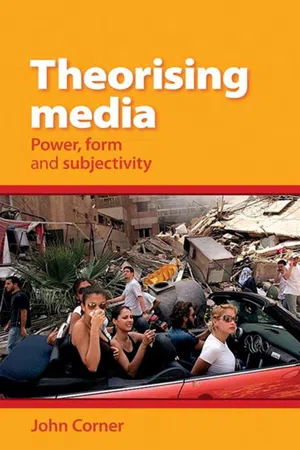
In this book, John Corner explores how issues of power, form and subjectivity feature at the core of all serious thinking about the media, including appreciations of their creativity as well as anxiety about the risks they pose. Drawing widely on an interdisciplinary literature, he connects his exposition to examples from film, television, radio, photography, painting, web practice, music and writing in order to bring in topics as diverse as reporting the war in Afghanistan, the televising of football, documentary portrayals of 9/11, reality television, the diversity of taste in the arts and the construction of civic identity.
Theorising media brings together concepts both from Social Studies and the Arts and Humanities, addressing a readership wider than the sub-specialisms of media research. It refreshes ideas about why the media matter and how understanding them better remains a key aim of cultural inquiry and a continuing requirement for public policy.
- 248 pages
- English
- ePUB (mobile friendly)
- Available on iOS & Android
eBook - ePub
About this book
Information
Subtopic
Film & Video1
Power
In this chapter I want to explore a selection of the numerous and wideranging issues that are to do, directly or otherwise, with the ‘power’ of the media. Research into the various aspects of power, and arguments about it, have always been at the centre of academic interest in media. Sometimes, the focus has been on ‘influence and effects’, a concern with the measurable consequences of output for the perceptions and attitudes of media readerships and audiences. This is the strongest strand of international research, operating across a wide variety of often contesting theoretical and methodological approaches, and it is certainly one that has been continuously well-funded, including by governments and by corporate enterprise. However, the concern with the power of the media goes beyond the specific research objectives of ‘influence and effects’ research, even if it is regularly returned to them in one form or another. It is present, for instance, in much content and textual analysis, it is often the central issue underlying production studies, and it is a principal theme in work on history, policy and, with an obvious directness, on media–political relations.
In my discussion I shall attempt to differentiate the most important aspects of thinking about media power, including those strands of work which serve to connect ideas about power to specific, researched instances and examples as well as to broader theorisations about social and political organisation. I shall look at some of the terms which have regularly been used in writing about power and examine what possibilities there are for revising and developing our ideas around the issues that they seek to identify and, often, to engage with critically. One recurring theme will be the extent to which, in any given theoretical account or offered example, media power is seen to be ‘bad’, something which our politics and our culture would be improved by having less of. A recurrent assessment here is that it is ‘power without responsibility’, to use a resonant phrase from the writings of Rudyard Kipling which provides the title of a major, long-standing textbook in media studies (Curran and Seaton, 2009). As in many debates about power in other contexts, the idea of ‘good power’ is often rather elusive, although the necessity of power itself is an implicit premise of any political and social order. It is interesting here, and relevant to some of the work elsewhere in this book, to reflect on the way in which the term ‘powerful’, when used of a specific programme, film or printed item, is nearly always a term of approval. Such usage is essentially about the ‘strength’ of the work so described, variously aesthetic or thematic. Saying that a programme was ‘powerful’ is at some distance from general claims about the ‘power of the media’, but the degree of descriptive continuity with the larger claim and what is often the evaluative contrast with it are revealing of the complexities underlying ideas of media power at the level of the artefact (where individual critical appreciation is projected in the judgement) and then of the ‘system’ (where a worrying degree of subordinate social relations may appear to be involved).
Another recurring theme is the way in which the powers of the media are perceived to be in various degrees of alignment or disjunction with other agencies and institutions of power in society. In some cases, this amounts to seeing media organisations not as exercising power ‘of their own’, but acting as a relay or conduit for sources of power external to them, most often the state or major corporate bodies. They can thereby be perceived, in at least part of their functions, to transform political or economic power into forms of cultural power through the legitimising visibility they give it across a range of generic types. Indeed, as Dahlgren (2009) points out, the principal issue then becomes that of ‘power over’ the media rather than the more familiar ‘power of’ question, although typically both become combined, since anxiety about the former is largely grounded in assumptions about the latter. In other cases, tensions and even conflicts can be observed between given media organisations and governmental agencies, companies or entire commercial sectors, a situation sometimes reflected openly in media content, thereby complicating, perhaps radically, the profile and flows of ‘relayed power’.
The capacity of the media to contribute to the ‘way things are’ in society, to circumstances and events, as a result of the perceptions they encourage, the information they provide and the feelings they generate, whether directly or in combination with other factors, is essentially a form of ‘soft’ power. It does not have the physical, possibly coercive, dimension that, for instance, military power, police power and aspects of economic power, including the power of labour relationships, can and do have in many countries. As a form of ‘soft’ power, the measurement of its causality and its consequences in any particular instance presents difficulties and generates dispute. The final focus of most debates about media power concerns the transfer or generation of meanings and of value. These debates are essentially (if not always explicitly) about conditions of subjectivity, of awareness, knowledge and affective orientation. Even if the primary evidence of media power is present in given economic circumstances (as in the structure and pattern of information and entertainment distribution) or in institutional scale and prominence (as in the relative dominance of given media providers within a national or international area), the final consequences, and then the arguments about these, may largely turn on the impact of such arrangements upon the terms of individual perception, knowledge and feeling and the conditions for behaviour which these provide. In that sense, the arguments are about symbolic and cultural aspects of power.
It is worth noting that it is now a routine assumption in most societies that the media do have power. The strength and direction of it (and even the definition used to identify it) may be subject to heated dispute, but most public and commercial organisations carry out their work, most obviously their publicity work, with the premise that media outputs can exert a significant degree of power over both public and corporate perceptions and therefore bring about changes to the ‘action frames’ within which they operate. This power is perceived as providing the grounds of opportunity, perhaps bringing state, corporate or broader public benefit (it is power worth courting), but there is also a perceived risk of getting caught up in media power flows which may be harmful. The harm may relate to specific news stories or to particular characterisations and themes in entertainment and fiction, but it is often thought to require clear strategies of avoidance and, where encountered, of damage control. The whole, fraught debate about the kind and level of regulation to apply to the media system is essentially one concerning the different kinds of ‘benefit’ and of ‘harm’ to which the powers of the media can contribute, if not solely bring about. Both organisations and individuals are implicated, as is clear from the way in which entry into the highly mediated celebrity sphere, even for a temporary period, can bring fame, wealth but also a sometimes disastrous transformation of the terms of ‘private’ living for many of those involved (Marshall, 2006 provides an exploration of diverse media–celebrity relations).
THEORISING POWER IN SOCIAL RESEARCH
Before exploring in more detail the character of media power and some of the more disputed aspects of our attempts to understand it, it might be useful to consider briefly the conceptual problems posed by thinking more generally about power as a factor in politics and social order. One very good, if by no means comprehensive, way to do this is by looking at the key arguments in Lukes (2005), a book which offers a revision of his classic work of thirty years earlier (Lukes, 1974). This revision has special interest for media researchers, since it is informed by the author’s reading of the two theorists whose ideas of power have been referenced most often (if not always with the clearest outcomes) by writers in media and cultural studies – Pierre Bourdieu and Michel Foucault. Not all parts of Lukes’ scheme of conceptualisation have relevance for media, but a great deal of it is suggestive, particularly where questions of systemic power relations involving other sources of power (the subject of my next section) are concerned.
Lukes organised his original account around three ‘dimensions of power’. The first was the dimension of formal (and ‘official’) decision-making, and the social actors identifiably involved in this. The second was the less definable routes and processes of agenda-setting, by which certain issues attained public visibility, and were given prominence within a ranking, or were perhaps marginalised or excluded altogether, without this being made fully explicit and accountable. The third was power through almost entirely unacknowledged modes of domination, in which a strongly hegemonic relationship produced deep levels of compliance through intensive socialisation. It was this last dimension of power which, in 1974, Lukes saw as requiring the most attention, since it seemed so central to the way in which political and social order was maintained in many countries, and yet it so frequently escaped from those ‘audits’ of power carried out through the empirical investigations of political scientists. In many countries, the media have been seen as decisively operative in all three dimensions, either in a relationship characterised by (selective) relay from other, more established, sources of power, or in ways that have introduced quite distinctive power elements (for instance, that of the projected personalities of the powerful) into the dynamics of political and social organisation.
In his commentary of revision and development, Lukes makes a number of general points about power that have implications for any approach to the study of the power of the media. These include:
1. Power is a capacity or ability to bring about a specific effect or consequence. It can be identified in its potential agency as well as in its realisation.
2. Power needs to be thought of in relation to the potentially positive, affirming, enabling idea of ‘power to’ as well as the dominative, negatively constraining idea of ‘power over’. (We can note the widespread use of the term ‘empowering’ here to describe an increase in power for individuals and groups previously having marginal scope for emancipation, self-definition and social action).
3. The possession of the capacity for power and the exercising of such capacity are not dependent upon ‘intentions’, although motives and strategies should be taken into account in power analysis.
4. Following Foucault (for example in the work collected in Foucault, 2002), power needs to be engaged with in its close and crucial relationship with forms of knowledge and the distribution of knowledge.1
5. Following Bourdieu (for example in Bourdieu, 1992), forms of power often work through symbolic means, including firm strategies to achieve and sustain control that can in their strongest articulations be called forms of ‘symbolic violence’.2
Certainly, the powers of the media have frequently been regarded within recent debate as working to ‘constrain’ rather than ‘enable’ the interests of the majority of the people, although throughout this chapter I will want to make connections with both kinds of judgements, sometimes to be found in uneasy combination. In this respect, the economic ‘freedom’ of the press to operate with minimal public regulation has often been regarded as allowing, in practice, limitations to be imposed on the wider political and cultural freedoms of citizens to enjoy a diversity of views and opinions (Baker, 2002 and Splichal, 2002 discuss this fully). One of the reasons that debate about media power is distinctive is that it concerns the major agencies of popular knowledge and of cultural engagement and reproduction, whose growth and social permeation have produced a situation where degrees of ‘media-dependency’ (a reliance on media sources) are the norm, whether or not this is finally assessed as constituting a form of domination. Like other forms of political and social power, the power of the media can be met by expressions of criticism and of personal rejection and opposition but it is only really countered by kinds of practical intervention. Increased scope for effectively placing a check on mainstream media power can follow from democratic public policies in which there are built-in channels of proper responsiveness to public dissatisfaction, codes of public representation and the development of the media in the public interest (this last term being, inevitably, subject to definitional debate; see Chapter 6). On the other hand, it can be the result of direct action to provide independent alternatives to established production and circulation. This is a strand of work with a strong record of commitment, effort and imagination, but one perennially limited by the economic requirements for becoming a successful media ‘player’, even at local levels (see Atton, 2001 on the history and varieties of the ‘alternative media’ perspective).
It is beyond dispute that media activities are deeply implicated in the broader pattern and profile of power in a society, particularly where the distribution of knowledge and the according of values are concerned. Indeed, their positioning and function here exceed the significance accorded to them in Lukes’ suggestive account, a common enough kind of oversight in accounts from political sociology and political theory. In addition to advancing a framework for engaging with the symbolic dimension of media, Bourdieu has also influentially used the idea of ‘field’ to explore the broader interconnections of the different domains of social and cultural production, providing degrees of both autonomy and interdependence (including economic and political) for specialist practices (see Bourdieu, 1993 and the discussions in Benson and Neveu, 2005 and Couldry, 2007). However, the most comprehensive and influential framework for thinking about this issue of the broader societal linkage of the media has centred on the idea of the ‘public sphere’ as developed by the critical social theorist, Jürgen Habermas (see Chapter 4). Habermas (particularly Habermas, 1989) presents what has become a persuasive narrative of how ‘good’ media power, the power to resource and circulate deliberation about political and social matters, a power which appeared to provide the basis of a public, critical rationality and thereby held the hope of being an agency of democratic progress, transformed itself. It became, by contrast, an increasing constraint on this development, aligning with dominant economic power blocs and shifting its primary imperative from one of providing open information and argumentation across contesting positions to one of commercial profit and the reinforcement of established authority. In these narrowing circumstances, retaining the space for a public sphere separate both from the state and from purely corporate interests has become increasingly difficult even to envisage, let alone achieve. Habermas’s writings on this theme, including later ones in which the precise terms of the critique and the prognosis are subject to revision, remain a key reference point for a wide range of international media studies (for examples of diverse approaches, see Calhoun, 1993; Garnham, 2000; McKee, 2005; Couldry, 2010; and Chapter 4 of this volume). Given the continuing vulnerability of the ‘public’ idea and continuing perceptions of commercial distortion and elite alignments within the media system, the references are likely to grow. It is to issues of alignment that I now turn.
MEDIA AND SYSTEMIC POWER
I have suggested that there are very good reasons, historical, political and sociological, for seeing media institutions and processes as exercising their powers systemically, that is to say within the terms of a broader pattern of determining relationships with other sources of power, the vested and often elite interests of which they routinely serve to maintain, whatever the localised tensions and questioning that might also occur. It is clear that the systems within which the media are placed, and against which any general claims for the independence of media organisations have to be judged, vary greatly across national settings, even though strong elements of internationalisation have become evident at the level of media markets and media products. These systems also show the transitions of historical change and development, sometimes in gradual and uneven transformation, but also in rapid and radical shifts, such as those brought about widely by the new media technologies of the last twenty years and by the forms of ‘free market’ thinking about the media economy that have extended across Europe and beyond, often revising or displacing older models (Baker, 2006 provides a useful synopsis).
It is without doubt the kind of ‘fit’ that the components of the media system have with the political system that has produced the most anxiety and received the most attention over the years. Here, the connection with external power relations is frequently made explicit, perhaps in formal, even constitutional, arrangements between political and media institutions. However, in many countries this kind of recognition of the media’s placement within the political system has been considerably modified, as indicated above, by an emphasis on the media’s location within the system of market economics, at its local, national and globalised levels. China is an obvious example, along with countries in Eastern Europe, but subtler shifts have occurred in many national systems across the world. The kinds of power relationship involved here are unlikely to be openly proclaimed and may not be immediately identifiable. Nevertheless, the impact upon the economic organisation of everyday life and upon forms of consciousness and value (including political value) has often been judged to be pervasive and deep across a diversity of suppliers and kinds of media goods and services.3
Where tendencies and orientations in the political system and the economic system are in broad harmony, then the expectation of a strong ‘power reinforcement’ role by the media, embracing different technologies, modes of funding and both formal and informal controls, seems justified, and research would expect to discover this. Where there is some distance, and even tension or conflict, between the two, then the possibility of a more complicated pattern, one in which a degree of ‘power-questioning’ occurs, emerges. Outright opposition to the policies and actions of dominant power formations may be articulated, either within the terms of an already formed political or economic elite that is a subordinate power formation (e.g. a parliamentary opposition), or within the terms of an emerging group (e.g. a political party or a campaigning body) which is perhaps attempting to become such a formation. Elite dissensus, a split about ends or means within the sphere of those already possessing ‘political capital’ (see Davis, 2010 on use of this term, taken from Bourdieu), is a point of significant development, even of crisis, in the history of many countries, often interconnecting their political, economic and media systems, and bringing about decisive shifts.4 The emergence of new groups wishing to develop or even to ‘seize’ power through routes of corporate and/or public approval, and having realistic chances of doing so is, of course, also of great significance for media institutions and practices. Their response to such emergence is crucial for any analysis of just how, and with what predictability, they are systemically connected to broader patterns of elite economic and social management and to the dyna...
Table of contents
- Cover Page
- Title Page
- Copyright Page
- Dedication
- Contents
- Acknowledgements
- Introduction
- Part I
- Part II(1): Terms of analysis
- Part II(2): Visuality and documentation
- References
- Index
Trusted by 375,005 students
Access to over 1.5 million titles for a fair monthly price.
Study more efficiently using our study tools.
Frequently asked questions
Yes, you can cancel anytime from the Subscription tab in your account settings on the Perlego website. Your subscription will stay active until the end of your current billing period. Learn how to cancel your subscription
No, books cannot be downloaded as external files, such as PDFs, for use outside of Perlego. However, you can download books within the Perlego app for offline reading on mobile or tablet. Learn how to download books offline
Perlego offers two plans: Essential and Complete
- Essential is ideal for learners and professionals who enjoy exploring a wide range of subjects. Access the Essential Library with 800,000+ trusted titles and best-sellers across business, personal growth, and the humanities. Includes unlimited reading time and Standard Read Aloud voice.
- Complete: Perfect for advanced learners and researchers needing full, unrestricted access. Unlock 1.5M+ books across hundreds of subjects, including academic and specialized titles. The Complete Plan also includes advanced features like Premium Read Aloud and Research Assistant.
We are an online textbook subscription service, where you can get access to an entire online library for less than the price of a single book per month. With over 1.5 million books across 990+ topics, we’ve got you covered! Learn about our mission
Look out for the read-aloud symbol on your next book to see if you can listen to it. The read-aloud tool reads text aloud for you, highlighting the text as it is being read. You can pause it, speed it up and slow it down. Learn more about Read Aloud
Yes! You can use the Perlego app on both iOS and Android devices to read anytime, anywhere — even offline. Perfect for commutes or when you’re on the go.
Please note we cannot support devices running on iOS 13 and Android 7 or earlier. Learn more about using the app
Please note we cannot support devices running on iOS 13 and Android 7 or earlier. Learn more about using the app
Yes, you can access Theorising Media by John Corner in PDF and/or ePUB format, as well as other popular books in Media & Performing Arts & Film & Video. We have over 1.5 million books available in our catalogue for you to explore.